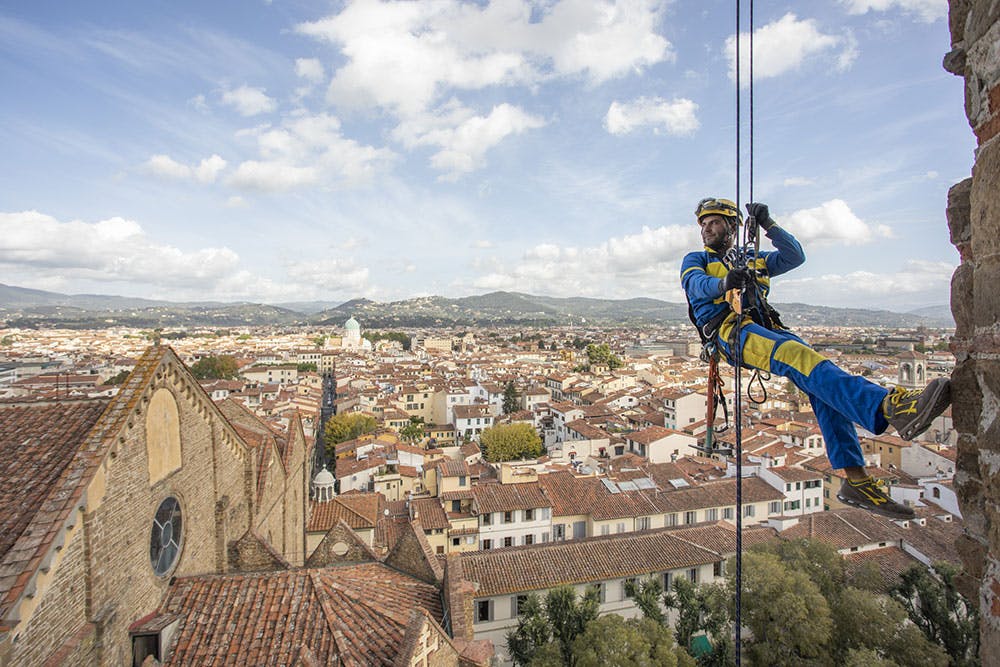
A construction worker has a great view from Santa Croce in Florence.
So many different kinds of jobs in the world! Today’s story is about construction workers with specialized talents that might just as easily have gotten them hired by the circus.
Rebecca Ann Hughes has the story at Apollo. “Beneath the celestial vistas of Parma Cathedral’s frescoed dome, two men swing like trapeze artists from ropes crisscrossing under the roof as though in a circus tent. They seem to be attempting to join the swirling vortex of angelic limbs in Correggio’s scene of the Virgin’s Assumption above them. But they are actually members of EdiliziAcrobatica, an Italian construction company specializing in rope access building interventions. On this occasion, the company has been drafted in to repair a bell in the cathedral.
“EdiliziAcrobatica’s team has rock-climbed up and abseiled down some of Italy’s most significant historic monuments. The company has worked on the Ponte Vecchio in Florence, Siena Cathedral, and the Roman Forum, to name a few. It has also intervened in banks, apartment blocks and various other public and private buildings. Suspended from ropes, the acrobatic technicians can perform a whole range of tasks, from the waterproofing of roofing to welding – all the necessary tools in bags and buckets attached to their harnesses. To watch the team at work is a breathtaking and nail-biting experience. From street level, they are minute figures poised on the roof of Parma’s dome to replace copper panels damaged by rain or casually dangling above the waters of the Arno to repair a leaking fountain on the Ponte Vecchio. …
“The building company didn’t choose to specialize in these acrobatic techniques just for the spectacle. Rope access, a construction work-at-height technique that started to become popular in the 1980s, comes with a multitude of advantages over traditional scaffolding, as Riccardo Iovino – who founded EdiliziAcrobatica in 1994 – explains via email.
“At the forefront is safety. Workers are attached by two ropes, one for safety, and ropes can also relay equipment. Although founder Iovino was, as a skipper, at home shimmying up and down rigging – and was thus inspired to adopt the technique professionally – EdiliziAcrobatica’s workers are not expected to have a mountaineering or caving background. The company assists the construction workers – who are overseen by specialist surveyors – with training and obtaining the required permit for rope access work. Thus, suspended from the side of a building, EdiliziAcrobatica’s technicians can carry out restoration work, paint walls, clean windows, replace gutters and repair unsafe elements of a building in total safety.
“That’s not to say that these strict safety procedures dampen the thrill of the work. Enzo Spitale, who began as an acrobatic builder and now acts as coordinator overseeing the team in Italy, returned from his interview 10 years ago thinking it was all completely mad. But he now says his employment at EdiliziAcrobatica was a life-changing opportunity. Dangling from a Renaissance dome or a medieval bridge, ‘you feel one step away from the sky,’ Spitale says. ‘It is unique and unimaginable for those with their feet on the ground.’
“This aspect of the job comes with its own risks. ‘It is always important, as I remind the new company recruits, never to lose concentration at work,’ says Spitale. ‘We are suspended from ropes several metres off the ground, we have to pay attention to what we are doing and not get distracted by the clouds!’ “
More at Apollo, here.
 Photo: Jorge de la Quintana
 Suzanne's Mom's Blog