Feeds:
Posts
Comments

Posts Tagged ‘adapt’

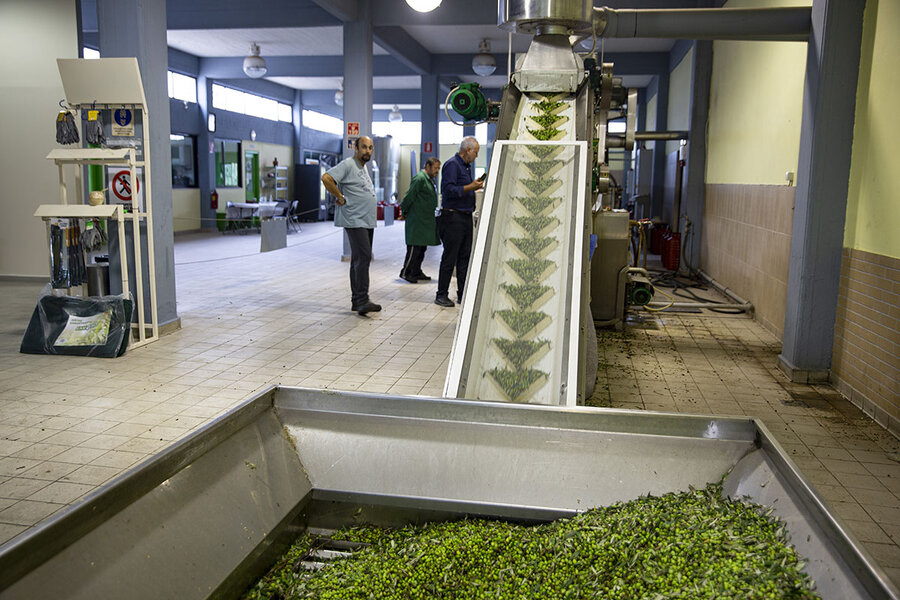
Photo: Dominique Soguel.
Michael Antonopoulos, president of the Agricultural Cooperative of Kalamata, tells the Christian Science Monitor, “We want to adjust as soon as possible to the environment and be pioneers. Our place has to be fully ecological.”

In Greece, where farmers have grown olives for millennia, global warming has imposed a new normal. Nevertheless, writes Dominique Soguel at the Christian Science Monitor, “the result is not resignation. Rather, it’s fresh thinking and approaches.”

Soguel continues, “Olives and olive oil have become synonymous with Greece, and are credited, in part, with fueling the rise of Greek civilization. But despite a history spanning thousands of years, these culinary pillars of Greek identity are under threat. Small farmers expect this year’s harvest season, which got underway in November, to be one of the worst years on record, thanks to climate change and the irregular seasonal shifts it has wrought upon the flowering process and fruit development.

“ ‘We are collecting olives much earlier than ever before. Our producers do not recall any year like this,’ says Michael Antonopoulos, president of the Agricultural Cooperative of Kalamata. …

“He is not alone in expecting southern Europe to look like northern Africa in the span of 50 to 100 years. But Mr. Antonopoulos, a geologist and geotechnical environmentalist by training, is optimistic. He points to a series of steps that the community is taking to adapt to unseasonal temperature variations.

‘You can’t change the climate, but you can adjust.’

“[He] notes that traditional olive groves have an important role to play in combating climate change. They are carbon sinks and could easily be integrated into carbon-offsetting projects, increasingly popular but also controversial methods used to reduce the carbon footprint of a company or country. Kalamata is among six Greek cities participating in the European Union mission for 100 climate-neutral and smart cities by 2030.

“ ‘We want to adjust as soon as possible to the environment and be pioneers,’ he says. ‘Our place has to be fully ecological. We don’t care about higher productivity. We care about sustainability. We know people in the future will appreciate that more than anything.’

“One November day in Kalamata, as the mill that serves a community of roughly 300 olive oil producers operates at full throttle, the rain outside turns to hail. … It’s been that kind of year for Kalamata’s olive crop. In 2023, it endured winter conditions during the spring and, unlike much of Greece, experienced relatively low summer temperatures. That unusual weather, coupled with low rainfall, resulted in fewer and smaller olives. …

“ ‘If you don’t have certain weather conditions at a certain time,’ explains Mr. Antonopoulos, ‘you can’t have olive oil.’

“But the mill is also representative of how Greek olive farmers are adapting to the new environment. It is designed to run as sustainably as possible. Waste compost from the mill enriches the soil of the surrounding groves. It is the first mill in the region to rely on solar panel energy, and it recently secured a deal to sell electricity to the Greek government. Further, its farmers have adjusted their pruning tactics to optimize water use. And geothermal energy heats the olive oil extraction plants. …

“ ‘It’s all about feeding the soil,’ says George Kokkinos, head of the Nileas olive oil producers cooperative in the broader Messenia region, which encompasses Kalamata. ‘Soil health is top priority.’ …

“ ‘The philosophy was to look at how olive tree cultivation adapts to climate change,’ adds Mr. Kokkinos. ‘It was the first time that we heard of the expression “climate change.” … The consequences only start to be seen and felt here in 2016.’

“One of the most visible of these consequences, he says, are warmer, humid winters. This led to the spread of fungal diseases. Another change … summer now starts in July and lasts longer. All that confuses the olive tree, which decides in February whether to flower and delivers olives in April. …

“ ‘The normal, maximum temperature for this place this time of year would have been 16-18 C [60-66 F]. Typically, we would start the harvest wearing heavy clothes. Now we harvest in our T-shirts.’

“The mitigation measures are working, he says, even though recent summer heat waves dried up thesoil. He sees evidence of that in a 30% loss of productivity this year on his grove, compared with much higher losses among those who took no measures. The techniques they tested in the project now form part of the EU sustainable agricultural policy. But he worries that the Greek government is not prioritizing action and the spread of know-how to other farmers.

“ ‘The farmer stands in the middle and does not connect the dots,’ he says. ‘The average farmer in Greece is 60 years old. It’s a hard time. That’s true. But there are opportunities. The key is to adjust.’ ”

More at the Monitor, here. No paywall.

Read Full Post »

Photo: Gabrielle Canon/The Guardian.
Lakeside Farms, near Oregon’s Upper Clamath Lake, now features a wetland drawing harmful pollutants out of the soil. It also serves as a sanctuary for birds.

This may sound strange, but one of the things I most want to be able to do as an old person is to relearn things. I have a lot of preconceptions and outdated information that I’ve relied on, and I don’t want my feet to stay stuck in mud.

In today’s story, an Oregon farmer shows he was capable of relearning.

Gabrielle Canon reports at the Guardian that he once allowed his land to leak “pollution into a nearby lake. Now, 70 acres are home to waterfowl, turtles and endangered fish.”

Canon continues, “Birdsong hums over the rumble of Karl Wenner’s truck as it bounces along the dusty trails that weave through his property. For almost 100 years, this farm in southern Oregon grew barley, but now, amid the sprawling fields, there lies a wetland teeming with life.

“Wenner installed the wetland on 70 of the farm’s 400 acres to help deal with phosphorus pollution that leaked into the adjacent Upper Klamath Lake after his land flooded each winter. With support from a team of scientists and advocates, the project has become a welcome sanctuary for migrating and native birds that are disappearing from the area.

“Today, this corner of Lakeside Farms looks far different from a typical American farm. Waterfowl nest among the vegetation, joining pond turtles and even endangered native fish near rows of sprouting barley.

“Looking out at the swaying cattails and wocus plants peeking through the water on an afternoon in June, Wenner beams:

‘This place wanted to be a wetland.’

“It’s a remarkable transformation and a promising example of a symbiotic solution to one of the world’s most pressing environmental problems.

“The stakes are high. Considered ‘among the most productive ecosystems in the world,’ wetlands are disappearing rapidly. Roughly 80% around the world have already vanished. In the expansive Klamath basin that straddles the California-Oregon border, once described as the ‘Everglades of the west,’ more than 95% of wetlands have been drained, diverted or dried.

“Wenner, a co-owner of the land, hopes the farm won’t be unique for long. With an unprecedented amount of federal funding available through the Biden administration’s Inflation Reduction Act and other government programs, Wenner and his partners are encouraging more farmers and ranchers to follow in their footsteps. …

“The Lakeside Farms wetland broke ground in 2021, flattening the barley fields and carving dikes and channels for water flows that would leave small artificial nesting islands. The water, produced from a natural spring on the property, quickly germinated seeds for marsh plants that had been dropped by birds and long left dormant.

“By the summer of 2022, the vegetation began to do its work, feeding fowl and cleaning the farm’s runoff, pumped within its banks rather than into the lake. … Wenner says his costs have largely been covered with government funds, and there’s a lot more to go around. …

“The benefits, Wenner says, have been almost immediate. Wetlands serve as a natural sponge, soaking up harmful minerals and pollution before they seep into the watershed. …

“ ‘You set the stage and Mother Nature takes over,’ Wenner said. ‘It’s just a magical thing to see.’

“Wenner is convinced the move has been a boon to business. The farm is no longer running afoul of regulations, while a plan to add a rotating wetland on other parts of its land will enable it to go organic, yielding ‘a much higher price for the crop.’ …

“The climate crisis is making the Klamath basin hotter and drier, creating stress for farmers and wildlife alike. Populations of migrating birds have plummeted, falling from roughly 5.8 million observed in 1958 to a peak of just 93,000 counted last year.

“Many are finding hope in plans to demolish four dams along the Klamath River – the largest dam removal project in US history – bringing the ecosystem one step closer to recovery. But more solutions will be needed. …

“The work is not without obstacles. ‘Our biggest challenge is where water is available to manage wetlands,’ said Ed Contreras, a coordinator of the Intermountain West Joint Venture, an organization dedicated to building public-private partnerships to support bird habitats. He added that the Lakeside Farms project was an important case study. …

“Thousands of miles away, Paul Botts is confronting the same challenges. As the executive director of the Wetlands Initiative, a non-profit conservation organization in Chicago, he is determined to expand the use of what he calls ‘smart wetlands’ across productive farm belts. …

“ ‘The ultimate goal here is that one day my children or grandchildren are driving around the midwest and every other farm field has one of these wetlands,’ he said. …

“These natural systems help blunt climate catastrophes, holding water for dry times and slowing the speed of floods. ‘We view smart wetlands as an excellent example of a big-picture climate adaptation solution,’ Botts added.”

More at the Guardian, here. No paywall but donations keep it free.

Read Full Post »

Photo: Bulletin of the US Fish Commission.
The massive Humboldt squid has adapted to climate change. But that’s a challenge for fishing communities who depended on it.

Climate change is forcing the creatures of the Earth to adapt or perish. This is the story of one creature that adapted but, in doing so, forced a more painful adaptation on some human creatures.

Michael Fox reports at PRI’s the World, “On a late afternoon in Kino Bay, Mexico, Gerardo Hernandez is repairing his fishing nets. He strings them out in front of his home, made from old pieces of plywood and corrugated tin. 

“He lives along the Gulf of California, the body of water that separates most of Mexico from the Baja California peninsula. Hernandez, a seasoned fisherman now in his 60s, can still remember the time of the giant Humboldt squid — a massive invertebrate that used to grow up to 6-feet long. Their abundance made for a robust squid industry fueled by 2,000 fishing boats — the vast majority being small pangas like Hernandez’s.

‘There were always a ton of squid,’ Hernandez said. ‘You would go out, and you’d see them on the surface of the water. The more squid you took, the more there were.’

“The days of the giant jumbo squid are over now. About 13 years ago, after a hurricane and an abnormally warm El Niño year, the squid disappeared from the Gulf. Eventually, they returned. But by 2015, they were gone again. Scientists attribute the shift to animal adaptation amid a rapidly changing climate. 

“Hernandez’s kids say they want him to retire now. But he still goes out fishing every night with other members of his small fishing cooperative, and they mostly catch Pacific Sierra fish and crab. He said he brings home enough — but not nearly as much as he did in the days of the Humboldt squid. 

“ ‘They’ve left,’ Hernandez said. ‘They’ve emigrated. Only God knows where they’ve gone.’

“But scientists think they have an idea. They say they haven’t actually disappeared. Instead, the Humboldt Squid that live in the Gulf have shrunk from about 6-feet long to less than a foot, and they’re sticking to deeper depths and cooler waters offshore. 

“Stanford University biologist William Gilly said the squid seem to have developed this strategy long ago to deal with fluctuating water temperatures that come with El Niño cycles. … It’s a species that seems evolved to adapt to the warming waters brought on by climate change. At least, that’s the theory.

“ ‘There’s a lot we don’t know,’ said Rufino Morales, a fisheries biologist and the coordinator of the Producto Calamar subcommittee, a Mexican group that researches and supports squid fishers. ‘We assume that the shift is due to climate change, or global warming, or because it coincides with El Niño, but these are scientific theories. We haven’t been able to prove them yet.’

“The squid seem to be adapting.  The fishing communities they used to support are trying to as well.

“On a warm afternoon in La Manga, a fishing village about an hour west of the port city of Guaymas, a handful of residents gutted a stack of manta rays, whitefish and parrotfish caught that morning. …

“ ‘When the squid was abundant, this was another Guaymas,’ said Maria Collins, a member of the Francisco Flores small fishing cooperative in town. ‘We lived well.’ When the squid left, a lot of people lost their jobs. …

“Many fisherfolk now work in factories off the highway on the northern side of town. Others are doing construction, gardening or plumbing. 

“Some boats began to hunt for jellyfish, which they sell to Asian markets. But the season is short. Locals up and down the coast say none of the catches are doing well. They blame the large sardine ships for overfishing and depleting stocks. 

“ ‘We are fishermen in danger of extinction,’ said Hernandez as he repaired his fishing net. ‘I think everything that’s happening in the ocean is our fault. Like, we aren’t taking care of it. Or, we don’t care for it, and there’s the proof.’ ”

More at PRI’s the World, here.

Fondly remembered fantasy squid.

This is just pretend, you know.

Read Full Post »

I’ve been learning recently, both from my daughter-in-law and online, that parents frustrated with the imperfections of pandemic school are complaining about the problems to teachers even though it’s mostly not something teachers can control.

Meanwhile, teachers adapt. They’ve been going beyond the extra mile to make everything work. An ESL teacher I work with often spends long, unpaid hours solving technical problems, and my husband’s orchestra-teacher niece in North Carolina rarely finishes her day before 10:30 pm.

Max Tapogna writes at Oregon Artswatch about what arts teachers in his state are doing with limited resources for remote instruction.

“One by one, students pop into the classroom, each in a respective Zoom window. Trisha Todd, a drama teacher at Portland’s Grant High School, waits a few minutes until everyone in her Beginning Theatre class has arrived. Todd is teaching from her office at Grant, which is full of theater tchotchkes: a turquoise folding screen, a poster for Sarah Ruhl’s play Orlando, and what looks like poor Yorick’s skull. Todd’s students, however, are scattered around the city. …

“Class begins, inconspicuously, with a warmup. First some stretching. Then Todd asks the students to go around and share the musical artists they’ve been listening to recently. More than one student mentions Billie Eilish; another says he’s been blasting a lot of classic rock.

“ ‘I’m doing whatever I can to keep them engaged,’ Todd says. ‘We’re just hoping to keep them with us until they get back.’ …

“When classrooms were shuttered due to the coronavirus. Arts educators, especially those with subjects in the performing arts, were forced to grapple with ways to reach students from a distance.

“ ‘It was really hard,’ says Lisa Adams, a music teacher at Duniway Elementary School. … ‘Participation was not required. There wasn’t a unified way that every school was handling it.’

“ ‘Spring was very doomy gloomy,’ says Laura Arthur, a music teacher on special assignment for the district. ‘I feel like the fall is the second, third stage of grief. We’ve reached acceptance and solutions.’ …

“Mary Renaur, a visual arts teacher at Mt. Tabor Middle School … created online tutorials on how to make art supplies at home, like glue and paint, from materials that could be found in a kitchen or recycling bin. …

“Similarly, Adams has taught her students at Duniway to craft their own instruments from household objects, like a ‘guitar’ made from a berry container and rubber bands. One student, Adams says, filled a paper towel tube with beans and fixed tape to the edges. …

“Of course, the technology comes with its complications. On the day I spoke with Renaur, she described how a student’s Chromebook unexpectedly had stopped working.

When she learned the computer wasn’t working, Renaur hopped in her car and drove to school, picked up a new computer, dropped it off at the student’s home, and drove back to her house in time for her next class.

“ ‘Between classes, I had forty-five minutes,’ Renaur says. …

“Other adjustments have been less stressful. Chris Meade, who teaches drama and music at Lent K-8, says, ‘I did a whole assignment on taking silly selfies just to get students used to using a camera.’

“At the beginning of the school year, Meade surveyed his students to get a sense of their preferences for learning music virtually. ‘The majority of my kids were really uncomfortable singing by themselves into a computer,’ Meade says. …

“Instead, Meade shifted his focus to emphasizing music appreciation and literacy. This fall, for example, students are learning about the various musics of Latin America. District-wide, arts classes are now structured around themes like emotional resilience and racial equity. That change, Meade says, has been welcome.

“He says, ‘It’s nice to [explore] all these other aspects of music that kind of get glossed over during the regular school year.’

“For theater, Todd says her goal is less forcing her old curriculum into a new format than tailoring her subject to online learning. ‘We can look at history, we can look at Shakespeare, we can look at the Greeks,’ Todd says. ‘We could just read plays for a semester.’

“Instead of directing a fall play, Todd is organizing a 24-hour devised theater piece. The festival will showcase a play written, directed, and acted entirely by students. ‘It’s supposed to happen really quickly,’ says Todd. ‘You go with your instinct. You don’t have set limitations. You create them.’ ”

Read at Oregon Artswatch, here, how the typical isolation of arts teachers has been altered by pandemic isolation, which in at least one district has led to a collaborative way of working that will likely outlast lockdowns.

Read Full Post »

It’s amazing what you can learn from DNA. Recently, scientists have been collecting insights from camel DNA about how camel ancestors were used on ancient trade routes.

Victoria Gill writes at the BBC, “Scientists examined DNA samples from more than 1,000 one-humped camels. Despite populations being hundreds of miles apart, they were genetically very similar. Scientists explained that centuries of cross-continental trade had led to this ‘blurring’ of genetics.

“The findings are published in the Proceedings of the National Academy of Sciences.

“One of the team, Prof Olivier Hanotte, from Nottingham University, explained that what made the dromedary so biologically fascinating was its close link to human history.

” ‘They have moved with people, through trading,’ he told BBC News. ‘So by analysing dromedaries, we can find a signature of our own past. … Our international collaboration meant we were able to get samples from West Africa, Pakistan, Oman and even Syria.’ …

” ‘People would travel hundreds of miles with their camels carrying all their precious goods. And when they reached the Mediterranean, the animals would be exhausted.

” ‘So they would leave those animals to recover and take new animals for their return journey.’

“This caused centuries of genetic ‘shuffling’, making dromedaries that are separated by entire continents remarkably similar.

“Crucially, this has also ensured that the animals maintained their genetic diversity — constantly mixing up the population. This means that dromedaries are likely to be much more adaptable in the face of a changing environment. …

” ‘The dromedary will be our better option for livestock production of meat and milk. It could replace cattle and even sheep and goats that are less well-adapted.’ ”

More at the BBC website, here.

Photo: Mark Payne/Gill/NPL
Ships of the desert: camels provide transport, milk and food in arid, hostile environments

Read Full Post »