Feeds:
Posts
Comments

Posts Tagged ‘adopted’

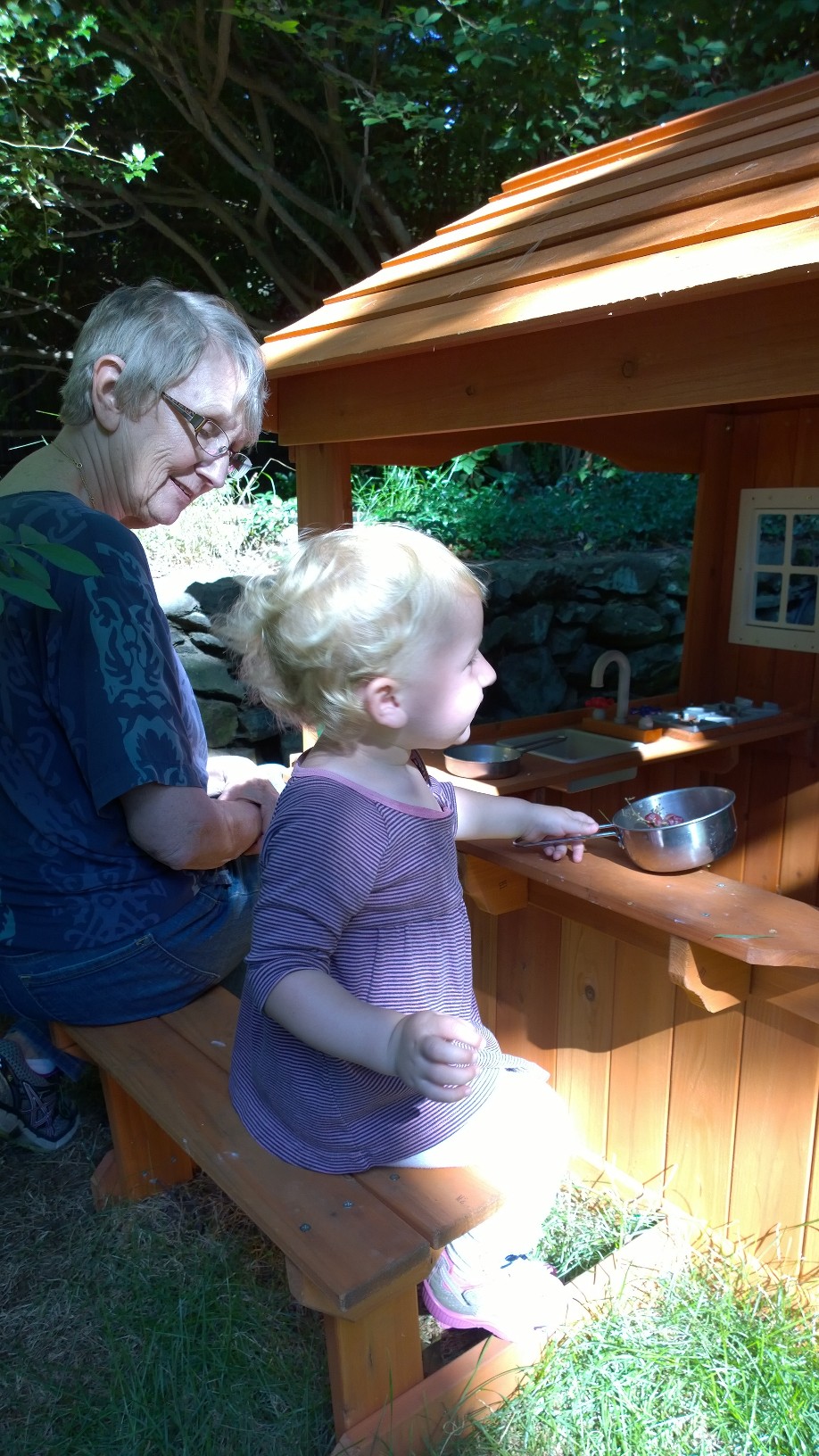
Being around kids can be good for old folks.

As my friends and I discuss whether or not to sign up for senior communities, one big worry is not seeing children very often. Not necessarily just children in our own families, but the kids that are in the neighborhood or that we pass on our walks or our trips to the the library and shops. Many of us don’t want to be somewhere with no sidewalks to a town, where you can feel a bit normal.

Eleanor Laise at MarketWatch recently reported on a trend that aims to deal with that issue.

She writes, “It’s a warm spring Monday in Easthampton, Mass., and from the front porch of her townhome in the Treehouse intergenerational community, Sue Brow can see several neighbors’ well-kept gardens in bloom. Brow, 60, has helped plant the garden of one neighbor who was ill, and she’s pitching in to grow tomatoes on another neighbor’s patio. Later in the afternoon, residents gather to play games in a communal building. Brow’s 16-year-old son helps take out the older neighbors’ trash, and in their living room sits a birdhouse he just painted at a community celebration attended by residents and friends ranging in age from three to 83. 

“In her four years living at Treehouse, a community designed to bring together seniors with families who are fostering or adopting children, Brow … raised her adopted son with the help of dozens of fellow residents who live within a few minutes’ walk along the horseshoe-shaped street that forms the neighborhood’s backbone. ‘I don’t know what I would have done’ without that [says] Brow. …

“As America enters an era of unprecedented age diversity, new designs for intergenerational communities are taking shape across the country, intentionally weaving together the lives of older and younger residents and breaking down barriers that have segregated elders in traditional senior housing.

“In these new communities, octogenarians can help 8-year-olds with their math homework after school, residents of all ages can prepare and eat meals together, and neighbors can take turns caring for a sick resident who might otherwise wind up in a nursing home. 

“[The] communities often feature smaller, age-friendly dwellings tightly clustered around shared green spaces. Many include community gardens and common buildings where older and younger residents can work and play side by side.

“The trend is not so much a new idea as the resurrection of a very old one. ‘Multiple generations living close by and looking out for each other is possibly the oldest of all human ideas,’ says Dr. Bill Thomas, a geriatrician who last year announced the launch of new, intergenerational Kallimos Communities. …

“In addition to Kallimos, which plans to open its first community in Loveland, Colo., next year, other intergenerational communities in the works include Regenerative Communities, spearheaded by hospitality entrepreneur Chip Conley; Agrihood, designed around an urban farm in Santa Clara, Calif.; and 4300 San Pablo, an Emeryville, Calif., community designed for seniors and young adults who are aging out of the foster care system. …

“These communities are springing up at a time when COVID-19 has spotlighted the pivotal role they can play in society, aging experts say. During the pandemic, it was ‘truly heartbreaking and horrifying how all these ways we’ve separated people — including by age — left us ill-prepared to deal with a crisis of this magnitude,’ says Marc Freedman, president and CEO of Encore.org, a nonprofit focused on intergenerational connection. 

“Isolation proved devastating not only for seniors in locked-down facilities but also younger people stuck taking Zoom classes in their bedrooms, says Bob Kramer, cofounder and strategic adviser for the National Investment Center for Seniors Housing and Care. Now, when he teaches college students about the impact of isolation, he says, ‘for the first time, 22-year-olds I’m speaking to can empathize with what I’m talking about.’ …  

“Intergenerational communities reflect efforts ‘not just to remake housing but to reinvent the notion of what a family is,’ Freedman says. Those efforts come as the U.S. reaches a new milestone in age diversity, with the population roughly evenly distributed across chronological ages through the mid-70s, according to a recent study from the Stanford Center on Longevity. … ‘The demography of America is changing faster than the financiers and developers of housing are willing to change,’ Thomas says. Housing that was developed for a much younger population, he says, is ‘increasingly out of sync with who we really are.’ “

More at MarketWatch, here. No firewall.

Read Full Post »

Photos: MoSwo PR
Despite birth defects resulting from her birth mother’s exposure to Chernobyl radiation, Oksana Masters won medals at three Paralympics in different sports: London 2012, Sochi 2014, and PyeongChang 2018.

There is so much to like in this story about a girl adopted from a Ukrainian orphanage who became a champion despite severe disabilities.

I lucked into Gary Waleik’s interview with her at WBUR radio’s Only a Game.

“Oksana Masters spent her early childhood in Ukraine. … When she was 7, Oksana stood only 36 inches tall and weighed just 35 pounds. She was malnourished, but that wasn’t the only reason she was small. Oksana was born in 1989, about 200 miles from Chernobyl, just three years after the nuclear disaster there.

” ‘I was missing the main weight-bearing bone in both legs,’ Oksana says. ‘And the left leg, I didn’t have a full knee. It was a floating knee. I had six toes. My hands were webbed, and I also have one kidney. I don’t have a full bicep on my right side. Thank God my hair didn’t get ruined. I could use a little more body, but I’m happy with it.’

“Oksana’s birth mother gave her up for adoption when she was a baby. Life was hard at the three orphanages she lived in, which were situated in the former USSR.

” ‘One of the things that I remember is, like, just that pain in your stomach from when you’re really, really hungry, and just how to ignore that feeling,’ Oksana says. ‘And sometimes you’d go to bed with no meals, or just a cup of soup, or just bread.’ …

“Thousands of miles away, a Buffalo, New York, speech pathologist saw a picture of Oksana in adoption agency literature.

“Says Gay Masters … ‘When I saw her picture, I just knew she was my daughter.’ …

“Not long after that, Oksana was shown a picture of Gay. [Then] on a freezing cold night in January, 1997, orphanage workers woke Oksana from a sound sleep. ..

” ‘I just see my mom, and she’s kneeling down on the bed next to me,’ Oksana says. ‘And I said, “I know you. You’re my Mom. I have your picture, see?” ‘ …

“Two weeks later, the new family landed in Buffalo. For the first time in Oksana’s life, there was ample food. There were toys and hugs. And there was a new language to learn. …

“Oksana did well in school. She had a restless energy that drove her to push her physical limits with the help of new prostheses. She climbed trees and jumped off steps with the neighborhood kids. …

” ‘My mom basically got me into ice skating, not necessarily to get into sports and be competitive, but have an opportunity to move and use your body and make friends,’ Oksana says. ‘And I fell in love with it.’ ”

Alas, first one and then the other malformed leg had to be amputated. Recovery after the second surgery was long and difficult.

“Then someone mentioned the Paralympics to her.

” ‘And I had no idea what the Paralympics was,’ she says. ‘When I found out about it, I went home, looked it up and then my competitive nature came out. Like, “Oh, my gosh, I can represent the United States? I can wear a flag on my back? What?” ‘ ”

Read about Oksana’s continuing quest for new sports, her triumphs and setbacks — and a moving visit to demoralized Ukrainian soldiers who had lost legs — at Only a Game, here.

And since you may be wondering what happened at the Winter Paralympics after that radio interview, Wikipedia reports that Oksana “claimed a silver medal in the women’s 6km sitting biathlon event during the 2018 Winter Paralympics.”

Oksana at the Ukrainian orphanage in 1993.

Read Full Post »

I checked Gwarlingo not long ago to catch up on Michelle Aldredge’s thorough, sensitive meditations on art and literature.

What caught my attention was her review of a movie about restoring an old house in Japan.

“It is rare to find a film that is pitch-perfect in its cinematography, story, pacing, and length,” Aldredge writes, “but Davina Pardo’s short film Minka is such a gem. (I owe writer Craig Mod a thank you for turning me onto this quiet masterpiece.)

“Based on journalist John Roderick’s book Minka: My Farmhouse in Japan, the film is a moving meditation on place, memory, friendship, family, and the meaning of home. Most remarkable, this haunting story plays out in a mere 15 minutes.

Minka is the Japanese name for the dwellings of 18th-century farmers, merchants, and artisans (i.e., the three non samurai-castes), but as Wikipedia explains, this caste-connotation no longer exists in the modern Japanese language, and any traditional Japanese style residence of an appropriate age could be referred to as minka. The word minka literally means ‘a house of the people.’

“The story of how AP foreign correspondent John Roderick and his adopted Japanese son Yoshihiro Takishita met, and then rescued a massive, timber minka by moving it from the Japanese Alps to the Tokyo suburb of Kamakura is full of small surprises and revelations (the biggest one comes at the end of the film).

Minka is a film that celebrates stillness. Pardo’s camera lovingly lingers on sun, shadows, and dust. But the peaceful home is not just a restored space full of beautiful, personal objects, it is also an expression of the deep connection between Roderick and Takishita and of familial love.”

Read about that at Gwarlingo, where the filmmaker will let you watch the entire 15-minute movie.

Photo: Davina Pardo & Birdlings LLC
A still from the film
Minka

Read Full Post »