Feeds:
Posts
Comments

Posts Tagged ‘airport’

Photo: Nashville Airport.
Singer Songwriter Joe West is the “house band” for the Nashville International Airport. He’s the son of Sarge and Shirley West, the first and only African American Country and Western Duo.

Remember when going to the airport was fun and even exciting? It’s sad that all the protective measures needed now have made the experience excruciatingly tiresome. Nowadays when I think of wanting to visit someone by plane, I hesitate.

Among the attributes of airports that today’s travelers object to is noise, and today’s story is about how some airports are making an effort to change that unpleasantness.

Dee-Ann Durbin has the story at the Associated Press.

“Background music,” she writes, “is no longer an afterthought at many airports, which are hiring local musicians and carefully curating playlists to help lighten travelers’ moods.

London’s Heathrow Airport built a stage to showcase emerging British performers for the first time this summer. The program was so successful the airport hopes to bring it back in 2025. Nashville International Airport has five stages that host more than 800 performances per year, from country musicians to jazz combos. In the Dominican Republic, Punta Cana International Airport greets passengers with live merengue music.

“Tiffany Idiart and her two nieces were delighted to hear musicians during a recent layover at Seattle-Tacoma International Airport.

“ ‘I like it. There’s a lot of people here and they can all hear it,’ said Grace Idiart, 9. ‘If their flight got delayed or something like that, they could have had a hard day. And so the music could have made them feel better.’

“Airports are also carefully curating their recorded playlists. Detroit Metro Airport plays Motown hits in a tunnel connecting its terminals. Austin-Bergstrom International Airport in Texas has a playlist of local artists compiled by an area radio station. Singapore’s Changi Airport commissioned a special piano accompaniment for its giant digital waterfall.

“Music isn’t a new phenomenon in airport terminals. Brian Eno’s ‘Music for Airports,’ an album released in 1978, helped define the ambient music genre. It’s minimalist and designed to calm.

“But Barry McPhillips, the head of international creative for Mood Media, which provides music for airports and other public spaces, said technology is enabling background music to be less generic and more tailored to specific places or times of day.

“Mood Media – formerly known as Muzak – develops playlists to appeal to business travelers or families depending on who’s in the airport at any given time. It might program calmer music in the security line but something more energizing in the duty-free store. …

“There’s a science to Mood Music’s decisions on volume, tempo, even whether to play a song in a major key versus a minor one, he added. ..

“At the same time, many airports are going low-tech, hiring local musicians to serenade travelers and give them a sense of the place they’re passing through.

“Chicago’s O’Hare and Midway airports have more than 100 live performances each year. Phoenix’s Sky Harbor International Airport began a live music program five years ago and now has two stages featuring local artists.

“Tami Kuiken, the manager of airport music in Seattle, said the Seattle-Tacoma airport launched its live music program about a decade ago after a city commissioner heard live music at the airport in Austin, Texas.

“ ‘The idea was like, “Man, why doesn’t Seattle have music? We’re a music city too,’ Kuiken said. …

“It decided to try live musicians for a 12-week trial. It was so successful that the airport now features live musicians daily and is building new performance spaces.

“ ‘People’s anxiety levels are very high when they’re traveling,’ Kuiken said. ‘The feedback that we started getting was that once they got through the checkpoint and they were greeted with music, all of a sudden their anxiety and stress levels dropped.’ …

“When Colorado Springs Airport announced a live music program in March, more than 150 musicians applied. It now hosts two two-hour performances each week.

“David James, a singer and guitarist who plays at Seattle’s airport about once a week, said waking up in time for a daytime gig took some adjustment. But he’s gained new fans from all over the world.

“ ‘I get really sweet responses from people all the time, saying, “That was so soothing to be able to just sit and listen to [music],” ‘ James said. …

“Country stars like Blake Shelton and Keith Urban have come through Nashville’s airport and interacted with local musicians, said Stacey Nickens, the airport’s vice president of corporate communications and marketing. Shelton even gave one his guitar.

“Otto Stuparitz, a musicologist and lecturer at the University of Amsterdam who has studied airport music, said airports should think carefully about their selections. Music that’s meant to be actively listened to – like live music or catchy pop songs – can be very distracting in an already chaotic environment, he said. He has noticed some airports – especially in Europe – turning off piped melodies altogether. …

” ‘A well-crafted audio strategy is one that people aren’t particularly cognizant of,’ he said. ‘They just know they’re having a good time and that it’s appropriate.’ ”

I think that watching musicians playing live would create a more relaxing ambiance for me than canned recordings by whatever Musak calls itself now. How about you?

More at AP, here.

Read Full Post »

Photo: Rafael Viñoly Architects.
This airport in Italy will incorporate “multi-modal transport” links as well as … a vineyard.

No matter how innovative and complicated an architectural design is, it’s the quirkiest little thing that captures the attention of the public. As a member of the public, I am really hoping that the plans for a working vineyard on the roof of an airport in Florence will work out.

Lizzie Crook writes at Dezeen, “US studio Rafael Viñoly Architects has unveiled its plans for an international terminal at Florence Airport in Italy that will be crowned by a 7.7-hectare [19 acre] vineyard.

“The airport terminal will encompass 50,000 square meters [538,196 square feet] and is expected to be used by more than 5.9 million passengers annually. …

“The terminal’s main feature will be a vast sloping roof, which will be lined with skylights and 38 rows of usable vineyards.

“According to Rafael Viñoly Architects, this is a nod to Florence’s reputation as ‘the heart of Italy’s renowned wine country. … A leading vintner from the region will cultivate the vineyards, and the wine will be crafted and aged in specialized cellars beneath the terminal’s roof.’

“Inside, the terminal will feature a large piazza-like space at its centre, which will be flanked by the arrivals and departures areas on opposite sides. This central space will be linked to transport, parking and retail spaces open to both passengers and local people, and is hoped to streamline circulation for the terminal.

“Other key elements of the proposal include the reorientation of Florence Airport’s, formerly Aeroporto Amerigo Vespucci, existing runway by 90 degrees. This move will turn the runway away from the surrounding hills and lengthen it to better suit modern aircraft.

“The plans will also improve the airport’s links to the city and wider region through ‘multi-modal transport options including a new light rail system,’ the studio said. [The] construction of the airport terminal will be carried out in two phases, with the first slated for completion in 2026 and the second in 2035.”

The architects’ website adds this: “Linear structures of precast concrete contain the soil and irrigation to sustain the vineyard and are held aloft by a network of branching columns that preserve layout flexibility for the terminal’s internal components. …

“Between each of these sloping, elevated structures [are] insulated skylights that flood the interior with natural light. The structures’ trapezoidal section (narrower on the bottom than the top) increases the view angle of the sky from below. In all there are 38 rows of productive vineyards that will grow on the building’s roof while providing excellent thermal insulating characteristics that contribute to the building’s targeted LEED Platinum sustainability rating. …

“The wine will be crafted and aged on-site in specialized cellars below the area where the ground begins to slope up to become the terminal’s roof. This enormous surface, which hides the airport terminal when viewed from Brunelleschi’s Duomo and other prominent vantage points in the city, will not only serve as a new landmark for the city’s sustainable future, but also as a symbol of the traditions, history and innovative spirit that continue to drive the Italian economy into the 21st Century.” More here.

More at Dezeen, here.

Read Full Post »

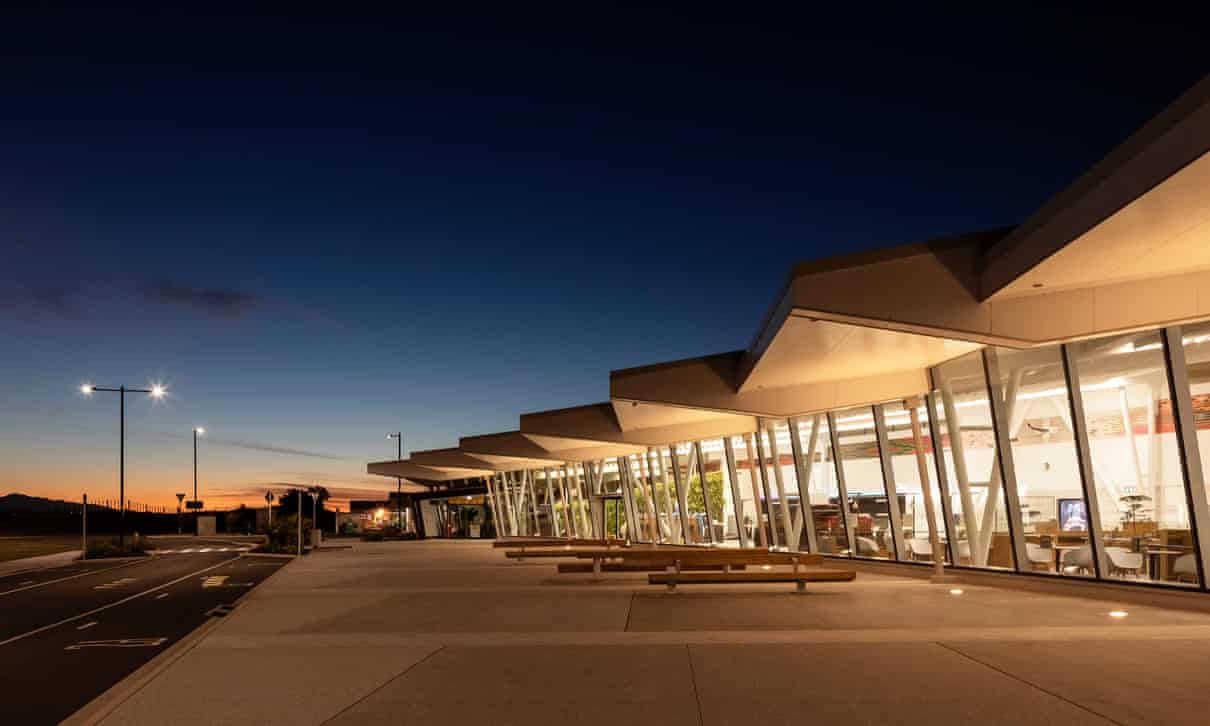
Photo: Patrick Reynolds.
The Maori-designed “redevelopment of New Zealand’s New Plymouth regional airport is a finalist in the Prix Versailles Airports 2021 awards,” the Guardian reports.

A modicum of justice is seen in an unlikely place: the redesign of an airport by indigenous people from whom the airport land was stolen as recently as 1960.

Eva Corlett reports for the Guardian, “A tiny regional airport in New Zealand that weaves a Māori story of love and longing into its architecture is in the running for a prestigious design award, up against international heavyweights including New York’s LaGuardia.

“Unesco’s Prix Versailles recognizes architecture that fosters a better interaction between economy and culture, and includes a range of categories from airports to shopping malls. The finalists for the airport category include the New York LaGuardia upgrade, Berlin’s Brandenburg airport and international airports in Athens, Kazakhstan and the Philippines.

“The sixth airport finalist is Te Hono – meaning ‘to connect’ – and is found in New Plymouth, a town with a population of 85,000, on the western shoulder of the North Island.

“After six design options were floated, Rangi Kipa – a member of the local Puketapu hapū (subtribe) and lead figure on cultural design, settled upon a story. ‘The Ascension from the Earth, Descending from the Sky,’ tells the story of Tamarau, a celestial being, who was so captivated by the earthly beauty of Rongo-ue-roa, a terrestrial being, that he came down to meet her.

“ ‘This story aligns closely with the creation narrative of Te Ātiawa iwi [tribe],’ said Rangi. …

“The spine of the building is oriented to represent the journey from the mountain to the river – the main ancestral walking track in this area, and while visitors may notice these aspects of the architecture first, there are many subtle stories told through the details.

“Manaakitanga – the Māori concept of hospitality – also influences the design. Campbell Craig, the project’s architect and associate for design at firm Beca, said the project attempted to challenge western architectural practices that do not bear any relationship to Māori design.

“ ‘It was important for Puketapu to welcome and take care of guests in a place that is in many ways the gateway to the region,’ said Craig. ‘The faceted curved forms of the building at the entrance and airside “embrace” travelers, to shelter them from the elements.’

“In 1960, the land the airport sits on was confiscated from Māori, under the Public Works Act to build an aerodrome. This was a major source of grievance for the hapū, who had urupā [burial grounds] on the site. …

“Kipa said: ‘For the most part, we have been invisible in our own landscape for 160 years, so it’s amazing to have the chance to influence, and give life to, some of the things that make us who we are.’

“For Craig, the most heartening aspect of the project was the intensive collaboration between Māori, the airport and the architects, which enabled a sense of collective ownership over it.

“ ‘The experience at Te Hono provided a blueprint for working with tāngata whenua [people of the land],’ he said, adding that it would be an approach embedded into all of their future projects.”

More at the Guardian, here.

Read Full Post »

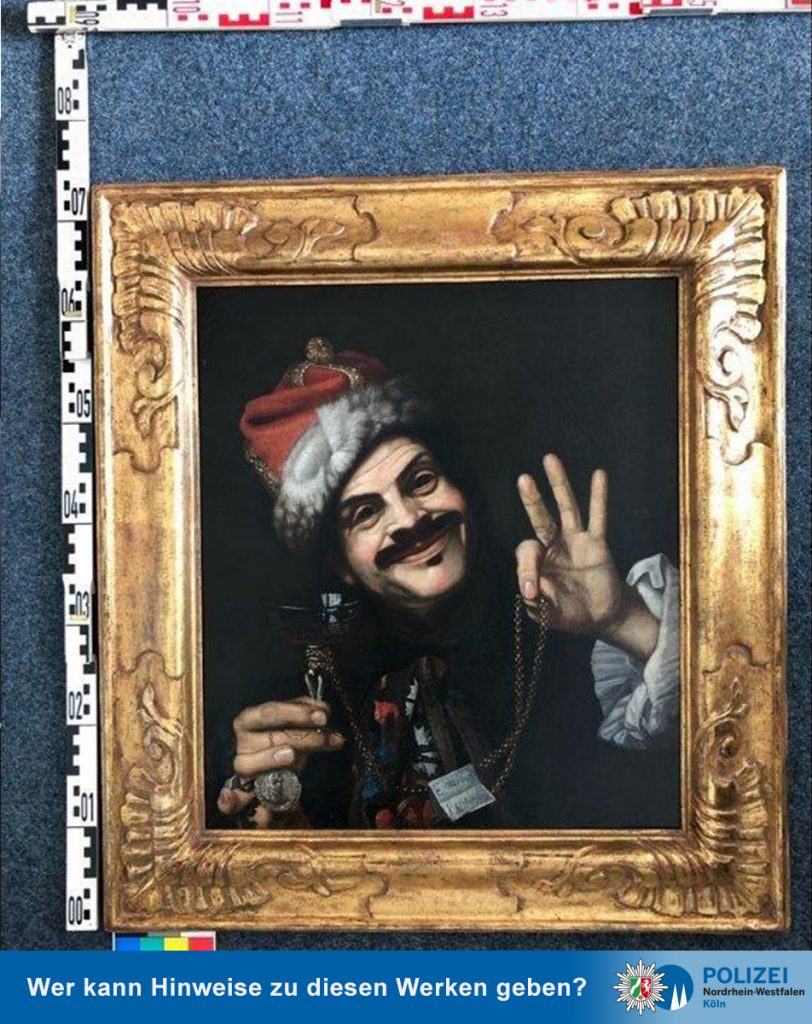
Photo: Cologne, Germany, police.
This painting by the artist Pietro Bellotti was found in a dumpster in Germany.

German dumpsters are yielding up treasures these days. In one case the rightful owners are unknown and being sought; in another, an owner realized in time that he’d left a valuable painting in an airport. (We all know how that can happen when our flight is called and we jump up. But we’re more likely to leave a sweater than a Tanguy.)

Naomi Rea writes about the unknown owners at Artnet News: “Police in Germany are appealing to the public for tips about the origins of two 17th-century paintings that mysteriously ended up in the garbage at a highway rest stop last month.

“According to authorities in the western city of Cologne, a 64-year-old man stumbled upon the two oil paintings in a dumpster at a rest stop near Ohrenbach on May 18. The man, who was taking a driving break at the stop at around 4 p.m., took the paintings with him and later turned them in to police in Cologne.

“After the paintings were examined by an expert, police concluded that they are both 17th-century originals, and have put out a public appeal to find their owner: ‘Who knows the paintings shown and / or how they got into the dumpster at the service area?’

“The first painting is a raucous self-portrait by the Italian painter Pietro Bellotti, dated to 1665. The other is a portrait of a boy by the Dutch Old Master Samuel van Hoogstraten, which has not been dated.

“The auction record for a Belloti is $190,000, achieved at the Swiss house Koller Auktionen in 2010, according to Artnet’s Price Database. There are multiple versions of the painting, and a very similar portrait, titled Self-Portrait of the Artist as Laughter, was put up for sale at Christie’s London in 2006 (estimate: $55,000–$91,000). … Other versions of the Bellotti painting are in the collection of the Uffizi Galleries in Florence, the Pinacoteca di Brera, and a third was once part of the Scheufelen Collection in Stuttgart.

“Meanwhile, works by Van Hoogstraten, who studied under Rembrandt in Amsterdam, have sold for as much as $788,000 (at Christie’s Monaco in 1993). The artist is best known for his experiments with perspective.” More at Artnet News, here.

In related news, a surrealist work turned up in another German dumpster. Check out Jesse O’Neill’s New York Post article from December.

“A surrealist painting worth $340,000 was recovered from a paper-recycling dumpster in Germany, police say.

“The valuable artwork, by French painter Yves Tanguy, was accidentally left behind by a businessman at Duesseldorf’s airport. The flier had forgotten the painting, which was packaged in cardboard, at an airport check-in counter before he boarded a flight to Tel Aviv, Israel, on Nov. 27.

“By the time the man landed in Israel, realized what he’d done and contacted police, the 16-by-24-inch masterpiece had disappeared. The mystery was solved only after the businessman’s nephew traveled to the airport from Belgium and talked with police. An inspector was able to trace the painting to a recycling dumpster used by the airport’s cleaning company.”

More at the New York Post, here. At least in that case, the owner knew where to look.

Read Full Post »

It took a little poking around on the web as neither the Rhode Island State Arts Council nor the Block Island Airport seem to have published any information on the airport’s new exhibit, but I can finally share some tidings of artist Neal Personeus.

From Cape Scapes: “Neal began his interest in driftwood sculptures as a young boy on the beaches of North Truro in Cape Cod, Massachusetts. His original works were typically pirate ships in the sand made from the various flotsam and jetsam that Cape Cod Bay and the Atlantic Ocean would return to the land. By the time he was in his early teens, his works began to change towards wharf scenes and typical seaside shops perched upon interesting driftwood base pieces.

“When Neal was in his early twenties, he became an architectural and engineering draftsman. He rented a beachside cottage with some friends during the summer of 1984, and spent the entire vacation working beachside on his sculptures while watching the Olympics. It was during this time that he honed in on the type of works he would ultimately settle upon. Utilizing his interest in architecture, he would scour the beaches and dunes for beautifully bleached and unusually shaped base pieces, and then picture the style of house that would blend into and compliment the environment of the base piece.” More here.

You can find lots of Neal’s work on Pinterest if you search on Neal Personeus. And check out this Warwick Museum of Art poster featuring the piece called “Yeah … but the view” here.

Art: Neal Personeus
This humorous piece, currently in an exhibit of Personeus sculptures at the Block Island Airport, is called “Yeah … but the view.”

Read Full Post »

I make an annual carrot cake. I have an old, tattered newsprint recipe living in a Ziploc bag, but this year the recipe was on a shelf several hours away from where I needed to buy the ingredients (long story), so I’m putting them here for future Internet access.

2 cp flour, 1 tsp baking soda, ½  tsp salt, 1-1/2 cp sugar, 2 tsps cinnamon, 3 eggs, ¾ cp buttermilk, ½ cp oil, 2 tsps vanilla, 1 8-1/2 oz can crushed pineapple, 2 cps grated raw carrots (no liquid), 1 cp chopped nuts, 1 cp flaked coconut

I will print the recipe, too, if you ask.

The question is always what to do with the extra buttermilk. I have used it for cornbread in the past. You can also put it in your blueberry pancakes the next morning. I don’t know anyone who likes to drink it.

Except Amelia Earhart.

I’ve been reading a 2010 self-published book called by Allene G. “Squeaky” Hatch, Real Pearls and Darned Stockings: Tales of the Hudson Valley, which includes a memorable visit that Amelia Earhart paid to Squeaky’s family when Squeaky was little.

Squeaky’s Uncle Clint was stowing away his biplane at the Hudson Airport one night when he saw storm clouds threatening. A woman approached him from her own plane, and he recognized the famous aviatrix. Writes Squeaky:

“ ‘Could you recommend a good hotel nearby for my co-pilot and me?’ Earhart asked.

“Clint’s answer was that the best place to stay was his farm.” He phoned the house, and Squeaky’s mother rushed madly around to get ready. Having heard that Earhart liked buttermilk, and having none in the house, Squeaky’s mom improvised, mixing viengar with fresh milk! At dinner Amelia Earhart took a polite sip of the “buttermilk.” She didn’t take a second, says Squeaky.

Read Full Post »