Feeds:
Posts
Comments

Posts Tagged ‘alabama’

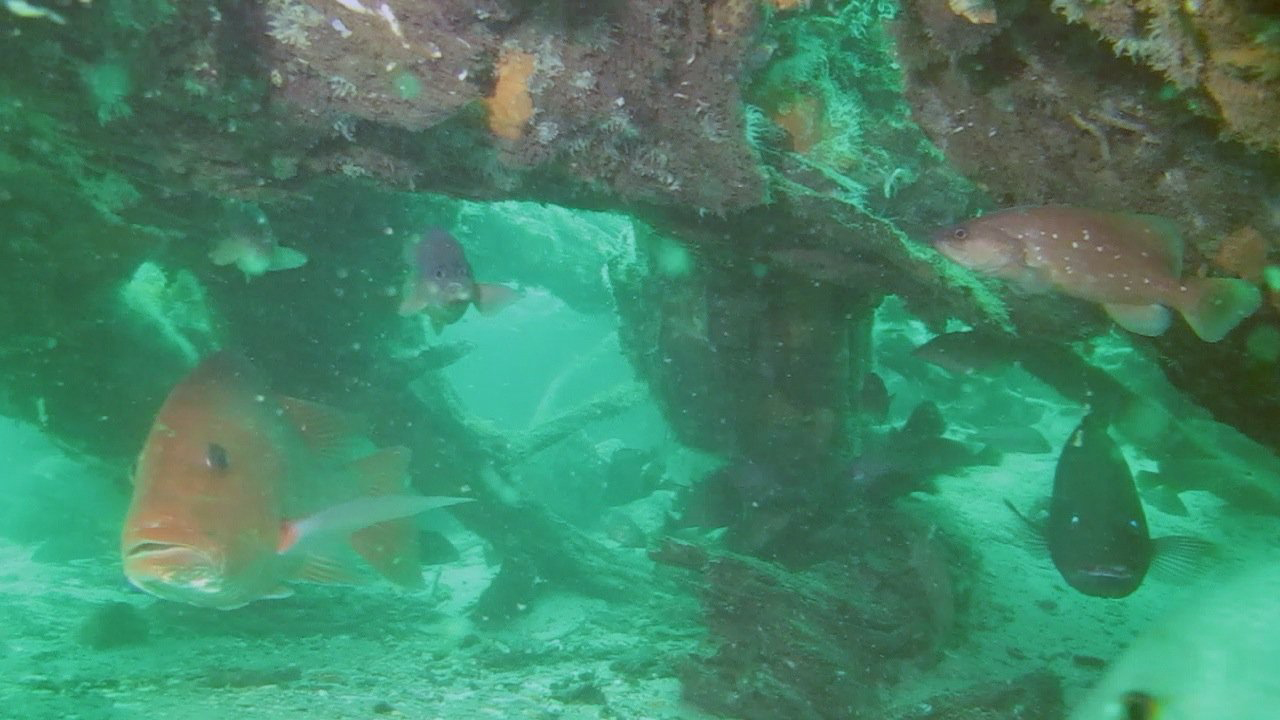
Photo: Ben Raines/ Alabama Press Register.
“Sixty feet beneath the waters off the Gulf coast of Alabama lies a forest of cypress stumps more than 50,000 years old,” says Living on Earth. “Fish hide among the roots of the trees.

Hello from Hurricane Central. The guy in charge of New Shoreham’s power company says to expect that Henri will cause a loss of electricity, so if I break my perfect 10-year-plus record of daily blogging, you’ll know why.

Meanwhile, let’s think about scuba diving in an ancient, submerged forest in the Gulf of Mexico.

Living on Earth host Steve Curwood interviewed Ben Raines in 2012 about this and reposted the story and video because of new urgency to get the area classified as a marine sanctuary before it’s exploited.

“STEVE CURWOOD: Deep beneath the surface of the Gulf of Mexico, off the Alabama coast, lie ancient cypress trees that only a handful of people have ever seen. One of those lucky few is Ben Raines, director of the [South Alabama Land Trust].

“BEN RAINES: For many years I was the environment reporter for the paper down here, the Press-Register, and so I had a buddy who owned a scuba diving shop, and he used to taunt me with this tale of an underwater forest that he had been diving on one time, and I pestered him for years and years and years, and he finally agreed to take me out there.

“He heard about it from a fisherman who just noticed a ledge on his bottom machine as he was riding across the gulf. So he started fishing there and catching a lot of Red Snapper. And he gave the numbers, the GPS coordinates, to my buddy that owns the dive shop and asked him to go out there and see what it was. He hit the bottom and said there’s a bunch of trees.

“CURWOOD: Now how deep is deep for an underwater forest?

“RAINES: Well, this is about 60 feet. Of course, all over the Earth, we know sea levels have gone down hundreds of feet. So we have a delta, a river delta here. Further up in the delta, about 80 miles inland, there’s sand dollars all over in these limestone bluffs. So we know sea level was that high at one time. Now we’ve got these trees 60 feet underwater, so sea level was that low, and it’s just a fascinating push and pull of the ocean through the climatic change over the eons.

“CURWOOD: So when did you finally get to visit the forest?

“RAINES: I got out there a year ago last August. …

The way we dive here, we’ll drop the anchor over whatever the GPS number is. And then we swim down the anchor line to get to the spot because the water’s a little murky — otherwise you get lost.

“I went down the anchor line, and when I hit the bottom, there it was. The first stump. And it was about as big around as a garbage can lid, but it had that very distinctive irregular shape that a Cypress trunk has. … Then it was surrounded by ‘knees.’ You know, Cypress trees have knees — you see them in the swamps — that stick up out of the water to kind of help hold them in place, and here was a Cypress tree on the bottom of the ocean. And I swam a few feet, and there was another one, and a few feet more, another one, and I quickly realized they were all around me in every direction. …

“It’s totally enchanting. You know, these trees are covered in anemones and crabs and shrimp — and then you have these huge clouds of Red Snapper and Grouper following you around. I was down there one day swimming along the ledge where the biggest stumps are, and I turned around and there was this huge funnel shape of fish behind me, I mean it must have been 200 Snapper, and they were just following me around. When I stopped, they would stop. When I turned around, they all fell in behind me. …

“[Groupers] come right up to you. And some of the fish that are down there, the trigger fish, will actually come up and chew on your camera. You have to shoo them away. They just seem to have no fear. …

“From the moment I hit the bottom and saw the stumps, it was just exhilarating. You knew you were in this sort of ‘land of the lost,’ this place that shouldn’t exist, but here it was, and I got the camera out, I hit the record button, and I never turned it off, and that’s exactly what I’ve done every dive I’ve made down there. And now I’ve been going down there with three cameras, you know, setting them up in different locations just to kind of capture this place while it’s there, because if we get a storm, it could theoretically come into the Gulf and change everything out there and bury this place up again. You know, it may be a very ephemeral place. We may only get to see it for a little while. …

“I cut some sections out of them, gave them to Christine DeLong at LSU, and she had them radio carbon dated, and they had to do them three times in all I think because they didn’t believe the results. So they expected them to be 12,000 years old, which was the last ice age. Instead they came back radio carbon dead each time they tested them, which means they’re 50,000 years old or longer. …

“We had another team come out from University of Southern Mississippi, and we had them do a sonar survey so we could try and get an extent of it because I’ve only been swimming around 300 yards of it. It turns out it’s spread close to a mile. …

“CURWOOD: We first aired this story back in 2012 and the fight to protect Alabama’s underwater forest from business interests continues. Scientists and advocates have asked the Biden administration to designate the site a marine sanctuary.”

More at Living on Earth, here.

Read Full Post »

Today’s article is about an environmental health advocate from rural Alabama who was honored recently by the MacArthur Foundation. One thing her story suggests to me is that when parents demonstrate concern for the world around them, later generations can work miracles. The parents of Catherine Coleman Flowers were civil rights activists in the 1960s.

Sarah Kaplan writes at the Washington Post, “To Catherine Coleman Flowers, this is ‘holy ground’: the place where her ancestors were enslaved and her parents fought for civil rights and she came of age. …

“Yet this ground also harbors a threat, one made worse by climate change. Untreated sewage is coursing through this rural community, a consequence of historic government disinvestment, basic geology and recent changes in the soil. On rainy days, foul effluent burbles up into bathtubs and sinks, and pools in yards. Some residents have hookworm, an illness rarely seen in developed nations.

“It’s America’s ‘dirty secret,’ Flowers said. … Heavier rainfall caused by climate change is saturating soil and raising water tables — confounding septic systems. From the flooded coasts of Florida to thawing Alaska towns, an estimated half-million U.S. households lack adequate sanitation.

“Now Flowers, a MacArthur Foundation ‘genius,’ is partnering with environmental engineers at Columbia University on a solution. They are working on a new kind of toilet that will act as a mini sewage treatment facility.

Instead of flushing waste, the system they’re working to build will filter, clean and recycle waste on site. Instead of sending raw sewage into the soil, it will turn it into water for use in washing machines, and into nutrients for fertilizer, and perhaps even energy for homes. …

“What was once a problem can become a solution, Flowers said. And the change will start in Lowndes County, as it has before.

“To Flowers, 62, the Lowndes County of her childhood was part rural idyll, part activism hotbed. … In 1965, about 80 percent of the county’s population was Black, but not a single Black person was registered to vote. …

“But then protesters from Selma marched down Lowndes’s dirt roads on their way to Montgomery, and a wave of activism erupted. … Flowers’s father, a military veteran and salesman, and her mother, a teacher’s aide, were heavily involved. Civil rights leaders streamed to their cinder-block home. …

“Her parents’ activism connected Flowers to the world beyond Lowndes County. As a teenager, she joined the Alabama Students for Civil Rights and spent a summer in D.C. as a youth fellow at the Robert F. Kennedy Memorial Foundation. She read ‘The Autobiography of Malcolm X,’ wrote politics-infused poetry and dreamed of becoming the first Black woman on the U.S. Supreme Court.

“In 11th grade, frustrated with subpar conditions at her high school, Flowers wrote an exposé for a local newsletter. That led to the formation of a community group, then a lawsuit and, ultimately, to the resignation of the principal and school board superintendent.

“ ‘My father’s famous thing he would always say was, “Catherine, if you take one step, God will take two,” ‘ Flowers said. It meant that change was possible, but you had to do the work.”

The article goes on to say that after Flowers had moved away, she learned her home county was suffering and that part of the problem was that the soil had changed and no longer worked for septic systems, which “require permeable soil. … All over the county, septic systems were breaking down. Heavy rainfall would seal up the soil until effluent had nowhere to go but up onto lawns or back into homes. …

“Flowers — then director of the nonprofit Alabama Center for Rural Enterprise (ACRE) — set out to determine the scale of the problem. …

“ ‘This is America,’ Flowers said. ‘We’re not supposed to have these kinds of problems — at least, that’s what we tell ourselves. But we do.’ …

“Climate change is making existing deficiencies worse. Rising sea levels have elevated the water table in coastal areas, shrinking the depth of leach fields and increasing contamination. Days of extreme rainfall — which have doubled in the Southeast as a consequence of warming — stymie septic systems. …

“ ‘Climate change is like a magnifying glass for everything,’ Flowers said. It exacerbates neglect, widens inequality and exposes problems once hidden. …

“Flowers has a vision for a better septic system. It’s cheap to buy and easy to run. It’s equipped with sensors that can monitor for signs of pathogens, including the coronavirus. Instead of allowing sewage to seep into the ground, the system separates waste into its component parts, which can then be recycled. …

“In Kartik Chandran, she found a partner who shares that vision. They met five years ago at a conference on wastewater issues. Chandran, an environmental engineer at Columbia University, was struck by how similar Lowndes County’s waste problems were to those in his native India. Flowers remembered hearing about Chandran’s research and thinking, ‘This is the technological solution we need.’ ” Read how it would work here.

Read Full Post »

A US student studying in Hungary was stunned by the refugee crisis at his doorstep and felt compelled to do something.

David Karas wrote in early November at the Christian Science Monitor, “Among those struck by the extreme hardships confronting the refugees is a graduate student from Mobile, Ala., who had been traveling in Europe. Motivated to find a way to help, he used his background in information technology and software to help provide something in high demand but extremely scarce: information.

“David Altmayer has launched the Refugee Help Map – an interactive mapping platform using Google tools that provides details on where refugees are traveling and what needs they have – to assist volunteers in best providing aid.

“ ‘At the beginning, it was just to get more information out there,’ Mr. Altmayer says. ‘I started helping in the first place because I couldn’t just sit by and not help. And then I just tried to find ways that I could best use my skill set to help.’

“Altmayer had worked in Seattle on IT and software projects, and is currently pursuing an MBA and master’s degree in global management through the Thunderbird Graduate School of Global Management and the University of Indiana, Bloomington. In order to finish his degree, he had to select a couple of courses that would be held abroad. …

“ ‘I live about one kilometer [0.6 miles] from the main railway station here in Budapest,’ he says, By mid-August, migrants had begun to flock to the station to take shelter. ‘Every day there were more and more people basically living there – camping, setting up tents, sleeping on cardboard,’ he says.

“Some of Altmayer’s friends had been providing support to refugees, mainly by bringing them meals. Altmayer noticed other volunteer groups were providing assistance. Wanting to learn more, he began to explore online – only to discover a need that he and his computer-literate colleagues could help to address.

“ ‘More and more people had been asking where they could get information in English,’ he says. Most efforts to provide information were in Hungarian. Before he knew it, he had become part of a group that launched an English website, making details about locations and needs accessible to English-speaking refugees and volunteers. …

“In the first six weeks the map was online, it received more than 80,000 views. It is constantly updated with markers indicating the location and urgency of needs, as well as comments about conditions facing refugees.

“ ‘There are so many people using it and counting on it,’ Altmayer says.”

More here. I do love stories about people working to solve a problem by offering the skills they have.

Photo: Andrea Giuliano
US college student David Altmayer created the online Refugee Help Map while living in Budapest, Hungary. Here he is shopping for supplies to help  migrants in Serbia.

Read Full Post »

You have heard of Let Us Now Praise Famous Men, the Depression era book on poverty in the South by James Agee and photographer Walker Evans. The forerunner was an article assigned by Fortune magazine to a young Agee but never published. This past Tuesday it was published as a book.

There are a couple aspacts to Christine Haughney’s NY Times story on the new book that intrigue me. One is the image of a young Agee moved by the plight of the sharecroppers and indignant at the magazine’s apparent exploitation of them.

The other is  how the original subjects, and later, their children, were embarrassed and didn’t want names used, but the grandchildren are able to see the beauty in their forebears.

Writes Haughney, “In 1936 Fortune magazine’s editors assigned a relatively unknown and disgruntled staff writer named James Agee to travel to Alabama for the summer and chronicle the lives of sharecroppers. When Agee returned, he was inspired by the subjects he had met and lived with, but frustrated by the limitations of the magazine format. His subjects, he argued, warranted far more than an article.

“What readers have known for decades is that Agee used his reporting material to create his 1941 book, Let Us Now Praise Famous Men, a literary description of abject poverty in the South, accompanied by starkly haunting Walker Evans photographs.

“The original magazine article was never published, as Agee squabbled with his editors over what he felt was the exploitation and trivialization of destitute American families. In the early pages of Famous Men, he wrote that it was obscene for a commercial enterprise to ‘pry intimately into the lives of an undefended and appallingly damaged group of human beings.’ What readers are about to discover now is what all the fighting was about.

“Melville House [is publishing] Agee’s original, unprinted 30,000-word article in book form, under the title Cotton Tenants: Three Families. The publication gives Agee fans a glimpse of an early draft of what became a seminal work of American literature.

” ‘With the book, we have a much better map of him writing Let Us Now Praise Famous Men,’ said John Summers, who edited Cotton Tenants and printed an excerpt from the article in a literary journal he edits, The Baffler. …

“Irvin Fields, whose grandfather Bud Fields was featured in the book, said he didn’t mind that the names were now being published.

“ ‘It makes me appreciate my relatives for bearing up under those circumstances and making me appreciate what I’ve got today.’ ” More.

A photo by Walker Evans, from “Cotton Tenants: Three Families,” via Library of Congress

Read Full Post »

In case you missed NPR's Weekend Edition today, you might like to check out this 
nice blues story.

"In a residential neighborhood in Bessemer, Ala.,about 20 miles from Birmingham, 
sits a blues lover's dream: an honest-to-goodness juke joint. Gip's Place is one 
of a precious few musical roadhouses still hanging on in this country. . . .

"Gipson has celebrated his 86th birthday about five or six times, we're told. In 
those years, he says, he's been struck by lightning and run over in a stampede. 
A singer who retired from the railroad, he's a gravedigger who owns a cemetery.


"Gipson has always been famous for his hospitality, whether it be with the locals 
he's known for decades or the wide-eyed college kids just discovering some gut-
bucket blues. When he opened his place back in 1952, it was little more than a 
glorified tent. Now, still several degrees removed from spiffy, the roadhouse 
has been fixed up — but not so much that it's lost its down-home appeal, says 
guitar player Lenny Madden, who functions as the house emcee."

Apparently people from all walks of life hang out there to enjoy the music and 
dance. And top-name performers are happy to just pass the hat and take whatever 
because it's such an awesome venue.

Read Full Post »