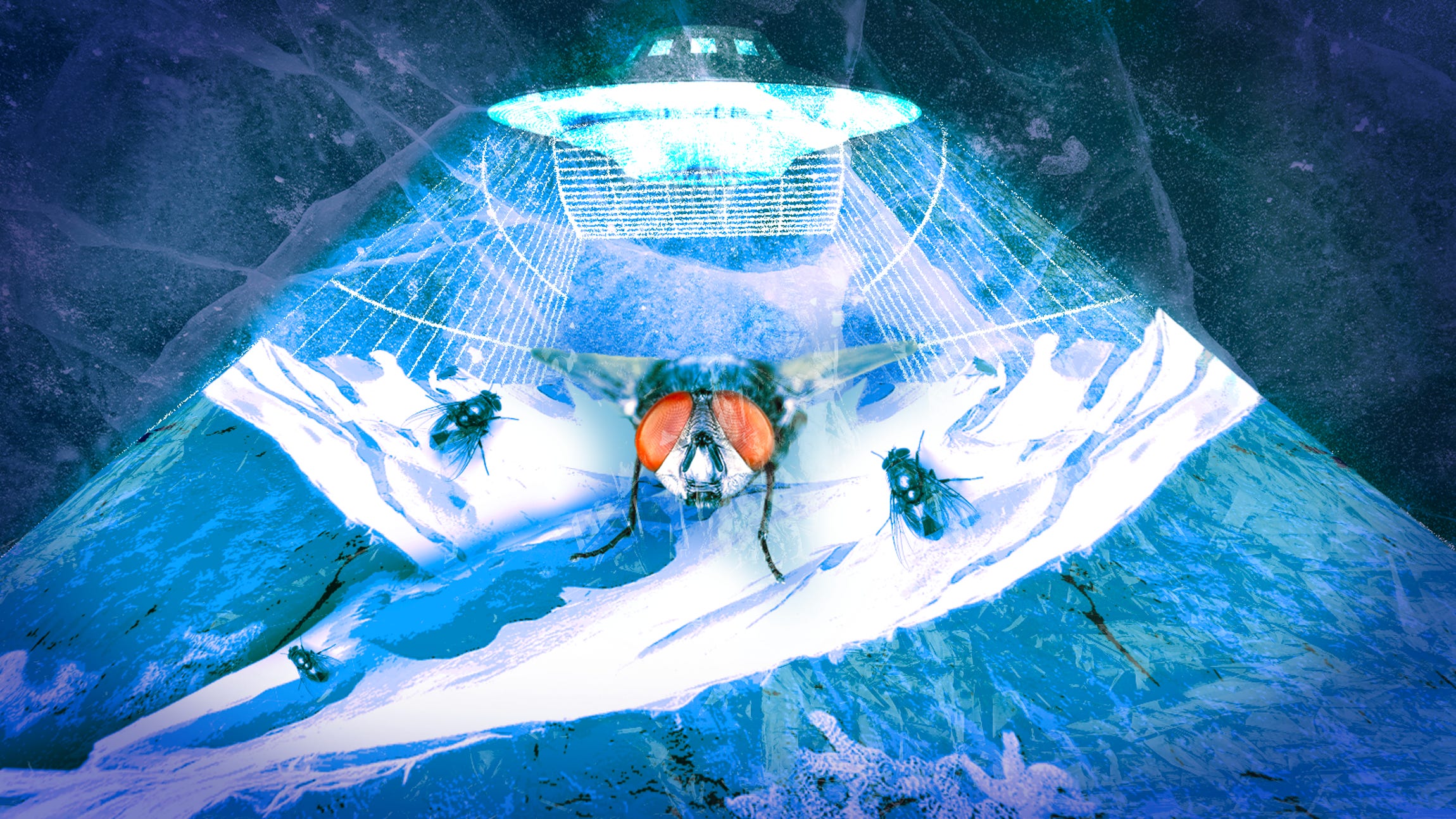
Photo: Naomi Antonino/CNET.
“As the world warms, non-native species threaten Earth’s last great wilderness,” says Jackson Ryan.
In the interest of identifying a problem in order to do something about it, today I share bad news about Antarctica: the invasion of alien species.
Jackson Ryan reports at CNET Science, “At the bottom of the stairwell leading to deck five, an alien lies upturned on green nonslip flooring. If you get close enough, you can see one of its six legs twitching and one of its translucent wings crushed to pieces. Unlike the throng of Antarctic expeditioners aboard the RSV Nuyina, Australia’s newest icebreaking ship, it hasn’t cleared customs.
“Days after the Nuyina departed its harbor in Hobart, Tasmania, the alien buzzed its way across the Derwent River, slipped through an open door and zipped into the bowels of the ship until this restless, twitching death.
“Scientists call the creature Musca domestica. You likely know it as the housefly.
“Even if it hadn’t been felled by an errant hand or boot, it likely wouldn’t have survived the journey to Antarctica. At temperatures below 14 degrees Fahrenheit, flies move lackadaisically and seem to barely get airborne. I know this because I’ve been watching them as part of the crew onboard the Nuyina as it crosses the Southern Ocean. Surviving flies buzz at the ship’s windows, trying to escape the upper decks.
“If their prison break were to succeed, they’d find themselves facing seemingly endless waters, with nowhere to go. The Southern Ocean provides a formidable barrier to entering Antarctica, a great wall of water and powerful currents that has separated the continent from the rest of the world for about 30 million years. Couple that with freezing temperatures, and the Antarctic provides little hope for a wayward housefly trapped on a ship.
“But Antarctica’s temperature is changing, and dramatically. In March, a French-Italian base in East Antarctica recorded temperatures 70 degrees higher than average for that time of year. That may just be an unprecedented anomaly, but it’s expected the continent’s average temperatures could rise a few degrees by 2050. In particular regions, like the western peninsula, the continent is warming at a rate 10 times faster than the rest of the world. In February 2020, the temperature at Argentina’s Esperanza Base research station reached 18.3 degrees Fahrenheit – an all-time high – providing the kind of conditions a wayward housefly might survive in.
“Historically, it’s been difficult for lost flies to reach the most southern landmass on Earth. As Antarctic explorers aimed to discover and map the continent in the 1800s, humans began providing fleeting opportunities for alien trespass. A handful of nations with a permanent presence across the continent annually resupply research stations that provide permanent outposts for studying the ice and the Antarctic ecosystem. …
” ‘Back-of-the-napkin math, less than a million people in the entire history of human existence have visited Antarctica,’ says Dana Bergstrom, an ecologist at the Australian Antarctic Division.
“But that too is changing. Before the pandemic slowed cruises to a halt, Antarctic tourism was on the rise. In the 2019-20 season, almost 75,000 people visited the continent, according to IAATO, the chief tourist body in the Antarctic. That’s a 35% increase over the previous season.
“Wherever humans go, so too our pests. Signatories to the Antarctic Treaty and the Madrid Protocol, which include protections for the Antarctic environment, must endeavor to limit their effects on the pristine wilderness, and tourist bodies like IAATO and national Antarctic programs go to great lengths to prevent biological invasions. …
“If an alien were to slip in, it could be disastrous for the delicate Antarctic ecosystems hidden from the world for millennia.
” ‘It’s a super special place to understand how the planet works,’ says Bergstrom. ‘And so it’s really worthwhile putting all our efforts to try to keep nature operating without interfering.’
“On the eastern edge of Antarctica … [a] base, called Davis, is Australia’s southernmost presence on the continent. In 2014, its hydroponics facility was the site of an infamous alien invasion.
“In May of that year, expeditioners entered the facility, composed of two gray shipping containers, to pick fresh greens for the chef’s evening meal. … During the vegetable collection, they inspected the facility’s water and noticed a black mat had developed over the surface. ‘When they looked closer, they realized it wasn’t a mat,’ says Andy Sharman, environmental manager at the Australian Antarctic Division, ‘it was thousands of tiny invertebrates.’
“Davis had been invaded by The Thing, a thousand times over. An alien species of arthropod known as Xenylla had snuck into the facility and began multiplying in the warm, wet conditions. The flealike critters, known as collembolans, hadn’t been seen in this region of the Antarctic before but had become established in warmer areas. A crack team of scientists deduced that should they get out, they might threaten the local ecosystem.
Almost immediately, the station went into eradication mode. ‘We had a biohazard response like you might get with a virus or disease,’ notes Sharman.
“The effort was blazingly fast. The response team sprayed alcohol throughout the facility, then bagged and burned everything, including recently harvested vegetables that had already made it to the Davis kitchen. The building was subjected to rigorous freeze-thaw cycling; the heat would trick any leftover eggs into hatching and then the temperatures would drop to minus 11 degrees Celsius, killing the hatchlings.
“The response team also took extreme social distancing measures. ‘We actually lifted the whole building out and parked it on the sea ice and left it there,’ says Sharman. A few months after the discovery and various eradication measures, the containers were shipped back to Australia.
“An investigation into the source of the incursion eventually discovered that the aliens likely got in through plant feed. Subsequent monitoring hasn’t found the collembolan in the area since, but other stations have experienced invasions, too, and protecting the continent from such risks is a constant battle.
“Exterminating The Things at Davis is one of the Australian Antarctic Division’s success stories, but the threat of incursion is constant. Invertebrates are the most widely dispersed non-native species and are known to hide in shoes and bags, while plant seeds can become stuck in Velcro and marine creatures can lurk in ballast tanks on vessels.”
The long, interesting CNET article is, here. No firewall.

 Suzanne's Mom's Blog