Feeds:
Posts
Comments

Posts Tagged ‘amsterdam’

Photo: Wikipedia.
Rembrandt’s “The Night Watch” (1642) at the Rijksmuseum in Amsterdam.

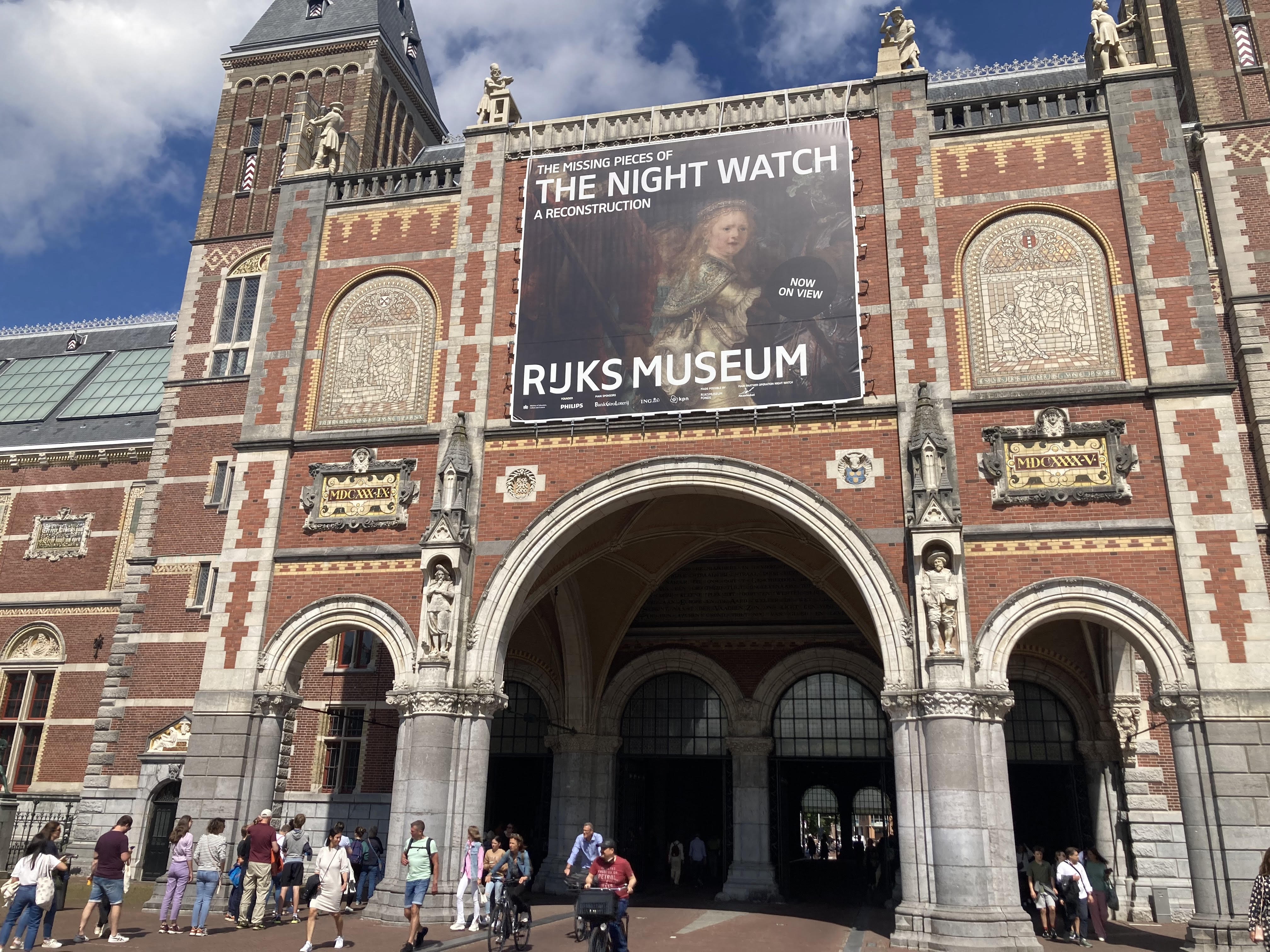
A couple years ago I wrote (here) about how AI was being used to help in the restoration of Rembrandt’s “The Night Watch.” Now at the Rijksmuseum in Amsterdam, conservators are taking another unusual step: allowing museum goers to watch the restoration process.

Kelsey Ables writes at the Washington Post, “Visitors eager to catch a glimpse of Rembrandt’s ‘The Night Watch’ at the Rijksmuseum in Amsterdam may be surprised to find the large oil painting looking more like a work in progress than a masterpiece that was completed in 1642. On Tuesday, conservators — equipped with masks, gloves, brushes and scaffolding — began a long-anticipated restoration of the work, a process that would usually take place behind the scenes but that the Rijksmuseum is putting on full display to the public.

“Images and videos from the museum show conservators inside a glass chamber, crouching over Rembrandt’s emphatic figures and gently removing decades-old varnish with brushes and solvent, as curious visitors crowd around outside.

“Taco Dibbits, director of the Rijksmuseum, said in a statement that the beginning of the restoration, which follows years of research and a re-stretching of the canvas, ‘is filled with anticipation.’ …

“A sprawling 12½-by-15-foot canvas that depicts a group of civic guardsmen cast in a dramatic lighting style known as chiaroscuro, ‘The Night Watch’ is considered one of the crowning artistic achievements of the Dutch Golden Age. The Rijksmuseum’s undertaking marks another chapter in the long life of the famous work, which has survived two knife attacks and was hidden in a cave during World War II.

“The process will involve removing varnish that was applied during its 1975-1976 restoration and will significantly change the look of the painting, making white paint whiter and dark areas more visible. The current varnish is ‘discolored, has yellowed, and it saturates poorly,’ Ige Verslype, paintings conservator at the Rijksmuseum, said in a video. …

“To remove the old varnish, conservators are using a special technique that reduces the need for ‘mechanical action’ and involves applying a measured amount of solvent to the canvas with a tissue and brush. As they remove the varnish, the famously dark painting will become more matte and gray, the Rijksmuseum explained, until a fresh layer is applied, imbuing the figures with new life.

“Paula Dredge, a lecturer in cultural materials conservation at the University of Melbourne in Australia … said that such work, which involves peeling back previous restorations, is a ‘process of discovery,’ even for the conservator. ‘The value we give originality and artists’ intent is a modern concept. In the past, restorations were more invasive and often covered over passages of the artist’s paint,’ she wrote, adding, ‘We may find more of Rembrandt.’

“In the 18th century, the painting’s old varnish and accumulated dirt actually became a part of its identity when it was nicknamed ‘The Night Watch,’ in response to its dark colors. The painting is in fact set during the day.

“It is a type of painting unique to the northern Netherlands, where civic watchmen companies commissioned group portraits that were intended to create a sense of local pride. While such paintings were usually stiff and straightforward, Rembrandt broke with tradition in ‘The Night Watch’ by imagining a dynamic composition that shows the guardsmen poised for attack. In his scene, the guardsmen, cloaked in darkness, appear to be responding to a threat. They hold up flags, raise weapons, play the drums, as their captain, bathed in light, guides them forward.

“Rembrandt also added unique flourishes, such as a personification of the watchmen’s company in the form of a small girl with a chicken — and even his own self-portrait (peeking over a soldier’s shoulder in the top row, just left of center).

“But the drama is a fiction. By the time Rembrandt finished this, the Dutch war of independence against the Spanish was nearly over, Amsterdam was mostly safe, and these watchmen companies were largely drinking societies.”

More at the Post (via MSN), here.
Read Full Post »

Photo: Stefano Giovannini for N.Y.Post.
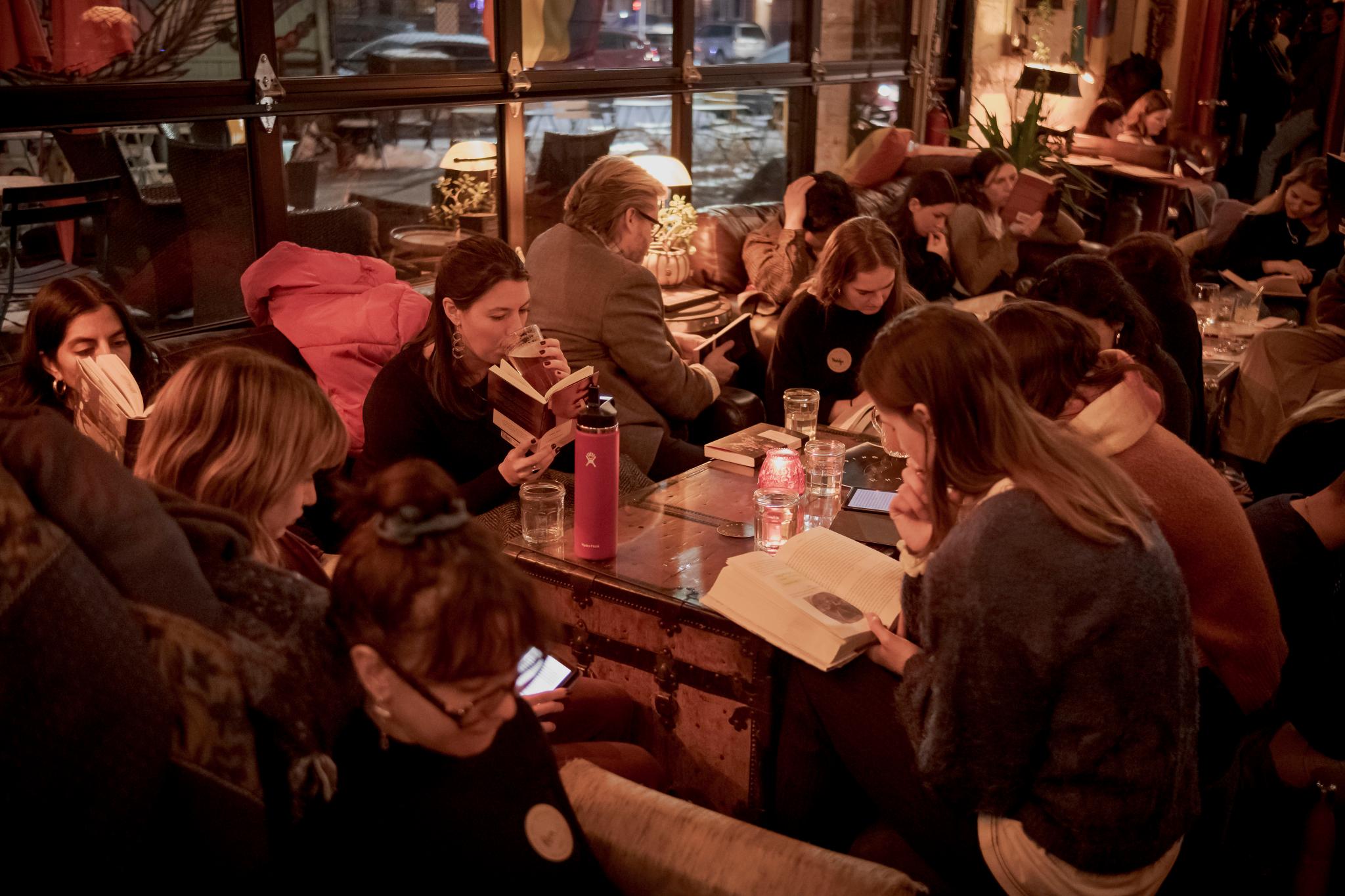
A reading party in New York. No phones.

I often wonder why anyone agrees to get notifications on their mobile phones. To me, it feels like some sort of conspiracy to keep us all from ever finishing a thought. That’s why I love hearing about people who have said “enough already” to cellphones, at least for a fewer hours a day.

Today’s story is from the Netherlands, and Orla Barry covers it at the radio show The World.

“Saliha Gündüz, a PhD student from Turkey, has just handed over her smartphone to one of the founders of The Offline Club in Amsterdam, who places it carefully in a ‘phone hotel’ — essentially a locker with dividers that holds up to 60 phones.

“Gündüz said she doesn’t feel apprehensive yet — and she settled down to a cup of herbal tea at the New Yoga School cafe in the center of Amsterdam.

“ ‘The withdrawal symptoms will kick in later,’ she said. ‘But maybe a withdrawal is what’s needed if I’m going to cure myself of my addiction.’ …

“Gündüz is among 20 people of all ages and nationalities who turned up at The Offline Club on a wet Friday evening in May to see if they could wean themselves off of their addiction.

“The club’s founders — Ilya Kneppelhout, Valentijn Klok and Jordy van Bennekom — started the venture in 2022 with a plan to host offline weekend getaways. Kneppelhout said, at the time, each of the co-founders felt their phones had been dominating their lives.

“Earlier that year, he took a short trip to the north of the Netherlands on his own with ‘some books, a journal and myself.’ No phone. He said something shifted over those four days.

“ ‘I felt so much creativity and, at the same time, a sense of peace.’

“Van Bennekom did the same and loved it. They began organizing weekend getaways with groups in a house in the countryside. Everyone was required to hand over their phones upon arrival. The three-day events were a hit. But Kneppelhout said that not everyone can afford to pay a few hundred dollars for the experience. So, the idea of The Offline Club was born.

“Each attendee at the club pays around $8 at the door. The events and venues differ each time. At the New Yoga School in Amsterdam, van Bennekom lays out the rules for the evening.

“First, there’s 45 minutes of quiet time, then a 30-minute break to chat, then a further 30 minutes of time to yourself. Most people bring books to read. Soft music plays in the background as van Bennekom lays out coloring books and markers for anyone who wants to draw or doodle.

“On that rainy Friday, three men from Puglia in Italy were huddled in one corner drinking tea. Two of them were visiting their friend Pietro Maggi who lives in Amsterdam. Maggi, who works for electric carmaker Tesla, said the evening was his idea and that he persuaded his two visitors to join him. …

“[Damiano Caforio admits] ‘I keep looking at the news constantly, checking to see what’s going on in the world, or, more specifically, with my job.’ He works at the Italian Chamber of Commerce.

“ ‘I need to know what’s going on, I feel I need to control the environment. … Actually, I desperately need this experience tonight,’ he laughed. …

“Leah Davies from Wales said she spotted a post about The Offline Club on Instagram.

“ ‘I saw people reading books and knitting and playing piano,’ she said. ‘And I just loved the idea of being able to go somewhere where you’re not checking your phone all night.’ …

“Davies said she would like to see phones restricted at other events too, like concerts and nightclubs, ‘so people can just dance or talk like you did in the ‘90s.’

“Phone-free music events are already happening elsewhere in the Netherlands. In Tilburg, a city in the south of the country, another group, Off the Radar, organizes music gigs where attendees are expected to hand in their devices at the door.

“There isn’t anything quintessentially Dutch about the desire to have smartphone-free events, said Ilya Kneppelhout, co-founder of The Offline Club. But work-life balance is an important aspect of life in the Netherlands. …

A study by the Organization for Economic Cooperation and Development (OECD) found only 0.3% of employees in the Netherlands work very long hours in paid work, the lowest rate in the OECD, where the average is 10%. In January, smartphones were banned in secondary schools across the country under government guidelines.

“A similar ban is set to be introduced in Dutch primary schools in the 2024-25 school year. A study last month by Radboud University in the Netherlands found that students were generally positive about the change, saying breaks were more enjoyable and there was less bullying during school hours.”

More at The World, here. No firewall. See my earlier post on the new book-reading parties, here.

Read Full Post »

Photo: Remko de Waal/ANP/AFP via Getty Images.
Rembrandt’s restored ‘Night Watch’ at the Rijksmuseum in Amsterdam.

A project to restore a Rembrandt called “Night Watch” has received a lot of attention recently, but at the risk of repeating what you already know, I’d just like to point out that trimming a work of art can seriously affect its greatness.

How many times have building renovations cut paintings to fit or squashed them into too small a space to be properly appreciated. I think, for example, of the many special WPA paintings in US post offices that have been significantly altered over the years. I understand competing needs, but it’s a loss.

What was lost in Rembrandt’s ‘Night Watch,’ the New York Times says, was a sense of movement. The original was “asymmetrical: The large arch that stands behind the crowd was in the middle, and the group’s leaders were on the right. Rembrandt painted them this way to create a sense of movement through the canvas.

“Once the new pieces were restored, so was the balance, [said Rijksmuseum’s director, Taco Dibbits.] ‘You really get the physical feeling that Banninck Cocq and his colleagues really walk towards you.’ “

The main focus of the recent news coverage, however, was on how experts used artificial intelligence (AI) — along with an early copy of the original painting — to reimagine Rembrandt’s intentions.

Nina Siegal reported at the Times, “Rembrandt’s “The Night Watch” has been a national icon in the Netherlands ever since it was painted in 1642, but even that didn’t protect it.

“In 1715, the monumental canvas was cut down on all four sides to fit onto a wall between two doors in Amsterdam’s Town Hall. The snipped pieces were lost. Since the 19th century, the trimmed painting has been housed in the Rijksmuseum, where it is displayed as the museum’s centerpiece, at the focal point of its Gallery of Honor.

“[Now] for the first time in more than three centuries, it will be possible for the public to see the painting ‘nearly as it was intended,’ said the museum’s director, Taco Dibbits. …

“Rather than hiring a painter to reconstruct the missing pieces, the museum’s senior scientist, Robert Erdmann, trained a computer to recreate them pixel by pixel in Rembrandt’s style. A project of this complexity was possible thanks to a relatively new technology known as convolutional neural networks, a class of artificial-intelligence algorithms designed to help computers make sense of images, Erdmann said.”

As amazing as AI is, the work would not have been possible if a less renowned painter hadn’t made an early copy of Rembrandt’s work.

“Indications already existed of how the original ‘Night Watch’ likely looked,” Siegal continues, “thanks to a copy made by Gerrit Lundens, another 17th-century Dutch painter. He made his replica within 12 years of the original, before it was trimmed.

“Lundens’s copy is less than one-fifth the size of Rembrandt’s monumental canvas, but it is thought to be mostly faithful to the original. It was useful as a model for the missing pieces, even if Lundens’s style was nowhere near as detailed as Rembrandt’s. Lundens’s composition is also much looser, with the figures spread out more haphazardly across the canvas, so it could not be used to make a one-to-one reconstruction.

“The Rijksmuseum recently made high-resolution scans of Rembrandt’s ‘Night Watch,’ as part of a multimillion-dollar, multiyear restoration project, initiated in 2019. Those scans provided Erdmann with precise information about the details and colors in Rembrandt’s original, which the algorithms used to recreate the missing sections using Lundens’s copy as a guide. The images were then printed on canvas, attached to metal plates for stability and varnished to look like a painting.” More at the Times, here.

The Guardian also covered the story, quoting the Dibbits as saying, “With the addition especially on the left and the bottom, an empty space is created in the painting where they march towards. When the painting was cut [the lieutenants] were in the centre, but Rembrandt intended them to be off-centre marching towards that empty space, and that is the genius that Rembrandt understands: you create movement, a dynamic of the troops marching towards the left of the painting. …

“I am always hoping that somebody will call up one day to say that they have the missing pieces. I can understand that the bottom part and top might not be saved but on the left hand you have three figures, so it is surprising that they didn’t surface because at the time in 1715 Rembrandt was already much appreciated and an expensive artist.”

Update 8/11/21 — Michiel of Cook & Drink went to the exhibit, sending a picture and comment: “The AI-part adds a lot of value to the overall painting, but obviously it’s a reconstruction. This is clearly visible (the painting lies a bit deeper than the reconstruction) and that helps to appreciate both the original and the extended version. We’ve seen the painting many times, always in its original frame. To see it without a frame was also special. Very nice to see so many people interested in this project. It’s special to see the combination of very advanced IT, AI, art and history.”

Nice to see a line for art!

Read Full Post »

When homes are destroyed in disaster zones, the Mobile Factory can turn the rubble into Lego-like building blocks to create new housing. They snap together without mortar.

Stella Dawson of the Thomson Reuters Foundation writes, “In Amsterdam a mobile factory, the size of two shipping containers, ingests rubble at one end, liquifies it into cement, and spurts out Lego-shaped building blocks.

“Call it rubble for the people, converting the deadly debris from disasters into homes and hospitals, cheaply and quickly.

“It’s the brainchild of Gerard Steijn, a 71-year-old sustainable development consultant turned social entrepreneur, who leads the Netherlands-based project to recycle the rubble from natural disasters and wars.

“He plans to create ecologically sound and safe housing by producing 750 building blocks a day from the debris, enough for one home at a cost of less than $20,000 each.

” ‘In disasters, you have piles and piles of rubble, and the rubble is waste. If you are rich, you buy more bricks and rebuild your home,’ Steijn said in a telephone interview.

‘But what happens if you are poor? In disasters it is the poorest people who live in the weakest houses and they loose their homes first. I thought, what if you recycled the rubble to build back better homes for poor people?’

“His rubble-busting Mobile Factory has fired the imagination of a landowner in Haiti and a civil engineer at the University of Delft. They have joined forces to test Steijn’s idea and build the first rubble community in Port au Prince next year. …

“Unskilled people can build the homes with the blocks, which meet demanding Dutch construction standards to ensure they will last for many years. [Hennes de Ridder, an engineering professor at the University of Delft,] expects further stress tests he planned for Peru in a few months will show the homes can withstand temblors of at least 6 on the Richter scale.” Read more here.

Photo: The Mobile Factory
Model homes built from cement rubble are on display at an industrial park in Amsterdam. The brightly painted homes are designed for disaster zones, using technology that creates Lego-style building blocks from cement rubble.

Read Full Post »

New online services make it easy to borrow things you need temporarily but don’t want to buy.

Janet Morrissey writes at the NY Times, “When vandals broke into Stephanie Ciancio’s Land Cruiser in 2014 and stole her car stereo, she did not have the time and money to replace it. It was particularly vexing for Ms. Ciancio, a 34-year-old San Francisco resident, because she had been planning to take a four-day road trip to Fern Canyon, Calif., over the long July 4 weekend, and the idea of making the eight-hour drive without music was depressing.

“So she logged onto Peerby.com, typed in her predicament, and within 40 minutes was connected with someone willing to lend her a Beats wireless Bluetooth speaker for her car trip.” She was thrilled.

Peerby founder Daan Weddepohl, Morrissey contintues, “was born in Rotterdam in 1980 and developed a passion for computers and programming at a young age. ‘I asked for a compiler for my 13th birthday,’ he said.

“He pored over books and joined online bulletin boards to hone his programming skills. His parents, both psychiatrists, encouraged his entrepreneurial spirit and interest in technology. But it was a fire that ignited the Peerby dream.

“In February 2009, fire ripped through Mr. Weddepohl’s apartment building, … Most of Mr. Weddepohl’s belongings were destroyed by fire, water or smoke.

“He was devastated. But in the months after, Mr. Weddepohl watched in amazement as friends — and even strangers — offered furniture, tools and other items to help him get back on his feet. It was a revelation. “’ discovered that the people around me were so much more important than the stuff,’ he said. ‘People love to help other people out — we’re wired to help others.’ ”

Read how the Peerby concept grew from the ashes, here.

I blogged earlier this year about this concept. You can read “Borrowing Gadgets you Need Only Once,” here.

Photo:Jason Henry for The New York Times
Stephanie Ciancio was able to borrow a wireless Bluetooth speaker from Matt Dodge through an online service called Peerby.com. 

Read Full Post »