Feeds:
Posts
Comments

Posts Tagged ‘cellphone’

Photo: Shane O’Neill/Washington Post.
Organizers pasted Summer of Ludd posters over different advertisements in a Brooklyn subway station, seen in June 2026.

What kinds of activities could lure you to experience a phone-free day? Is there enough rebellion out there to make a phone-free movement survive?

In June, Ethan Beck wrote at the Washington Post about a new kind of Luddite who is offering lots of alternatives to constant scrolling — alternatives characterized by interacting with other humans.

“Dan Fox hasn’t run for office before,” says Beck. “But that hasn’t stopped the strapping 38-year-old comedian from setting his sights on the presidency. Just don’t ask about his campaign.

“ ‘All I want to say right now is that my platform is that I have no platforms,’ said Fox. …

“On June 30, he’ll announce his candidacy in Washington Square Park. But Fox’s bid has been gestating for years. In 2015, he attended a Tame Impala concert, where he saw a sea of devices in the air, and left Radio City Music Hall ready to proselytize about how smartphones are ruining our lives. This crusade has taken many forms: Fox works for Light, a company that sells phones without internet access, and hosts a weekly, phone-free gathering in his Fort Greene brownstone.

“All of which brings us to the presidential run. Fox’s kickoff event comes three days into the Summer of Ludd, a festival designed to yank individuals off of their phones and into the real world. This fête builds off a burgeoning Luddite renaissance in New York, the result of an amorphous community of phone-free event organizers, self-described ‘attention activists,’ aligned nonprofits and a few not-smart phone companies.

“You’ll notice that Summer of Ludd isn’t anywhere online. … But organizers have other ways of reaching potential future Luddites. More than 15,000 guidebooks to the week’s phone-free events have been printed and scattered across trendy bookstores and cafes in the city. Wheat-pasted monochrome posters, with the festival’s ethos of ‘Free! Public! Participatory!’ and a festival hotline, can be found plastered over subway ads. …

“But the festival’s home base is Tompkins Square Park in the East Village, where, starting on June 28, daily meditations, jam sessions and puppet shows will take place. …

“Summer of Ludd organizers describe the goal of the event as twofold: help people understand how platforms are profiting off their helpless users, and remind them of a better, more meaningful world off social media. It’s the result of years of tech-skeptical organizing, according to various people involved with the festival. …

“Not all of the organizers consider themselves Luddites. But many were inspired by Logan Lane’s Luddite Club, which she started in 2021 while at Brooklyn’s Edward R. Murrow High School.

The club’s name came from Ned Ludd, a figure from English folklore who inspired 19th-century workers in their fight against industrialization. …

“Amanda Hanna-McLeer, who taught film, media and graphic design at Murrow, felt relieved that her students were concerned about phone addiction. Drawing from her experience working on shows including Broad City and The Americans, she shot a documentary about Lane’s Luddite Club and the wider neo-Luddite world in New York. Now, she’s hard at work on Luddite Recreations, a play she’s staging three times during Summer of Ludd, which tells the story of the textile-mill Luddites — only the factory owners look suspiciously like present-day technology CEOs.

“If the word luddite conjures images of anguished farmers and phone-smashing absolutists, Hanna-McLeer emphasizes that this movement isn’t about being anti-progress.

“ ‘You don’t have to have a flip phone and no social media to join us,’ said Hanna-McLeer, 33, while on break from building props. ‘You just have to be willing to examine your life in tandem with technology.’ “

Look at it this way: Who should be in charge of what you think about?

Lots more at the Post, here.
Read Full Post »

Photo: Stefano Giovannini for N.Y.Post.
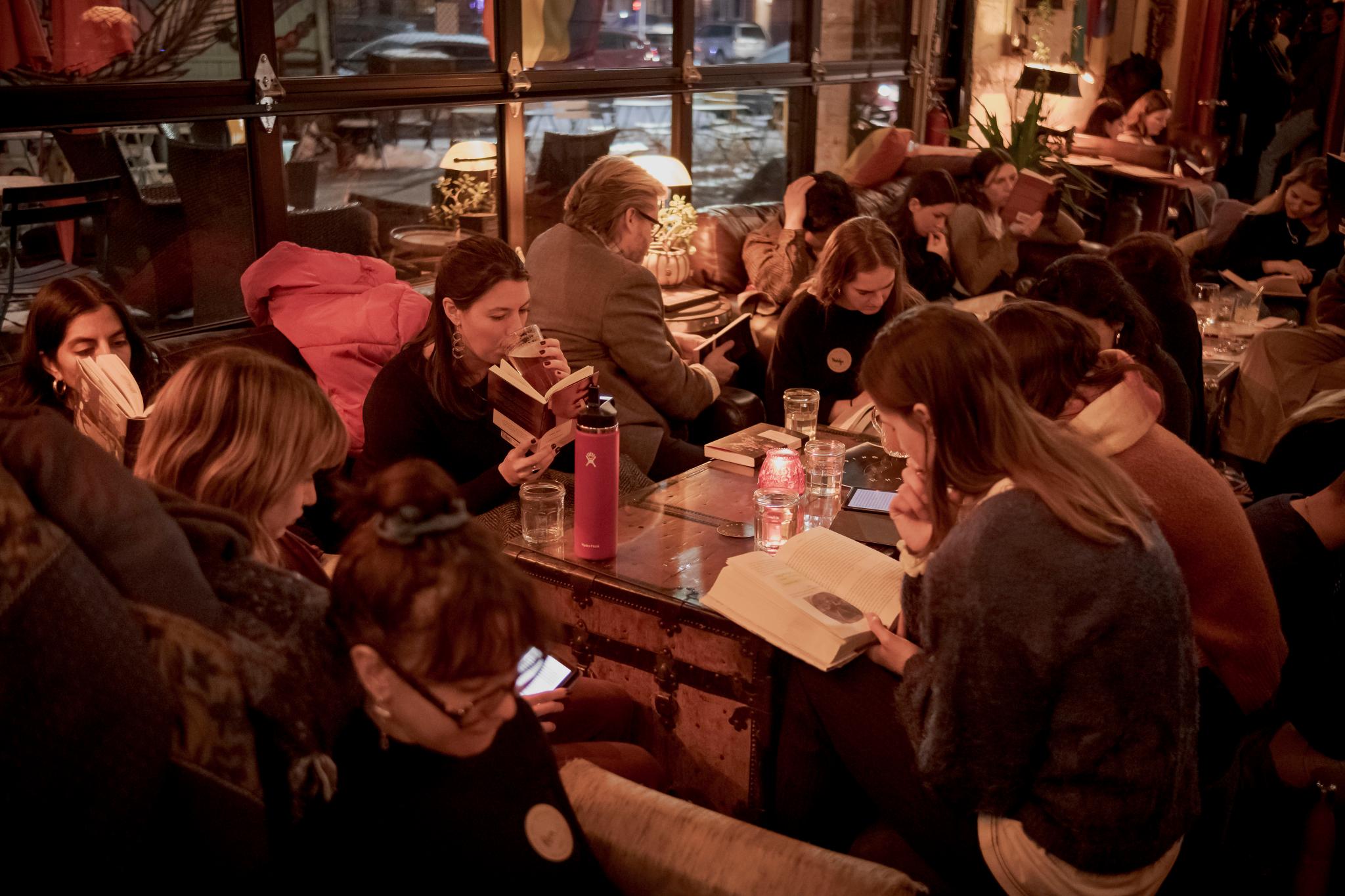
A reading party in New York. No phones.

I often wonder why anyone agrees to get notifications on their mobile phones. To me, it feels like some sort of conspiracy to keep us all from ever finishing a thought. That’s why I love hearing about people who have said “enough already” to cellphones, at least for a fewer hours a day.

Today’s story is from the Netherlands, and Orla Barry covers it at the radio show The World.

“Saliha Gündüz, a PhD student from Turkey, has just handed over her smartphone to one of the founders of The Offline Club in Amsterdam, who places it carefully in a ‘phone hotel’ — essentially a locker with dividers that holds up to 60 phones.

“Gündüz said she doesn’t feel apprehensive yet — and she settled down to a cup of herbal tea at the New Yoga School cafe in the center of Amsterdam.

“ ‘The withdrawal symptoms will kick in later,’ she said. ‘But maybe a withdrawal is what’s needed if I’m going to cure myself of my addiction.’ …

“Gündüz is among 20 people of all ages and nationalities who turned up at The Offline Club on a wet Friday evening in May to see if they could wean themselves off of their addiction.

“The club’s founders — Ilya Kneppelhout, Valentijn Klok and Jordy van Bennekom — started the venture in 2022 with a plan to host offline weekend getaways. Kneppelhout said, at the time, each of the co-founders felt their phones had been dominating their lives.

“Earlier that year, he took a short trip to the north of the Netherlands on his own with ‘some books, a journal and myself.’ No phone. He said something shifted over those four days.

“ ‘I felt so much creativity and, at the same time, a sense of peace.’

“Van Bennekom did the same and loved it. They began organizing weekend getaways with groups in a house in the countryside. Everyone was required to hand over their phones upon arrival. The three-day events were a hit. But Kneppelhout said that not everyone can afford to pay a few hundred dollars for the experience. So, the idea of The Offline Club was born.

“Each attendee at the club pays around $8 at the door. The events and venues differ each time. At the New Yoga School in Amsterdam, van Bennekom lays out the rules for the evening.

“First, there’s 45 minutes of quiet time, then a 30-minute break to chat, then a further 30 minutes of time to yourself. Most people bring books to read. Soft music plays in the background as van Bennekom lays out coloring books and markers for anyone who wants to draw or doodle.

“On that rainy Friday, three men from Puglia in Italy were huddled in one corner drinking tea. Two of them were visiting their friend Pietro Maggi who lives in Amsterdam. Maggi, who works for electric carmaker Tesla, said the evening was his idea and that he persuaded his two visitors to join him. …

“[Damiano Caforio admits] ‘I keep looking at the news constantly, checking to see what’s going on in the world, or, more specifically, with my job.’ He works at the Italian Chamber of Commerce.

“ ‘I need to know what’s going on, I feel I need to control the environment. … Actually, I desperately need this experience tonight,’ he laughed. …

“Leah Davies from Wales said she spotted a post about The Offline Club on Instagram.

“ ‘I saw people reading books and knitting and playing piano,’ she said. ‘And I just loved the idea of being able to go somewhere where you’re not checking your phone all night.’ …

“Davies said she would like to see phones restricted at other events too, like concerts and nightclubs, ‘so people can just dance or talk like you did in the ‘90s.’

“Phone-free music events are already happening elsewhere in the Netherlands. In Tilburg, a city in the south of the country, another group, Off the Radar, organizes music gigs where attendees are expected to hand in their devices at the door.

“There isn’t anything quintessentially Dutch about the desire to have smartphone-free events, said Ilya Kneppelhout, co-founder of The Offline Club. But work-life balance is an important aspect of life in the Netherlands. …

A study by the Organization for Economic Cooperation and Development (OECD) found only 0.3% of employees in the Netherlands work very long hours in paid work, the lowest rate in the OECD, where the average is 10%. In January, smartphones were banned in secondary schools across the country under government guidelines.

“A similar ban is set to be introduced in Dutch primary schools in the 2024-25 school year. A study last month by Radboud University in the Netherlands found that students were generally positive about the change, saying breaks were more enjoyable and there was less bullying during school hours.”

More at The World, here. No firewall. See my earlier post on the new book-reading parties, here.

Read Full Post »

Dirk-Jan Visser for The New York Times

I’m a sucker for any story about an angel because it gives me a chance to mention that Suzanne’s birthstone-jewelry company, Luna & Stella, has a lovely angel charm.

That is why I zeroed in on this article.

John Tagliabue writes in today’s NY Times, “The statue of an angel outside St. John the Evangelist Cathedral in ‘s Hertogenbosch, the Netherlands, holds a cellphone, which has two numbers.

“That is because, shortly after the statue was unveiled last April, a local couple, the parents of two children, set up a number so people could call the angel. Business cards soon appeared in pubs, restaurants and hotels with a picture of the angel and the number. So successful was the line that the couple opened a Twitter account, @ut_engelke, managed by the husband, which now has about 2,700 followers.”

Then the church, not amused by @ut_engelke, set up its own number. It charges for calls, and people get to hear recorded messages about the church.

The woman who answers the original phone number doesn’t charge. She answers with “Hello, this is the Little Angel,” and she just sees where it leads.

“ ‘In most cases there is laughter, but there are callers who have no faith in friends or relatives, so they would like to talk to someone they have some kind of faith in,’ she said. A widow in her 80s called from Amsterdam to complain of loneliness …

“ ‘She said she’d lost faith in humanity, in her own family,’ said the woman who lends the angel a voice. Two weeks later the elderly woman called again, to thank the angel. Things had gotten better.” Read more.

I would be interested in your angel stories.

Read Full Post »

I think I have always cut articles out of the paper to give people or to post on my fridge. (At the office, I post work-related clippings on the wall of my cubicle.) Suzanne and her brother, John, often teased me about how often the stories were dire warnings in the news. Around this time every year, they would be deluged with clippings about sun screen and melanoma or deer ticks and Lyme disease.

Now that they have grown up and have their own homes, the fridge is rather empty of news articles. But since they are reading this blog, I’ll post a typical dire warning from today’s Boston Globe, something I’ve been harping on since the mid-1990s. (Oh, well. They laughed at Columbus.)

Hiawatha Bray’s column for June 2 is about protecting oneself from possible cancer-causing effects of mobile phones. He has several pieces of advice any mother would love: “make like a teenager, and text instead of talking. Sending SMS or e-mail messages keeps the phone well away from your skull. The farther your brain is from the phone, the lower the risk of brain tumors. If you must talk, most handsets have a speakerphone feature to let you converse at a distance. I often use it because I’m too lazy to hold the phone. Now I’ve got a better reason.”

And a study done in Sweden a few years ago suggests that it isn’t just brains we need to worry about. Cellphones left on in a pocket can affect reproductive function.

Bray says, “I carry the phone on my hip, in a holster which keeps it the required distance from my body. I’ve mocked my wife for losing her Android smartphone in her purse, but carrying it well away from the body is the safest way to go.”

Read Full Post »