Feeds:
Posts
Comments

Posts Tagged ‘mobile phone’

Photo: Grace Coudal.
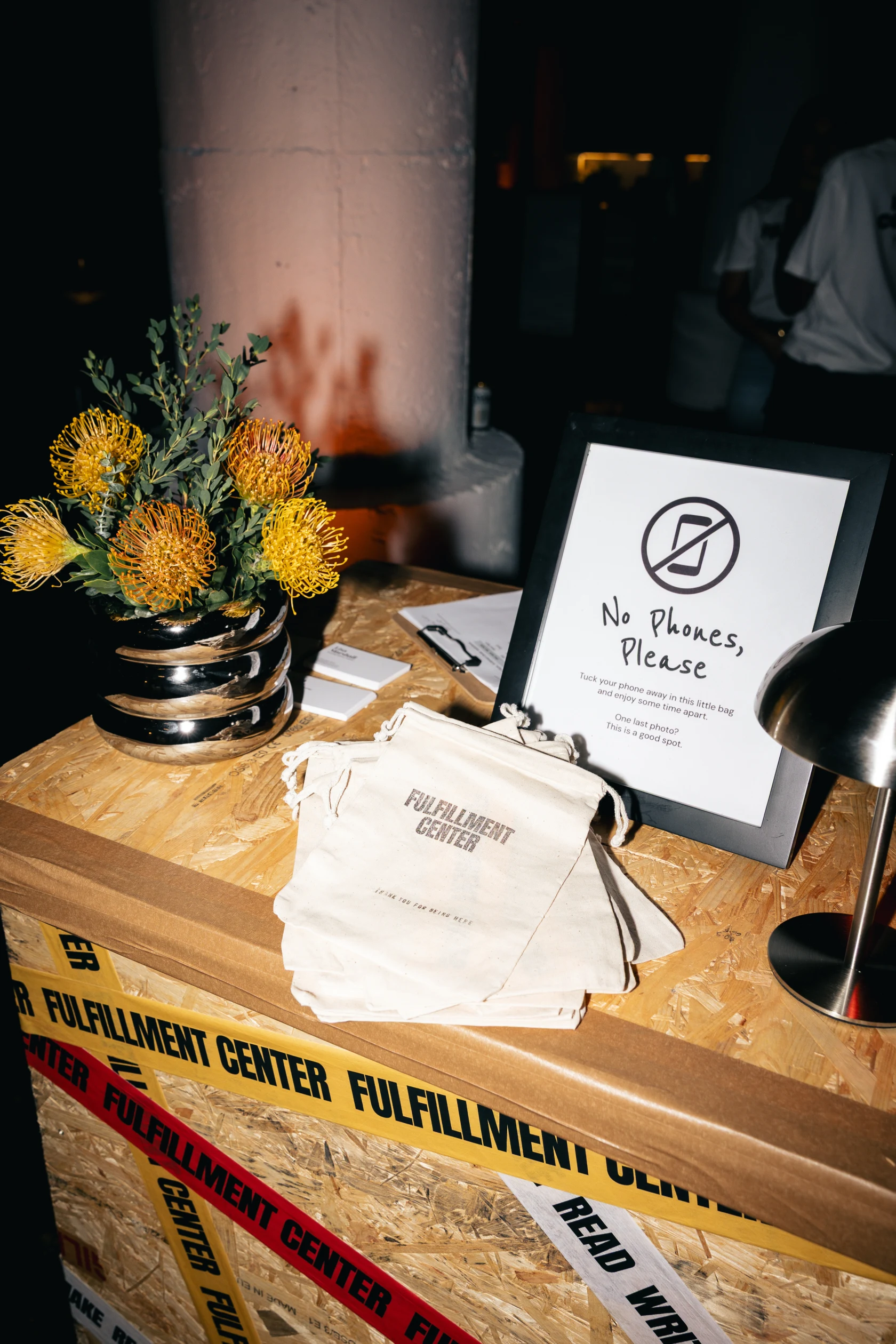
The Fulfillment Center organizers give attendees small cloth pouches to place their phones inside of for the duration of their “unplugged” events.

One day in the early 2000s, I was astonished to see a well-dressed woman walking down the sidewalk, apparently talking to herself. It took a moment to understand she was on the phone.

Before I knew it, there were numerous people on the commuter rail having long, loud, personal conversations as I tried to read a novel or sleep.

We’re not talking about that long ago. It was a time that many of us started to hate phones. Nowadays in Chicago, creatives are deciding to do something about the way phones have taken over.

Ambar Colón writes at WBEZ Chicago, “During the first weekend of May, dozens of people filed into a River North coworking space for what was billed as a hands-on, phone-free experience.

“After slipping their devices into small cloth pouches stamped with the words ‘Fulfillment Center,’ visitors made their way over to a pair of industrial shelves stacked with activity boxes labeled ‘make,’ ‘play,’ ‘read’ and ‘write.’ Inside the boxes, they found crafts, readable materials and games — plenty of things to do instead of scrolling endlessly on their mobile phones.

“Meanwhile, up in Edgewater, theater leaders from [producingbody] are introducing audiences to magnetically locking Yondr pouches, starting [in May] with the Chicago premiere of Spaceman. …

“If you want a deep dive into Chicago arts and culture, check your phone at the door: The ‘unplugged’ trend is growing locally among arts groups responding to a collective desire for more phone-free experiences. …

“For some Chicago cafes and lounges, such as Kibbitznest Books, Brews & Blarney and Verzênay in Lincoln Park, the unplugged trend is nothing new. These cafes are intentionally Wi-Fi-free, opting for board games and books instead of a sea of silent and disconnected remote workers.

“Major musicians such as Phoebe Bridgers and David Byrne have enforced no-phone zones at their events, too, using similar phone pouches, or in the case of Byrne’s ‘Theater of the Mind‘ theater installation in River North, requesting fans place their devices in lockers.

“The idea for the phone-free Fulfillment Center — a pop-up for people of all ages — started with a simple question, event creator and Little Council marketing co-founder Jessa Fuller said: ‘What if we took up a little bit of space in our communities with a center that was geared toward personal fulfillment?’ …

“After guests picked one of the four boxes [at the center], they took the box over to a table dubbed the ‘line’ and unpacked it. Inside, the materials and packing slip described the activity: ‘play’ boxes included classic games like Uno and Jenga, while ‘make’ boxes contained magazines and other supplies for collage-making.

“One box contained supplies for a game of ‘exquisite corpse’ — a drawing game invented in the 1920s, where artists come together to create a character without seeing the previous contributions. …

“ ‘Read’ boxes included articles from Chicago-based publications, such as copies of The Pub (which is print-only), or the Poetry Foundation’s poetry magazine. And inside the ‘write’ boxes, attendees received bios of older adults (through the group Love For Our Elders), and were inspired to write letters to friends and family. …

“Up north at the theater, [producingbody] founders Amy Carpenter and Taylor Dalton said their aim with the phone-free push is to restore the communal intimacy of traditional theater. …

“Plenty of humans are ‘addicted’ to their phones, even if just a little bit, Carpenter said. Though reminders to silence or power off phones are ubiquitous with pre-show warmups across Chicago theaters, devices are still a problem, she added.

“ ‘It’s tough because you want to believe that people will follow instructions, and then we just see time and time again that they don’t,’ Carpenter said.

Spaceman, written by Brooklyn-based playwright Leegrid Stevens, is a solo show about an astronaut who’s traveling to Mars with the sole task of laying the roots for a Martian colony. All that alone time gives the astronaut plenty of time to sit with her own thoughts and fears about life on Earth and what might await her when she arrives on the red planet. Carpenter and Dalton want the phone-free experience to mirror the protagonist’s isolation.

Upon check-in, guests will receive a Yondr pouch and sit, without the comfort of doom-scrolling, for at least 15 minutes before the show starts.

“ ‘That will inevitably give the audience a taste of our protagonist’s experience,’ they said.

“Still, phone-free rules can be risky for businesses, especially when social media is the top source for information and news about cultural events. …

“ ‘It is a risk. But I think the hope here is to ultimately make it worth it for [audiences],’ Dalton said. ‘We wanna make the experience so special inside the theater that they forget that they don’t have access to their phones.’ ”

More at WBEZ, here.

Read Full Post »

Photo: Melanie Stetson Freeman/CMS Staff.
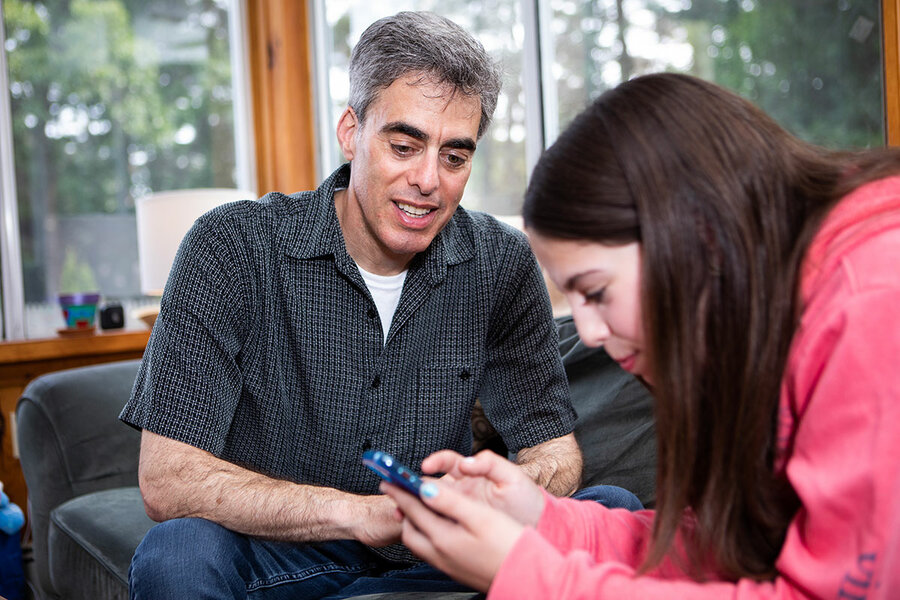
Andy Saks of Southborough, Massachusetts, says he is concerned about the constant presence of technology and its effect on children’s minds. His daughter Cara got an iPhone only after negotiating limits on social media use with her parents.

Our oldest grandson turned 13 this year and was able to get a phone, the first of our grandchildren to do so. He was already using an iPod for many of the same purposes and took a lot of nice pictures with it, so he wasn’t a neophyte. But as American children seem to get phones at younger and younger ages, his parents decided to go slowly.

Other parents are exercising caution, too, as Sophie Hills reports at the Christian Science Monitor.

She writes, “When Tanvi Chawla got a phone in fifth grade, she wanted access to ‘everything’ – all social media. But her parents said no until she was 13. Now in 10th grade at an all-girls school in Pasadena, California, Tanvi’s views on social media have almost entirely reversed.

“In early 2020, when Tanvi – along with the rest of the world – found herself stuck at home, social media became her ‘entire life,’ she says. ‘I didn’t post much but it was a means of communication with my friends.’ …

“But after a few months of life online, Tanvi deleted Instagram in the beginning of eighth grade. She hasn’t replaced it with any other social media. ‘I just saw how harmful it was to my mental health and I think it was negatively impacting my peers, too,’ she says. ‘So I made that decision for myself to stop using it.’ …

“Many students enter high school with their phones seemingly glued to the palms of their hands. And rates of anxiety and depression, particularly among girls, have skyrocketed since 2010.

“ ‘[Technology] is just so present that it’s impossible to completely disconnect and function for many people,’  says Liz Kolb, a clinical professor of education technologies and teacher education at the University of Michigan. …

“As a teacher, Ms. Kolb understands the inclination to go straight to cellphone bans. But whether a school bans phones or not, it’s worth taking the time to teach students good habits, she says. …

“In May, the U.S. surgeon general issued a public warning about the risks posed by social media to youth mental health. … A new poll found that most Americans, regardless of age, would like to return to a time when society was unplugged. The desire was highest among Americans ages 35-54 (77%), but 63% of 18- to 34-year-olds said they’d prefer to live in a simpler era, too.

In Ireland, parents and schools in the town of Greystones implemented a townwide voluntary cellphone ban for children.

“Rachel Harper, principal of St. Patrick’s primary school in Greystones, has noticed increasing anxiety among her 8-, 9-, and 10-year-old students. Parents report the same, adding that it’s hard to get their kids to sleep at night. Students are concerned about their bodies and self-image in a way Ms. Harper hasn’t noticed in that age group before. …

“Both parents and teachers are concerned for students’ online safety. ‘They’re just not emotionally ready to maneuver everything on a smart device,’ she explains.

“So she reached out to the principals of the other seven schools in Greystones. Together with parents, they started a community-led initiative to shelter children by agreeing that, across the town, students wouldn’t have phones until after primary school.

“The collective effort makes all the difference, says Ms. Harper. ‘From a kid’s point of view, there’s that sense of fairness, that it’s not just them’ without a phone.

The voluntary ban has attracted positive attention from all around the world, says Ms. Harper. She’s heard from many educators saying they’ve wished to implement a similar approach in their schools, though they didn’t think it was possible. …

“The Buxton School, a private day and boarding school in northwestern Massachusetts, last year banned cellphones entirely during the semester. Buxton offered students an alternative: the Light Phone, which texts, calls, and offers basic functions like a calculator, but has no capacity for email or accessing the internet.

“After one full school year, the experiment appears ‘largely successful,’ says assistant head of school John Kalapos, who also teaches English and wood shop. … Students do say they want to be on their phones less, he says, though not all of them love Buxton’s no-smartphone policy. …

“When students’ whole lives suddenly shifted online in 2020, Mr. Kalapos became much more aware of cyberbullying. It tends to be based on exclusion, which is challenging for teachers to mediate when it takes place in the form of ‘likes’ – or the lack thereof – online.

“It’s countercultural to not have a smartphone, says Joe Hollier, co-founder of Light. And while something like the Light Phone is a useful product, actually cutting back on technology exposure ‘takes user will.’

“Fear of missing out is what prevents most people – himself included – from moving away from smartphones, says Mr. Kalapos of the Buxton school. But once you do it, ‘you realize it’s not as valuable as you think.’ ”

In the anecdote from Ireland, kids were glad that it wasn’t just their school setting limits. All the schools in town did it. The importance of fairness made me think. Real fairness would involve parents agreeing to phone restrictions, too — maybe certain times of day when no one in the family uses their phone. What about that?

More at the Monitor, here. No firewall. Subscriptions encouraged.

Read Full Post »

Dirk-Jan Visser for The New York Times

I’m a sucker for any story about an angel because it gives me a chance to mention that Suzanne’s birthstone-jewelry company, Luna & Stella, has a lovely angel charm.

That is why I zeroed in on this article.

John Tagliabue writes in today’s NY Times, “The statue of an angel outside St. John the Evangelist Cathedral in ‘s Hertogenbosch, the Netherlands, holds a cellphone, which has two numbers.

“That is because, shortly after the statue was unveiled last April, a local couple, the parents of two children, set up a number so people could call the angel. Business cards soon appeared in pubs, restaurants and hotels with a picture of the angel and the number. So successful was the line that the couple opened a Twitter account, @ut_engelke, managed by the husband, which now has about 2,700 followers.”

Then the church, not amused by @ut_engelke, set up its own number. It charges for calls, and people get to hear recorded messages about the church.

The woman who answers the original phone number doesn’t charge. She answers with “Hello, this is the Little Angel,” and she just sees where it leads.

“ ‘In most cases there is laughter, but there are callers who have no faith in friends or relatives, so they would like to talk to someone they have some kind of faith in,’ she said. A widow in her 80s called from Amsterdam to complain of loneliness …

“ ‘She said she’d lost faith in humanity, in her own family,’ said the woman who lends the angel a voice. Two weeks later the elderly woman called again, to thank the angel. Things had gotten better.” Read more.

I would be interested in your angel stories.

Read Full Post »

I think I have always cut articles out of the paper to give people or to post on my fridge. (At the office, I post work-related clippings on the wall of my cubicle.) Suzanne and her brother, John, often teased me about how often the stories were dire warnings in the news. Around this time every year, they would be deluged with clippings about sun screen and melanoma or deer ticks and Lyme disease.

Now that they have grown up and have their own homes, the fridge is rather empty of news articles. But since they are reading this blog, I’ll post a typical dire warning from today’s Boston Globe, something I’ve been harping on since the mid-1990s. (Oh, well. They laughed at Columbus.)

Hiawatha Bray’s column for June 2 is about protecting oneself from possible cancer-causing effects of mobile phones. He has several pieces of advice any mother would love: “make like a teenager, and text instead of talking. Sending SMS or e-mail messages keeps the phone well away from your skull. The farther your brain is from the phone, the lower the risk of brain tumors. If you must talk, most handsets have a speakerphone feature to let you converse at a distance. I often use it because I’m too lazy to hold the phone. Now I’ve got a better reason.”

And a study done in Sweden a few years ago suggests that it isn’t just brains we need to worry about. Cellphones left on in a pocket can affect reproductive function.

Bray says, “I carry the phone on my hip, in a holster which keeps it the required distance from my body. I’ve mocked my wife for losing her Android smartphone in her purse, but carrying it well away from the body is the safest way to go.”

Read Full Post »