Feeds:
Posts
Comments

Posts Tagged ‘phone free’

Photo: Shane O’Neill/Washington Post.
Organizers pasted Summer of Ludd posters over different advertisements in a Brooklyn subway station, seen in June 2026.

What kinds of activities could lure you to experience a phone-free day? Is there enough rebellion out there to make a phone-free movement survive?

In June, Ethan Beck wrote at the Washington Post about a new kind of Luddite who is offering lots of alternatives to constant scrolling — alternatives characterized by interacting with other humans.

“Dan Fox hasn’t run for office before,” says Beck. “But that hasn’t stopped the strapping 38-year-old comedian from setting his sights on the presidency. Just don’t ask about his campaign.

“ ‘All I want to say right now is that my platform is that I have no platforms,’ said Fox. …

“On June 30, he’ll announce his candidacy in Washington Square Park. But Fox’s bid has been gestating for years. In 2015, he attended a Tame Impala concert, where he saw a sea of devices in the air, and left Radio City Music Hall ready to proselytize about how smartphones are ruining our lives. This crusade has taken many forms: Fox works for Light, a company that sells phones without internet access, and hosts a weekly, phone-free gathering in his Fort Greene brownstone.

“All of which brings us to the presidential run. Fox’s kickoff event comes three days into the Summer of Ludd, a festival designed to yank individuals off of their phones and into the real world. This fête builds off a burgeoning Luddite renaissance in New York, the result of an amorphous community of phone-free event organizers, self-described ‘attention activists,’ aligned nonprofits and a few not-smart phone companies.

“You’ll notice that Summer of Ludd isn’t anywhere online. … But organizers have other ways of reaching potential future Luddites. More than 15,000 guidebooks to the week’s phone-free events have been printed and scattered across trendy bookstores and cafes in the city. Wheat-pasted monochrome posters, with the festival’s ethos of ‘Free! Public! Participatory!’ and a festival hotline, can be found plastered over subway ads. …

“But the festival’s home base is Tompkins Square Park in the East Village, where, starting on June 28, daily meditations, jam sessions and puppet shows will take place. …

“Summer of Ludd organizers describe the goal of the event as twofold: help people understand how platforms are profiting off their helpless users, and remind them of a better, more meaningful world off social media. It’s the result of years of tech-skeptical organizing, according to various people involved with the festival. …

“Not all of the organizers consider themselves Luddites. But many were inspired by Logan Lane’s Luddite Club, which she started in 2021 while at Brooklyn’s Edward R. Murrow High School.

The club’s name came from Ned Ludd, a figure from English folklore who inspired 19th-century workers in their fight against industrialization. …

“Amanda Hanna-McLeer, who taught film, media and graphic design at Murrow, felt relieved that her students were concerned about phone addiction. Drawing from her experience working on shows including Broad City and The Americans, she shot a documentary about Lane’s Luddite Club and the wider neo-Luddite world in New York. Now, she’s hard at work on Luddite Recreations, a play she’s staging three times during Summer of Ludd, which tells the story of the textile-mill Luddites — only the factory owners look suspiciously like present-day technology CEOs.

“If the word luddite conjures images of anguished farmers and phone-smashing absolutists, Hanna-McLeer emphasizes that this movement isn’t about being anti-progress.

“ ‘You don’t have to have a flip phone and no social media to join us,’ said Hanna-McLeer, 33, while on break from building props. ‘You just have to be willing to examine your life in tandem with technology.’ “

Look at it this way: Who should be in charge of what you think about?

Lots more at the Post, here.
Read Full Post »

Photo: Grace Coudal.
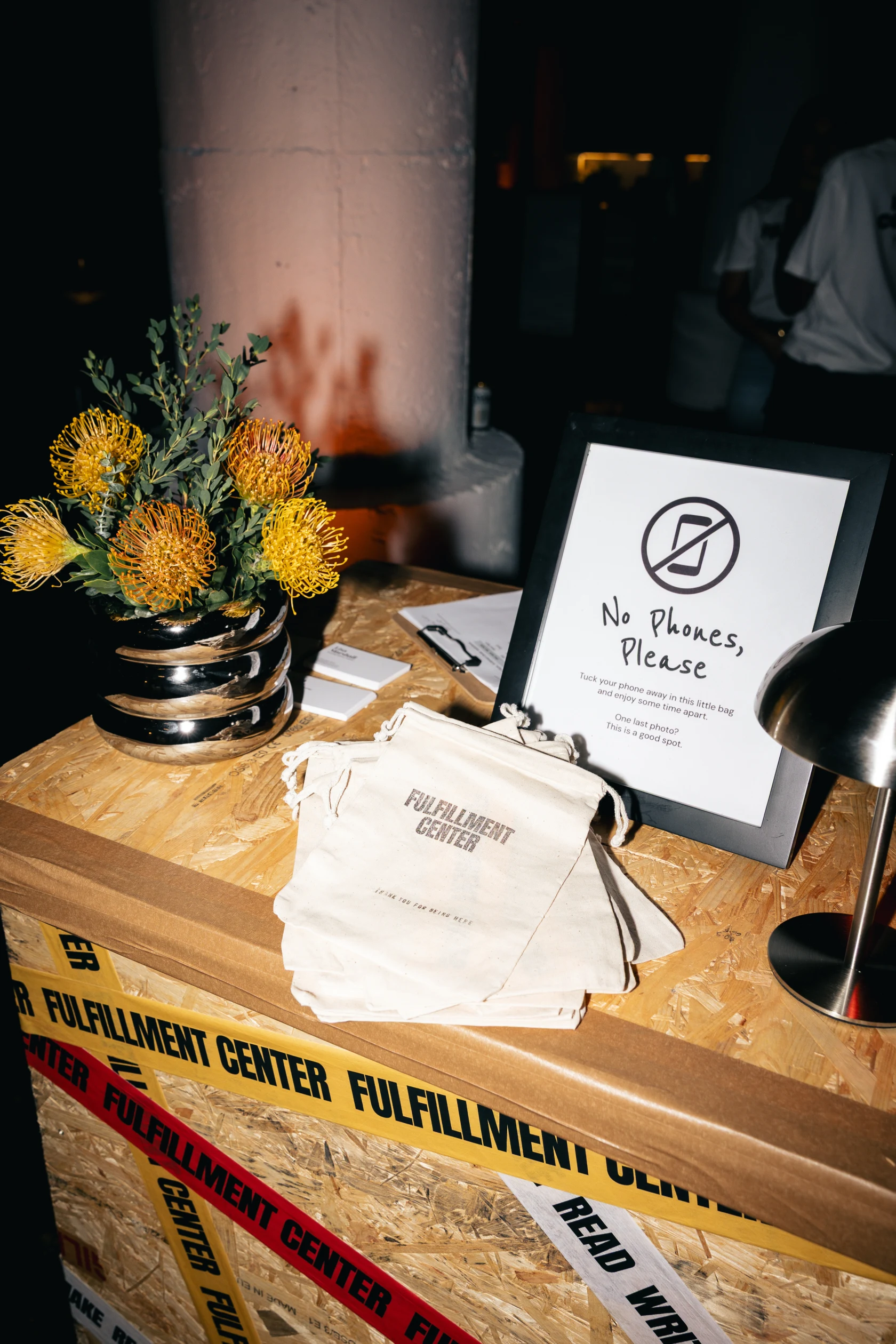
The Fulfillment Center organizers give attendees small cloth pouches to place their phones inside of for the duration of their “unplugged” events.

One day in the early 2000s, I was astonished to see a well-dressed woman walking down the sidewalk, apparently talking to herself. It took a moment to understand she was on the phone.

Before I knew it, there were numerous people on the commuter rail having long, loud, personal conversations as I tried to read a novel or sleep.

We’re not talking about that long ago. It was a time that many of us started to hate phones. Nowadays in Chicago, creatives are deciding to do something about the way phones have taken over.

Ambar Colón writes at WBEZ Chicago, “During the first weekend of May, dozens of people filed into a River North coworking space for what was billed as a hands-on, phone-free experience.

“After slipping their devices into small cloth pouches stamped with the words ‘Fulfillment Center,’ visitors made their way over to a pair of industrial shelves stacked with activity boxes labeled ‘make,’ ‘play,’ ‘read’ and ‘write.’ Inside the boxes, they found crafts, readable materials and games — plenty of things to do instead of scrolling endlessly on their mobile phones.

“Meanwhile, up in Edgewater, theater leaders from [producingbody] are introducing audiences to magnetically locking Yondr pouches, starting [in May] with the Chicago premiere of Spaceman. …

“If you want a deep dive into Chicago arts and culture, check your phone at the door: The ‘unplugged’ trend is growing locally among arts groups responding to a collective desire for more phone-free experiences. …

“For some Chicago cafes and lounges, such as Kibbitznest Books, Brews & Blarney and Verzênay in Lincoln Park, the unplugged trend is nothing new. These cafes are intentionally Wi-Fi-free, opting for board games and books instead of a sea of silent and disconnected remote workers.

“Major musicians such as Phoebe Bridgers and David Byrne have enforced no-phone zones at their events, too, using similar phone pouches, or in the case of Byrne’s ‘Theater of the Mind‘ theater installation in River North, requesting fans place their devices in lockers.

“The idea for the phone-free Fulfillment Center — a pop-up for people of all ages — started with a simple question, event creator and Little Council marketing co-founder Jessa Fuller said: ‘What if we took up a little bit of space in our communities with a center that was geared toward personal fulfillment?’ …

“After guests picked one of the four boxes [at the center], they took the box over to a table dubbed the ‘line’ and unpacked it. Inside, the materials and packing slip described the activity: ‘play’ boxes included classic games like Uno and Jenga, while ‘make’ boxes contained magazines and other supplies for collage-making.

“One box contained supplies for a game of ‘exquisite corpse’ — a drawing game invented in the 1920s, where artists come together to create a character without seeing the previous contributions. …

“ ‘Read’ boxes included articles from Chicago-based publications, such as copies of The Pub (which is print-only), or the Poetry Foundation’s poetry magazine. And inside the ‘write’ boxes, attendees received bios of older adults (through the group Love For Our Elders), and were inspired to write letters to friends and family. …

“Up north at the theater, [producingbody] founders Amy Carpenter and Taylor Dalton said their aim with the phone-free push is to restore the communal intimacy of traditional theater. …

“Plenty of humans are ‘addicted’ to their phones, even if just a little bit, Carpenter said. Though reminders to silence or power off phones are ubiquitous with pre-show warmups across Chicago theaters, devices are still a problem, she added.

“ ‘It’s tough because you want to believe that people will follow instructions, and then we just see time and time again that they don’t,’ Carpenter said.

Spaceman, written by Brooklyn-based playwright Leegrid Stevens, is a solo show about an astronaut who’s traveling to Mars with the sole task of laying the roots for a Martian colony. All that alone time gives the astronaut plenty of time to sit with her own thoughts and fears about life on Earth and what might await her when she arrives on the red planet. Carpenter and Dalton want the phone-free experience to mirror the protagonist’s isolation.

Upon check-in, guests will receive a Yondr pouch and sit, without the comfort of doom-scrolling, for at least 15 minutes before the show starts.

“ ‘That will inevitably give the audience a taste of our protagonist’s experience,’ they said.

“Still, phone-free rules can be risky for businesses, especially when social media is the top source for information and news about cultural events. …

“ ‘It is a risk. But I think the hope here is to ultimately make it worth it for [audiences],’ Dalton said. ‘We wanna make the experience so special inside the theater that they forget that they don’t have access to their phones.’ ”

More at WBEZ, here.

Read Full Post »