Feeds:
Posts
Comments

Posts Tagged ‘new york’

Art: https://commons.wikimedia.org/.

Recently, I started following historian Heather Cox Richardson online and learning obscure facts I’d never covered in history class. For Labor Day, Richardson pointed readers to a government website describing the first Labor Day and the parade in New York. The police would have started the march without music (gasp!) if the ferry from New Jersey hadn’t docked in the nick of time and unloaded the Jewelers Union of Newark Two and their band.

From the Department of Labor website: “On the morning of September 5, 1882, a crowd of spectators filled the sidewalks of lower Manhattan near city hall and along Broadway. They had come early, well before the Labor Day parade marchers, to claim the best vantage points from which to view the first Labor Day parade. A newspaper account of the day described ‘…men on horseback, men wearing regalia, men with society aprons, and men with flags, musical instruments, badges, and all the other paraphernalia of a procession.’

“The police, wary that a riot would break out, were out in force that morning as well. By 9 a.m., columns of police and club-wielding officers on horseback surrounded city hall. By 10 a.m., the Grand Marshall of the parade, William McCabe, his aides and their police escort were all in place for the start of the parade. There was only one problem: none of the men had moved. The few marchers that had shown up had no music.

“According to McCabe, the spectators began to suggest that he give up the idea of parading, but he was determined to start on time with the few marchers that had shown up. Suddenly, Mathew Maguire of the Central Labor Union of New York (and probably the father of Labor Day) ran across the lawn and told McCabe that two hundred marchers from the Jewelers Union of Newark Two had just crossed the ferry — and they had a band!

“Just after 10 a.m., the marching jewelers turned onto lower Broadway — they were playing ‘When I First Put This Uniform On,’ from Patience, an opera by Gilbert and Sullivan. The police escort then took its place in the street. … Eventually, there were 700 men in line in the first of three divisions of Labor Day marchers. Final reports of the total number of marchers ranged from 10,000 to 20,000 men and women.

“With all of the pieces in place, the parade marched through lower Manhattan. The New York Tribune reported that: ‘The windows and roofs and even the lamp posts and awning frames were occupied by persons anxious to get a good view of the first parade in New York of workingmen of all trades united in one organization.’

“At noon, the marchers arrived at Reservoir Park, the termination point of the parade. While some returned to work, most continued on to the post-parade party at Wendel’s Elm Park at 92nd Street and Ninth Avenue; even some unions that had not participated in the parade showed up to join in the post-parade festivities that included speeches, a picnic, an abundance of cigars, and ‘Lager beer kegs… mounted in every conceivable place.’ “

Writing in her Substack column, Richardson notes that the goal of establishing the federal holiday was “to emphasize the importance of workers in the industrializing economy and to warn politicians that they could not be ignored. Less than 20 years before, northern men had fought a war to defend a society based on free labor and had, they thought, put in place a government that would support the ability of all hardworking men to rise to prosperity.

“By 1882, though, factories and the fortunes they created had swung the government toward men of capital, and workingmen worried they would lose their rights if they didn’t work together. … Even the staunchly Republican Chicago Tribune complained about the links between business and government: ‘Behind every one of half of the portly and well-dressed members of the Senate can be seen the outlines of some corporation interested in getting or preventing legislation,’ it wrote. The Senate, Harper’s Weekly noted, was ‘a club of rich men.’

“The workers marching in New York City carried banners saying: ‘Labor Built This Republic and Labor Shall Rule it,’ ‘Labor Creates All Wealth,’ ‘No Land Monopoly,’ ‘No Money Monopoly,’ ‘Labor Pays All Taxes,’ ‘The Laborer Must Receive and Enjoy the Full Fruit of His Labor,’ ‘Eight Hours for a Legal Day’s Work,’ and ‘The True Remedy is Organization and the Ballot.’

“The New York Times denied that workers were any special class in the United States, saying that ‘[e]very one who works with his brain, who applies accumulated capital to industry, who directs or facilitates the operations of industry and the exchange of its products, is just as truly a laboring man as he who toils with his hands…and each contributes to the creation of wealth and the payment of taxes and is entitled to a share in the fruits of labor in proportion to the value of his service in the production of net results.’

“In other words, the growing inequality in the country was a function of the greater value of bosses than their workers, and the government could not possibly adjust that equation. The New York Daily Tribune scolded the workers for holding a political — even a ‘demagogical — event. ‘It is one thing to organize a large force of…workingmen…when they are led to believe that the demonstration is purely non-partisan; but quite another thing to lead them into a political organization.’ “

More at the Department on Labor, here. For Heather Cox Richardson’s posts, you need to sign up, here. There’s no charge, but if you eschew politics combined with history, best not go there.

Read Full Post »

Photo: Shane O’Neill/Washington Post.
Organizers pasted Summer of Ludd posters over different advertisements in a Brooklyn subway station, seen in June 2026.

What kinds of activities could lure you to experience a phone-free day? Is there enough rebellion out there to make a phone-free movement survive?

In June, Ethan Beck wrote at the Washington Post about a new kind of Luddite who is offering lots of alternatives to constant scrolling — alternatives characterized by interacting with other humans.

“Dan Fox hasn’t run for office before,” says Beck. “But that hasn’t stopped the strapping 38-year-old comedian from setting his sights on the presidency. Just don’t ask about his campaign.

“ ‘All I want to say right now is that my platform is that I have no platforms,’ said Fox. …

“On June 30, he’ll announce his candidacy in Washington Square Park. But Fox’s bid has been gestating for years. In 2015, he attended a Tame Impala concert, where he saw a sea of devices in the air, and left Radio City Music Hall ready to proselytize about how smartphones are ruining our lives. This crusade has taken many forms: Fox works for Light, a company that sells phones without internet access, and hosts a weekly, phone-free gathering in his Fort Greene brownstone.

“All of which brings us to the presidential run. Fox’s kickoff event comes three days into the Summer of Ludd, a festival designed to yank individuals off of their phones and into the real world. This fête builds off a burgeoning Luddite renaissance in New York, the result of an amorphous community of phone-free event organizers, self-described ‘attention activists,’ aligned nonprofits and a few not-smart phone companies.

“You’ll notice that Summer of Ludd isn’t anywhere online. … But organizers have other ways of reaching potential future Luddites. More than 15,000 guidebooks to the week’s phone-free events have been printed and scattered across trendy bookstores and cafes in the city. Wheat-pasted monochrome posters, with the festival’s ethos of ‘Free! Public! Participatory!’ and a festival hotline, can be found plastered over subway ads. …

“But the festival’s home base is Tompkins Square Park in the East Village, where, starting on June 28, daily meditations, jam sessions and puppet shows will take place. …

“Summer of Ludd organizers describe the goal of the event as twofold: help people understand how platforms are profiting off their helpless users, and remind them of a better, more meaningful world off social media. It’s the result of years of tech-skeptical organizing, according to various people involved with the festival. …

“Not all of the organizers consider themselves Luddites. But many were inspired by Logan Lane’s Luddite Club, which she started in 2021 while at Brooklyn’s Edward R. Murrow High School.

The club’s name came from Ned Ludd, a figure from English folklore who inspired 19th-century workers in their fight against industrialization. …

“Amanda Hanna-McLeer, who taught film, media and graphic design at Murrow, felt relieved that her students were concerned about phone addiction. Drawing from her experience working on shows including Broad City and The Americans, she shot a documentary about Lane’s Luddite Club and the wider neo-Luddite world in New York. Now, she’s hard at work on Luddite Recreations, a play she’s staging three times during Summer of Ludd, which tells the story of the textile-mill Luddites — only the factory owners look suspiciously like present-day technology CEOs.

“If the word luddite conjures images of anguished farmers and phone-smashing absolutists, Hanna-McLeer emphasizes that this movement isn’t about being anti-progress.

“ ‘You don’t have to have a flip phone and no social media to join us,’ said Hanna-McLeer, 33, while on break from building props. ‘You just have to be willing to examine your life in tandem with technology.’ “

Look at it this way: Who should be in charge of what you think about?

Lots more at the Post, here.

Read Full Post »

Photo: Kirbie Cravings.
This is one of many ways people make cake in a cup.
The article mentions using nonpareils on top, but some bakers use sprinkles, as here.

Because my older granddaughter likes to make a “mug cake” when there’s nothing sweet in the house for dessert, I was fascinated to read about Alex Posner, a woman who started a mug cake craze when she was only a teen.

Gabriella Gershenson writes at the New York Times, “The line starts as early as 6 a.m. and goes around the block. People wait for hours in the rain. Some of them cry when it doesn’t work out. Online, millions tune in to videos for the pretty colors and distinct sounds.

“The frenzy is all for a few spoonfuls of dessert in a cup known as the dotcake, a simple confection topped with frosting and nonpareil sprinkles exported from Long Island to Butterfield Market locations in New York. It tastes a lot like cake from a mix.

“ ‘People say it’s just cake and sprinkles, because it is just cake and sprinkles,’ said Alex Posner, 27, an owner of the Dotcakes, a bakery in Roslyn, N.Y., who created the baked good and sells it to Butterfield.

“Simple as they are, over the last month, dotcakes have exploded into a social media phenomenon. … Already, there are endless interpretations — dotcake ice cream, doughnuts, bagels and even manicures. …

‌”Those who manage to acquire one are often eager to recreate what has become a dotcake cliché: running a spoon over the hard, sprinkle-paved surface, oohing at the sound, then digging into the individually-portioned desserts, which come in vanilla, chocolate, red velvet, vanilla chocolate chip, and funfetti flavors.

“They seem tailor made for the TikTok era, with their tidy circle of colorful packed sprinkles, and the teeth-cracking crunch that serves as a kind of A.S.M.R [Autonomous Sensory Meridian Response]. There’s the nostalgic familiarity of a classic frosted cake, and if you’d rather not wait in line, it’s easy enough to make at home. …

“ ‘It’s a multisensory experience,’ said Alexa Matthews, a food influencer and the director of marketing at Butterfield Market, the only retailer in the city that sells the Dotcakes’s products. She added, ‘That’s what’s taking it to the next level.’

“Butterfield Market, an upscale grocer, often sells foods that are trendy or become internet sensations. … The store has given cake samples to some content creators, which may have pushed the popularity of dotcake over the edge.

“Are they worth the hype? ‘Everyone online just said it tastes like Betty Crocker,’ the influencer Lucie Rauschnabel said in a recent video, where she recreated a version at home.

“ ‘There’s a little bit of an eye-roll element to the fact that this cake went viral,’ said Carmel Hagen, the founder of the baking ingredient company Supernatural. …

“The most polarizing aspect of the dotcake may be the type of sprinkle that has catapulted to fame alongside it. It’s not the soft sprinkle or jimmy that has graced many an ice cream cone or funfetti cake. It’s the nonpareil — the hard, round bauble that was previously a wallflower of the baking aisle. …

“Posner sells around 3,000 ‘dotcups’ a week, plus 50 to 70 custom orders each day. … When she started Dotcakes in 2017 as a high school student working out of her parents home, ‘the point wasn’t the cake, it was the decoration,’ she said, citing pointillism and its totemic artist, Georges Seurat, as inspiration. ‘And now the point is the cake.’ ”

FYI: Coco doesn’t use a cake mix.

Coco’s Chocolate Chip Mug Cake
(Sometimes she calls it a Mug Cookie)

1 tbsp salted butter, melted
Add 1 tbsp brown sugar & 1 tbsp white sugar.
Mix.
Add 1 egg yolk and & 1 tsp vanilla.
Mix
Add 2 tbsp flour.
Mix well.
Mix in as many chocolate chips as you like.
Microwave for 45-60 seconds.

More at the Times, here.

Read Full Post »

Photo: Rhea Nayyar/Hyperallergic.
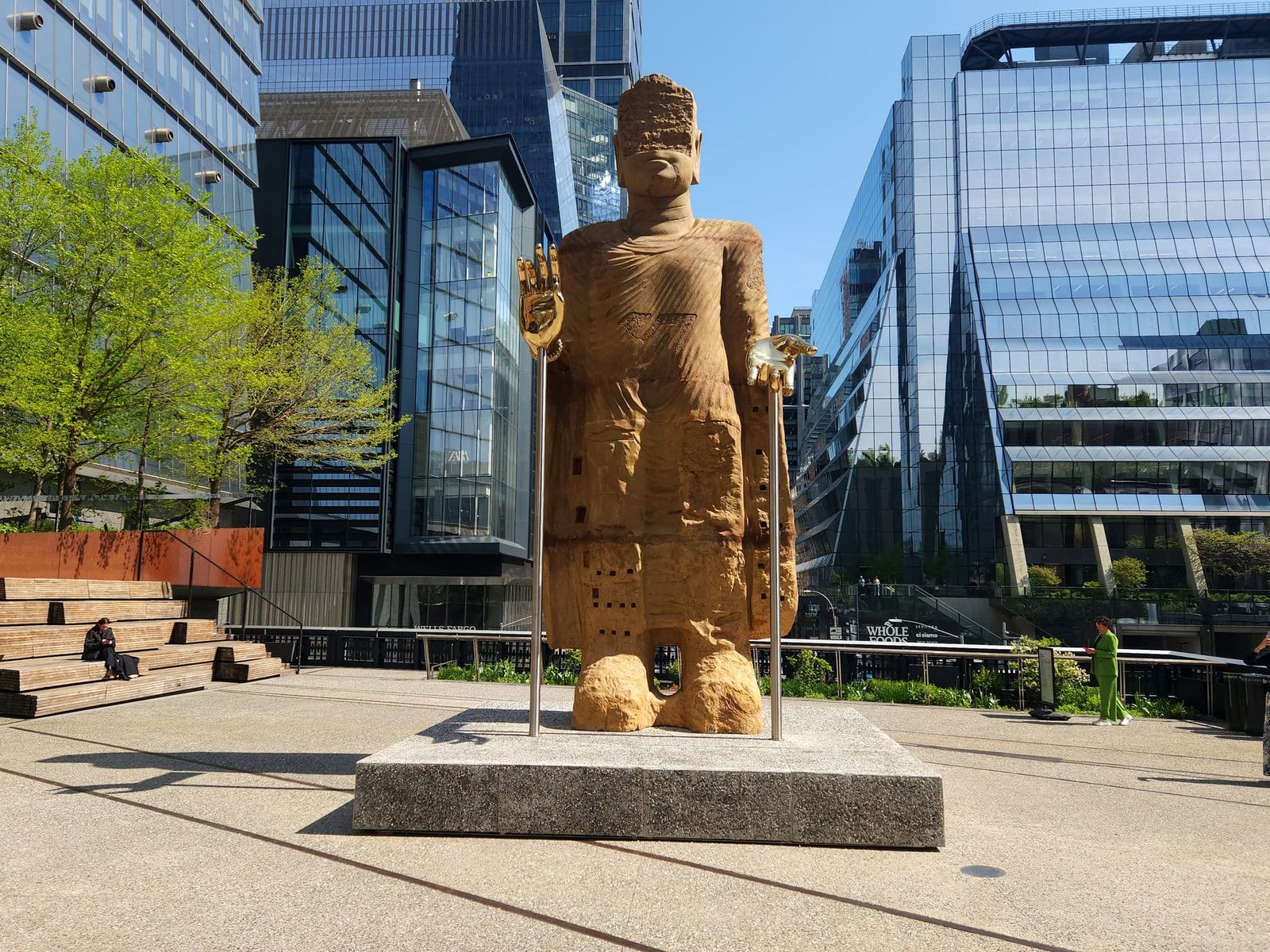
Frontal view of Tuan Andrew Nguyen’s High Line commission “The Light That Shines Through the Universe” (2026) in New York City.

It’s always a tragedy when warfare destroys art. I remember how I felt for Buddhists when the Taliban destroyed the famous Bamiyan Buddhas in 2001 in Afghanistan.

Now, an exhibit honoring those statues has appeared on New York City’s beautiful elevated park, the High Line. Rhea Nayyar at Hyperallergic describes seeing it and what it signifies to her.

“Between the sea of sky-blue high-rise windows and the traffic funneling toward the Lincoln Tunnel, a large sandstone Buddha stands tall on the High Line, inviting Manhattan to embrace a moment of tranquility.

“Tuan Andrew Nguyen’s ‘The Light That Shines Through the Universe‘ (2026), the park’s fifth site-specific commission, was selected from nearly 60 proposals. It was recently installed at West 30th Street and 10th Avenue, and is on view through Spring 2027. The 27-foot-tall sculpture stands out from its contemporary surroundings not only because of its warmth and timeworn quality, but because it resurrects a critical piece of destroyed cultural heritage — the Bamiyan Buddhas.

 “ ‘This sculpture creates a friction with the surroundings here in New York. It’s not sleek like everything else you can see here,’ High Line’s art director and chief curator Cecilia Alemani said to Hyperallergic. ‘It offers a hint to the public that temporality is not necessarily a straight line, that things can come back.’ …

“The Bamiyan Buddhas, enormous reliefs that dated back to around the 6th century, were hewn into a sandstone cliffside of the Bamiyan Valley in Afghanistan, a region along the Silk Road trade route that became a prominent Buddhist site. Of the two figures, the larger Buddha was affectionately referred to as ‘Salsal,’ which translates to ‘the light that shines through the universe.’ …

“Nguyen, who has recast or reinterpreted artillery associated with the Vietnam War throughout his practice, took the same approach to make the sculpture’s hands, which are disconnected from the sandstone body. He told Hyperallergic that he was able to source artillery brass from Afghanistan through a friend’s network across the Bamiyan region and bring it over the Pakistani border. There, he recast them into the shapes of mudras — symbolic hand gestures used extensively in Buddhist and Hindu iconography — before transporting them to Vietnam, where the sandstone was sourced and carved.

“Glinting from the sun overhead, the right hand invokes the Abhaya mudra, which signifies fearlessness, while the left hand connotes compassion and sincerity through the Varada mudra.

“Nguyen stated that his statue was not a replica of the lost cultural heritage, but rather an “echo.”

“ ‘ You keep a story, idea, or memory alive by retelling,’ he explained. ‘When I engage in this process of remaking, it’s like retelling the story. It gets translated through my hands and eyes.’

“Though it feels particularly timely because of the ever-evolving United States- and Israel-led violence in Iran, Alemani noted that Nguyen’s proposal had been selected a long time ago. ‘It’s a testimony to the strength of the artist’s voice that sometimes, the works we select become even more relevant when we install them,’ Alemani said.”

More at Hyperallergic, here.

Do you agree with the writer that the sculpture is telling us that history repeats itself? Do you have other reactions? I feel it’s also about humanity refusing to let good things be destroyed entirely.

Read Full Post »

Photo: Starr Whitehouse Landscape Architects and Planners.
Architects have submitted two designs for a park on a section of New York’s Park Avenue. This is the scheme with a bike lane.

Back in the day, when I was going to high school and living during the week with my mother’s sister, Park Avenue was not much of a park. I remember daffodils in spring, but they were surrounded by an iron fence.

Today I learn that there are plans to make big changes. At Markets Today (via MSN), Christopher Bonanos shares his opinions about a proposed park project.

Two summers ago, the city announced that it was taking a good hard look at (as every politician seemed to phrase it) ‘putting the park back in Park Avenue.’ … A century ago, the median down the middle of Park Avenue was much more welcoming than it is today, a place with seating and substantial plantings where you’d consider spending time.

“Starting in the 1920s, the city added a traffic lane on each side by paring the median down to a narrow strip, creating a pleasant but not useful viewing garden. In 2024, the city announced a call for proposals wherein those two lanes would be reclaimed from traffic for leisure and greenery. It was a once-in-a-century opportunity, because the aged Metro-North tunnel running under the avenue is being reconstructed, allowing its roof above to be rethought. …

“The rebuilt mall, the announcement said, would extend from 46th Street, where it emerges from the pass-throughs at the Helmsley Building, up to 57th Street. Each half of Park Avenue would go from four lanes to three. [Recently] we got a first look at plans produced by the firm Starr Whitehouse, and here they are. …

“The biggest difference between the two design schemes is a protected bike lane that snakes its way up the western side of the median, present in one rendering and absent from the other. The proposed park is, unlike its 1910s forebear, not symmetrical or uniform in shape. Carve-outs for left-turn lanes alter its form on every other block. … Bollards at the ends of each section will permanently keep errant (or malicious) drivers out of the median.

“That said, there’s somewhat less greenery and more paving than you might expect: The center islands have no plants at the corners, for example. …

“The best aspect of all: There’s seating! God bless everyone involved for rejecting the tools of hostile architecture and incorporating built-in masonry benches. That makes sense, given that office workers’ lunchtime and smoke breaks are a major use case for this project. They do set up the prospect of clashes between camped-out people and the police (and maybe Park Avenue office tenants’ security teams, too) over those spaces, and at the risk of sounding cynical, you can bet that the cops will prevail. But perhaps those conflicts will not arise as often as you’d expect. Judging by the newish seating in the plaza a few blocks away between Grand Central Terminal and One Vanderbilt, it will not be permanently occupied by unhoused people.

“The bike lanes are, at least when seen at the macro level of these renderings, not quite refined yet. They’re going to need a lot of visual cues and signage to keep walkers, cyclists, and cars out of one another’s way. The bike path runs through the crosswalks, and disabled or slow-moving pedestrians, or those who are simply inattentive, will have to contend with riders zinging through at high speed. If the bike lane is sharply delineated with curbs, that will help a lot. …

“One question that comes up is what knock-on effects will arise from shearing off car lanes. Some of the car trips now using them will simply disappear, as they do every time the inverse of induced demand, known as ‘reduced demand,’ kicks in. … To me, looking at both proposals, the plan that’s all park seems much more workable at a day-to-day ground level. I’d offer that the bike lane might instead be set on the outside edge of Park Avenue, at the sidewalk curbs, away from the median, even if that means shaving a couple of feet off the park to make room. Or we could perhaps shift the bikers over one short block to Madison Avenue. …

“An easy guess is that, if all of this turns out to be popular and successful, similar changes will happen all the way to 96th Street. … The question then becomes whether affluent residents of Park Avenue on the Upper East Side will approve of the greenery more than they will grumble about constraints upon their cars and drivers.

“Given that this is far too businesslike a city to ever go all out and turn an avenue into a full-on park — that is, to build our own version of the Rose Kennedy Greenway — it’s going to be a real public asset.”

More at MSN, here.

Read Full Post »

Photo: Yuvraj Khanna.
Of her collaboration with kathak dancers from India, tap dancer Dormeshia said, “What really struck me was how familiar some of their footwork feels. We might be using a different part of the foot, but rhythmically we’re speaking the same language.”

Recently in New York, dance traditions from two different countries collaborated to showcase their similarities — and to have some cross-cultural fun.

Brian Seibert wrote at the New York Times in February, “Some do it with metal. Others go at it barefoot and with bells on. But these dancers can communicate across those differences, through music.

“In ‘Speak,’ American tap dancers collaborate with their counterparts in kathak, a classical Indian percussive dance form. …

“On the tap side are Michelle Dorrance, the only tap dancer to have won a MacArthur grant, and Dormeshia, widely considered the world’s greatest. Representing kathak are Rachna Nivas and Rukhmani Mehta. …

“On Feb. 21, ‘Speak’ is to have its New York premiere at 92NY as the culmination of ‘What Flows Between Us,‘ a daylong festival of Indian music and dance curated by Nivas. In line with 92NY’s ‘Women Move the World’ series, of which it is a part, all the leading artists are women. …

“ ‘Speak’ has two bands: a jazz trio and a group of classical Hindustani musicians. There are traditional solos in each idiom, but the kathak dancers also jam with the jazz players, and the tap dancers trade rhythms with the tabla drummer. …

“In one sense, ‘Speak’ is a demonstration of differences between kathak and tap. Where tap dancers have amplifying metal on the bottoms of their shoes, kathak dancers drum the floor with bare feet; they wear bells around their ankles that mark accents like a shaker but also resonate nearly continuously, almost like a high-pitched drone. Each form has distinct ways of using the feet and organizing rhythm, developed over centuries.

“The collaboration has been a learning experience that both sides have had to approach with a beginner’s mind. Dorrance described the ‘insane’ but pleasurable challenge of jumping into a kathak meter of 9 ½ beats. (Tap dancers usually work in threes and fours, maybe fives.) ‘The kathak footwork is so subtle and so fast as it moves between notes that it’s hard to see what’s happening,’ she said.

“Mehta recalled struggling to understand jazz grooves and marveling at tap technique. ‘There are so many things that Michelle and Dormeshia can do with their feet that we can’t,’ she said. …

“Teaching each other has also revealed much about their own forms. ‘It’s like a mirror,’ Nivas said. ‘Michelle and Dormeshia ask me questions about things I learned without being fully aware, and I have to investigate my form to answer.’ …

“Dorrance alluded to the tradition of improvisational exchange in tap, in which one dancer will copy or ‘steal’ a move or rhythm from another dancer, then change it. This is called ‘making it your own.’

“ ‘Some of the exchange here is stealing it back,’ Dorrance said. She can take a tap step that has been translated through the bodies and traditions of the kathak dancers and incorporate it back into hers.

“ ‘We were teaching them the Shim Sham,‘ Dorrance said, referring to a routine from the 1920s that almost all tap dancers know. She noticed that the kathak dancers were shifting their weight in a manner derived from Indian technique. ‘And I’m like, “That’s a great choice, why don’t I shift my weight that way?” ‘ …

“Improvisation is an essential part of kathak, Nivas said, though these days it is often neglected in favor of choreography. With their guru, she and Mehta ‘lived it day in and day out,’ she said. ‘But with him gone, we’re always wanting to have that nourished and fed, and Michelle and Dormeshia do that.’

“This is what flows between them. ‘Hanging around with these tap dancers feels like home,’ Nivas said. …

“The women also connected through a shared reverence for elders. ‘We all take very seriously being tradition bearers and cultural historians,’ Dorrance said. The dancers spent many hours showing each other video footage of masters in their arts, many long dead, delighting in the discovery of similarities.

“ ‘Speak’ is a continuation of a project by Nivas and Mehta’s guru, [Chitresh] Das. In the early 2000s, Das, in his 60s, met the then-young tap phenom Jason Samuels Smith while jamming near the dressing rooms at a performance at the American Dance Festival. ‘It was like love at first sight,’ Nivas said. ‘They couldn’t stop dancing together.’

“That meeting grew into a duo performance, ‘India Jazz Suites,‘ which toured North America and India many times. (It was the subject of the 2013 documentary Upaj: Improvise, produced by Mehta.)

“ ‘Both had this generosity of spirit where they brought in their own communities and worlds,’ Nivas said. Through Das, Nivas met Smith, who invited her to the Los Angeles Tap Festival, where she met Dormeshia, taught kathak and bravely leaped into the intense competitions of one-upmanship that tap dancers call cutting contests.”

More at the Times, here. The little videos really illustrate the text well.

Read Full Post »

Photo: Mimi d’Autremont for the New York Times.
Over a 40-year run, Catherine Russell has starred in all but four performances of Perfect Crime. It’s a job, and she doesn’t care what critics say about the script.

Some of you may have seen The Fantasticks when in New York City. It ran for 42 years and closed in 2002. It was well beloved and launched many stars.

Ben Kawaller writes at the (UK) Times, about another New York show that is reaching that benchmark — in spite of not being beloved at all. Kawaller focuses on the almost heroic actor who has been in Perfect Crime for the whole time.

“New York’s longest-running play may also be its most hated,” he writes. “It is the lowest-ranked out of 28 live shows listed on the site Show Score, where a third of its reviews give zero, one, or even half a star out of five. … On TripAdvisor, one user warns: ‘Don’t waste your money!’ Another pleads: ‘Kill me now!’

“And yet, since 1987, Perfect Crime has been running eight times a week. Every performance stars the same actress, Catherine Russell; in nearly four decades she has missed only four performances, and has an ‘understudy,’ per rules set by the Actors’ Equity Association, in name only.

“I first witnessed Perfect Crime as a teenager in the early 2000s. All I remember from that experience is that it starred a blond, leggy knockout. Now 69, that knockout is still knocking about in the role of Margaret Brent, an inscrutable psychiatrist who may or may not have murdered her husband.

“I’m not trying to avoid a spoiler with that phrasing: I couldn’t spoil Perfect Crime if I wanted to, as I have more or less no idea what happens over the course of this two-hour play, or why any of it happens. It’s a four-character murder mystery involving a married couple of psychiatrists trying to get away with having murdered their chef. There’s a detective on their trail making trouble, along with a patient of Margaret’s who I think gets off on simulating murder while wearing a dress. There are gunshots, and an intermission.

That is nearly all I can recall of Perfect Crime, I suppose because watching this play is what I imagine it would be like to experience the onset of dementia.

“Actions are taken for no evident reason; proclamations are made apropos of seemingly nothing. It somehow unfolds chronologically but not sequentially. …

“That’s not to say the show doesn’t have its admirers. If you can follow its plot, says one online review, you may very well find yourself ‘screaming in joy.’ Others call it ‘clever,’ ‘fun’ and ‘thought-provoking.’

“And so on it chugs, attracting a few dozen a night to the Theater Center, the no-frills performance space on West 50th Street where Russell is also the general manager. … The show is a permanent fixture at TKTS, the Theatre Development Fund’s half-price same-day ticket booth. Russell added that most of the show’s tickets are sold on TodayTix, and that on average the show sells 50–60 tickets per weeknight.

“On January 5, I attended what a sign next to the theatre entrance informed me was performance number 15,429. … Most of the people I spoke to afterwards told me that they enjoyed the play. Two of them even claimed to have understood it.

“I was not one of them, which colors my ability to appraise Russell’s performance. There is a rushed quality to the whole thing, including mundane acts like juggling multiple phone calls (Dr Brent is evidently able to place people on hold without pressing any buttons on her phone). … At the same time, Russell has a magnetic, irrepressible stage presence, impossible to look away from as she barrels through the material. I found her fascinating. …

“I met the wiry, youthful, almost-septuagenarian on the fourth floor of the Theater Center. She greeted me warmly and as we walked together into the theatre, I wondered how long I could go without betraying my honest feelings. …

“Russell rescued me: ‘If I got upset over everybody who didn’t like Perfect Crime, I’d never get out of bed.’

“It also helps that the time Russell spends as Dr Brent takes up only a sliver of her professional life. Her other jobs are teaching English at Baruch, teaching acting at NYU and running the Theater Center, which has four performance spaces. In addition to Perfect Crime, the venue houses musical ‘parodies’ of SeinfeldFriends and The Office, which Russell sub-licensed. …

“Russell graduated from Cornell University in 1977 with a degree in English and theatre. In 1980, she got a master’s in Educational Theatre from NYU, and began teaching undergraduates in 1981.

Perfect Crime found her several years thereafter, when she acted in a theatre company helmed by its writer, Warren Manzi. They initially put up the play as a 16-performance showcase, and then, with Manzi’s attorney cousin producing, launched its off-Broadway production. From there it took off, to everyone’s surprise.

“ ‘I didn’t think it would last six months,’ Russell said. ‘And it just kept going.’ ”

More at the (UK) Times, here. For a different take, read the New York Times article on Russell, here

Read Full Post »

Art: Michael Francis Reagan.
Adirondack Park covers one-fifth of New York State — larger than Yellowstone, Yosemite, and many other national parks combined. It differs from those national parks, says the Nature Conservancy, in that it combines existing towns, businesses, recreation, and wilderness.  

When I was very young, I used to visit a great aunt who had a “camp” in New York State’s beautiful Adirondacks. It’s all coming back to me as I read Ginger Strand’s article in the Nature Conservancy magazine.

She begins by describing a meeting she had with scientists at Follensby Pond.

“This place served as timberland for over a hundred years and was privately owned by different families, but it still has a primeval feel … a unique, interlinked landscape of forest, streams, wetlands and rare silver maple floodplains. In 2008, The Nature Conservancy bought this vast parcel of land from the estate of the former owner. In addition to Follensby Pond, the 14,600-acre property includes 10 miles along the Raquette River, a prime paddling waterway that makes up part of the longest inland water trail in the United States. …

“It was widely expected that TNC would sell the land to the state of New York. Instead, to the surprise of everyone, including itself, TNC concluded that the property needed a special level of management and protection, and kept it. In 2024 the Nature Conservancy sold two conservation easements to the state. The easements opened part of the parcel to recreational access and designated the rest of it as a freshwater research preserve with managed public access. …

“The 6-million-acre Adirondack Park, covering one-fifth of New York state, is the largest park in the lower 48 states. But it differs from national parks, like Yellowstone or Yosemite, and state parks, which are typically set aside for recreation or wildlife. Managed by two state agencies, the park has no gates or entry fees, and it’s peppered with small towns, farms, timberlands, businesses, and hunting camps, all nestled among forests, mountains, rivers, and lakes. All told it is one of the largest tracts of protected wilderness east of the Mississippi, and if it had a heart, it would be right about at Follensby Pond.

“Follensby Pond is not really a pond, but rather a 102-foot-deep lake slightly larger than Central Park. For the local Haudenosaunee and Abenaki, it was a hunting area, accessed via canoe routes that traversed the Raquette River, the historic ‘highway of the Adirondacks.’ … Tourists sought it out until the 1890s, when a timber company bought the land. In private hands, it became a family retreat as well as timberland. …

“In 2008, the Nature Conservancy closed on the Follensby property. Just about everyone expected the organization to sell it to New York state to become part of the Adirondack Forest Preserve. But with the economy entering a recession, the state had no funds to buy another big parcel. Under no time pressure to transfer the land, TNC began studying it. …

“To start, TNC hosted a ‘bioblitz,’ bringing 50 scientists — geologists, soil scientists, ecologists, fish experts — onto the land to survey its flora and fauna. What the science showed was that this property wasn’t just historically vaunted; it was ecologically significant. The lake in particular held a ‘functioning ecosystem that is almost as intact as they come,’ says Michelle Brown [Michelle Brown, a senior conservation scientist for TNC in New York]. …

“This lake harbors a population of freshwater lake trout. And not just any lake trout — ‘old-growth’ lake trout, according to past research led by McGill University. Because of the minimal fishing at Follensby, the trout have been able to grow older than similar trout might in other lakes. …

“The trout’s length here can reach 2 to 3 feet; the record one here weighed 31 pounds. That’s a prized quarry for someone who has been obsessed with fishing since he was four. Yet [Dirk Bryant, who directs land conservation for TNC in New York] loves the idea of keeping the pond and these fish protected.

” ‘The hardest thing for me as an angler was to learn to think differently. … But we’re thinking about our fisheries in climate change. The lake trout is our timber wolf, our apex predator.’ Now, he says, many of the lakes that used to have the trout don’t have them anymore.

“In fact, a 2024 study found that soon only 5% of the lakes in the Adirondacks will be capable of supporting native populations of trout. … Follensby Pond is one of a rare few cool enough and healthy enough to support lake trout. …

“ ‘If you have some intact waters that can support native populations, those are the places that will support adaptation to climate change, as well as providing brood stock for restocking other waters,’ Bryant says. ‘You don’t hunt wolves in Yellowstone.’ …

“Still, when the ‘brain trust’ floated the idea of protecting the pond as a freshwater preserve, it was a surprise to many. … Paddling guidebooks in particular had been anticipating that the Follensby parcel would soon be accessible. The Adirondacks team looked for ways to balance protecting the lake with not turning the area into a conservation fortress.

“ ‘There were all these different needs: public access, Indigenous access, hunting clubs with leases, the fishery, the town,’ [Peg Olsen, TNC’s Adirondacks director] says. ‘We wanted to honor and respect all the stakeholders.’

“They landed on a compromise. The conservation easements sold to New York state create two distinct areas on the Follensby property. On nearly 6,000 acres along 10 miles of the Raquette River, one easement creates new public access for hiking, paddling, camping, hunting and fishing. The other easement protects a nearly 9,000-acre section around Follensby Pond as a freshwater research preserve, guided by a public-private consortium, to collaborate on research and preserve the lake’s unique ecosystem. While making Follensby a living laboratory, it also provides for Indigenous access and managed public access aimed at education.

“Like the wider Adirondack Park, with its combination of private lands, active towns and protected wilderness areas, it, too, will be an ongoing experiment in balancing environmental preservation with human communities.”

Read more at the Nature Conservancy magazine, here.

Read Full Post »

Photo: Stefano Giovannini.
Phyllis Bogart discovered the Pacemakers, a dance group for older people, after her beautician recommended them.

They say, “You’re never too old,” but I know from experience that zumba requires a better sense of balance than I have now. Still, there are plenty of people who can not only dance after a certain age but learn new routines.

McKenzie Beard writes at the New York Post, “On the dance floor, Phyllis Bogart moves like she’s made of electricity, not metal. At 78, her pink-and-purple-streaked curls bounce as she shimmies and shakes with the energy of someone half her age, each twirl punctuated by a wide, wild grin. It’s clear that four hip replacements, a mechanical knee and a string of other surgeries haven’t slowed her down — though they did earn her a nickname.

“ ‘With all the titanium in my body, I’ve become known as the bionic babe,’ Bogart told the Post.

“The retired nurse and pharmaceutical rep is a member of the Pacemakers — a precision dance troupe that’s redefining what it means to be a senior, helping people in their 60s, 70s and even 80s stay active both mentally and physically. …

Founded in 2019, the NYC-based Pacemakers sprang to life after founder Susan Avery faced ageist backlash as the oldest dancer for the Brooklyn Cyclones from strangers online. …

“ ‘That is how I learned what it was like to be cyberbullied,’ said Avery, 65, recalling the 2017 incident. … But instead of letting it defeat her, Avery says her daughter urged her to channel the hurt into action.

“So Avery placed an ad in Playbill inviting seniors to audition for a new senior dance team. Sixteen performers answered the call.

“ ‘Our first performance was July 6, 2019,’ she said. ‘I was so nervous, but we ended up getting a standing ovation — and our dance card has been full ever since.’

“Now seven seasons in, the Pacemakers boast 47 members and have won fans around the globe with viral performances that have racked up millions of views online. The team performs for hundreds of thousands of fans each year, appearing frequently at sporting events, community centers, festivals and conferences across the Northeast. …

“While you have to be 60 to join, the group hosts workshops and ‘day discos’ open to all ages.

“Notably, only two members have professional dance training; the rest come from healthcare, education, law enforcement, journalism and a variety of other fields. … But there’s one thing they all share: a fearless approach to aging. … During performances, each member wears their birth year on the back of their jersey, loud and proud. …

“As the Pacemakers embrace their senior status, members say the group helps them stay well as they get older.

“ ‘I never thought at this age that I would be involved in something so exciting, so energizing, so fun and so challenging to my body and my brain,’ Bogart said. …

Studies show that learning choreography is excellent for the brain, engaging memory, focus, coordination, timing, rhythm and movement simultaneously. Research suggests it helps slow cognitive decline and may even reduce the risk of developing dementia.

“The Pacemakers are also getting a full-body workout. Their complex routines require strength, flexibility and balance, helping members stay physically fit. … The group also creates a community, preventing social isolation and loneliness common among older Americans. …

“The group’s choreographer, Marissa Montanez, designs each routine with the dancers’ mobility and physical limits in mind.

“ ‘I want them to look good. I want them to shine. I don’t want to give them something so hard that they can’t handle it,’ said Montanez. … ‘But at the same time, I don’t want to give them a routine that makes people say, “Oh, old people, how cute …” I want people to be like, “Oh damn, they’re really good; I can’t even do that!” ‘ “

More at the Post, here.

Read Full Post »

Photo: The Guardian.
The Santa Claus Express sleeper ready to leave Helsinki station on its journey north to Rovaniemi in Finnish Lapland.

When Suzanne and John were small, we somehow acquired a large poster of Finnish Lapland that purported to show the way to Santa’s headquarters. I had always assumed Santa lived at the North Pole, but I was beginning to learn about marketers with other ideas.

Natasha Geiling and Kayla Randall have the story at the Smithsonian magazine, starting with Alaska’s claim: “It wasn’t the actual North Pole. But the fact that it was over 1,700 miles from it, smack in the heart of interior Alaska, was a minor detail.

“When Bon and Bernice Davis came to Fairbanks in early April 1944, they weren’t looking for the North Pole. As they drove their rental car out of town, they had something else on their mind: finding 160 acres on which to make their homestead, something Alaska law allowed if they used the area for trading or manufacturing purposes. … In the summer, nearby streams might attract grayling fish and waterfowl, but in the snow-covered month of April, it was hard to see that potential. The area did boast one unique quality: consistently cooler temperatures, about seven to ten degrees colder than anywhere else in interior Alaska. …

“With its proximity to both the highway and Fairbanks, the Davis’ homestead soon attracted neighbors. … By the early 1950s, the homestead had also attracted the attention of the Dahl and Gaske Development Company, which purchased the land — nearly in its entirety — in February 1952. … If they could change the homestead’s name from ‘Davis’ to ‘North Pole,’ they reasoned, toy manufacturers would flock from far and wide. …

“Things didn’t go according to plan — even with its location right on Richardson Highway, the Alaskan North Pole was too remote to sustain manufacturing and shipping. However, part of Dahl and Gaske’s vision eventually did take shape at a local trading post, which became one of several places that claimed to be Santa Claus’ home during the 20th century. Now a tourist destination, the town of North Pole in Alaska calls itself the place ‘where the spirit of Christmas lives year round’ and boasts the Santa Claus House, a holiday-themed family business.

“The real Santa Claus — the historical figure upon which the legend is based — never lived anywhere near the North Pole. Saint Nicholas of Myra was a fourth-century bishop who lived and died far from the Arctic Circle, in what is now Turkey. Born into a wealthy family, Nicholas is said to have loved giving gifts. …

“Santa’s red robes and gift-giving habits were based on Saint Nicholas, but his chilly home base is the invention of cartoonist Thomas Nast, whose famous depiction of Santa Claus in a December 1866 issue of Harper’s Weekly set the precedent for our modern image of the jolly fellow. Before Nast, Santa had no specific home, though by the 1820s, he was already associated with reindeer and, by extension, the frigid climes in which those reindeer live.

“In 1866, Nast’s cartoon ‘Santa Claus and His Works‘ featured the words ‘Santaclaussville, N.P.’ alongside Santa performing the tasks people now associate him with, from making toys to making his list (and checking it twice, of course). The ‘N.P.’ stood for North Pole, where Nast had placed his workshop and residence. …

“In 1949, [Santa’s home] took physical form for the first time, 13 miles from Lake Placid, New York. While trying to keep his daughter occupied during a long drive, Julian Reiss, a New York businessman, reportedly told her a story about a baby bear who went on a great adventure to find Santa’s workshop at the North Pole. Reiss’ daughter demanded he make good on his story and take her to the workshop. …

“He teamed up with the artist Arto Monaco — who also helped design Disneyland in California — to create a physical version of Santa’s workshop on 25 wooded acres around Lake Placid. Santa’s Workshop in North Pole, New York, with its novel depiction of Santa’s magical workplace, brought visitors by the thousands. …

“Other businesspeople found success drawing tourists with the Santa Claus legend without borrowing the Arctic landmark. America’s first theme park, now Holiday World & Splashin’ Safari in Santa Claus, Indiana, actually operated as ‘Santa Claus Land‘ until 1984. …

“[Paul Brown — who today runs Alaska’s Santa Claus House along with his wife, Carissa] acknowledged that other places that claim equal ownership to Santa’s legend. ‘From a competitive standpoint, if you want to call it that, Rovaniemi, Finland, would be our biggest competition.’

“Rovaniemi — the administrative and commercial capital of Lapland, Finland’s northernmost province — wasn’t much of a tourist destination before Santa Claus came to town. Lapland had served as a sort of nebulous home base for Santa Claus in the European tradition ever since 1927, when a Finnish radio host proclaimed to know the secret of Santa’s hometown. He said it was in Korvatunturi, a mountainous region in Laplan. … Like the North Pole of Nast’s creation, however, Korvatunturi was real in theory but not necessarily to be visited.

“Santa’s home later moved over 225 miles south to Rovaniemi, thanks to an American visitor. During World War II [Rovaniemi burned] to the ground, leaving Lapland’s capital city in ruins. From those ashes, Rovaniemi rebuilt itself according to design plans that dictated its streets spread like reindeer antlers through the city. In 1950, on a tour of postwar reconstruction, former first lady Eleanor Roosevelt paid Rovaniemi a visit, allegedly saying she wanted to see Santa Claus while in the Arctic Circle. The town hastily constructed a cabin, and Santa’s Village in Rovaniemi was born. But tourism to Rovaniemi really took off in 1984. …

“From North Pole, Alaska, and North Pole, New York, to Rovaniemi, Finland, the mythology of where Santa Claus lives creates an economy. [But] Brown, for his part, sees himself as safeguarding the legend of Santa Claus. ‘We are very protective of the magic of Christmas and allowing kids to have that for as long as they can have it,’ Brown said. ‘Just like Santa is the embodiment of joy and goodwill, we think of ourselves as one of the embodiments of the spirit of Santa.’ ”

More at the Smithsonian, here. Check out a trip on Lapland’s Santa Express at the Guardian, here.

Read Full Post »

Art: Richard Estes.
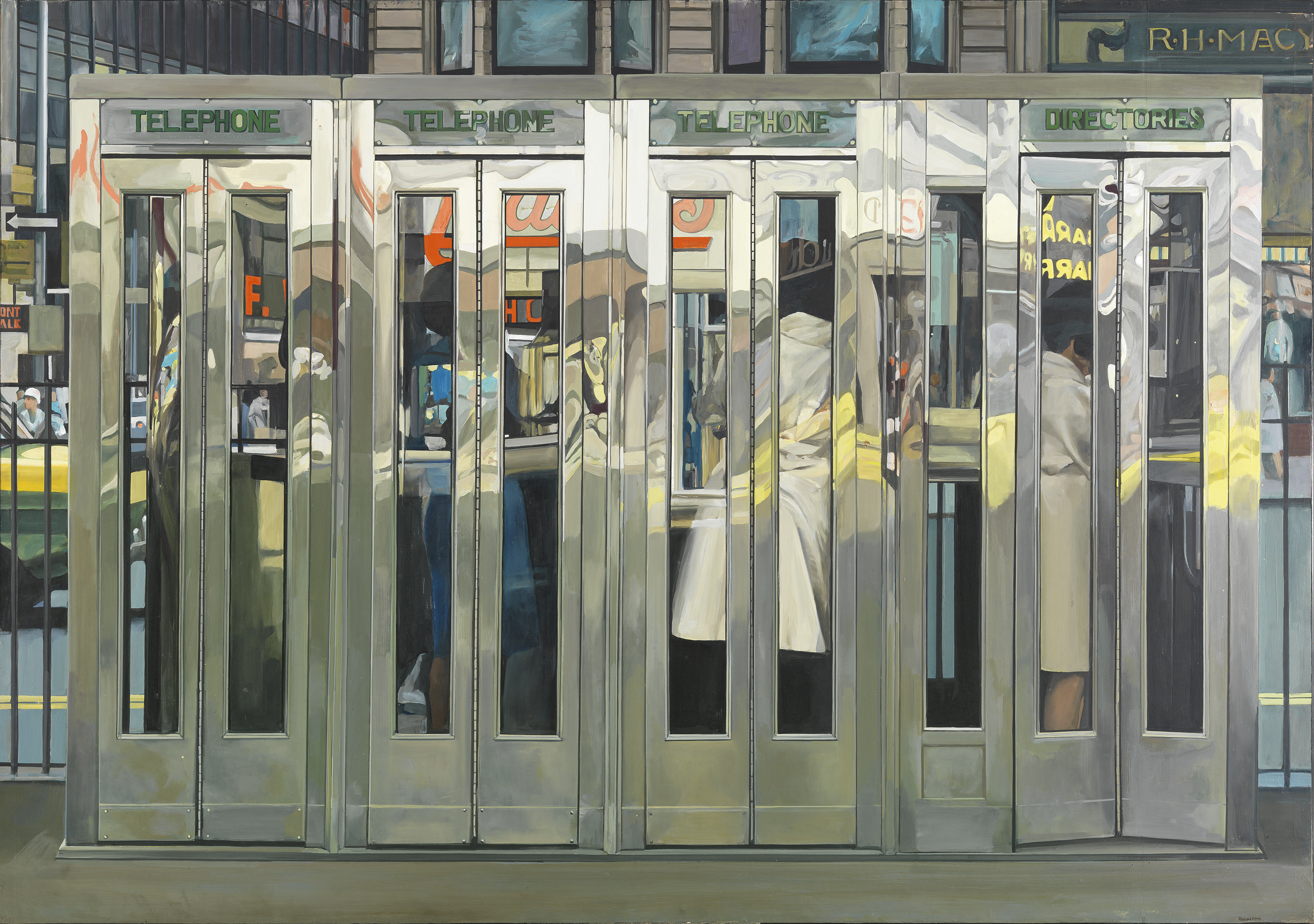
From the Museo Nacional Thyssen-Bornemisza in Madrid, a glimpse of the old days.

Some of us appreciate the old-style telephone booth, its relative privacy, and the way you could still make a call if your mobile was out of juice.

Julian Ring reports at National Public Radio (NPR) that for folks in Vermont, where mountain vistas are jealously protected and limited cell towers don’t always reach, pay phones can be important with or without booths. A local electrical engineer wanted to do something about that.

“Patrick Schlott often finds himself in a cellular dead zone during his drive to work,” writes Ring.

” ‘You go down the road, you turn the corner and you’re behind a mountain and you’ll lose cell coverage pretty fast,’ he says.

“The 31-year-old electrical engineer says poor reception is a common frustration for residents of Vermont’s Orange County. To address this issue, he’s providing his community with a new way to stay connected.

“Schlott has taken old pay phones, modified them to make free calls, and set them up in three different towns across the county. … With just an internet connection, these phones can make calls anywhere in the U.S. or Canada — no coins required. And Schlott covers all the operating costs himself.

” ‘It’s cheap enough where I’m happy just footing the bill,’ he says. ‘You know, if I’m spending $20 a month on, say, Netflix, I could do that and provide phone service for the community. And to me, that’s way more fun.’

“Since Schlott installed the first phone in March last year outside a general store in the town of Tunbridge, Vt., hundreds of calls have been made.

” ‘I knew there would be some fringe cases where it would be really helpful,’ he says. ‘But I never expected it to get daily use and for people to be this excited about it.’

“He says the phones have come in handy for drivers whose cars have broken down nearby. And at a public library in Thetford Center — the most used installation by far — kids have been able to call their parents for rides home or simply to check in.

In June, Vermont voted to ban cellphones in schools beginning in the 2026-2027 academic year. Schlott says public telephones will soon be more essential for students in the area. …

“Schlott has received some donations to help sustain his project. But he says his one-man funding model may need to adapt if the initiative continues to grow.

” ‘One of the cornerstones that I want to stick to is, no matter what happens on the backend, the calls will always be free,’ he says. ‘And I will figure out a way to make that happen.’ “

Meanwhile in New York City, reporter Rachel Treisman says that “New York City pay phones are officially a thing of history. The last public pay phone was removed from the streets of midtown Manhattan [in May], and is heading straight to an exhibit in a local museum.

“It’s the final chapter in a saga that’s been unfolding since 2015, when the city started uprooting phone booths and replacing them with LinkNYC kiosks, which offer free public Wi-Fi, charging ports, 911 buttons and screens with maps and other services (they also generate revenue for the city).”

There may be no workable pay phones in New York now, but I know that film and ad companies will always have need for a phone booth that looks like it works. There is one on the corner of my late sister’s apartment building that is frequently in demand. I believe it was used in Matrix.

The two pay phone stories are at NPR, here, and here. See also the research by “Mark Thomas, who has spent decades tracking the ‘world of public telephony’ through his website, The Payphone Project.”

Read Full Post »

Photo: Dina Litovsky.
Román Baca leads rehearsal on the deck of the Intrepid, the aircraft carrier turned museum on the Hudson River.

The wars that have been fought in my lifetime sometimes seem to have been necessary and inevitable. Most often, not. As the young people head off, I always think about how their lives will have been warped if they get back. It seems so wrong. And right now the services we’ve promised them are being slashed.

Fortunately, there are efforts at healing that forge ahead. One such program involves ballet.

Brian Seibert writes at the New York Times, “When Román Baca was serving as a Marine in Iraq in 2005, he didn’t tell many people what kind of work he had done before the war. He had tried that in boot camp, and it hadn’t gone well. So when his best friend in the platoon asked him why he seemed so interested in local dance practices, he hesitated before admitting the truth: He was a ballet dancer.

“Baca’s friend wasn’t bothered by the revelation. So Baca told him his crazy idea: to translate their wartime experiences into dance.

“Eventually, that crazy idea became Baca’s life. With his wife, Lisa Fitzgerald, he founded Exit12 Dance Company, which makes and performs works about military experience. What started as a way for Baca to deal with his trauma has expanded into a mission to help other veterans deal with theirs — through dance.

“In recent weeks, a group of veterans and family members of veterans, ranging in age and physical ability, has been gathering in the belly of the U.S.S. Intrepid, an aircraft carrier turned museum on the Hudson River. Using various improvisational exercises, they have been creating a dance work [to] perform on May 30 on the ship (on the flight deck, weather permitting). More important than that performance, though, is the process.

“Baca sees the workshops as a corrective for military training. ‘To make a person respond immediately to orders and commit acts of violence, military training changes your identity,’ he said. ‘It removes everything that defines a person’ — your clothing, your haircut — ‘and then it changes you through physical exercises, repetitive motion and powerful brain-body connections.’

“Baca, who has been leading these workshops since 2011, recalled a moment from one: Everett Cox, a Vietnam War veteran who had kept away from everything military for decades, responded to a prompt of action verbs by expertly stabbing and slashing with an invisible bayonet. His long-unused training was intact in muscle memory.

“Another time, Baca was choreographing a military exercise sequence and directed his dancers to yell ‘kill’ with every motion. When Fitzgerald questioned if that creative decision might have been a bit much, Baca explained that he was only being accurate: Coupling all actions with the word ‘kill’ was part of boot camp.

” ‘That’s absolutely needed when you are in uniform,’ he said. ‘But what do you do with that after you get home?’

“The workshops use physical exercises to help restore what Baca, borrowing a term from the philosopher Paul Ricoeur, called narrative identity. ‘You start to tell people who you are and parts of your story and then you listen to others do the same,’ he said.

“ ‘A lot of trauma survivors will say that you never fully heal,’ he added. But as evidence of how the process can work, he pointed to the experience of Cox, who returned from service in Vietnam feeling so guilty and ashamed that he did not consider himself a veteran. ‘I lost my mind in Vietnam’ is how Cox put it to me.

“For nearly 40 years, Cox, who took drugs and attempted suicide, tried to lock away what had happened. He was diagnosed as paranoid schizophrenic; one psychiatrist told him he was incurably insane. Then, in 2010, he attended a retreat for veterans at the Omega Institute, a holistic wellness center in the Hudson Valley. ‘It changed my life,’ he said. For the first time, he began to talk about his wartime experiences, and to write about them, and to cry. …

“ ‘If you’re holding a war in, it takes a lot of energy,’ he said. ‘And if you want to loosen that up, it also takes a lot of energy.’ ”

I so admire Baca, who against what seems to me like very long odds, keeps working hard to bring these damaged veterans back to life.

More at the Times, here.

Read Full Post »

Photo: Hufton+ Crow.
This affordable housing in New York was designed by the firm of famed architect Daniel Libeskind.

If you’ve spent your career catering to the wealthy, where do you go for other worlds to conquer? One architect turned to the poor.

The story is from Justin Davidson at Markets Today via MSN.

“Walk down an ordinary blah-colored stretch of Marcus Garvey Boulevard in Bedford-Stuyvesant, past the dispiriting bulk of Woodhull Hospital and the brown-brick boxes of the Sumner Houses project, and you come upon an incongruous apparition, a great white sugar cube that’s been carved, beveled, and knocked askew. Stranger still, this work of obviously ambitious architecture was executed on a spare budget for residents with meager incomes. Even more startling, the Atrium, an affordable-housing development for seniors and veterans of the shelter system, was designed by the firm of Daniel Libeskind, he … of the kind of jagged form that would defy attempts to gift-wrap it.

“With the Jewish Museum in Berlin, opened in 2001, Libeskind established himself as a pioneer of deconstructivism, a style based on the illusion that buildings were lifting off, bursting, imploding, or peeling apart. After the 9/11 attacks, when he was appointed master planner of the World Trade Center rebuilding project, he became famous as the embodiment of advanced architecture, headlining a period when a dozen or so celebrities scattered the world with signature structures. You might not know where a building was or what it was for or how it stood up, but you could quickly identify who designed it. His global brand would seem like an odd choice for the most basic tier of New York’s urban shelter. …

“Spend some time in and around the Atrium, though, and you begin to see that the pairing of high-design auteur and low-income residents meets an assortment of needs and isn’t just noblesse oblige. Erected by a cluster of nonprofits — Selfhelp Community Services, Riseboro Community Partnership, and the nonprofit developer Urban Builders Collaborative — on a patch of NYCHA [New York City Housing Authority] land, the Atrium leavens the neighborhood with 190 new apartments, a spacious community room, fresh landscaping, and a jolt of jauntiness.

“Like many public-housing projects, the original Sumner Houses, built in the late 1950s, withdraw from the street, lurking behind a perimeter of pointless lawn. The Atrium does the opposite, hugging the sidewalk, peppy and reassuring. This is an active, even restless building that greets passersby with a smooth dance move. … The whole structure makes a quarter-twist from ground to roof, and you can trace its sinews stretching diagonally across the grid of ribbon windows.

“Inside, comfortable apartments encircle the raised, skylit courtyard that gives the building its name. That arrangement is a resonant one for Libeskind, who grew up in the Amalgamated Houses in the Bronx, a complex developed in the 1920s by the garment workers union. …

” ‘It stood out,’ Libeskind told me. ‘It was populated by working-class people, but it had a sense of elegance.’ The courtyard was essential, a way for mostly Jewish immigrants to replace the tenement’s narrow, stinking air shaft with a form of genuinely gracious living. …

“Still, there’s a difference between an outdoor courtyard and an indoor atrium. Carelessly handled, the nine-story doughnut form could easily have evoked stifling precedents. … To avoid any hint of that oppressiveness, Libeskind laced the floor with diagonal walkways between raised planters and sculpted the inner façade almost like a climbing gym, with protrusions, ledges and trapezoidal windows placed in an apparently random arrangement. The goal was to make the court a destination rather than a vestibule. Since it’s one floor up from the lobby, going there requires an affirmative decision. …

“The success of a low-income housing complex depends on its social warmth. Selfhelp maintains a small team of social workers on-site, mostly to help residents navigate the welfare bureaucracy but also just to be there if they want to chat. …

“The residents I spoke to enjoy the Atrium, not because of its architectural pedigree but because it is clean and safe and orderly and bright, a rare haven for New Yorkers whose lives have often been turbulent. Still, loneliness is a tough enemy. …

“Designing a building and running it are different arts, but doing each one well fortifies the other. With the Atrium, Libeskind has given vulnerable people a place they can gradually make their own. He has also demonstrated that the daunting list of rules, requirements, prohibitions, and economic strictures that govern affordable housing in New York don’t have to choke off inventive architecture. …

“Ahmed Tigani, a deputy commissioner at the city’s Department of Housing Preservation and Development, insists that the Atrium shouldn’t be a one-off showcase of precious design. Recruiting architects like Libeskind makes it clear that low-income housing is an integral part of the cityscape. City housing staffers should wrestle with loftier questions than those described by the number of units built, Tigani says. ‘What is the physical impact of our investment, but also the social and spiritual impact? What does a building visually contribute? Does it feel like a part of your neighborhood? Does it feel like a statement of belief in what that housing can be?’ ”

More at MSN, here.

Read Full Post »

Photo: Jackie Molloy for KFF Health News.
Hilda Jaffe, 102, in her apartment in New York. Jaffe enjoys doing puzzles, reading, volunteering, and attending cultural events.

I have always thought that a city like New York, with many kinds of public transportation and easy walking to whatever you need, is the best kind of place to grow old. The problem for most of us is that we may still need a car to do the simplest things long after we can’t drive.

Here’s a story about a thriving 102-year-old doing her errands without assistance in New York. I’m convinced that part of her good fortune is not having to drive.

Judith Graham writes at the Washington Post, ” ‘The future is here,’ the email announced. Hilda Jaffe, then 88, was letting her children know that she planned to sell the family home in Verona, New Jersey. She’d decided to begin life anew on her own in a one-bedroom apartment in Hell’s Kitchen in Manhattan.

“Fourteen years later, Jaffe, now 102, still lives alone — just a few blocks from the frenetic lights and crowds that course through Times Square.

“She’s the rarest of seniors: a centenarian who is as sharp as a tack, who carries grocery bags in each hand when she walks back from her local market, and who takes city buses to see her physicians or attend a matinee at the Metropolitan Opera.

“Jaffe is an extraordinary example of an older adult living by herself and thriving. She cleans her own house, does her own laundry, manages her own finances, and stays in touch with a far-flung network of family and friends via email, WhatsApp and Zoom. Her 78-year-old son lives in San Jose. Her 75-year-old daughter lives in Tel Aviv.

“I’ve spoken with dozens of seniors this past year for a series of columns on older Americans living alone. Many struggle with health issues. Many are isolated and vulnerable. But a noteworthy slice of this growing group of seniors maintains a high degree of well-being. …

“Sofiya Milman is the director of human longevity studies at the Institute for Aging Research at Albert Einstein College of Medicine. She studies people known as ‘superagers’ age 95 and older. ‘As a group, they have a very positive outlook on life’ and are notably resilient, like Jaffe, she told me.

“Qualities associated with resilience in older adults include optimism, hopefulness, an ability to adapt to changing circumstances, meaningful relationships, community connections and physical activity, according to a growing body of research on this topic.

“Jaffe has those qualities in spades, along with a ‘can-do’ attitude. ‘I never expected to be 102. I’m as surprised as everybody else that I am here.’ …

“She credits her genetic heritage, luck and her commitment to ‘keep moving,’ in that order. … Asked to describe herself, she quickly responded with ‘pragmatic.’ That means having a clear-eyed view of what she can and can’t do and making adjustments as necessary.

“Living alone suits her, she added, because she likes being independent and doing things her way. ‘If a problem comes up, I work it out,’ Jaffe said. …

“There are only some 101,000 centenarians in the United States, according to the most recent Census Bureau data. Of this small group, 15 percent live independently or conduct their lives independently while living with someone, according to Thomas Perls, the founder and director of the New England Centenarian Study, the largest study of centenarians in the world. …

“About 20 percent of centenarians are, like Jaffe, free of physical or cognitive impairments, Perls said. An additional 15 percent have no age-related illnesses, such as arthritis or heart disease. …

“Every day, Jaffe tries to walk 3,000 steps — outside if the weather is good, or inside, making laps in her hallway, if the weather is bad. Her diet is simple: bread, cheese and decaffeinated coffee for breakfast; a sandwich or eggs for lunch; often chicken and a vegetable or restaurant leftovers for dinner. She never smoked, doesn’t drink alcohol and sleeps an average of eight hours each night.

“Even more important, Jaffe remains engaged with other people. She has subscriptions to the Metropolitan Opera, the New York Philharmonic and a chamber music series. She participates in online events and regularly sees new exhibits at four of New York’s premier museums, where she has memberships. She’s in regular contact with family members and friends.

“Jaffe also belongs to a book club at her synagogue on Manhattan’s Upper West Side and serves on the synagogue’s adult education committee. For more than a decade, she has volunteered several times a week as a docent at the New York Public Library’s main branch on Fifth Avenue. …

“When I asked about the future, Jaffe said she doesn’t worry about what comes next. She just lives day to day.

“That change in perspective is common in later life. ‘Focusing on the present and experiencing the here and now becomes more important to older adults,’ said Laura Carstensen, founding director of the Stanford Center on Longevity, who has studied emotional changes that accompany aging for decades. …

“Jaffe certainly understands the value of facing forward and letting go of the past. Losing her husband, Gerald Jaffe, in 2005 after 63 years of marriage was hard, she admitted, but relinquishing her life and most of her belongings in New Jersey five years later was easy. …

“ ‘It was so exciting for me, being in New York,’ she continued. ‘Every day you could do something — or nothing. … In a house in New Jersey, I would be isolated. Here, I look out the window and I see people.’ ”

More at the Post, here.

Read Full Post »

Photo: Rentbrella.
An umbrella-sharing startup from Brazil.

I used to live in New York City, and one of the many characteristically New York phenomena I observed back then was what would happened in a rainstorm.

All of a sudden, from nowhere, sellers of umbrellas would appear. The umbrellas sold quickly, but most often they were poorly made. If there was a high wind, you would see them inside-out in a trash bin, dumped before the buyer even got home.

I can’t speak to the quality of the umbrellas in today’s story, but I’m guessing they are made of sturdier stuff — else how could they be shared repeatedly?

Aleksandra Halina Michalska and Carolina Pulice write at Reuters, “A Brazilian umbrella-sharing app, which has for several months been giving New Yorkers a way to cope with unexpected downpours, is now preparing to expand to Europe.

“Rentbrella launched in 2018 in Sao Paulo, a city known for torrential late afternoon summer rains. It offers an app that allows customers to borrow an umbrella from an automated kiosk and use it free of charge for 24 hours.

“If they don’t return the umbrella within that period, they are charged $2 for the second day under the U.S. price plan and another $2 for the third day. When the daily charges hit $16, the user can keep the umbrella.

“Freddy Marcos, one of the company’s three co-founders, said in an interview that Rentbrella aims to expand to at least 10 other countries in Europe in the next two years.

“The company launched in the New York boroughs of Manhattan and Brooklyn in October with 35 kiosks, each with 100 umbrellas, under agreements with real estate firms such as WeWork … Tishman Speyer … and Beacon Capital. Rentbrella plans to add 100 more stations throughout the United States this year.

” ‘The best thing about it is that it is free,’ said co-founder Ary Krivopisk, adding that Rentbrella aims to expand into London early this year.

“The company plans to generate revenue from advertisements printed on the umbrellas, although it has yet to sign any such deals in New York.

“The startup, which has so far raised $7 million from undisclosed investors, has around 40,000 umbrellas available in Sao Paulo.”

More at Reuters, here.

Read Full Post »

Older Posts »