Feeds:
Posts
Comments

Posts Tagged ‘anaerobic’

Photo: Joanna Detz/ecoRI News.
Tess Feigenbaum and Brendan Baba in the hot-composting room at their Providence facility.

At my retirement community, there’s a handful of people who are serious about composting both garden waste and food waste. We have Black Earth bins available for anyone hardy enough to trek to the garden area.

Massachusetts, meanwhile, passed a law that the kitchens of institutions our size must also compost food waste. But no one seems to be enforcing it. Here, the powers that be say it’s too complicated and expensive to reconfigure kitchen processes. Maybe they’d have to knock down a wall to build out the space.

Still, the idea of composting is catching on slowly in New England generally, and more restaurants and institutions are finding it can save a lot in trash-pickup fees.

In a story supported by 11th Hour Racing (get it — we are at the 11th hour with climate), Frank Carini of ecoRI News writes about a particularly dedicated composting couple in Rhode Island.

“Their journey, so far, has been epic, from Pawtucket to Los Angeles and back to Rhode Island. They left for the City of Angels with an idea borrowed from ecoRI News and returned with a business model to help the Ocean State get out from under all its food waste.

“Tess Feigenbaum and Brendan Baba co-founded Epic Renewal soon after landing in Los Angeles in late August 2016. They left three years later, but not before keeping some 23,000 pounds (11.5 tons) of L.A. food scrap from being landfilled or incinerated.

“Their for-profit operation, now run out of a 3,000-square-foot space on Acorn Street [Providence], provides low-cost composting services for events, businesses, and homes. Epic Renewal also offers zero-waste consulting services, products such as vermicompost and red wiggler worms, and software that helps other composting businesses track the amount of organic matter they are keeping out of the waste stream.

“ ‘Our big focus area is zero-waste events,’ Feigenbaum said. ‘We do a little bit of commercial and residential, but we very intentionally lean out of residential because of the density there … we’re not interested in competing with all of our friends. The events are really our fun place. They also let us reach a ton of people who otherwise might not really care about it.’

“Feigenbaum and Baba are part of an unofficial composting collaborative that Michael Merner, founder of Earth Care Farm in Charlestown and godfather of Rhode Island composting, unknowingly started in the mid-1980s. For years, Earth Care Farm went at it alone.

“Now, four decades later, about a dozen composting operations, including Epic Renewal, are helping Earth Care Farm take a bite out of the amount of food scrap being unnecessarily wasted.

“ ‘We had three generations of Merners at the last compost fund bill hearing,’ Feigenbaum said. ‘It was awesome.’

“The bill (H5195) would create a compost fund that would award composting and waste-diversion grants to help reduce the amount of material being sent to the getting-crowded Central Landfill in Johnston. …

“Baba said, ‘We need every single solution at the table, but what we really firmly believe in is hyper local, many sites that are smaller, especially knowing we have the most expensive farmland in the country, and we want those to be farms. It’s pretty critical when we’re thinking about urban spaces and creating a resilient network that we create more sites, not just one or two big ones.’ …

“In November 2024, they experienced a life- and career-changing event: they moved their composting operation from a Central Falls basement — Feigenbaum called the space ‘depressing’ — to a roomy, industrial space in Providence’s Valley neighborhood. Epic Renewal was born in an extra bedroom in the couple’s Los Angeles apartment.

“Their newish Acorn Street workspace includes room to store the operation’s 300 or so containers of various sizes, hot-composting boxes made of wood, and parking for their biodiesel-powered truck, a van, and two trailers. …

“Baba, with help from LA Compost founder Michael Martinez, replicated something similar to ecoRI Earth. By the time the duo left Los Angeles, Epic Renewal had 200 residential and 16 commercial customers. …

“When the couple isn’t collecting food scrap and other organic material and making compost with it, Feigenbaum works part-time at the Social Enterprise Greenhouse in Davol Square and Baba works full-time as a financial technology consultant. He wrote the material-tracking software Epic Renewal is sharing with other composting business for free while he works on putting the final touches on the tech. …

“Epic Renewal diverts about three-quarters of a ton of organic matter monthly from the waste stream. Since 2022, the operation has diverted 35.6 tons. Feigenbaum and Baba work with offices, food service and retail businesses, gyms, cosmetic producers, weddings, marathons, and festivals to reduce their waste.

“All of Epic Renewal’s magic is done indoors, thanks to bokashi composting. This anaerobic process, using a culture of bacteria that thrive in an oxygen-free environment, doesn’t produce off-gassing and is ‘ideal for indoor composting.’

“Feigenbaum noted this method requires less space, offers more input options, and is better suited for an urban environment or anywhere with limited green space. There is no runoff. The little liquid that is produced is recycled back into the process, which avoids the need to add tap water. …

“ ‘The biggest thing is demystifying it for people,’ Feigenbaum said of getting folks to compost. ‘We just need to get people exposed to it.’ ”

This story is part of a series “Black Gold Rush: The Race to Reduce Food Waste and Save Soil.”

More at ecoRI News, here.
Read Full Post »

Photo: Melanie Stetson Freeman/CSM.
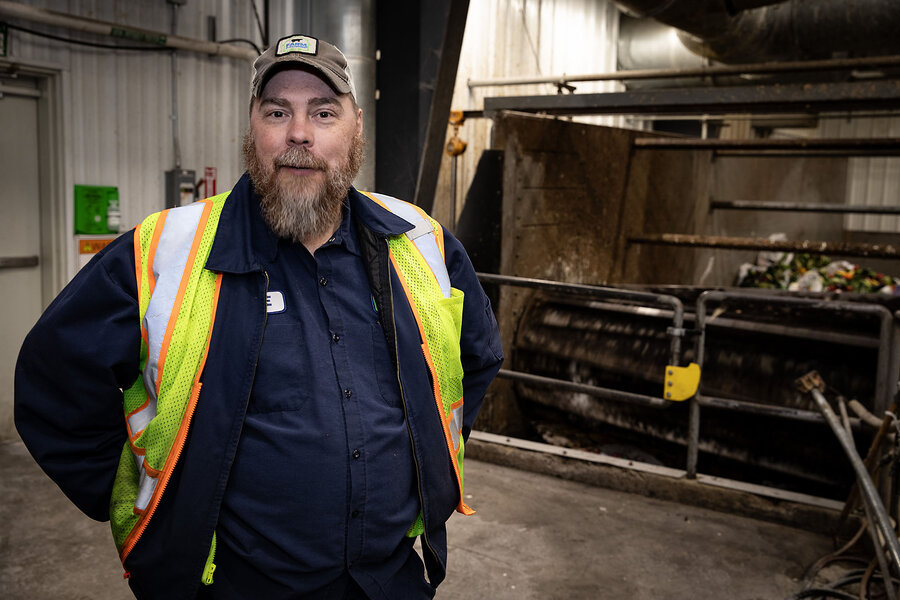
Abe Marciniec is the site manager of Vanguard Renewables, an organics recycling facility in Agawam, Massachusetts. It processes food waste from supermarkets, distribution centers, universities, and residential drop-offs, turning it to fuel.

Today’s story about Massachusetts being the only state to reduce food waste would seem to be a triumph, and in terms of intentions, it is. But I am ambivalent about the value of turning food waste into gas. Methane, after all, is one of the worst. See what you think.

Troy Aidan Sambajon reports at the Christian Science Monitor, “On a recent Thursday, Abe Marciniec unloads two dozen pallets of ice cream – enough to fill 31 refrigerators – into a machine that transforms it into fuel.

“Today’s flavor is room-temperature rocky road, but this facility handles all kinds of food waste from supermarkets, distribution centers, universities, and even residential drop-offs.

“ ‘We get everything you can find in Aisles 1 through 12,’ says Mr. Marciniec, site manager of the Agawam Organics Recycling Facility, owned and operated by Vanguard Renewables. Mr. Marciniec’s recycling facility is one of six in the commonwealth and only one of 25 nationwide.

“As the expired ice cream funnels into a turbo separator, Mr. Marciniec watches the machine strip food from its packaging. The organic waste is then trucked to a dairy farm, where it’s mixed with cow manure and processed into renewable natural gas.

“ ‘It’s really a great circle,’ says Mr. Marciniec. ‘Food starts at the farm, and our farms turn it back into energy. Farm to table, then back to farm.’ …

“Facilities like this one, which can process up to 250 tons of food waste daily, replace manual work typically done by hand or not done at all. That’s a crucial step in diverting waste away from landfills. Americans throw out about 40% of food annually – a waste of both money and natural resources. Reducing food waste can increase food security, promote resource and energy conservation, and address climate change.

“The Bay Sate has become a leader in reducing food waste. In fact, it’s the only state to significantly do so – to the tune of 13.2% – according to a 2024 study. Massachusetts was among the first five states to enact a food waste ban in 2014. (The others were California, Connecticut, Rhode Island, and Vermont.)

“ ‘The law has worked really well in Massachusetts,’ says Robert Sanders, an assistant professor of marketing and analytics at the University of California San Diego and co-author of the study. ‘That’s due to three things: affordability, simplicity, and enforcement.’

“[Food waste is] the largest category of waste – at 25% – sent to landfills in the United States. In 2019, 66 million tons of food waste came from retail, food service, and households. Around 60% of this waste was sent to landfills, according to the Environmental Protection Agency.

“Vanguard Renewables specializes in turning organic waste into renewable energy. The Massachusetts-based company partners with dairy farms to convert food scraps and manure into biogas through anaerobic digestion.

Microorganisms in cow manure digest organic matter, releasing biogas – a mix of methane and carbon dioxide. 

“The gas is captured in large steel vats on the farm and refined into renewable natural gas, which can be used to heat homes and power buildings. … Since 2014, Vanguard has processed more than 887,000 tons of food waste in New England, producing enough natural gas to heat 20,000 homes for a year. By 2028, the company plans to have more than 50 systems across the country.

“In western Massachusetts, Amherst College has become a model for limiting food waste at the source. Last year, it was recognized as the winner in the zero waste category in the Campus Race to Zero Waste Case Study Competition.

“ ‘The goal has been to push us aggressively to make sure everything is compostable,’ says Weston Dripps, director of sustainability. To achieve that, the school has phased out single-use plastics, to-go boxes, and even canned water, replacing them with refill stations and compostable materials.

“In 2023, Amherst College generated 238 tons of food waste – roughly 4 to 5 tons per week. But instead of ending up in landfills, Vanguard collected 100% of that waste and processed it at its Agawam facility.

“That total includes both pre-consumer waste – such as kitchen scraps from food prep – and postconsumer waste, like leftovers scraped off plates in the dining hall and campus cafés. ‘To really have a clean waste stream, we have to focus on the front end,’ says Mr. Dripps.

“Amherst’s approach goes beyond composting. Each month, the school donates 2,000 to 3,000 pounds of frozen surplus food to the the Food Bank of Western Massachusetts, ensuring edible food reaches those in need.

“Commercial businesses, too, are finding ways to cut down on waste. Maura Duggan, founder and CEO of Fancypants Baking Co., knows firsthand how much food can go to waste in the food industry. Her company produces hundreds of thousands of cookies each week.

“At its Walpole facility, Fancypants has large totes from Vanguard, which collect burnt cookies, food scraps, and anything that can’t be donated or sold. Last year alone, Fancypants diverted about 22 tons of waste. …

“Back in Agawam, Mr. Marciniec passes by 275-gallon totes full of leafy vegetables. Every day, he faces the reality that Americans waste 92 billion pounds of food a year – enough to make 145 million meals.

“ ‘It really makes you think about the things we take for granted,’ he reflects.

“ ‘Millions of people are starving everywhere, and the amount of food waste in this country is substantial,’ says Mr. Marciniec. ‘I’m sure we can do a better job.’ ”

Although I hate to quibble with this effort to at least do something, I know that enforcement has not reached my residential facility yet. Moreover, I’m pretty sure what we really need is not to have so much waste in the first place. What do you think? Is this a good first step?

Note Earle’s comment on my earlier post about this process, here.

More at the Monitor, here.

Read Full Post »

img_2495_custom-67b416e668a5cfa1cb29c0344380143ce08b2baf-s600-c85

Photo: Allison Aubrey/NPR
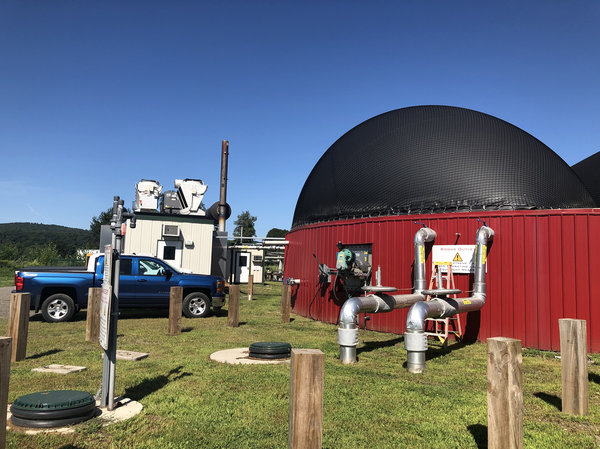
In the digester on his farm, Peter Melnik combines food waste with manure from his cows. The mixture cooks at about 105 degrees Fahrenheit. As the methane is released, it rises to the top of a large red tank with a black bubble-shaped dome to create electricity.

People are complicated. Even companies are complicated. Just the other day, I noted that I avoid Whole Foods because there is already enough money going to Amazon owner Jeff Bezos. Today I give you a story about something Whole Foods is doing for the environment.

Alison Aubrey reported the story for the PBS NewsHour and National Public Radio (NPR).

“If you piled up all the food that’s not eaten over the course of a year in the U.S., it would be enough to fill a skyscraper in Chicago about 44 times, according to an estimate from the U.S. Department of Agriculture.

“And, when all this food rots in a landfill, it emits methane, a powerful greenhouse gas that contributes to climate change. In fact, a recent report from the United Nations from a panel of climate experts estimates that up to 10 percent of all human-made greenhouse gas emissions are linked to food waste.

So, here’s one solution to the problem: Dairy farmers in Massachusetts are using food waste to create electricity. They feed waste into anaerobic digesters, built and operated by Vanguard Renewables, which capture the methane emissions and make renewable energy.

“The process begins by gathering wasted food from around the state, including from many Whole Foods locations. We visited the chain’s store in Shrewsbury, Mass., which has installed a Grind2Energy system. It’s an industrial-strength grinder that gobbles up all the scraps of food the store can’t sell, explains Karen Franczyk, who is the sustainability program manager for Whole Foods’ North Atlantic region. …

“While Whole Foods donates a lot of surplus food to food banks, there’s a lot waste left over. Much of it is generated from prepping prepared foods. Just as when you cook in your own kitchen, there are lots of bits that remain, such as onion or carrot peel, rinds, stalks or meat scraps. The grinder turns all these bits into a slurry. …

“From here, the waste is loaded into a truck and sent to an anaerobic digester. ‘There’s no question it’s better than putting it in the trash,’ Franczyk says. She says the chain is committed to diverting as much waste as possible and aims for zero waste. …

“We visited Bar-Way Farm, Inc. in Deerfield, Mass. Owner Peter Melnik, a fourth-generation dairy farmer, showed us how his anaerobic digester, which is installed next to his dairy barn, works.

” ‘We presently take in about a 100 tons [of waste], which is about three tractor-trailer loads, every day,’ Melnik says. In addition to all the food waste from Whole Foods, he gets whey from a Cabot Creamery in the area, as well as waste from a local brewery and a juice plant.

“In the digester, he combines all of this waste with manure from his cows. The mixture cooks at about 105 degrees Fahrenheit. As the methane is released, it rises to the top of a large red tank with a black bubble-shaped dome.

” ‘We capture the gas in that bubble. Then we suck it into a big motor,’ Melnik explains. Unlike other engines that run on diesel or gasoline, this engine runs on methane. ‘This turns a big generator, which is creating one megawatt of electricity’ continuously. …

‘We only use about 10 percent of what we make, and the rest is fed onto the [electricity] grid,’ [enough] to power about 1,500 homes.

“He says times are tough for dairy farmers, so this gives him a new stream of revenue. … In addition, he’s able to use the liquids left over from the process as fertilizer on his fields.”

More here.


Read Full Post »

In Massachusetts, large facilities are complying with a food-waste ban, creating many green jobs and boosting economic activity.

EcoRi News reports, “The Massachusetts Department of Environmental Protection (DEP) recently issued a report which found that the state’s commercial food waste ban has created more than 900 jobs and stimulated $175 million in economic activity during its first two years.

“Implemented in 2014, the nation’s first food scrap and organics ban requires any commercial organization that disposes of a ton or more of food scrap a week to pull it out of the waste stream and reuse it, send it for composting or animal feed operations, or use it in an anaerobic digestion facility that produces renewable energy.

“The report, conducted by ICF International Inc. of Cambridge, assessed the economic development benefits of food-waste-reduction initiatives. The 25-page report compared jobs and economic activity among food-waste haulers; composting, anaerobic digestion and animal feed operations; and food-rescue organizations before and after the Oct. 1, 2014 implementation of the ban. The ban creates jobs by driving a market for alternatives to disposing of food waste in Dumpsters, according to the report.

“The report also shows that food-waste haulers and processors, as well as food-rescue organizations, employ 500 people directly, while supporting more than 900 jobs when accounting for indirect and induced effects. These sectors generate more than $46 million of labor income and $175 million in economic activity. …

“About 1,700 facilities, including restaurants, hotels and conference centers, universities, supermarkets and food processors, are covered under the ban.” More here.

Meanwhile, the more of us who convert our own food scraps to compost for our yards, our friends’ yards, or community gardens, the better for the envionment. “One and one and 50 make a million,” after all.

Photo: Green Fingers
Converting food scraps to compost instead of putting them in the trash. In Massachusetts, large facilities are complying with a food-waste ban. Individual efforts add up, too.

Read Full Post »