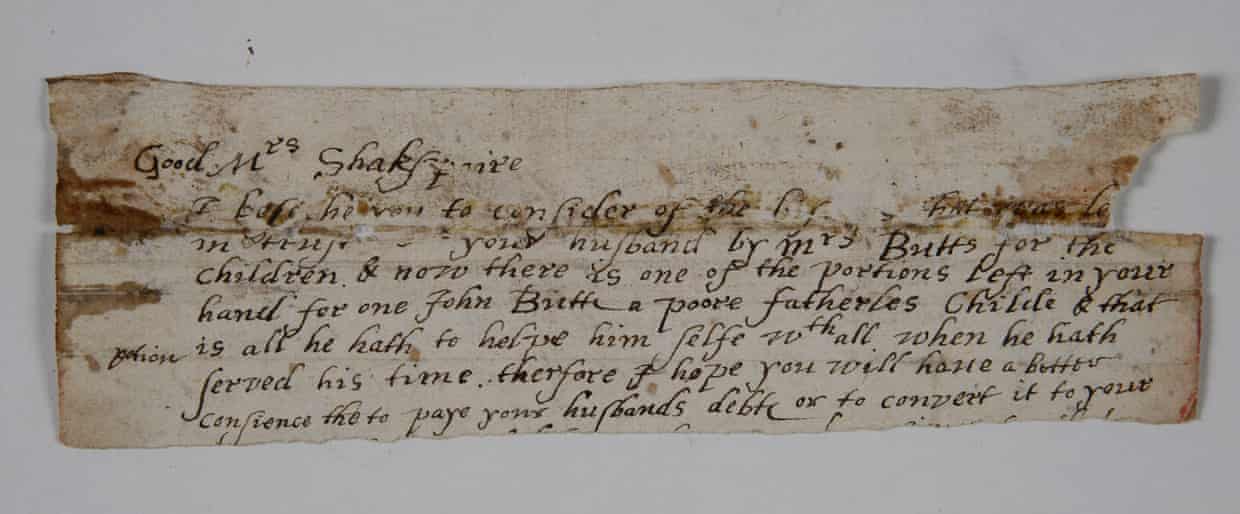
Photo: Hereford Cathedral and the Hereford Mappa Mundi Trust.
The letter fragment seems to place Anne Hathaway in London with William Shakespeare.
Where do our firm convictions about history come from? Sometimes the accepted wisdom is based on facts, sometimes on what the influencers of the time thought, sometimes on mistakes. If for example, we have always thought Shakespeare had a bad marriage because his wife never came to London with him, what does new information contradicting that do to the accepted wisdom?
And there’s always new information.
Dalya Alberge writes at the Guardian, “It has long been assumed that William Shakespeare’s marriage to Anne Hathaway was less than happy. He moved to London to pursue his theatrical career, leaving her in Stratford-upon-Avon and stipulating in his will that she would receive his ‘second best bed,’ although still a valued item.
“Now a leading Shakespeare expert has analyzed a fragment of a 17th-century letter that appears to cast dramatic new light on their relationship, overturning the idea that the couple never lived together in London.
“Matthew Steggle, a professor of early modern English literature at the University of Bristol, said the text seemed to put the Shakespeares at a previously unknown address in Trinity Lane – now Little Trinity Lane in the City. It also has them jointly involved with money that Shakespeare was holding in trust for an orphan named John Butts.
“Addressed to ‘Good Mrs Shakspaire,’ the letter mentions the death of a Mr Butts and a son, John, who is left ‘fatherles,’ as well as a Mrs Butts, who had asked ‘Mr Shakspaire’ to look after money for his children until they came of age. It suggests the playwright had resisted attempts to pay money that the young Butts was owed.
“Steggle said: ‘The letter writer thinks that “Mrs Shakspaire” has independent access to money. They hope that Mrs Shakspaire might “paye your husbands debte.” ‘
“They do not ask Mrs Shakspaire to intercede with her husband, but actually to do the paying herself, like Adriana in The Comedy of Errors, who undertakes to pay a debt on her husband’s behalf, even though she was previously unaware of it: “Knowing how the debt grows, I will pay it.” ‘ …
“The fragment was preserved by accident in the binding of a book in Hereford Cathedral’s library. Although it was discovered in 1978, it has remained largely unknown because ‘no one could identify the names or places involved,’ Steggle said.
“Crucial evidence includes the 1608 book in which the fragment was preserved, Johannes Piscator’s analyses of biblical texts. It was published by Richard Field, a native of Stratford, who was Shakespeare’s neighbor and his first printer.
“Steggle said that it would be a ‘strange coincidence’ for a piece of paper naming a Shakspaire to be bound, early in its history, next to 400 leaves of paper printed by Field, ‘given Field’s extensive known links to the Shakespeares.’
“John Butts seems to have been serving an apprenticeship because the letter mentions ‘when he hath served his time.’ Scouring records from the period 1580 to 1650, Steggle found a John Butts, who was an apprentice, fatherless and in the care of his mother. …
“Steggle found John Butts in later records, placing him in Norton Folgate, outside the city walls, and living on Holywell Street (Shoreditch High Street today), home to several of Shakespeare’s fellow actors and associates.
“It was an area in which Shakespeare worked in the 1590s, first at the Theatre in Shoreditch, the principal base for the Lord Chamberlain’s Men throughout those years, and then at its near neighbor, the Curtain theatre. Shakespeare’s lifelong business partners, the Burbages, were involved in innkeeping and victualing nearby.
“Steggle said: ‘The adult John Butts, living on the same street as them, working in the hospitality industry in which they were invested … would very much be on the Burbages’ radar. So Shakespeare can be linked to Butts through various Norton Folgate contacts.’
“If the writing on the back of the letter – in another hand – was written by Anne, the words would be ‘the nearest thing to her voice ever known,’ he noted.
“The research is being published in Shakespeare, the journal of the British Shakespeare Association.”
What accepted wisdom will future historians overthrow by their scouring of our — probably digital — records? And will they draw such broad conclusions about what they find? I myself don’t see how you claim that Shakespeare had a good or bad marriage on the basis of his wife’s residence in London. But it’s fun to see how long new ideas can keep turning up.
More at the Guardian, here.

 Suzanne's Mom's Blog