Feeds:
Posts
Comments

Posts Tagged ‘anonymous’

Photo: John and Suzanne’s Mom.
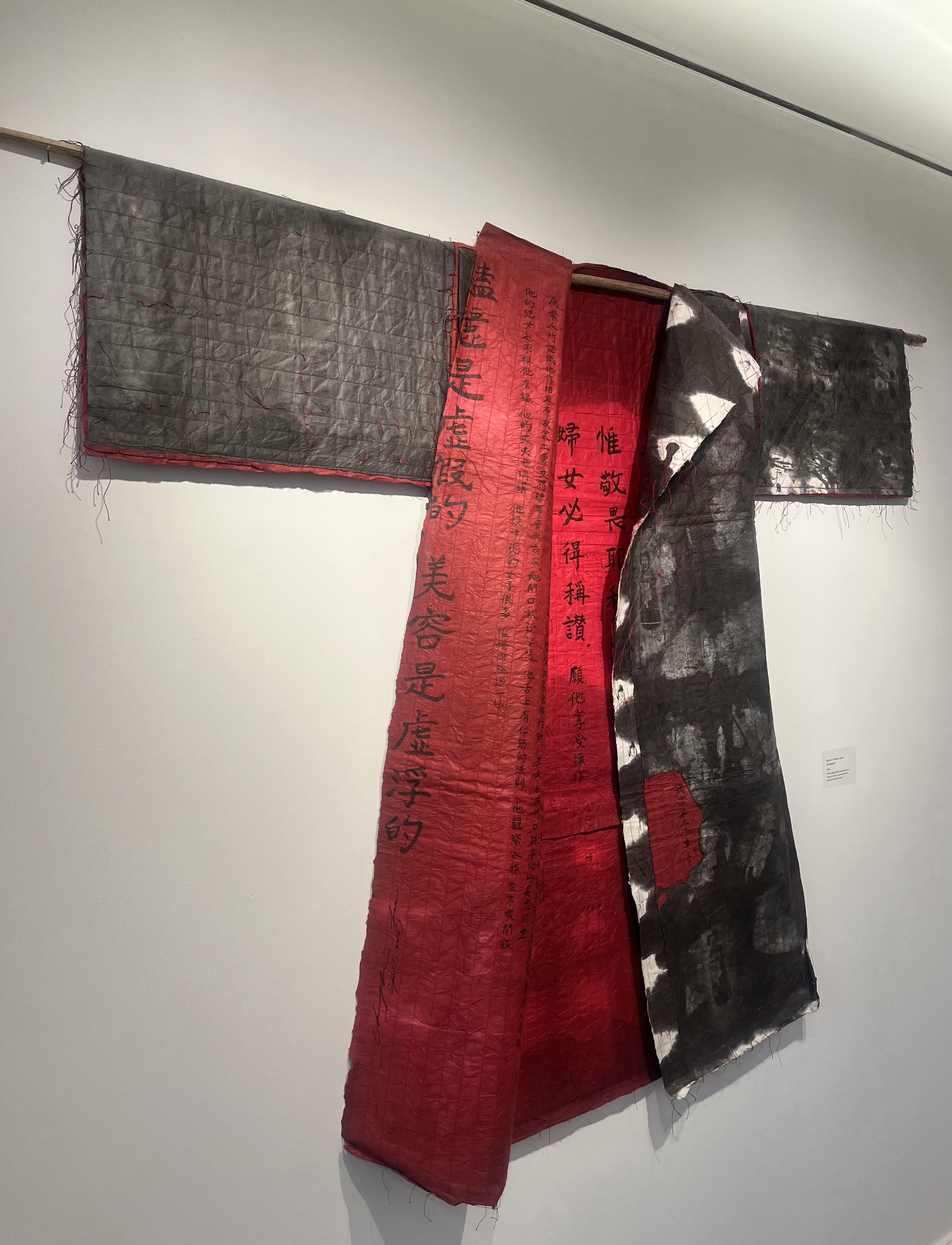
Chunghie Lee‘s bojagi style “No-Name Women Paper DuRuMaGill”: photo images silk-screen-printed on Korean mulberry paper dyed with ground oriental ink stick. At Lexington Arts in Massachusetts.

My friend Ann, the textile artist, put me on to a new/ancient type of quilting and fabric art. It’s from Korea and it’s called bojagi.

According to the websit for Beyond Above Publications, “Bojagi (Bo-Jah-ki), or wrapping cloth, is the ancient Korean folk tradition of making pieced textiles for both everyday and ceremonial use. Originally made by anonymous housewives to fulfill a practical need along with an artistic impulse, Bojagi and its techniques have recently gained attention outside of Korea due to the increasing interest in the value of handmade items, as well the use of recycled materials and the politics of sustainability in textiles and contemporary art.”

I would never know about this type of thing, but Ann is on every email list imaginable for textile art in Greater Boston and beyond. So one day I headed over to Lexington Arts and Crafts to see contemporary bojagi by artist Chunghie Lee.

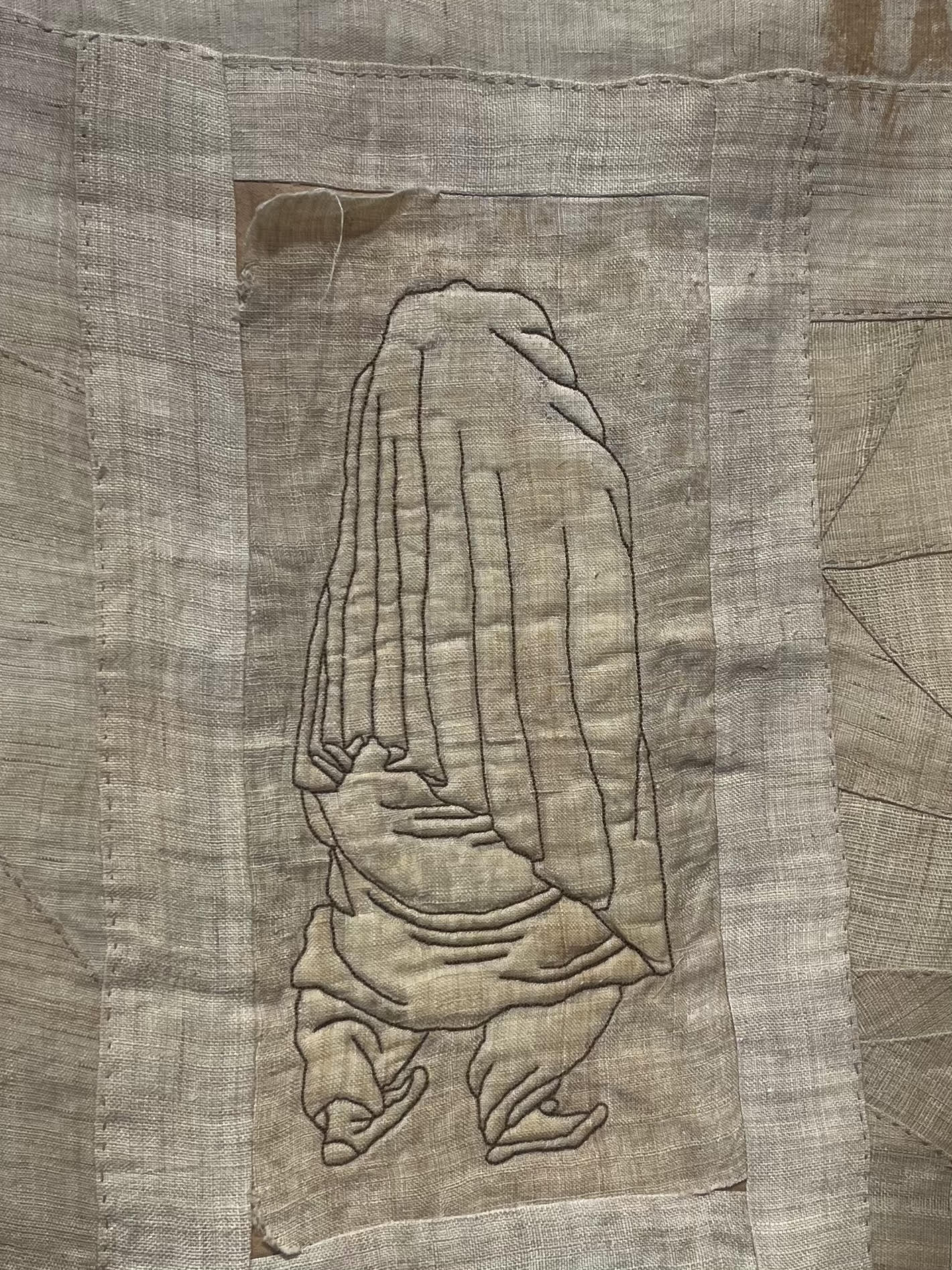
Apart from appreciating Lee’s skillful needlework, I was struck by her use of sustainable materials: previously used fabrics, mulberry paper, and ground-up ink sticks for red and black dyes. Especially moving was her focus on “no-name women,” the anonymous people behind this technique to make scraps of cloth go far. Women unknown and unappreciated.

You have to look closely to see them. Lee brings them into her work with silk screens of old-time photos, barely visible. Which is why for this piece I am showing you only a close-up.
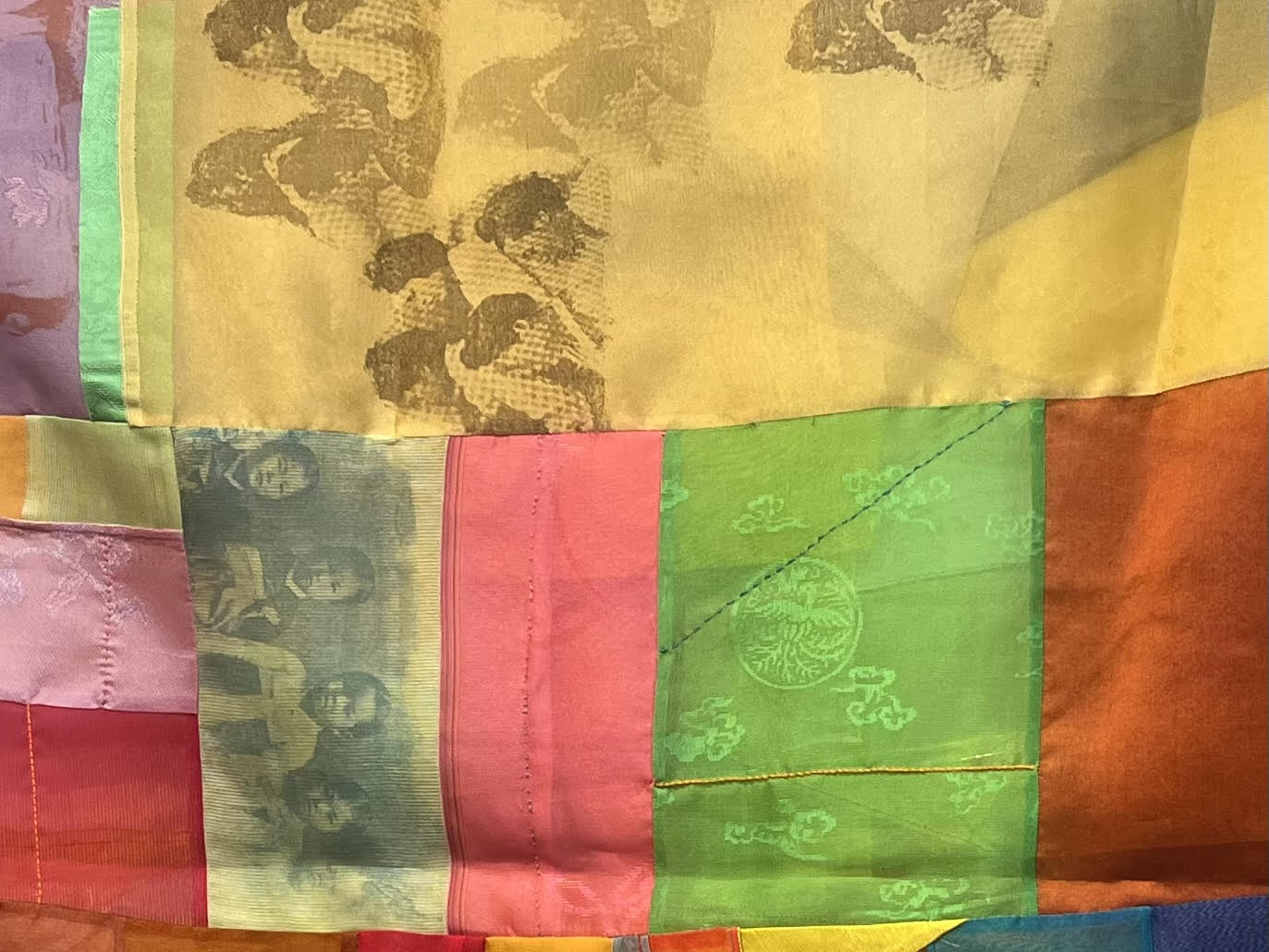
Close-up of silk bojagi “no-name women” piecework by Chunghie Lee.

Here is more detail from the publishing company Lee founded with Jiyoung Chung, a visual artist inspired by the Joomchi papermaking tradition.

“From traditional women’s work to contemporary sustainable textiles, bojagi works include delicately pieced and hand-stitched traditional bojagi, reinterpreted bojagi, wearable pieces, installations, and wall hangings.

This uniquely Korean art form made by anonymous ancestors has evolved from functional works into a contemporary art form that is embraced worldwide.

“Since the late 14th century, every household, from the royal palace to the thatched-roof hut in a mountain village, has found these wrapping cloths indispensable. The tradition of making and using bojagi was established during the Josun Dynasty (1392 – 1910), when women were restricted from leaving their households. To spend the long, tedious hours of the day, girls were taught to sew at age ten, and needlework became a big part of their lives as they moved into  adulthood. This folk art tradition was the only escape from the sequestered lifestyle of Korean women, and provided them with an artistic outlet for creative expression.”

Chunghie Lee adds, “I see this patchwork as a metaphor for human life. We may feel ourselves to be as random pieces of fabric, alone and without meaning, but God’s hand places us together in a beautiful composition, which has great harmony and meaning. As artists of all nationalities, generations and heritages, we discover we are all alike, and have been saving and making beautiful things with discarded fabric and other materials. In the eyes of artists, fabric scraps can be transformed and repurposed to fulfill the design and vision of the creator.”

More on bojagi at the website for publishing company Beyond Above, here. Follow Lee on Facebook, here.

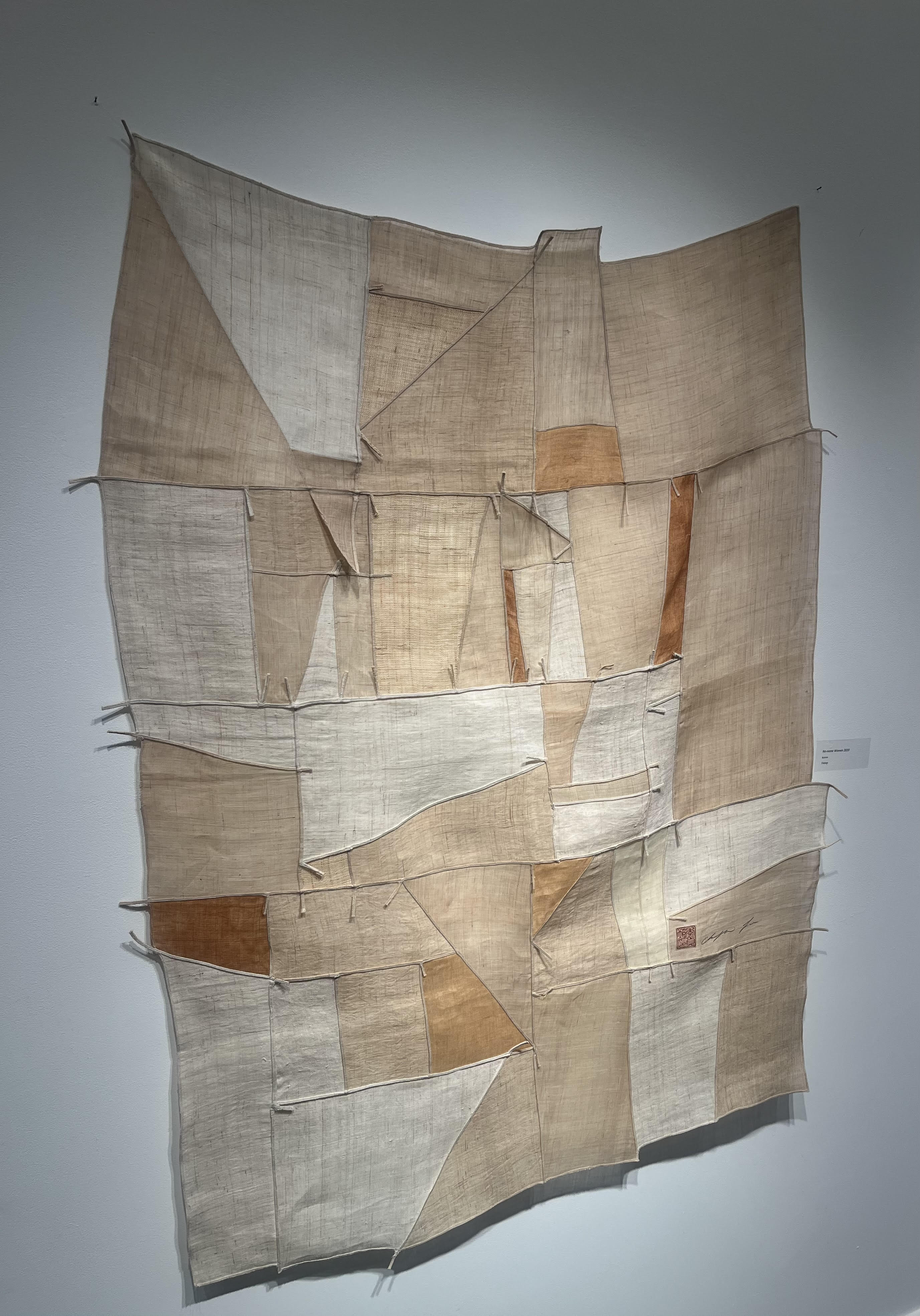
Below, Chunghie Lee’s contemporary version of Korean piecework, followed by her careful stitching for “No-name Woman with Head Covering.”
Read Full Post »

Photo: Andy Hall/The Observer.
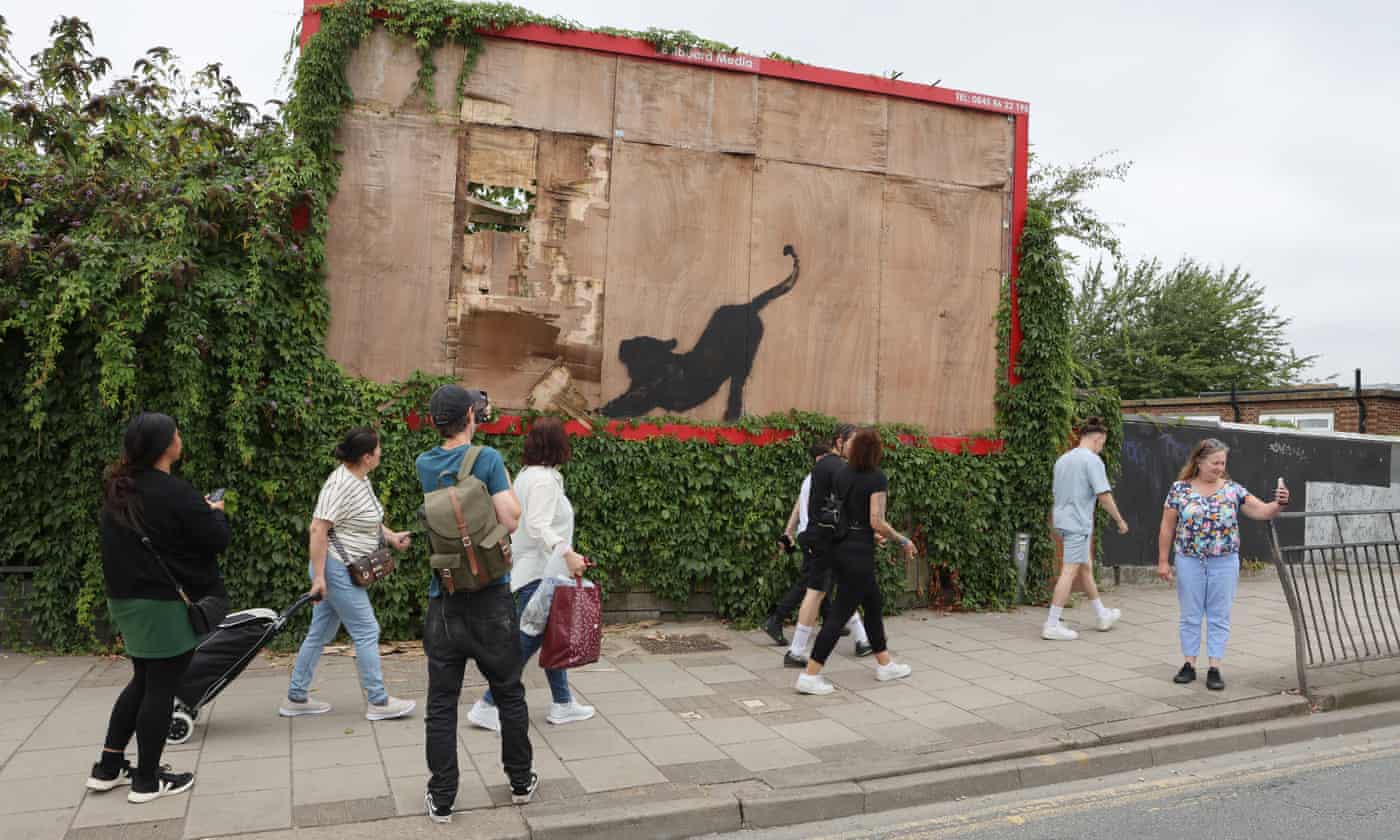
The Banksy cat mural in Cricklewood, north-west London, before the billboard was removed last summer.

I love the stealth artworks of Banksy and have taken a few photos of murals that could have been his, except that they were in Boston and New York.

People love guessing what the pieces mean, what his angle is.

At the Guardian last August, Vanesa Thorpe demonstrated that Banksy’s views are increasingly transparent.

“A big cat by Banksy appeared briefly, ­stretching in the morning sun, on a bare advertising hoarding on Edgware Road in Cricklewood, north-west London, on Saturday. A few hours later,” Thorpe writes, “it had gone, removed by contractors who feared it would be ripped down.

“The anonymous artist known as Banksy, who confirmed the image was his at lunchtime on Saturday, also promised a little more summer fun to come. …

“For a week now, the streets of the capital have been ­populated by a string of unusual animal sightings, courtesy of Banksy, ­including ­pelicans, a goat and a trio of monkeys.

“The artist’s vision is ­simple: the latest street art has been designed to cheer up the public ­during a period when the news headlines have been bleak. … Banksy’s hope, it is understood, is that the uplifting works cheer ­people with a moment of unexpected ­amusement, as well as to ­gently underline the human capacity for ­creative play, rather than for destruction and negativity.

“Some recent theorizing about the deeper significance of each new image has been way too involved, Banksy’s support organization, Pest Control Office, has indicated.

“When a goat teetering on a ­precipice first appeared on Monday near Kew Bridge, in south-west London, some thought it might be a symbol of humanity’s folly. Others speculated it might be a visual pun on the idea of the goat, now standing for ‘greatest of all time’ in popular parlance.

“On Tuesday, two silhouetted elephant heads popped up, their trunks reaching out to each other through the bricked-up windows of a house in Chelsea.

“Next came perhaps the most joyous so far when a trio of monkeys was revealed on Wednesday, swinging their way across a bridge over Brick Lane in east London.

“On Thursday, an outline of a howling lone wolf, painted on to a large satellite dish on a roof in Peckham, was removed by two masked men with a ladder, who made off with their prize. …

“On Friday, a pair of hungry pelicans appeared above a Walthamstow fish and chip shop on a corner of Pretoria Avenue, their long beaks snapping at fish. …

“While Banksy’s new menagerie has been springing up, the rescue boat the artist funds has been working to help endangered asylum seekers to reach safety. The M V Louise Michel, a high-speed lifeboat, patrols migrant routes in the Mediterranean.

“It has picked up at least 85 ­survivors in the past couple of days, taking them safely to Pozzallo, Sicily. … Five years ago, Banksy announced that he would finance the vessel, named after a French feminist anarchist, with the intention of rescuing refugees in difficulty as they fled north Africa.

“In June, at Glastonbury, an inflatable migrant boat created by Banksy was used to crowdsurf during performances by Bristol indie punk band Idles and rapper Little Simz. The Conservative home secretary at the time, James Cleverly, said the artist was ‘trivializing‘ small boat ­crossings and ‘vile.’

“Banksy responded that the detention of the Louise Michel by Italian authorities at the time was the really ‘vile and unacceptable’ development.

“His latest street art, however, is deliberately lighthearted, like Banksy’s lockdown series the Great British Spraycation of 2020. Banksy’s seaside series also memorably featured chips, with an image of a seagull hovering over oversized ‘chips.’ …

“Another image from the lockdown campaign made reference to the ­refugee crisis. It showed three children sitting in a rickety boat made of scrap metal. Above them, Banksy had inscribed: ‘We’re all in the same boat.’ “

More at the Guardian, here. No paywall. Delightful photos.

Read Full Post »