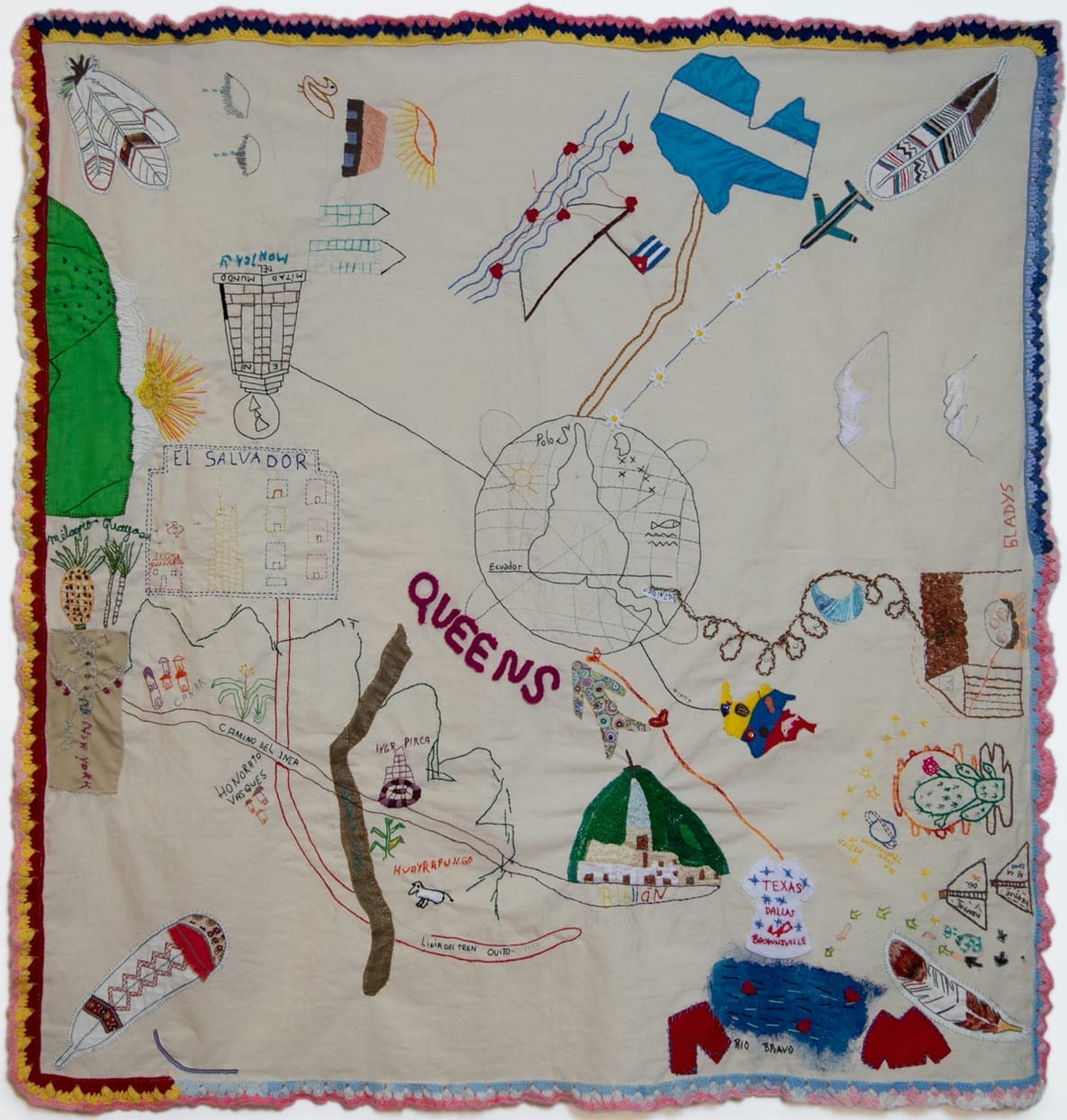
Photo: Andrés Altamirano.
“The Collective Map of Paths” is needlework created by immigrant women in New York City.
A needlework cartography project that some of the textile makers call ‘un mapa extraño (‘a weird map’) uses emotional parameters rather than a birds’ eye approach to mapping migration journeys. The inventive results are one more reason to love the richness that immigration has brought to our land. (Always recognizing that the original in habitants may have a different view of all us immigrants.)
Amalia Uribe Guardiola writes at Hyperallergic, “For the past two years, I have been working with two immigrant-led costureros: circles of women from all over Latin America that gather to create textiles together. Located in different community centers in Northwestern Queens in New York City, these spaces have become a safe haven for many undocumented, working-class immigrants. …
“The first group, BordeAndo, was founded in 2018 as a community engagement initiative of the Queens Museum, though it soon grew beyond the institution to become an independent collective. Its name plays with multiple meanings in Spanish: bordar (to embroider), borde (border or frontier), and the suffix –ando, which evokes movement or walking. Most of its members come from the Ecuadorian highlands (la Sierra), though others are from the Dominican Republic, El Salvador, and Mexico. They range in age from 30 to 83 and have lived in the United States for between 10 and 50 years.
“Las Comadres Bordadoras was founded in 2021 in the aftermath of the COVID-19 pandemic by two Mexican immigrants, who sought to bring women out of isolation and foster a mutual support network. Their name, also difficult to translate, gestures toward camaraderie and kinship. The comadre refers specifically to women who are, in their words, ‘a midpoint between friend and family.’ The comadres come from Mexico, Cuba, El Salvador, Uruguay, Colombia, Ecuador, and Argentina; range in age from 35 to 75; and have lived in the United States for between two and 30 years. They mostly embroider Mexican cloth napkins, but all forms of needlework are welcome. …
“Last year, BordeAndo and Las Comadres Bordadoras were the protagonists of ‘Thread of Voice / Un hilo de voz‘ at the Queens Museum. The exhibition, which I curated, featured Andrés Altamirano’s photographs of the costurero members along with film by documentarian Eleonora Privitera. …
“I see these costureros as living archives — as sites where craft traditions converge, and concrete embodied and material practices connect geographies of affect and displacement, like a woman knitting a stitch learned by her grandmother back home or another embroidering a napkin for the altar of a dead loved one whose grave she cannot visit because of her migratory status. “Text” and “textile” share an etymological root — the Latin verb texere — that reveals both that texts are woven and textiles written. In this sense, textiles are texts that we have forgotten how to read. …
“Based on the premise that mapmaking should not be a practice exclusive to traditional ‘expert’ cartographers, I invited the women of the costureros to make a collective map of their migration paths. ‘Where to begin? What to draw?’ many asked at first, reluctant to make the first stitches when faced with the blank surface. I proposed not drawing a croquis of the bird’s-eye view of either northwestern Queens or their home countries because it would prescribe their drawings. … Drawing a map freehand invites the women to express with their own hands and dimensions geographical and emotional landmarks, rooted in their own experiences and in dialogue with one another.
“Collectively, we chose three spatial parameters for the textile project: there’ — homeland, point of origin — stitched on the edges of the fabric; ‘path’ — journey, trail — stitched on the middle; and ‘here’ — destination, arrival point — stitched in the center. The map has been worked on in public libraries, community centers, the Queens Museum, and the homes of over 10 women. It is still in progress, moving between costureros. I consider it a countercartography because it does not abide by the dominant parameters of mapmaking — scale, legend, orientation, grid — but is rather dictated by the subjectivities and hands of its immigrant Latin American makers. It, too, is also an archive, a growing document of the transnational memory of its makers, ever changing, ever growing.”
More at Hyperallergic, here. No firewall but membership is solicited. The article was part of a series focusing on underrepresented craft histories, researched and written by the 2025 Craft Archive Fellows, and organized in collaboration with the Center for Craft.