Feeds:
Posts
Comments

Posts Tagged ‘textiles’

Photo: Andrés Altamirano.
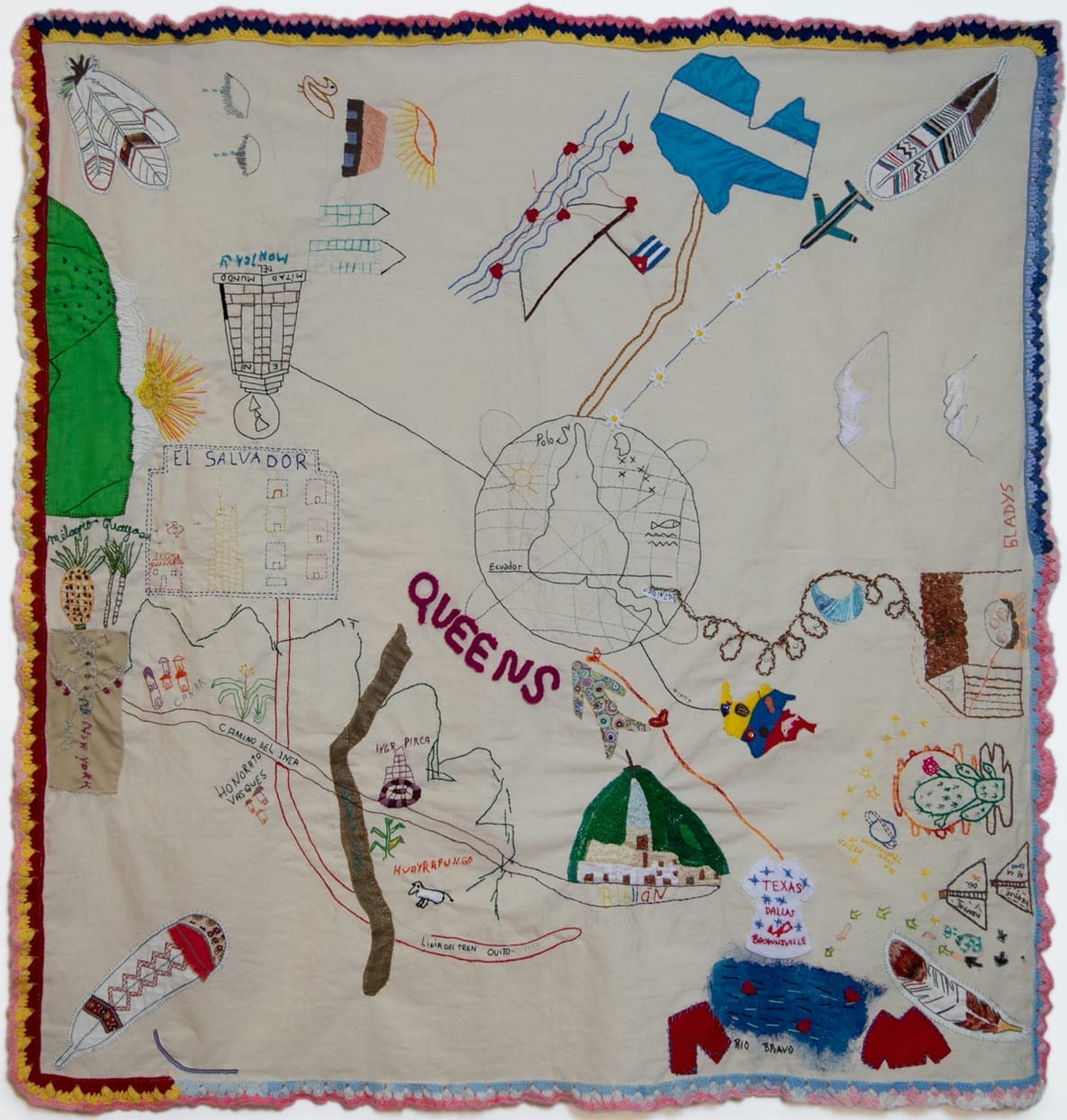
“The Collective Map of Paths” is needlework created by immigrant women in New York City.

A needlework cartography project that some of the textile makers call ‘un mapa extraño (‘a weird map’) uses emotional parameters rather than a birds’ eye approach to mapping migration journeys. The inventive results are one more reason to love the richness that immigration has brought to our land. (Always recognizing that the original in habitants may have a different view of all us immigrants.)

Amalia Uribe Guardiola writes at Hyperallergic, “For the past two years, I have been working with two immigrant-led costureros: circles of women from all over Latin America that gather to create textiles together. Located in different community centers in Northwestern Queens in New York City, these spaces have become a safe haven for many undocumented, working-class immigrants. …

“The first group, BordeAndo, was founded in 2018 as a community engagement initiative of the Queens Museum, though it soon grew beyond the institution to become an independent collective. Its name plays with multiple meanings in Spanish: bordar (to embroider), borde (border or frontier), and the suffix –ando, which evokes movement or walking. Most of its members come from the Ecuadorian highlands (la Sierra), though others are from the Dominican Republic, El Salvador, and Mexico. They range in age from 30 to 83 and have lived in the United States for between 10 and 50 years.

“Las Comadres Bordadoras was founded in 2021 in the aftermath of the COVID-19 pandemic by two Mexican immigrants, who sought to bring women out of isolation and foster a mutual support network. Their name, also difficult to translate, gestures toward camaraderie and kinship. The comadre refers specifically to women who are, in their words, ‘a midpoint between friend and family.’ The comadres come from Mexico, Cuba, El Salvador, Uruguay, Colombia, Ecuador, and Argentina; range in age from 35 to 75; and have lived in the United States for between two and 30 years. They mostly embroider Mexican cloth napkins, but all forms of needlework are welcome. …

“Last year, BordeAndo and Las Comadres Bordadoras were the protagonists of ‘Thread of Voice / Un hilo de voz‘ at the Queens Museum. The exhibition, which I curated, featured Andrés Altamirano’s photographs of the costurero members along with film by documentarian Eleonora Privitera. …

“I see these costureros as living archives — as sites where craft traditions converge, and concrete embodied and material practices connect geographies of affect and displacement, like a woman knitting a stitch learned by her grandmother back home or another embroidering a napkin for the altar of a dead loved one whose grave she cannot visit because of her migratory status. “Text” and “textile” share an etymological root — the Latin verb texere — that reveals both that texts are woven and textiles written. In this sense, textiles are texts that we have forgotten how to read. …

“Based on the premise that mapmaking should not be a practice exclusive to traditional ‘expert’ cartographers, I invited the women of the costureros to make a collective map of their migration paths. ‘Where to begin? What to draw?’ many asked at first, reluctant to make the first stitches when faced with the blank surface. I proposed not drawing a croquis of the bird’s-eye view of either northwestern Queens or their home countries because it would prescribe their drawings. … Drawing a map freehand invites the women to express with their own hands and dimensions geographical and emotional landmarks, rooted in their own experiences and in dialogue with one another.

“Collectively, we chose three spatial parameters for the textile project: there’ — homeland, point of origin — stitched on the edges of the fabric; ‘path’ — journey, trail — stitched on the middle; and ‘here’ — destination, arrival point — stitched in the center. The map has been worked on in public libraries, community centers, the Queens Museum, and the homes of over 10 women. It is still in progress, moving between costureros. I consider it a countercartography because it does not abide by the dominant parameters of mapmaking — scale, legend, orientation, grid — but is rather dictated by the subjectivities and hands of its immigrant Latin American makers. It, too, is also an archive, a growing document of the transnational memory of its makers, ever changing, ever growing.”

More at Hyperallergic, here. No firewall but membership is solicited. The article was part of a series focusing on underrepresented craft histories, researched and written by the 2025 Craft Archive Fellows, and organized in collaboration with the Center for Craft.

Read Full Post »

Large quantities of clothes that are damaged in textile manufacturing end up in landfills. To organizations like Renewal Workshop, that seems like a waste. So they are stepping up to the plate, with real benefits to the planet.

“As discarded clothing piles up in landfills around the country,” writes the Huffington Post, “a handful of companies are trying to save some of those garments and give them new life.

“The Renewal Workshop is one of these. It takes shirts, jackets and other items damaged during manufacturing, then repairs and resells them for 30 to 50 percent off the original price, co-founder Nicole Bassett told The Huffington Post. Its goal is to prevent imperfect items, which traditional retailers can’t sell in stores, from being tossed in the trash. …

“Companies fighting clothing waste have their work cut out for them. The average American throws out 70 pounds of clothing or household textiles a year. Only 15 percent of that is recycled, according to a report by the Environmental Protection Agency. The other 85 percent ― around 13 million tons of textiles in 2013 ― ends up in landfills, where it decomposes alongside other solid wastes, releases greenhouse gasses and contributes to global warming.

“The Renewal Workshop is attempting to combat waste in the textile industry by ‘closing the loop,’ or trying to ensure new clothes are made from recycled or used garments. … It creates every single one of its products out of existing garments.

“The company partners with apparel companies like prAna, Ibex and Toad & Co, which are all outdoor clothing brands selected specifically for their commitment to sustainability, Bassett told HuffPost.

“The Renewal Workshop takes those brands’ damaged or returned clothes ― items with broken zippers, seam tears or missing buttons ― and then repairs, cleans and resells them at a discount.

“Apparel partners provide damaged items at no cost to The Renewal Workshop, and pay a partnership fee. When a customer buys a repaired garment, the partner business that provided it gets a portion of the sales, and the customer receives an item with the original company’s brand label and a Renewal Workshop label on it.” Read more here.

And ordinary folks can always help by giving old clothes to organizations that distribute nice ones to new users.

Photo: GaijinPot

Read Full Post »

I like this story about a couple of idealistic young men who have created fair-wage, environmentally sustainable textile jobs in the United States with the help of customers’ T-shirt collections. Their company, Project Repat, is “repatriating” some textile jobs lost overseas years ago.

From the website: “Project Repat story starts in Nairobi, Kenya, where Project Repat co-founder Ross Lohr was doing non-profit education work. After sitting in traffic for 2 hours, he discovered the cause of the jam: an overturned fruit and vegetable rickshaw pushed by a Kenyan man wearing a t-shirt that said ‘I Danced My Ass Off at Josh’s Bar Mitzvah.’

“Amazed by all the incredible t-shirts that get sold off and sent overseas by non-profit and for-profit companies in America, [Nathan Rothstein and I] began working with Kenyan artisans to design new products out of castaway t-shirts, including bags, scarves, and re-fabricated t-shirts. Those products were ‘repatriated’ (or returned to the country of origin) back to the United States and sold to raise money for non-profits working in East Africa.

“When trying to sell our upcycled products at markets in Boston, we quickly discovered the difference between a ‘good idea’ and a real business: while potential customers liked the idea of a repatriated upcycled t-shirt bag, they didn’t like it enough to actually buy it. What customers did ask for, time and time again, was an affordable t-shirt quilt.

“We had heard enough: instead of shipping goods all around the country, why not create fair wage jobs in the United States and create a product that has a lot of meaning for customers? As they say, the rest is history. Rather than ‘repatriating’ t-shirts back to the United States, Project Repat creates a high quality, affordable t-shirt quilt with minimal carbon impact.”

The factories are located in cities once-renowned for textiles: Fall River, Massachusetts (where “Precision Sportswear has been able to succeed by specializing in custom work and smaller production runs for made-in-USA. companies”), and Morgantown, North Carolina (where “each worker at Opportunity Threads is part of a collaborative working model, [and] each employee adds input to the production process and has the opportunity to earn an ownership stake in the company”).

I was not able to find on the website what happened to the artisans in Africa when the company’s focus changed. Ping @lunastellablog1 if you know.

On this Repat page, you tell the company what size quilt to make with your T-shirts, what size panels, and what color PolarTec backing you want.

Photo: Project Repat

Read Full Post »

Photo: The Slater Mill, Pawtucket, Rhode Island, bears the name of Samuel Slater, the father of the American Industrial Revolution.

Suzanne is interested in textiles as well as jewelry. (Check out the little purses she had made for Luna & Stella using weavers in Bhutan, here.) So I wasn’t surprised when she passed along an article from the NY Times on the U.S. textile industry today.

It seems that in addition to artists who create textiles for artistic purposes (see yesterday’s post), niche textile businesses still exist in the United States.

Rivka Galchen writes, “In 1776, America didn’t have a single textile mill. There were no spinning mules, no water-powered looms. There were only rumors of what such things might look like … Nearly every American woman, except the wealthiest, knew how to spin her own yarn and weave her own cloth …

“Samuel Slater was 14 when he began working at a cotton-spinning mill in Derbyshire, England. Seven years later, in 1789, he disguised himself as a farmer to pass English customs and board a ship to the United States. When he arrived in America, he got a mechanized loom up and running, then a textile factory and later factory towns, eventually becoming known as both Slater the Traitor and the father of the American Industrial Revolution.”

In 2010, Galchen continues, photographer Christopher Payne “came across a yarn mill in Maine and was transfixed by the way it seemed to exist both in the past and the present; it became the first textile mill he photographed.” He has since photographed more than 20.

“Langhorne Carpet Company, in Penndel, Pa., used to share its building with a hosier, but that business closed long ago. … On the day I visited, a young man in a hooded sweatshirt and jeans was making a five-color runner on one of the narrow looms, while an older man in a denim smock was restringing a broad one; 5,040 spools of yarn needed to be knotted on.

“ ‘We’ve stayed in business because we’ll take a 20-yard order, that’s our niche,’ said Langhorne’s president, Bill Morrow, whose grandfather and great-grandfather founded the company in 1930. … Langhorne has made reproductions of historic carpets for the Frederick Douglass house in Washington; the Congress Hall of Philadelphia; and the Rutherford B. Hayes home in Fremont, Ohio. …

“Langhorne employs about 40 people, whom it trains in-house. When a machine needs a new part, it is specially forged. ‘We’ve bought a lot of [our] machinery from other companies that have closed down,’ Morrow said.” More here.

Kind of nice to know that not all manufacturing has gone overseas. American ingenuity still can create jobs doing specialty work, training people in-house.

Read Full Post »