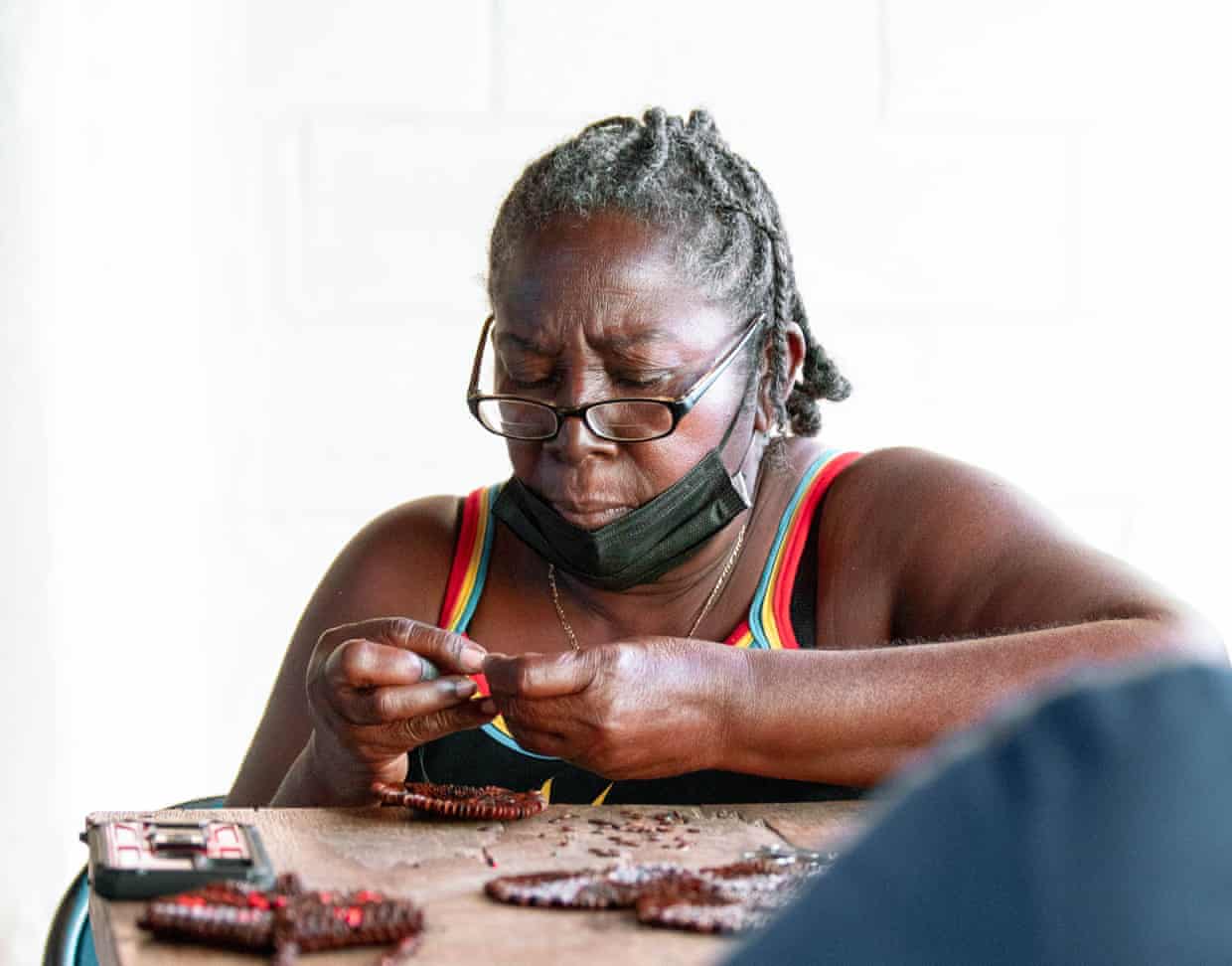
Photo: Botanique Studios & Thomas Barzilay Freund.
“Louise Edwards has been making jewelry from tamarind seeds for more than 50 years,” the Guardian reports.
Today’s story is bringing back memories. I’d completely forgotten that as a child I had a seed necklace like one of these. I have no idea where my mother got it. Maybe on my parents’ trip to St. Thomas. Did you ever see one?
Sarah Johnson writes at the Guardian, “For a little more than 50 years, Louise Edwards has been collecting tamarind seeds that grow wild on the Caribbean island of Antigua to create earrings, mats and belts.
“Edwards grew up surrounded by women stitching the seeds, but today she is one of only five remaining master artisans on the island, all in their 70s.
“ ‘It’s a dying art,’ she says. ‘We will soon give it up when we can’t see.’
“Practiced for centuries in the twin-island nation of Antigua and Barbuda, home to about 100,000 people, seed work began among enslaved African women forcibly brought to the islands and post emancipation it became a source of income. …
“Anne Jonas, secretary to the governor general of Antigua and Barbuda, with the help of Barbara Paca, the country’s cultural envoy, have applied for funding to expand free workshops to teach seed art.
“In 2017, Jonas founded Botaniqué Studios, dedicated to revitalizing the practice. ‘This is extremely transformative in terms of my appreciation for what we consider to be uniquely Antiguan and Barbudan heritage artisanship,’ says Jonas. …
“Seed work is laborious. Wild tamarind (Leucaena leucocephala) is one of the world’s 100 most invasive species; it grows everywhere, and collecting seeds causes no environmental damage.
“The seeds are boiled in sea water and kept moist, before being strung together by hand – Edwards has lost a number of fingernails during her career due to accidentally stabbing her finger with the needle. Once the seeds dry, they remain hard for decades.
“It takes Edwards an hour to make earrings, but more intricate pieces, such as placemats, can take a week. ‘The young ones don’t want to do it. They say it’s too much work and not enough money for the work they put into it,’ Edwards says.
“But the workshops are a start to renewing interest, says Jonas.
“Denise Walcott, 47, went to her first workshop in June with her 16-year-old daughter. ‘My daughter likes it, and I love it,’ she says. ‘The pieces are beautiful and the designs are so intricate. … This is an Antiguan culture and it should be a way of life for us. It is something that is empowering for us to use as an avenue to go along with our tourism industry.’ …
“As well as the Botaniqué website, Jonas showcases products on social media. Seed work featured as part of Antigua and Barbuda’s offering at the Venice Biennale, one of the world’s longest-running cultural festivals, and is on display at the Frank Walter exhibition at the Garden Museum in London.
“Michelle Donawa, another workshop attendee, learned seed art from her grandmother and is working on a book. ‘It’s something to preserve culture, as well as an educational tool,’ she says. …
“ ‘I think if young people see this, and how you can make something so beautiful that can [also bring in an income], they’d become very interested, especially if they are at home with nothing to do,’ says Walcott. ‘I really hope to see this being produced in Antigua on a larger scale, and exported.’ “
Folks, if you ever despair of humanity, think about how humans make art out of everything they see. More at the Guardian, here. No firewall.
And for a different kind of seed art, see my recent post on the Minnesota State Fair, here.
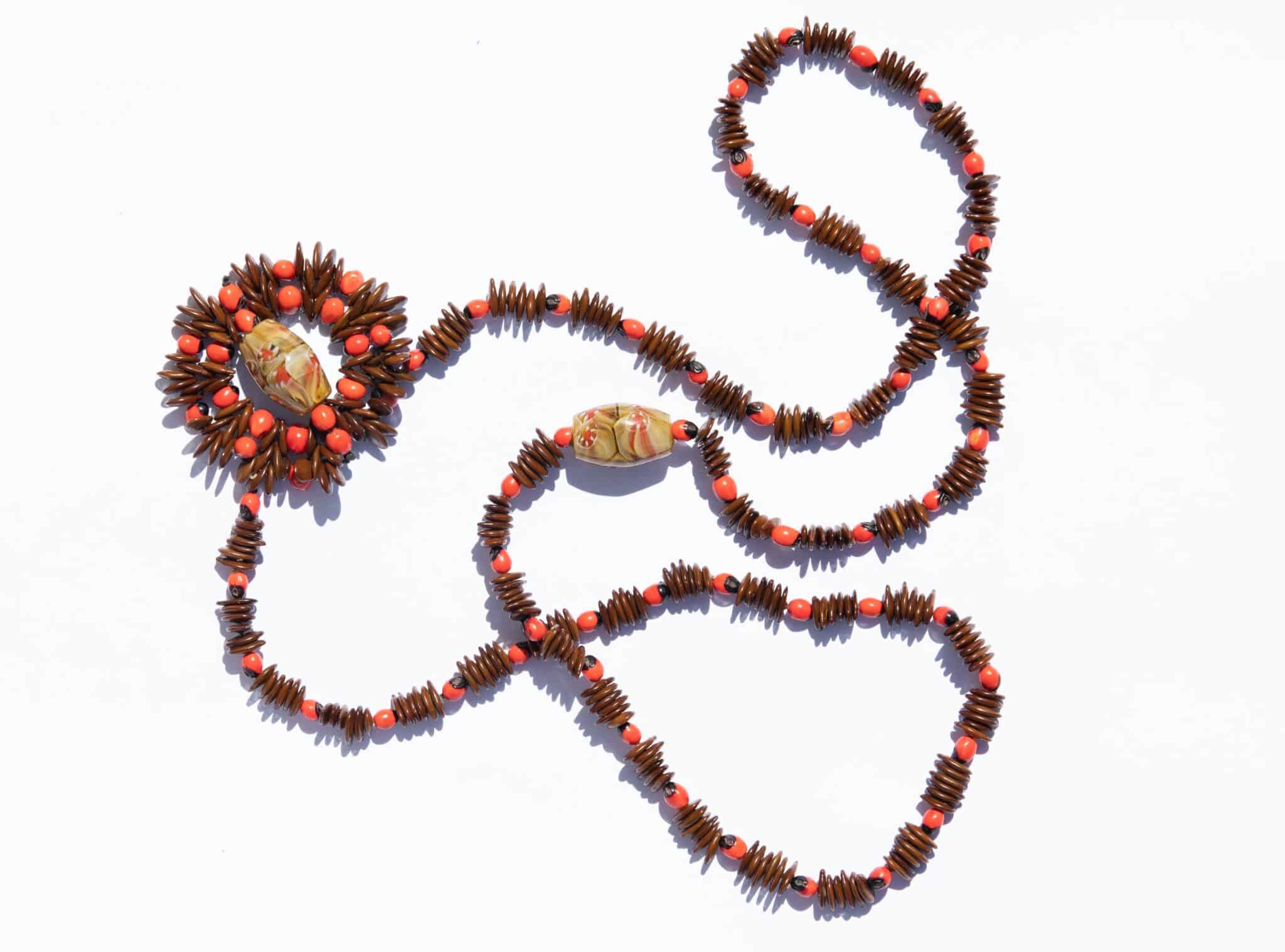
Photo: Thomas Barzilay Freund.
Botaniqué Studios Best of Both Worlds necklace. Style meets sustainability.


 Suzanne's Mom's Blog