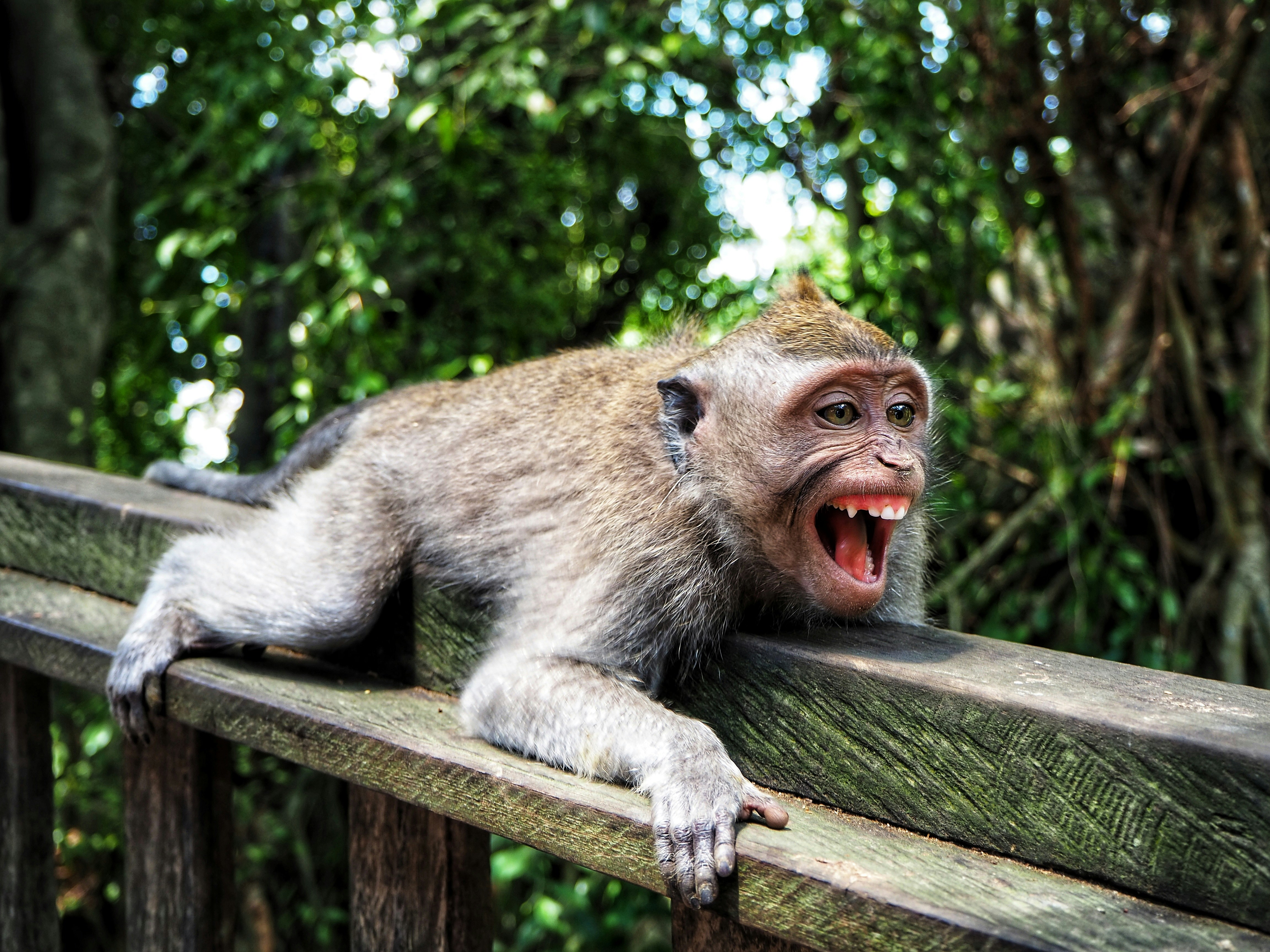
Photo: Simone Fischer/Unsplash.
Humans aren’t the only ones who like to share a good laugh.
Today’s story is about the similarities and differences in something we humans share with certain neighbors on Planet Earth. Laughter.
Emily Anthes writes at the New York Times, “Humor is deeply personal. A punchline or a pratfall that leaves one person doubled over in delight might elicit blank stares from another. But laughter is universal, an innate instinct shared by humans everywhere.
“And not just humans. Chimps chuckle, gorillas guffaw, bonobos bust a gut. All the planet’s great apes laugh, and they often do so in the same kind of regular, repeating rhythm that humans do, scientists found in a small new study.
“The research sheds light on how laughter evolved with and among great apes, becoming faster and more variable in humans. … Apes appeared to laugh in ways that were largely fixed; humans were more flexible in their expressions of mirth, changing up the tempo of their chuckles depending on the circumstance, the scientists found.
“ ‘I think we can say we are the masters of laughter,’ said Chiara De Gregorio, a research fellow at the University of Warwick in Britain and an author of the study. ‘We can have a small, polite laugh in front of the Queen of England, and then we are in the pub with our friends, and we laugh so much in a different way. We can even laugh in a way that communicates to the other person that we actually didn’t find the joke they said funny.’ …
“In the new study, which was published [in June] in the journal Communications Biology, the researchers analyzed the recorded laughter of four children and 13 young, captive apes: four orangutans, two gorillas, three bonobos and four chimpanzees. Some of the recordings featured laughter produced during play, while others captured laughter elicited by tickling.
“(Many of the recordings were initially created two decades ago by Marina Davila-Ross, a comparative psychologist at the University of Portsmouth in Britain and an author of the new study. ‘I wasn’t lucky enough to be there tickling baby gorillas at the time,’ Dr. De Gregorio said.)
“During tickling, the scientists found, all the species produced laughter that shared the same basic rhythmic characteristic: It was isochronous, meaning that each vocalization — each pant, hoot or ‘ha’ — occurred at regular, evenly spaced intervals, like the ticking of a clock or metronome.
“The scientists did not observe this same regularity in the laughter that [humans] produced during play, perhaps because the physical, rough-and-tumble nature of many of these play sessions disrupted regular breathing patterns.
“Though the laughter of humans and apes shared some basic rhythmic properties, the tempo, or speed, of these rhythms varied considerably. … On average, humans had laughter that was quicker. …
“Even though humans were the fastest laughers on average, they displayed enormous variability in their laugh speeds, laughing languidly in some circumstances and rapidly in others. They [also changed] the tempo of their laughter depending on the context, laughing faster, for instance, while being tickled than during play.
“The study had limitations; the subject pool was small, and the researchers analyzed just a handful of laughter’s many characteristics. But future studies with larger sample sizes could help scientists learn more about how humans made it their own.
“ ‘Laughter is such an important part of our way of communication,’ Dr. De Gregorio said. ‘It’s able to communicate way more than, “I’m playing and I’m having fun.” ‘ “
More at the Times, here. Check out the recordings of various kinds of apes laughing.


