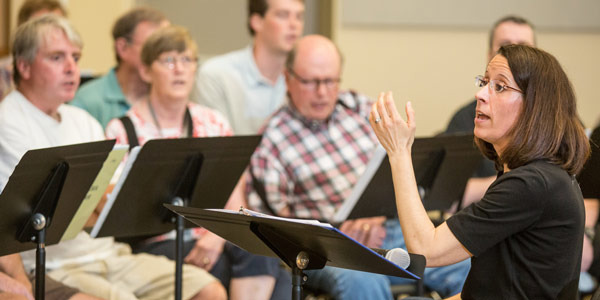
Photo: The Aphasia Choir of Vermont. Aphasia Choir of Vermont founder and director Karen McFeeters Leary leading the group in a concert. Aphasia is caused by damage to the parts of the brain that control language.
We all know, or knew, someone who lost the ability to speak well because of a stroke or other brain injury. The condition is called aphasia. We also have heard that music can do miracles for people with disabilities — dementia for example. (Click here.)
Now read about the Aphasia Choir of Vermont and how it produces miracles for people with aphasia — and their families.
From the website: “The Aphasia Choir of Vermont was founded in 2014 by singer/songwriter and former speech-language pathologist Karen McFeeters Leary.
“The choir is composed of stroke and traumatic brain injury survivors who have expressive aphasia (difficulty talking or using language) as well as spouses, family members, University of Vermont (UVM) students studying speech-language pathology, and rehabilitation professionals from the UVM Medical Center who provide assistance.
“Because music is largely mediated by the undamaged hemispheres of the brains of people with aphasia, they can sing and are often fluent while singing even if they have severe difficulty speaking or are nonverbal. Bringing these individuals together in song enables them to experience freedom of expression in a context that fosters social connections and a sense of belonging.
“In honor of National Aphasia Awareness Month, the Aphasia Choir of Vermont performs a free public concert each spring, wherein educational information is provided in order to raise aphasia awareness in our communities. Concert audiences have grown since the choir’s inception, and attendees have used words and phrases such as ‘amazing’ and ‘awe-inspiring’ to describe what they’ve witnessed. In 2020, the American Stroke Association chose the Aphasia Choir of Vermont as the winner of their Stroke Hero Award for Outstanding Group. …
“If you or someone you know has aphasia and is interested in joining next year’s choir program, please contact Karen McFeeters Leary at kmcfeeters@aol.com or (802) 288-9777 for more information.”
But if you don’t live in Vermont, you should know there are aphasia choirs around the world. Click here.
It was my daughter-in-law who first heard about this music program in Vermont and knew it would be great for the blog. More here.
Photo: Juan Rumimpunu via Unsplash. Thinking? This pensive character looks like me when I’m struggling with word retrieval.
With every passing year, most of us take a bit longer to retrieve le not juste. Sometimes a lot longer.
The research of Nichol Castro, assistant professor of communicative disorders and sciences at the State University of New York at Buffalo, looks at “word retrieval in aging adults and adults with language impairments (e.g., aphasia, dementia), with a particular focus on how words are organized in memory.” What I loved about this story is learning that no two people have the same way to retrieve words because no two people have built up exactly the same associations with words.
Castro writes at the Conversation, “Just like a physical dictionary, your mental dictionary contains information about words. This includes the letters, sounds and meaning, or semantics, of words, as well as information about parts of speech and how you can fit words together to form grammatical sentences. Your mental dictionary is also like a thesaurus. It can help you connect words and see how they might be similar in meaning, sound or spelling.
“As a researcher who studies word retrieval … I’m intrigued by how words are organized in our mental dictionaries. Everyone’s mental dictionary is a little bit different. And I’m even more intrigued by how we can restore the content of our mental dictionaries or improve our use of them, particularly for those who have language disorders. …
Your personal mental dictionary is customized based on your individual experiences.
“What words are in my mental dictionary might overlap with the mental dictionary of someone else who also speaks the same language, but there will also be a lot of differences between the content of our dictionaries.
“You add words to your mental dictionary through your educational, occupational, cultural and other life experiences. This customization also means that the size of mental dictionaries is a little bit different from person to person. …
“There is a lot of debate about how mental dictionaries are organized. Many scholars agree that it’s probably not like an alphabetized book.
“One widely rejected theory, the grandmother cell theory, suggests that each concept is encoded by a single neuron. This implies that you would have a neuron for every word that you know, including ‘grandmother.’
“While not accepted as accurate, the aspect of the grandmother cell theory suggesting that certain parts of the brain are more important for some types of information than others is likely true. For example, the left temporal lobe on the side of your brain has many regions that are important for language processing, including word retrieval and production. Rather than a single neuron responsible for processing a concept, a model called parallel distributed processing proposes that large networks of neurons across the brain work together to bring about word knowledge when they fire together.
“For example, when I say the word ‘dog,’ there are lots of different aspects of the word that your brain is retrieving, even if unconsciously. You might be thinking about what a dog smells like after being out in the rain, what a dog sounds like when it barks, or what a dog feels like when you pet it. You might be thinking about a specific dog you grew up with, or you might have a variety of emotions about dogs based on your past experiences with them. All of these different features of ‘dog’ are processed in slightly different parts of your brain. …
“Your mental dictionary can’t be like a physical dictionary [because] it is dynamic and quickly accessed. Your brain’s ability to retrieve a word is very fast. In one study, researchers mapped the time course of word retrieval among 24 college students by recording their brain activity while they named pictures. They found evidence that participants selected words within 200 milliseconds of seeing the image. After word selection, their brain continued to process information about that word, like what sounds are needed to say that chosen word and ignoring related words. This is why you can retrieve words with such speed in real-time conversations. … Until you have a breakdown in word retrieval. One common failure in word retrieval is called the tip-of-the-tongue phenomenon.
It’s the feeling when you know what word you want to use but are unable to find it in that moment.
“You might even know specific details about the word you want, like other words with similar meaning or maybe the first letter or sound of that word. With enough time, the word you wanted might pop into your mind.
“These tip-of-the-tongue experiences are a normal part of human language experience across the life span, and they increase as you grow older. One proposed reason for this increase is that they’re due to an age-related disruption in the ability to turn on the right sounds needed to say the selected word.
“For some people, though, tip-of-the-tongue experiences and other speech errors can be quite impairing. This is commonly seen in aphasia, a language disorder that often occurs after injury to the language centers of the brain, such as stroke, or neurodegeneration, such as dementia. …
“Fortunately, there are treatments available that can help someone improve their word retrieval abilities. For example, semantic feature analysis focuses on strengthening the semantic relationships between words. There are also treatments like phonomotor treatment that focus on strengthening the selection and production of speech sounds needed for word production. There are even apps that remotely provide word retrieval therapy on phones or computers.” Find out more at the Conversation, here.
National Public Radio recently featured a researcher who has figured out a way to help people who can’t talk by matching the sounds they are able to make to someone else’s voice and creating a synthetic voice.
“Speech scientist Rupal Patel creates customized synthetic voices that enable people who can’t speak to communicate in a unique voice that embodies their personality.
“Rupal Patel directs the Communication Analysis and Design Laboratory at Northeastern University. She helped found VocaliD, an organization working to help the millions of people who use computerized devices to communicate in unique voices.
“Patel’s technique to move beyond the usual generic male voice. She samples the tones of those with severe speech disorders and matches them with a surrogate talker. By blending the two, the team can create a synthetic voice to match the person using it.”


 Suzanne's Mom's Blog