Feeds:
Posts
Comments

Posts Tagged ‘stroke’

Photo: Maxine Wallace/Washington Post.
Participants feel joyful while singing in a choir that helps stroke and brain injury survivors restore what was lost
.

Hope no one’s getting tired of posts on healing through music. I really like them, especially as there’s a lot of stroke in my family and I feel like I’m in the queue. Today’s article, from Washington DC, focuses on rehabilitation after stroke and brain injury.

At the Washington Post (via MSN), Jasmine Golden interviewed several patients in the program.

“Susan Robinson flipped through printed pages of lyrics as she sat alongside her fellow singers. Microphone stands were lined up nearby. The lunch-hour performance was set to begin just after noon. But Robinson had arrived at 11 a.m. Thursday. She wanted enough to time to warm up and relax, she said.

“Five years earlier, Robinson, a wife, mother, and retired speech and language pathologist at D.C. Public Schools, experienced a stroke while she was asleep. She now has weaker mobility on her left side.

“ ‘The first thing I said is, “I’m going to beat this,” ‘ recalled Robinson, 63. …

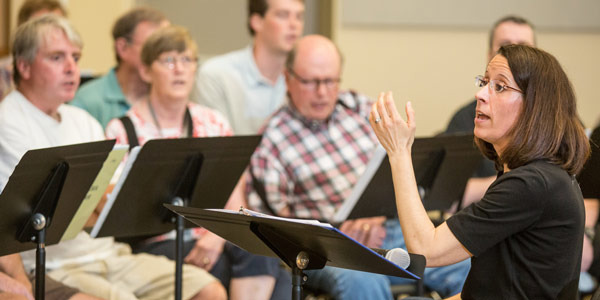
“Now, she’s part of a choir of other stroke and brain injury survivors who have found community through the neurologic music wellness program at MedStar National Rehabilitation Hospital in the District. …

“ ‘All right,’ Dana Griff, who leads the program, said to the crowd with a smile. ‘Y’all ready?’

“Griff played the piano as the choir began with ‘Lift Every Voice and Sing,’ referred to as the Black national anthem. …

“Griff, 31, a board-certified music therapist, came up with the idea for a choir to provide continued care for people who have completed inpatient rehabilitation or who have otherwise passed through the hospital. The choir officially launched last July, and Thursday marked its third performance.

“Since it began, participants have seen some encouraging changes, they said. Singing is improving 41-year-old Brandie Stinson-Brown’s memory, restoring 54-year-old Tiffany King’s confidence and giving Harriet White, 68, who sang in several groups before her stroke, the ability to harmonize again. …

“The choir is part of a wellness program at the hospital that uses music to stimulate neurologic change in the brain and help patients with speech, movement, coordination and mood, Griff said. Philanthropy keeps the program going. Donors, some of whom are referred to as ‘grateful patients,’ include former patients of MedStar who want to give back.

“Most choir members met through the hospital’s expansive adaptive programming, including sports and fitness, and are considered outpatient.

“Robinson began her physical therapy with circuit training. She remembers singing along to tunes with others at the hospital. Griff, who met Robinson and participants in various programs, proposed a choir. They jumped on the idea.

“Griff remembers seeing a choir perform adorned in red robes when she was a child, sparking her interest in musical assembly. While the hospital’s choir doesn’t have robes, its members do wear matching light-blue shirts emblazoned with their group name — Vocal Cortex, a group of people ‘coming together to form one,’ Griff said. …

“Members of Vocal Cortex say they’re family who love one another. They go to movies, spend time on park trails and eat dinner together. And every Thursday afternoon, about a dozen assemble for choir practice. …

“King said, ‘Being able to come together and just sing from our hearts is a beautiful thing.’

“At the recent lunchtime performance, songs ranged from gospel to groovy. The choir sang Whitney Houston’s ‘I Wanna Dance With Somebody,’ ‘The Lion Sleeps Tonight’ by the Tokens and a mix of other tunes reflecting the members’ preferences, Griff said. …

“Ellsworth Slye, 69, performed a solo midway through — ‘Swing Low, Sweet Chariot/Swing Down Chariot’ — his deep tone matching the sincerity of the lyrics. … ‘Sing it, Slye!’ someone from the crowd shouted.

“Deonte Gay, 36, listened from his table. An outpatient in therapy himself, he had watched the choir practice for weeks. Gay said that he joked with the group about singing louder, but he knows all too well what can happen to one’s voice after a life-altering brain injury. Gay survived a shooting nearly 17 years ago. …

“Gay said, ‘Sometimes you gotta push yourself a little harder, and you gotta get your wind patterns up.’ …

“Throughout the half-hour performance, a smile never left Robinson’s face.

“ ‘We’re able to bounce back and celebrate life and sing,’ she said of performing.”

More at the Post via MSN, here.
Read Full Post »

Photo: The Aphasia Choir of Vermont.
Aphasia Choir of Vermont founder and director Karen McFeeters Leary leading the group in a concert. Aphasia is caused by damage to the parts of the brain that control language.

We all know, or knew, someone who lost the ability to speak well because of a stroke or other brain injury. The condition is called aphasia. We also have heard that music can do miracles for people with disabilities — dementia for example. (Click here.)

Now read about the Aphasia Choir of Vermont and how it produces miracles for people with aphasia — and their families.

From the website: “The Aphasia Choir of Vermont was founded in 2014 by singer/songwriter and former speech-language pathologist Karen McFeeters Leary.

“The choir is composed of stroke and traumatic brain injury survivors who have expressive aphasia (difficulty talking or using language) as well as spouses, family members, University of Vermont (UVM) students studying speech-language pathology, and rehabilitation professionals from the UVM Medical Center who provide assistance.

“Because music is largely mediated by the undamaged hemispheres of the brains of people with aphasia, they can sing and are often fluent while singing even if they have severe difficulty speaking or are nonverbal. Bringing these individuals together in song enables them to experience freedom of expression in a context that fosters social connections and a sense of belonging.

“In honor of National Aphasia Awareness Month, the Aphasia Choir of Vermont performs a free public concert each spring, wherein educational information is provided in order to raise aphasia awareness in our communities. Concert audiences have grown since the choir’s inception, and attendees have used words and phrases such as ‘amazing’ and ‘awe-inspiring’ to describe what they’ve witnessed. In 2020, the American Stroke Association chose the Aphasia Choir of Vermont as the winner of their Stroke Hero Award for Outstanding Group. …

“If you or someone you know has aphasia and is interested in joining next year’s choir program, please contact Karen McFeeters Leary at kmcfeeters@aol.com or (802) 288-9777 for more information.”

But if you don’t live in Vermont, you should know there are aphasia choirs around the world. Click here.

It was my daughter-in-law who first heard about this music program in Vermont and knew it would be great for the blog. More here.

Read Full Post »

Photo: Pari Naderi 
In the dance called Stroke Odysseys, projections reveal stroke victims’ inner thoughts.

What is your experience of stroke? Both my brothers recovered from theirs, but our father was incapacitated by a stroke in his late 40s and lived as an invalid for the next 23 years. Medicine has improved a lot since then, as have programs that get people moving again.

At the Guardian, Lyndsey Winship has an interesting story about life after stroke.

“It was around four in the morning when Pauline Boye woke up and realised she couldn’t move. ‘I was unable to get up,’ she remembers. ‘I called to my partner, “Can you help me? I can’t get up!” ‘

“Boye, who was 47, had suffered a stroke. She spent four months in hospital, and was left with physical impairment down her right side and difficulty with her speech. The former nurse suddenly went from caring for others to being the one in need of care. Once she was home, she didn’t want to leave the house. …

“Boye was shy even to speak, worried that people wouldn’t understand her. But eight years later, on stage in front of me, she is acting out a scene based on her time in hospital, her voice carrying across the stage. Clearly she is not ashamed any more.

“The transformation is thanks to the [UK] organisation Rosetta Life and its director, Lucinda Jarrett, who works with artists and health professionals to devise arts projects that have a meaningful impact on the lives of people with brain injuries. For Boye, this now means touring the country as a performer in Stroke Odysseys, a production by choreographer and director Ben Duke and the composer Orlando Gough, featuring a cast of musicians, dancers and five stroke survivors. …

“The physicality of each person is different and shows vulnerability but also determined strength. Through a series of scenes and songs, the performers’ experiences – of struggling to express themselves, mixing up words – come to life, with projections cleverly revealing inner thoughts and subtext. …

“The discipline of rehearsals, the camaraderie and the drive towards performance can offer very real motivations and therapeutic benefits. ‘The key outcomes are increased mobility, increased cognition, increased verbal articulacy,’ says Jarrett. One in three people experience depression after a stroke, but evaluations of Rosetta Life’s work shows that it has ‘enabled people to change the perception of their disability and look forward to a new life’, says Jarrett. Reducing depression means people stay more active and are less isolated, and hopefully therefore less prone to accidents, second strokes and hospital readmissions.

“In that light, it is surprising when Duke says: ‘I’m interested in the idea of dance as a useless activity.’ But he goes on to explain the benefits of physical activity that have no practical function. When you lose the use of one hand, for example, you tend to use your other hand instead, and the impaired hand becomes weaker as a result. Whereas with dance, the performers are asked to make gestures simply because it’s the choreography, and they’re forced to do things they might not otherwise. …

“ ‘For Pauline, dancing was a big part of her life,’ Duke says, remembering the day she brought in some videos of her dancing at a wedding. ‘But the first time she talked about it, she stood up and she [danced], and even now with her limited movement, it’s all there. Physically it is a fraction of how she used to be, and yet, it’s there. The body lights up.’ ”

More at the Guardian, here.

Read Full Post »