Feeds:
Posts
Comments

Posts Tagged ‘archive’

Photo: Library of Congress.

I have often thought about what we’ve lost in the digital age, when we can no longer scrutinize the thought process of a novelist from seeing her many revisions. Nor can we learn much about the significant people in her life, given that so many of her emails and texts will have been erased.

What will biographers do? How will today’s archivists deal with the challenge?

Michael Waters writes at the Atlantic (via MSN), “It was long the case that archives were full of physical ephemera. Think of Oscar Wilde’s love letters to Lord Alfred Douglas; … Sylvia Plath’s shopping list; Malcolm X’s lost poem; and other scraps of paper buried in boxes. Today, text messages and disappearing voice notes have replaced letters between close friends, Instagram Stories vanish by default, and encrypted platforms such as Signal, where social movements flourish, let users automatically erase messages. Many people write to-do lists in notes apps and then delete them, line by line, when each task is complete.

“The problem for [historians]: On the one hand, celebrities, artists, executives, and social-movement leaders are generating more personal records than ever, meaning a lucky researcher might have access to a public figure’s entire hard drive but struggle to interpret its contents. On the other hand, historians might lose access to the kind of intimate material that reveals the most. …

“The work of history starts with a negotiation. A public figure or their descendant — or, say, an activist group or a college club — works with an institution, such as a university library, to decide which of the figure’s papers, correspondence, photos, and other materials to donate. Archivists then organize these records for researchers, who, over subsequent years, physically flip through them. These tidbits are deeply valuable. They reveal crucial details about our most famous figures and important historical events. …

“Over the past two decades, the volume of these donations has increased dramatically. When Donald Mennerich, a digital archivist at NYU, first started working in the field, 15 years ago, writers or activists or public figures would hand over boxes of letters, notes, photos, meeting minutes, and maybe a floppy disk or a ‘small computer that had a gigabyte hard drive,’ he told me. Now, Mennerich said, ‘everyone has a terabyte of data on their laptop and a 4-terabyte hard drive’ … plus an email inbox with 10,000 messages or more. …

“Now many libraries possess emails that they don’t have the bandwidth to make accessible to researchers. … Even when an email archive is made public … it’s easy to get lost in the chaos. Jacquelyn Ardam, a writer and a literary scholar, was one of the first people to visit Susan Sontag’s archive, which she told me was filled with digital clutter: Sephora marketing emails, files with unlabeled collections of words (rubberyineluctable), and lots and lots of lists — of movies she’d liked, drinks she’d enjoyed. …

“Among that mess of information, however, Ardam found emails confirming Sontag’s relationship with the photographer Annie Leibovitz, which Sontag had denied. All Ardam had to do to locate them was ‘search her computer for the word Annie,’ she said. …

“In the past, even a writer of Sontag’s stature would typically have a small-enough correspondence collection that they could plausibly review the letters they were planning to donate to an archive—and perhaps wouldn’t have included missives from a secret lover. But the scope of our digital lives can make it much harder to account for everything (imagine giving up your whole social-media history to a researcher) and much easier for a historian to locate the tantalizing parts with a single search.

“Of course, that’s if historians are lucky enough to access records at all. Many people delete their old texts to save storage space. … Mennerich said he’s been locked out of the email accounts of several deceased public figures because they never shared their passwords. …

“Archivists might be able to sidestep some of these problems by rethinking how they present collections of digital records. Today, after archivists do their initial review of a collection, visitors can typically get a complete box of someone’s letters with no questions asked. With emails, conducting that whole initial review up front would be so much more time intensive that blanket access might no longer be realistic. …

“The archivists I spoke with told me they’re all bracing themselves for the moment when, inevitably, a public figure donates their smartphone. It is in some ways the most personal kind of donation someone can make, offering access to text and WhatsApp histories, photos, Tinder messages, saved recipes, TikTok likes. Such a donation seems both likely to reveal more than a person’s emails ever could and even harder to sort through and interpret.”

More at the Atlantic, here.
Read Full Post »

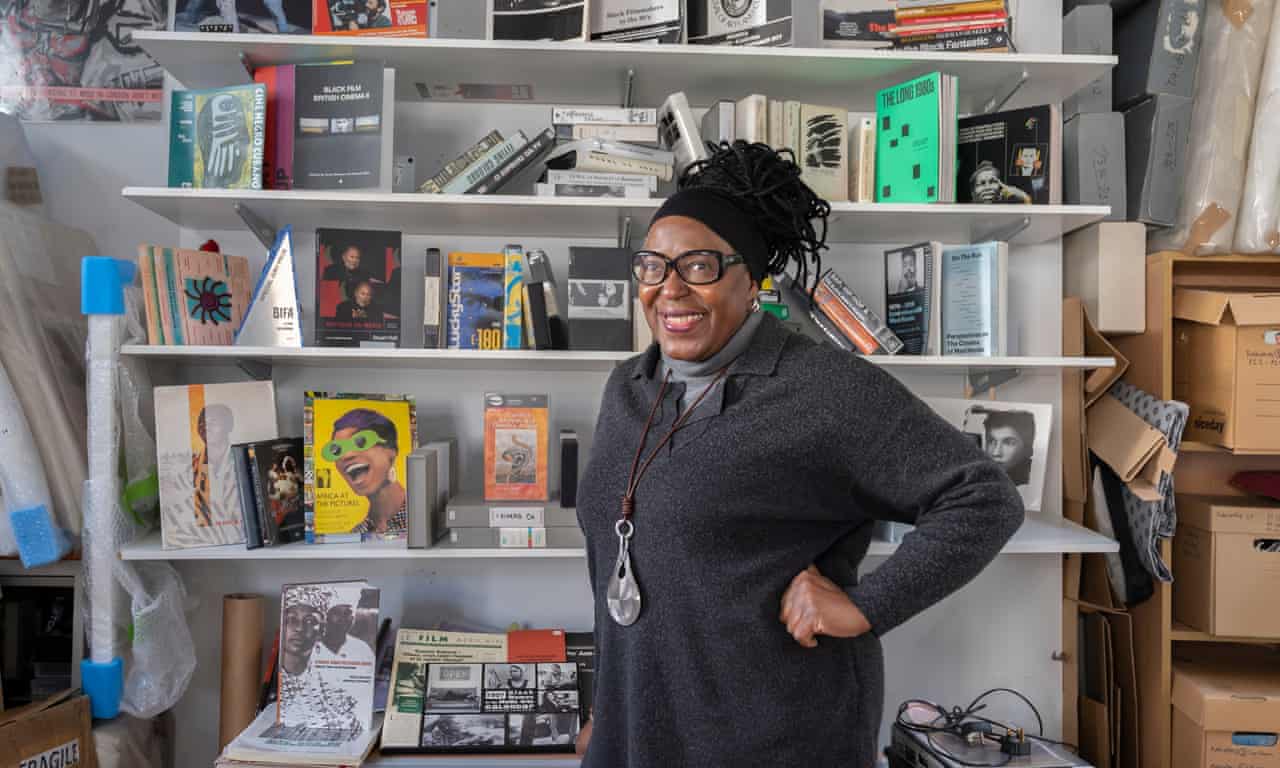
Photo: Amaal Said/JGPACA [June Givanni Pan African Cinema Archive].
From a Mogadishu film week
poster to VHS videos of pioneering art movies, June Givanni has collected a range of Black film artifacts and is now ready to share.

Sometimes people whose childhood struggles involve race-based discrimination grow up to embrace and trumpet the beauty of their heritage. I enjoy stories like that.

At the Guardian, Leila Latif interviews one such person, the founder of June Givanni Pan African Cinema Archive.

Discussing her recent exhibition, “PerAnkh: The June Givanni Pan African Cinema Archive,” Givanni played down the show’s title. Says Latif, “The Black British film curator, activist and archivist who created it is hesitant about positioning herself front and center.

“ ‘I don’t want it to sound like it’s all me, me, me,’ she worries. ‘My name is part of it because I worked as a curator for many years and collected work throughout the non-digital era, which developed into this archive.’

“Though she wants the films, documents, artworks and objects she has preserved to be the focus of people’s attention – from an installation of the earliest audiovisual works by the Black Audio Film Collective to new works by the Chimurenga collective from South Africa – Givanni is more than worthy of the spotlight. When she received the British independent film awards’ grand jury prize in 2021, the organizers said that she had ‘made an extraordinary, selfless and lifelong contribution to documenting a pivotal period of film history.’

Born in British Guiana 72 years ago, Givanni moved to the UK aged seven and was immediately underestimated.

“ ‘They put me with the five-year-olds because I was Black and I’d come from the Caribbean,’ she remembers. ‘My mum went to the school twice before they moved me up to my age range.’

“As an adult, Givanni collaborated with some of the most significant figures and institutions in pan-African cinema and across ‘different territories, different continents.’ She kept adding elements to her collection, she says, ‘because I needed to use them for subsequent programs and as part of building a body of knowledge and a whole series of resources that can be shared with others.’

“Lack of preservation has meant many of pan-African cinema’s masterworks have disappeared. In America alone, it is estimated more than 80% of Black films from the silent era are lost, and technological advances endanger film further. While physical film has a potential shelf life of hundreds of years, digital preservation requires constant migration to keep up with changing technology. …

“Givanni has faced changes in technology, politics and culture since she began in the early 80s. The first film festival she worked on was called Third Eye, inspired by the Latin American Third Cinema movement which set out to challenge Europe and North America’s dominance in film. For Givanni, the festival provided ‘an area to develop our own ideas about representation and taking charge. Pan-African cinema has always been a cinema of resistance. I can’t tell you how inspiring it was that there were all these people out there doing things that really chimed with what I thought should be happening.’ …

“She programmed festivals on five continents; worked for Greater London Council’s ethnic minorities unit and the Independent Television Commission; ran the BFI’s African Caribbean film unit and co-edited Black Film Bulletin, which relaunched in 2021 as a quarterly collaboration with Sight and Sound magazine, and has celebrated the under-sung work of film-makers. …

“The spirit of pan-Africanism was a guiding light, connecting all cultures that originated on the continent without treating them as a monolith. Givanni explains, ‘When I say pan-African, it’s not just the African continent; it’s the entire diaspora. All those significant histories are interconnected and cinema is very much part of that.’

“Choosing how to represent that history at Raven Row, with selections from an archive that now surpasses 10,000 items, was a gargantuan task. But Givanni immediately knew she wanted to include ‘a poster of the Mogadishu film week, given to me at my first attendance at the Fespaco film festival in 1985 by a Somali film-maker. Now people mention Somalia and they don’t picture these vibrant and strategic cultural events taking place there. …

“ ‘At the Havana film festival I bought a collection of silkscreen posters that will be exhibited. Lots of art can be seen digitally, but to see a silkscreen poster, the texture and the color of it – there’s an experience of culture and artifacts that goes beyond digital representation.’

“Beyond allowing the public to admire key objects from Givanni’s collection, the exhibition is structured around a program of films from the likes of Sarah Maldoror and Ousmane Sembène (the mother and father of African cinema). There is also an archive studio and reading room in the spirit of the exhibition’s title, PerAnkh – an Egyptian term for ‘a place of learning and memory.’ “

More at the Guardian, here. No firewall.

Read Full Post »

An old, falling-apart film of a heath hen has been unearthed.

Why is that thrilling? The heath hen is extinct.

Writes Carolyn Y. Johnson in the Boston Globe, “The bird stamps its feet on the ground, taking mincing dance steps through the corn stubble. Neck feathers flare like a headdress, and the male puffs out his neck, making a hollow, hooting call that has been lost to history.

“These courtship antics are captured on a silent, black-and-white film that is believed to be the only footage of something not seen for nearly a century: the extinct heath hen.

“The film, circa 1918, is the birding equivalent of an Elvis sighting, said Wayne Petersen of Mass Audubon — mind-blowing and transfixing to people who care. It will premier Saturday [March 8] at a birding conference in Waltham.

“Massachusetts officials commissioned the film nearly a century ago as part of an effort to preserve and study the game bird, once abundant from Southern New Hampshire to Northern Virginia. Then, like the heath hen, the film was largely forgotten.

“Martha’s Vineyard is where the last known heath hens lived, protected in a state preserve. But the last one vanished by 1932. …

“Jim Cardoza, a retired wildlife biologist who worked for the Division of Fisheries and Wildlife, said that for him, the film holds lessons about how conservation efforts have evolved.

“ ‘The thing that is striking to me is the habitat of the animal — it looks like they’re out in corn fields and open areas and things like that,’ Cardoza said. ‘That isn’t what the birds really inhabited — they were a scrub-land species.’ Conservationists at the time, he said, ‘didn’t know what the habitat requirements of the species even was.’  ”

Read the rest of the article and watch the film here.

I love the idea of a long-rumored, valuable film finally being found. It’s a great story. It’s also an argument for better filing systems.

State of Massachusetts woodcut, 1912. The fancier heath hens are males.

Read Full Post »