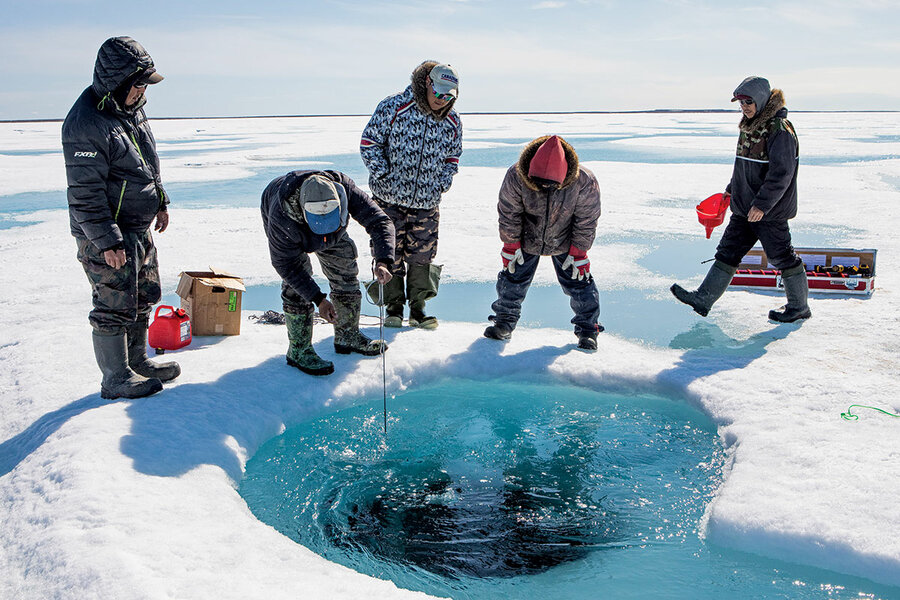
Photo: Melanie Stetson Freeman
The Christian Science Monitor highlights indigenous “Guardians” who made a “hole in Arctic Ocean ice – a window on climate-related changes – where they monitor water quality and measure ice thickness.”
Cold parts of the world are threatened. The cold-loving people who live there are deeply concerned and are monitoring the losses for climate scientists.
Sara Miller Llana writes for the Christian Science Monitor, “Masked against the Arctic glare in orange-tinted sunglasses, Tad Tulurialik is a modern conservation ‘Guardian’ of his fast-melting homeland.
“At the start of an early summer workday that never sees the sun set, he kicks his all-terrain vehicle into gear. Safe in his ancestors’ knowledge of sea currents and ice fissures, he navigates a course right off the edge of the Canadian shore onto the aqua iridescence of the frozen Arctic Ocean. He’s following older Guardians to a manmade hole in the ice shelf, a window toward understanding climate-related changes in the sea.
“Even out on the ocean surface, his rifle is always swung over his shoulder. Wherever he sees a caribou or musk ox, it’s an existential given that he’ll take it. Food security isn’t found in a grocery aisle in this northernmost Canadian mainland settlement, tellingly named with the Inuktitut word for a caribou hunting blind.
“In some ways, as a government-paid conservation Guardian in training, the 24-year-old Mr. Tulurialik is doing what he’s done his whole life. Like most Inuit boys, he was ‘on the land’ as soon as he could walk. His childhood was spent on tundra and on sea and lake ice to hunt and fish with his grandparents, who raised him. His life was marked not by school grades but by first fox trapped, first polar bear shot. These were such priorities that he dropped out of high school.
“That could have made him part of Canada’s persistent social inequality – Indigenous youth in some of the remotest parts of the country, undereducated, underqualified, and often losing touch with rich traditions and fleeing homelands for economic opportunity. Except today, he’s part of a solution, as a member of Canada’s Indigenous Guardians, a conservation corps working in 170 far-flung Indigenous communities.
“Guided and taught by elders, he and other young Inuit born since 1989, when warming of the Arctic turned precipitous, are part of an effort to safeguard their homelands and their cultural ‘right to be cold.’ They’re also helping Canada achieve international conservation commitments made last year, when it led a global pledge at the United Nations Biodiversity Conference in Montreal to protect 30% of its land and oceans by 2030.
“For Mr. Tulurialik, who worked in construction and sewer maintenance after leaving school, a paid job as a conservationist is a dream: ‘I never thought I would work and get paid for what I grew up doing.’
“Together, he and his Guardian colleagues are tasked with creating a sustainable future, transforming Western-style conservation work into something that more closely resembles a traditional Indigenous environmental ethos. Guardians blend science with Indigenous knowledge in a budding conservation economy dependent on the transfer of knowledge from elders to youth.
“The ultimate aim of the Guardians’ work in Taloyoak is to use their sustainable Inuit practices – learned orally over millennia – to support the creation and maintenance of an Indigenous Protected and Conserved Area. The size of Maine, it is one of more than 90 in development across Indigenous Canada. Here in northern Nunavut territory, the IPCA conservation plan is led by the local hunter and trapper association.
It’s nurturing an economy of land-based jobs and markets as an alternative to a future in extractive industries in a territory long eyed by mining and oil interests.
“The land will be protected from development, conserving both biodiversity and a way of life based on sustainable hunting and fishing – while sequestering huge amounts of carbon, the culprit in global warming.
“ ‘This is a win-win situation’ … says Paul Okalik, the first premier of Nunavut who now works with Canada’s World Wildlife Fund (WWF), which is supporting Taloyoak’s efforts. …
“Indigenous lands, from the Brazilian Amazon to Hawaii coastlines to Canada’s high-latitude forests, represent 20% of the globe but hold 80% of the world’s biodiversity. Inhabitants have stewarded the land for centuries. Yet in a warming climate, their homelands are in some of the most at-risk environments.
“The Arctic is this nation’s – and arguably the world’s – crisis point. Here, warming is happening at up to four times the rate of the rest of the world, leading to melting permafrost, retreating glaciers, and receding sea ice. This has broad implications for the global ecosystem. Arctic ice melt slows ocean currents and makes the oceans more acidic – changes that have global implications for both climate patterns and sea habitats. Increased melting also creates what scientists call a ‘positive feedback loop’: As dark water replaces white snow on ice, the surfaces of the ocean and Earth absorb more sunlight rather than reflecting it. This causes even more warming. …
“Taloyoak locals have already worried about warming changing their ways. Last summer was the Northern Hemisphere’s hottest on record. The year prior, Taloyoak recorded its all-time hottest temperature of 78.8 F. Locals stayed home rather than go outside in, for them, the unbearable temperature.”
Imagine the high 70s being unbearable! The rest of North America will be learning about “unbearable” soon — if it hasn’t already.
The Monitor‘s long and intriguing feature on the work in the far north is here. No firewall.


 Suzanne's Mom's Blog