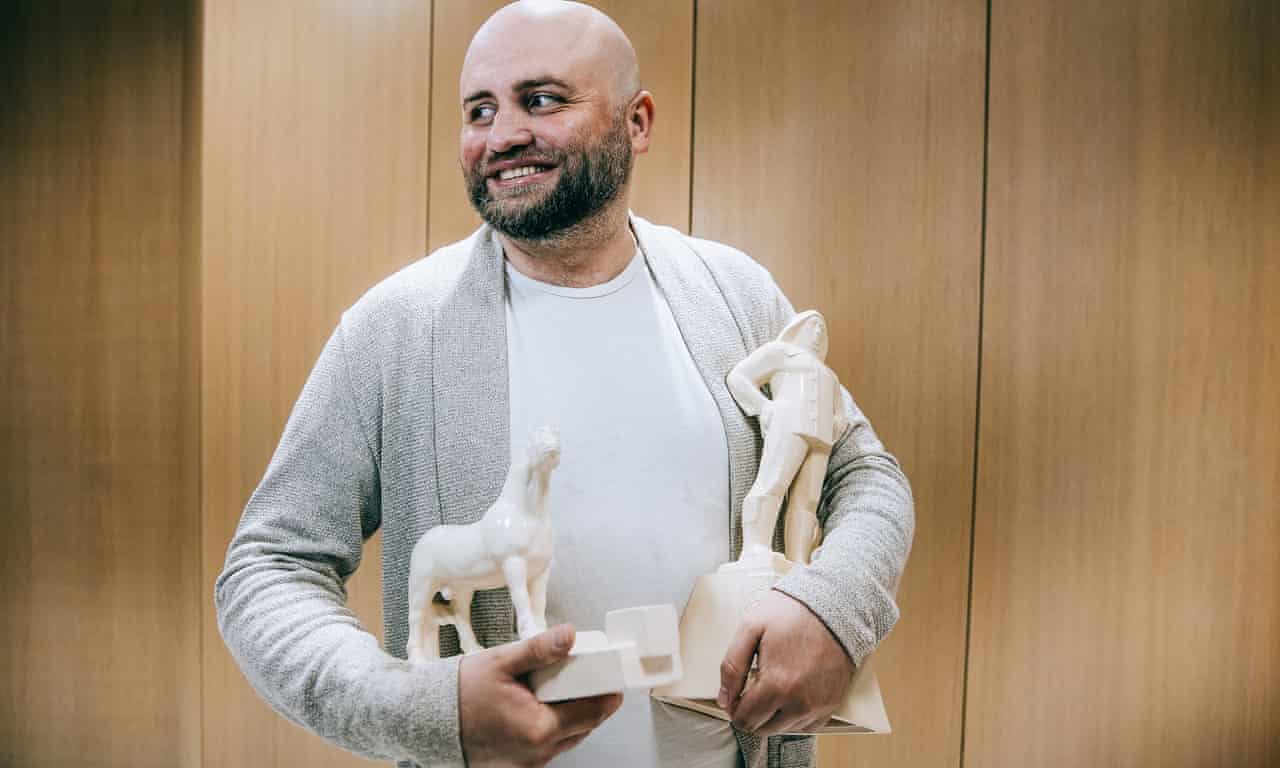
Photo: Julia Kochetova/The Guardian.
Leonid Marushchak with artworks from his private collection. He launched a death-defying rescue plan to help museums save Ukraine’s art from the invaders.
You may know about the Monuments Men, charged by President Roosevelt with protecting cultural heritage during World War II. In Ukraine, after the Russian invasion, private individuals took on a similar task. One man especially.
At the Guardian, Charlotte Higgins has a fascinating piece about what historian Leonid Marushchak and his cohorts have accomplished.
“In early March 2022, when his country seemed in danger of falling to the Russians, it occurred to Leonid Marushchak, a historian by training, to call the director of a museum in eastern Ukraine to check that a collection of 20th-century studio pottery was safe.
“He had loved the modernist works by artist Natalya Maksymchenko since he had encountered them almost a decade earlier. There were vessels covered with bold abstract glazes in purple, scarlet and yellow; exuberant figurines of musicians and dancers with swirling skirts; dishes painted with birds in flight. The collection was the radiant highlight of the local history museum in Sloviansk, the ceramicist’s home town.
“It was remarkable that they were in this small museum at all. Though she was born in Ukraine in 1914 and studied in Kharkiv, Maksymchenko had lived the rest of her life in Russia. But, after her death in 1978, her family, fulfilling her wishes, oversaw the transfer of about 400 works from her studio in Moscow to the city of her birth. … Maksymchenko’s final gift to her home town and country seemed like a statement of defiance.
“Now, as the Russian army inched nearer and nearer to the museum, Marushchak worried that these works in delicate porcelain could be destroyed by a missile in a moment – or, if Sloviansk were occupied, taken by the invaders back to Moscow. Had the ceramics been prioritized for the first round of evacuations, Marushchak asked the museum director on the phone.
“ ‘Lyonya, what round?’ came the reply. ‘We still haven’t got the order to evacuate!’
“Marushchak phoned his friend Kateryna Chuyeva, who was then Ukraine’s deputy minister for culture. ‘Katya,’ he asked her, ‘why have you still not given the order for the Sloviansk museum?’ She explained that she couldn’t just authorize it herself – the regional authorities needed to request it first. So he called the region’s culture department. They said that to issue an order, they would first need a full list of items to be evacuated.
“Marushchak was furious. The situation was urgent; there was no time for that kind of paperwork. ‘Let’s just say I have sometimes had to take my time and breathe slowly,’ said Chuyeva, in the face of her friend’s sometimes volcanic passion. She found a way to break the bureaucratic impasse. Before the official order had even arrived, Maruschak was on his way to Sloviansk.
“Marushchak cannot drive. … Without his own means of getting to Sloviansk, Marushchak had his brother-in-law drive him from Kyiv 300 miles east to the city of Dnipro. From there, friends took him a further 50 miles, to the city of Pavlohrad. Then he walked to the last checkpoint in town and hitched a lift for the last 120 miles – this time, on a Soviet-era armored personnel carrier.
“In Sloviansk, artillery boomed alarmingly close; the opposing armies were fighting over a town only 18 miles away. When Marushchak reached the museum, staff were finally packing up the exhibits – though, to his annoyance, the official instructions on what should be prioritized dated from 1970, and stated that what he referred to as ‘an old bucket of medals’ from the second world war should be rescued first. Aside from the Maksymchenko ceramics and the medals, there was also a natural history collection to deal with – AKA, stuffed animals, which, just to add another layer of danger to the enterprise, had probably been preserved with highly toxic arsenic. …
“Since those early days of the war, with the help of a motley group of intrepid friends, Marushchak has achieved something quite extraordinary. He has organized the evacuation of dozens of museums across Ukraine’s frontline – packing, recording, logging and counting each item and sending them to secret, secure locations away from the combat zone. Among the many tens of thousands of artifacts he has rescued are individual drawings and letters in artists’ archives, collections of ancient icons and antique furniture, precious textiles, and even 180 haunting, larger-than-life medieval sculptures known as babas, carved by the Turkic nomads of the steppe.
“ ‘At times,’ said Chuyeva, ‘he has been doing almost unbelievable things’ – putting himself into extreme personal danger for the sake of often humble-seeming regional museum collections on Ukraine’s frontline.
“A nation’s understanding of itself is built on intangible things: stories and music, poems and language, habits and traditions. But it is also held in its artworks and artifacts, fragile objects that human hands have made and treasured. Once lost or destroyed, they are gone for ever, along with the stores of knowledge they contain, and potential knowledge that future generations might harvest from them. For Marushchak, his country’s culture, no less than its territory, is at stake in this war: a culture that Vladimir Putin has repeatedly claimed has no distinct existence, except as an adjunct to Russia’s.
“On that day in Sloviansk, something became clear to him: there was no point relying on official evacuation efforts. If he wanted to see the job done, he was going to have to do it himself. ‘He had to do it with his own hands,’ his friend, the artist Zhanna Kadyrova told me. ‘There was no one else.’
This is a long article. Read it at the Guardian, here. No paywall, but contributions are solicited.

 Suzanne's Mom's Blog