Photo: Shandra Back.
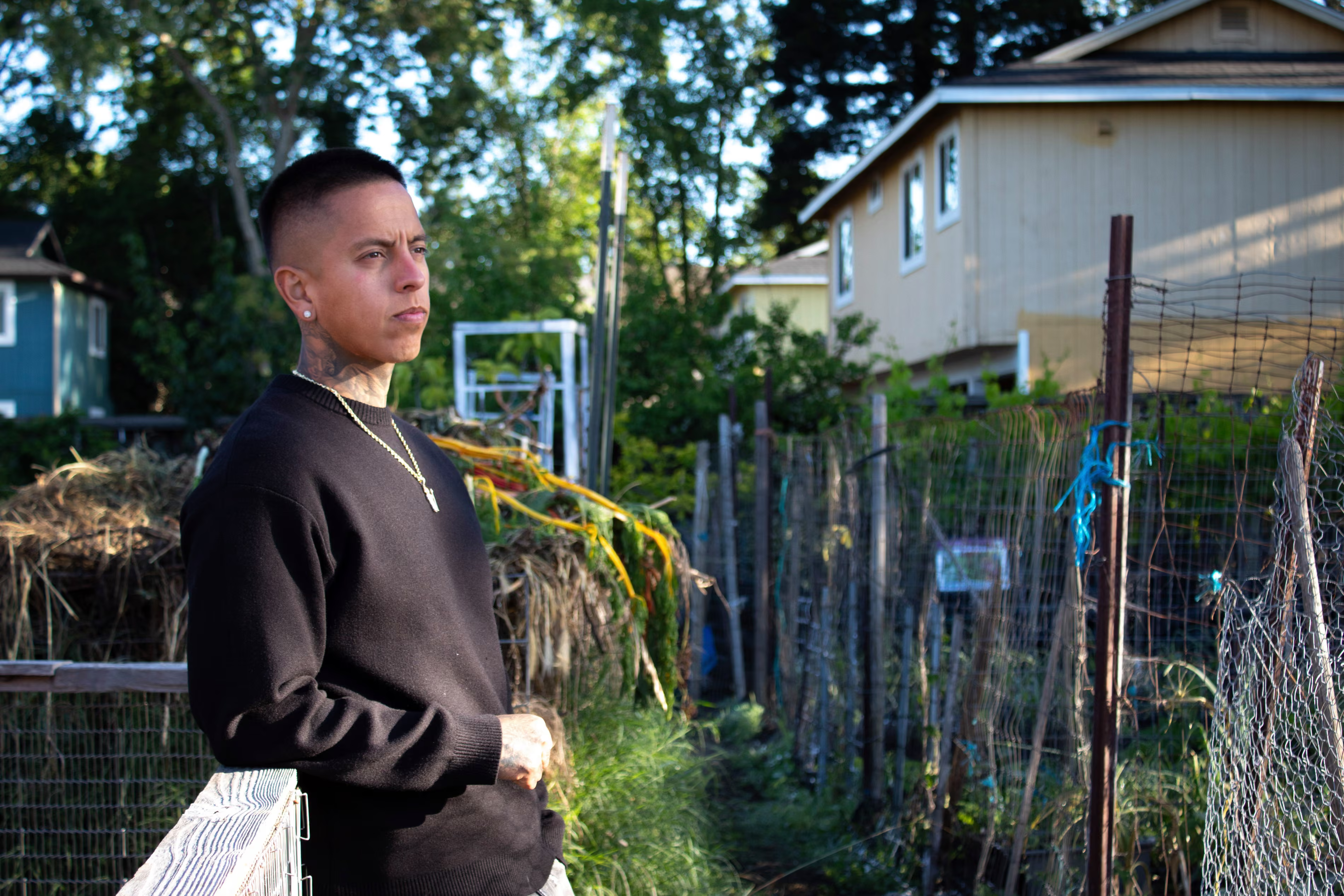
Danny Chaparro at Bayer farm in Santa Rosa, California’s Roseland neighborhood where he hosts outdoor activities for young people through LandPaths.
A California organization is doing some great work with young people drawn to gangs.
Shandra Back writes at the Guardian about LandPaths, which “takes at-risk youth out of their concrete, urban environments and into the natural one, offering many their first encounters with the land.” She begins with one of the participants.
“Alejandro Elizarraraz stands in the middle of a grassy field with a saw in his hands. On a hillside overlooking the lush forests of northern California, the 18-year-old cuts back brush and branches as a way to help prevent wildfires.
“ ‘We’re going to give the tree a high fade cuz it’s 10 feet,’ he said, grinning. …
“Wiping rain and sweat from his brow, he leans into the last branch, hears a crack, and lets out a whoop as it falls to the ground. His black Nike Air Force squelch through mud as he carries the pieces to a large pile, which will later be burned to eliminate fuel for future wildfires.
“He grew up in the northern California city of Santa Rosa, nearly 60 miles north of San Francisco. While the surrounding region is best known as a destination for wine, redwoods and rugged coastline, the city also has high levels of gang activity.
“The city has also been touted for its innovative youth violence prevention work. Now, it’s pioneering a new strategy: outdoor youth violence‑prevention programs that use the natural beauty of the region as a way to mitigate gun violence.
“Working with the city, LandPaths, an environmental conservancy non-profit, takes at-risk youth out of their concrete, urban environments and into the natural one, where they hike, camp and explore the natural wonders of Sonoma county, offering many of them their first encounters with the land. …
Elizarraraz pulls back the hood of his poncho for a better view of the mist-filled hills. ‘Like, damn,’ he said. ‘I feel amazed when I see all of this.
“Ocean Song/Meyers preserve, the coastal prairie and oak woodland where LandPaths hosts some of its programming, is only a 45‑minute drive from the neighborhood Elizarraraz grew up in. But the high schooler, who started in the program last year, says he had never spent time outdoors before he started working with the group.
“ ‘I never had a personal connection with nature,’ he said. Most Saturdays he would stay inside and watch TV. Now, things are different. …
“Like many teens who come through LandPaths’s violence prevention program, Danny Chaparro grew up in Roseland, a predominantly Latino neighborhood in Santa Rosa with a long history of gang violence. For more than a decade he has worked in youth violence prevention, showing young people that a kid from Roseland who looks like them can grow up to lead a prosperous life. …
“As LandPaths’s new audiences manager, he oversees programs that bring underserved communities out into nature. Chaparro always knew he wanted to uplift the community he came from, but never imagined his job would be bringing at-risk youth into outdoor spaces he himself never explored. …
“ ‘If you look around,’ he said of Roseland, ‘everywhere that you see, there isn’t a mountain view in your sight.’
“But since the violence prevention program was created early last year, he’s already seeing the effects of connecting teens with the natural world. …
“During his work at other organizations, Chaparro said many young people would walk into the building, sit down and stay put the whole time. But LandPaths, he says, brings out a different side of them. ‘I’ve seen some of those same youths now through my time at LandPaths show up to a preserve and start running and climbing a tree and just being a kid.’ …
“Some of the students who came to LandPaths were so enthusiastic that after graduating from the program, Chaparro hired them for another initiative that teaches environmental stewardship skills. One of them was Elizarraraz. The Young Stewards program is a part-time outdoor program that has teens work on trail building, habitat restoration and land-stewardship projects in Sonoma county.
“Out of more than two dozen Saturday sessions, Elizarraraz has never missed a day. The consistency matters because Chaparro knows the struggles many young Latino kids are navigating outside these programs: the lack of a stable income, the influence of gangs, a parent who’s always working, easy access to guns. …
“Chaparro recalled a night-time walk when the students were getting rowdy and messing around. So he set them to a challenge: two minutes, no talking, just staring up at the stars. As the students settled in, staring up at the open sky, two minutes passed, then three, four, five. Chaparro stopped the timer and let the silence expand.
“Later, in a reflection circle, he asked them why they let the time stretch longer than the challenge. Many told him that ‘they’ve never felt that much peace.’ “
More at the Guardian, here.