Feeds:
Posts
Comments

Posts Tagged ‘auction’

Photo: Christie’s Images Ltd. 2025.
Eva Hesse, “Landscape Forms” (1959).

If you found a painting you loved in some cheap second-hand shop, what would you do with it? Even if it turned out to be valuable? I think if I bought it because I loved it, I’d want it on my walls. Everything in the world is not valued only in terms of gold.

In April, Laurie Gwen Shapiro reported at Hyperallergic about a brother-sister team who are in it for the gold.

“One afternoon last fall, 55-year-old Kara Spellman was working from her Upper East Side apartment when her phone pinged. Her big brother Glenn, 58, a longtime licensed appraiser and self-described ‘picker,’ who lives in the same building, had texted a photo and a short message: ‘Take a look at this.’

“The image was of a small abstract painting — 30 by 24 inches — titled ‘Landscape Forms’ and newly listed on ShopGoodwill.com, the online auction wing of the national thrift store chain. The brushwork was gestural, the color palette felt just right, and in the lower-right corner, a signature: E.H.

“Glenn had a hunch. Kara, director of Estates and Acquisitions at Hollis Taggart Gallery in Chelsea, had a stronger one.

“ ‘We both have a good eye,’ she told Hyperallergic, laughing. ‘The brushwork looked too specific to be a copy.’

“But instinct wasn’t enough. The siblings, who’ve teamed up before on treasure hunts, needed the catalogue raisonné — the official compendium of an artist’s authenticated work.

“Kara emailed the Watson Library at the Metropolitan Museum of Art and begged them to pull the volume by the end of the day. Miraculously, someone she knew replied right away: They’d do it. She jumped in a cab.

“ ‘There it was,’ she said. ‘Landscape Forms’ (1959). Signed. Documented. And officially marked: ‘Whereabouts Unknown.’

“The only visual in the book was an off-color image made from an unmarked slide in the artist’s papers at Oberlin College’s Allen Memorial Art Museum. In fact, as noted in the catalogue raisonné, it’s ‘one of 15 paintings known only by unmarked slides’ included in that archive. But it matched exactly. And it was lost for decades until it popped up at a Goodwill warehouse in Frederick, Maryland.

“The Jewish artist Eva Hesse, born in Hamburg in 1936, escaped the Nazis as a child via the Kindertransport to London with her sister. Their desperate parents followed soon after, and the family eventually resettled in New York. Hesse would go on to become one of the most influential figures of the postwar American avant-garde. Best known for her radical, impermanent sculptural work in materials such as latex, fiberglass, and cheesecloth, she died in 1970, at just 34. Fragile and emotionally charged, her most important pieces helped define Post-Minimalism and, though rarely offered at auction, have sold for millions. Most are held in the collections of major museums.

“But before all that, Hesse painted. ‘Landscape Forms,’ made while she was an MFA student at Yale under Josef Albers — who affectionately called her ‘my little colorist’— is part of that rare early body of work. …

“And then one day, it was gone. Was it lost? Stolen? A gift quietly passed along, then forgotten?

“ ‘I’m not an artist,’ Glenn said in a phone call late at night after a grueling 10-hour day looking at estates. ‘I’m a treasure hunter. A detective.’ …

“ ‘Once or twice a year, something outstanding shows up there,’ he said of ShopGoodwill. ‘You just have to know what you’re looking at.’ …

“For bigger finds, Glenn often partners with Hollis Taggart, his former boss and longtime friend. They agreed it was worth pursuing together. After winning the lot for $40,000 — not exactly a steal, but Hesse’s auction record is above $4 million — Glenn drove to Frederick, Maryland, himself. …

“Back in New York, Glenn brought the painting to Hollis Taggart Gallery. There, it underwent conservation: surface cleaning, minor restoration, and re-stretching.

“It was shown at two major art fairs, including the Armory Show last September. There was interest — almost a sale — but no one bit. …

“Now, after regrouping, ‘Landscape Forms’ is headed to Christie’s Post-War and Contemporary Art Day Sale in May, with an estimate of $60,000–$80,000. [Update: It sold for $107,100.]

“The Spellman siblings, Gen Xers who’ve been in New York for decades, grew up in Ballston Spa, near Saratoga Springs, and got their start as bottle diggers.

“ ‘There was an old slaughterhouse near the creek bed,’ Glenn recalled. ‘We’d find colored, hand-blown bottles and sell them downtown, because there was also a one-cent candy store in town. If we sold an old bottle for a quarter, we’d get 25 pieces of candy. A home run would be a dollar bottle, which equaled 100 pieces of candy!’ …

“Both are longtime fans of American Pickers (2010–), the History Channel’s reality TV series whose hosts travel across the country in search of valuable artifacts. ‘I still watch it religiously,’ Glenn added. ‘You pick up more than you’d think.’

“When asked how it felt to hold the Hesse in his hands for the first time, Glenn got quiet.

“ ‘It was very exciting,’ he said. ‘You get the thrill when you win it, but when you finally handle it, when you know it’s real, that’s the magic.’ ”

More at Hyperallergic, here. No paywall, but your donation helps keep great art coverage going.

Read Full Post »

Photo: Hansons Auctioneers.
Ten rediscovered Salvador Dalí prints were scheduled to be auctioned off in September. 

Have you ever bought something and stored it away, only to forget about it for years? I have. Mystery objects turned up when I was downsizing, but nothing of great value. I remember a folk art candle holder of brown painted pottery, for example. It was sweet, but I have no idea why or when I bought it.

Lianne Kolirin at CNN wrote about a different kind of discovery.

“Ten signed Salvador Dalí lithographs have been discovered in a garage in London, where they have been stashed for half a century. The artworks, which were discovered by an auctioneer during a routine valuation, are now expected to fetch several thousand dollars at auction.

“The colorful prints were uncovered when the expert was called to a property in Mayfair, central London, to give the customer an assessment of some antiques at the property. But the visit took a turn when the pair went out to the garage of the client, who has not been identified.

“Chris Kirkham, associate director of London’s Hansons Richmond auction house, recalled … ‘It was an amazing find. … I was invited to assess some antiques at a client’s home. During the visit the vendor took me to his garage and, lo and behold, out came this treasure trove of surrealist lithographs – all 15 of them.’

“Together with the 10 Dalí lithographs, which are a mixture of mostly mythological and allegorical scenes, were another five by Theo Tobiasse, a French painter, engraver, illustrator and sculptor.

“ ‘They’d been tucked away and forgotten about for around 50 years. It felt quite surreal. You never know what you’re going to uncover on a routine home visit,’ said Kirkham. … ‘The prints ended up in his garage. They were rediscovered because the seller has been having a clear out. He’s looking to retire and move abroad, so now his lithographs will finally see the light of day at auction. …

“Dalí, a leading member of the Surrealist group, was born in Figueres in Catalonia in 1904 and died there in 1989. A prolific artist, he was renowned for his bizarre images which famously included melting clocks.”

According to Artnet News, the seller, who “paid just $655 for the lot in the 1970s,” sold them in September for $26,200. (Click here.)

More at CNN, here. I once read that it’s advisable to do downsizing regularly — maybe every year. That way you find out what you’ve got that would be better to move elsewhere. Maybe it would help if every time we acquired something new, we promised ourselves to give away something else.

Read Full Post »

Photo: Daguerre Val de Loire via the Guardian.
The family thought their painting was a fake, but it turned out to be an authentic work by Pieter Bruegel the Younger, “L’Avocat du village” (“The Village Lawyer”). It sold at auction for $850,000.

It can sometimes happen in families as younger generations come along, new people marry into the family — and those who know the history of a painting on the wall die off — that the importance of a work becomes something no one takes seriously.

I remember the husband of a babysitter John had when he was three scoffing about a painting his wife said was a Turner. I believed the babysitter was better informed. Today I wonder where that painting is.

Jonathan Edwards reports at the Washington Post about a similar situation.

“Malo de Lussac entered the tiny, dimly lit TV room in October, expecting the unremarkable as he assessed the value of the art and artifacts in his new client’s home in northern France. Then, a painting caked in dust and almost entirely hidden by a door caught the auctioneer’s eye.

“Pay it no mind, his client told de Lussac. Yes, the family had long called it ‘The Bruegel,’ but it was an affectionate dig at a painting that was clearly a fake.

“Turns out, the family joke was a hidden masterpiece, a genuine work of Pieter Bruegel the Younger, a 17th-century Flemish artist. Painted more than 400 years ago, ‘L’Avocat du village’ — or ‘The Village Lawyer’ — sold [in March] at auction in Paris for the equivalent of about $850,000 — the result of a discovery that de Lussac described as one of the most thrilling of his career.

“ ‘I was very, very surprised,’ de Lussac said.

“His coup started out as a workaday assignment: Travel from Paris to a client’s home in northern France to estimate how much their artwork and artifacts would sell for at auction. Because of the home’s size, he’d blocked out the entire day to accomplish the job.

“For the first hour, everything went as expected. After a half-hour of chatting and building a rapport with the owner over coffee, they started touring the house by surveying the living room. They then moved to the kitchen. Everything fell within de Lussac’s expectations: furniture, china, some ‘interesting’ but relatively unimportant paintings.

“They moved on to a TV room, where his client directed his attention to some 19th-century paintings they thought would be of the most interest. … Then de Lussac spotted part of a painting covered in dust and mostly obscured by a door. He shut it to get a look at the entire work. The brushstrokes, the colors, the canvas material: It all rang true with de Lussac’s knowledge of Bruegel the Younger. Born in Brussels around 1564, Bruegel was the eldest son of Pieter Bruegel the Elder, one of the most prominent artists of the Flemish Renaissance in Flanders, a Dutch-speaking region of what is now Belgium. …

“ ‘My heart was beating so hard,’ de Lussac said.

“The owners broke the bad news: The painting had long been regarded as a knockoff by the family. Their forebears had purchased it in the late 1800s, and it spent the next century bouncing to different houses as younger generations inherited the work. …

“But acting on his hunch, de Lussac pressed the current owner. Everything he observed jibed with what he knew of Bruegel the Younger, who had painted several works depicting the same scene of a Spanish official collecting taxes from Flemish peasants.

“The owners were skeptical but willing to let de Lussac send the painting to a Bruegel expert in Germany. In December, they got word: It was genuine.

“[DeLussac] said that he believes the original buyer purchased it as a genuine Bruegel, and that knowledge of its authenticity was lost to time.”

More at the Post, here. At the Guardian, there is an earlier version of the story without a firewall, here.

Read Full Post »

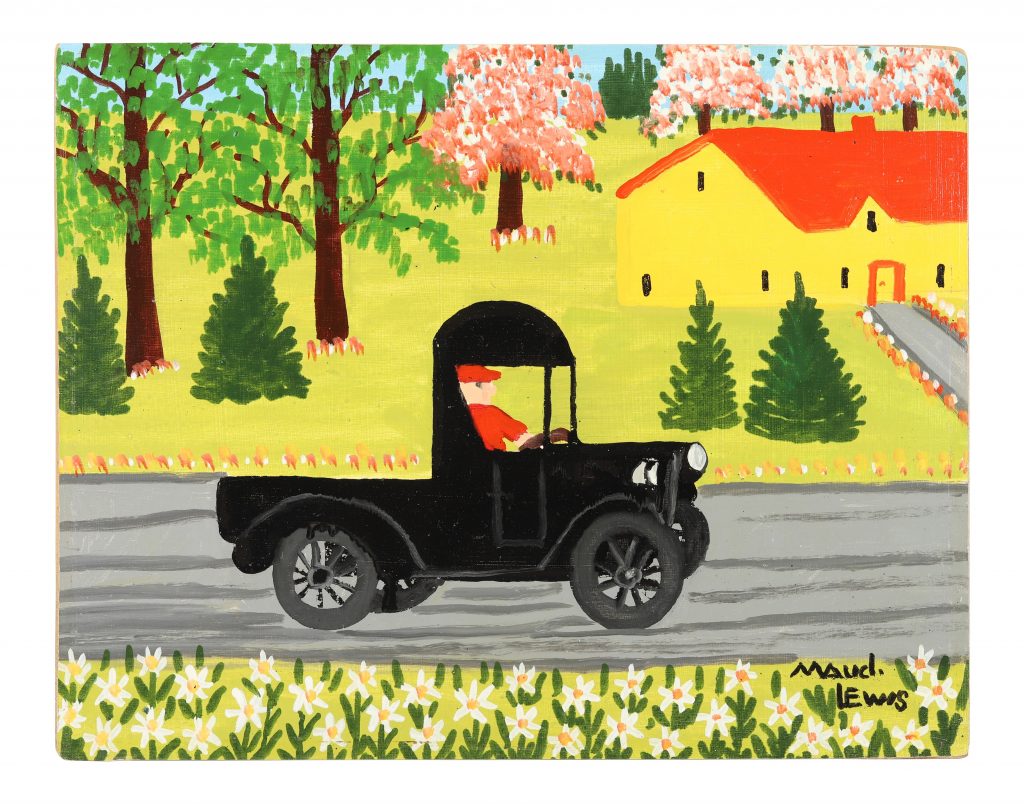
Art: Maud Lewis via Artnet.
The Maud Lewis painting “Black Truck” was once traded for grilled cheese sandwiches. Recently, it fetched 10 times its estimate at auction.

Maud Lewis was a self-taught folk artist in Canada, the kind of person no one takes seriously until they burst onto the world stage. Something similar happened to one of her paintings, “Black Truck.”

Sydney Page reports at the Washington Post, “Like clockwork, John Kinnear and his wife, Audrey, would go to the same restaurant each afternoon and sit at the table by the circular window. Kinnear would order only one thing: a grilled cheese sandwich.

“ ‘I could not convince Mr. Kinnear to have anything else,’ said Irene Demas, 69, who owned the Mediterranean restaurant The Villa with her husband Tony in Ontario for about a decade in the 1970s.

“The sandwich, priced at $1.95, was made with fresh bread from a local Italian bakery, aged cheddar cheese and a substantial smear of butter to make it perfectly crispy — exactly how Kinnear liked it.

“Kinnear, an artist, lived around the corner from The Villa, and he and his wife, both in their 50s, made it their regular hangout for several years in the early 1970s. The Kinnears, who are no longer alive, developed a close friendship with the Demases.

“ ‘My husband made a deal with them to trade food for art,’ said Demas, adding that Kinnear would often show up for lunch clutching a painting or two under his arm. ‘We needed art for our walls, and he needed to eat every day.’

“Demas said their arrangement with Kinnear wasn’t unusual back then.

“ ‘In the ’70s, it was different. We didn’t think so much about ourselves; we thought about our neighbors and how we could help each other out,’ she said. ‘They were very generous, and in return we did what we could for them.’

“Still, Demas and her husband, who is now 90, never imagined that a painting Kinnear traded them for a simple sandwich would one day be worth a small fortune.

“While Kinnear mainly brought his own work to the restaurant, he once arrived with several colorful paintings by an artist from Nova Scotia named Maud Lewis. …

“Lewis was a poor painter in Eastern Canada who could barely afford supplies, and she had suffered from crippling rheumatoid arthritis since she was a teen. Kinnear read about her in a 1965 newspaper article with the headline ‘The Little Old Lady Who Painted Pretty Pictures.’

“As a fellow artist, Kinnear was touched by her story and began sending her supplies, including brushes and paints. In exchange for his kindness, Lewis gave Kinnear several paintings. She typically sold her artwork at the side of the road for $10 per piece.

“Demas said the paintings — which Kinnear propped up on chairs in the restaurant that day — had a playful quality that intrigued her.

“ ‘I had never seen anything like that,’ she said. One in particular, featuring a black truck, ‘just jumped out at me.’ …

“The Demases had no idea that Lewis, who died in 1970, would become one of Canada’s foremost folk artists, despite never achieving wealth or prominence in her lifetime.

“Alan Deacon, an expert on Lewis’s work who authenticates her paintings, said her art skyrocketed in value after her death. …

“About a year ago, as the couple downsized their home, they decided to appraise a few items — including the black truck painting and the letters that authenticated Kinnear’s relationship with Lewis. …

“First, the Demases offered the artwork to their two children, both of whom urged their parents to sell it and enjoy the profits in their retirement. The couple decided it was time to part with the painting. …

“In a virtual auction on May 14, the painting sold for $272,548 — more than 10 times its assessed value. The letters fetched more than $54,500.

“ ‘I was just speechless,’ said Demas.

“Ethan Miller, chief executive officer at the auction house, was also stunned.

“ ‘Off the charts is an understatement,’ he said. ‘I think everybody saw in this painting exactly what Maud intended, which is brightness, optimism and fun. …

“ ‘Just given the heaviness of this era that we’ve managed to survive, suddenly someone mentions a grilled cheese sandwich and a celebrated artist that has overcome physical adversity,’ Miller said. ‘All of those things combined is as irresistible as a grilled cheese sandwich.’

“The buyer, a Canadian man who asked to stay anonymous to protect his privacy, said that was precisely what propelled him to purchase the painting. … ‘I’m not an art collector by any means.’

“The evening before the auction, he and his wife watched the 2016 film Maudie, which chronicles Lewis’s life. After learning her story of resilience, he wanted the piece.”

More at the Post, here. And if you have never seen the lovely Sally Hawkins film about the artist, Maudie, please check it out here.

Read Full Post »

Hip-Hop Auction

I don’t know much about hip-hop, or rap, but I thought it was fascinating that it’s been a part of our culture long enough for a Sotheby’s auction of “historic” memorabilia this month.

As Laird Borrelli-Persson wrote at Vogue, “Until now hip-hop, a global lingua franca, has been in use seemingly everywhere but in auction rooms. That’s set to change next week when, on September 15, Sotheby’s presents its first sale dedicated to the subject.

“The broad spectrum of items on offer — everything from teenage love letters written by Tupac Shakur to graffiti writer Buddy Esquire’s sketchbook — demonstrate that hip-hop has always been a multimedia genre. …

“Though hip-hop is an existing collectible category, it didn’t have an auction ‘home.’ Traditionally, explains [Sotheby’s Cassandra] Hatton, this world has been very focused on specific collecting categories, like cars, jewelry, books, and contemporary art. Hip-hop, she says, ‘is the sum of all of its parts, and if you take a part of it out, it’s not itself anymore.’ …

“ ‘What I think is really important here,’ says [Monica Lynch, former president of Tommy Boy Records], ‘is that the overwhelming majority of the people who are consigning to this auction are the artists and creators themselves, and that they are going to be recognized. … If this expands or brings them a new audience, … that’s a great thing.’ …

“Hip-hop’s influence on fashion is enduring. Lynch recalls being seated at a dinner across from [fashion designer] Karl Lagerfeld in the early 1990s and ‘the only thing he wanted to talk about was TLC.’

“The sale includes items designed and worn by MC Sha-Rock and, spectacularly, Salt-N-Pepa’s ‘Push It’ jackets, [also] a number of jackets that were made only for crews or for staff, as in the case of a Carharrt topper with a Shawn Stussy–designed logo made for Tommy Boy employees. …

“Lynch calls attention to the ‘DIY customization’ of many of the pieces, and also to luxury’s ‘strange history with hip-hop.’ (Note Dapper Dan’s Louis Vuitton jacket, circa 1988.)

“ ‘The hip-hop community always adapted,’ she continues. ‘They adopted and adapted. I think Carhartt was pretty shocked when it realized that a huge amount of its customer base was up in Harlem and in the Bronx. Slick Rick was always wearing Clarks Wallabees shoes. I don’t think they were marketing to a Slick Rick, but you know, the hip-hop community took brands that were known with different audiences and flipped them, turned them inside out, and they made them their own.’ …

“The sale will be an introductory experience for some, a nostalgic one for others. Hatton hopes it will be cheering for all. ‘I think something important about hip-hop is that it’s uplifting,’ she says. ‘There are some markets where money is made by making you feel like you’re not good enough, you’re not beautiful enough, or smart enough, or rich enough, or whatever, so the motivation for purchasing certain things is because it will make you look better or smarter or more sophisticated. And hip-hop is very different. It’s very much celebrating who you are and creating something great out of nowhere. That is what to me art is.’ ” More at Vogue.

Forbes reported on how the auction actually turned out, here. According to Jacqueline Schneider, “Five consignors (for lots 12, 36, 80, 81 and 118), with sales totaling $170,226, indicated their intention to donate money to various charities. Sotheby’s itself committed an undisclosed portion of its proceeds to benefit hip-hop programs at the Queens Public Library and Building Beats, a non-profit teaching young people in underserved communities tech literacy and entrepreneurial skills through DJ and music programs.”

At my September 1 post, Hannah commented, “In my anti-racism group one of our members, who studies racism as an academic discipline, has suggested listening –- really listening –- to rap.” I have been trying that.

Read Full Post »

cruise-auction-4

Photo: Cruise Critic
A Park West art auction in the Star Lounge on Royal Caribbean’s Navigator of the Seas.

My family went on a cruise only once (1990, New York to Bermuda), so in terms of special features, we know about Broadway-type entertainments, and that’s it. “Let’s give a warm welcome to the Royal Viking singers and dancers, Everyone!”

But cruise lines keep trying to outdo each other in offerings. One couple I know chooses their trip based on what chamber music group will be playing. And if you are into fine art or auctions, there’s a cruise for you, too.

Of course, you’re not going to pick up something valuable for cheap.

Sarah Cascone writes at Artnet, “I was lounging poolside, cocktail in hand, when I heard the announcement. The grand finale art auction was about to start.

“It was a weekend cruise from Miami to the Bahamas aboard Royal Caribbean’s recently refurbished Navigator of the Seas. … As I entered the event, hosted by cruise-ship auctioneer Park West Gallery, I bypassed the registration table, heading straight for the auction floor, where a waiter was handing out glasses of sparkling white wine.

“From the start, it was clear that this was no regular art auction. After a brief spiel encouraging folks to buy art as a legacy to leave to their children, the auctioneer, Robert Borotescu, got down to business.

‘I don’t know if you’ve seen Oprah,’ he said. ‘We have some surprises under the chairs.’

“Cue a frenzy as the few guests in the room rushed to upturn every seat cushion. There were no car keys to be found, but there were $100 certificates for discounts on winning bids.

“Borotescu, a dark-haired Romanian man in his mid-to-late 30s, endeared himself toward the crowd by offering additional raffle tickets for $100 credits throughout the auction. … With his pleasantly urbane accent, Borotescu set his audience at ease, acknowledging that they probably never had the time to visit art museums and galleries. But they were here now, and it was his job to make sure that they went home with something they absolutely loved. …

“Borotescu told us that [Park West] operates on 100 cruise ships, and claimed that the art aboard the Navigator of the Seas alone was worth $3 million. Representing some 200 artists, the company holds 1,200 auctions every month. …

“Unlike most art world organizations, Park West seems to hire employees with largely non-art backgrounds. Borotescu’s LinkedIn lists six years in fine jewelry and watch sales at Louis Vuitton Moet Hennessy before joining the company. A quick perusal of resumes of other auctioneers and art directors at the company yields unconventional experience in HVAC, used car sales, fitness instruction, and Royal Caribbean’s beverage team, to list just a few. …

“Park West specializes in what it calls ‘graphic works’: Mass-produced reproductions of original paintings, signed by the artist and released in limited editions. Some are giclée prints — a fancy term for high-quality inkjet prints. Other pieces might look like paintings, but these more expensive offerings are often merely hand-embellished, with brushstrokes layered over a printed image to give it a more ‘authentic’ feel. …

“ [The auctioneer] said: ‘If we look at the Oxford Dictionary of Art, every single artwork that can be traced back to the artist, or was created under the artist’s supervision, is considered to be an original work of art.’ …

“Most of the time, you won’t even take home the exact work you’re bidding on. Park West will ship you a functionally identical copy from its warehouse, rather than going through the trouble of turning over the on-board stock, according to Bloomberg Business. …

“The bidding kicked off with a piece by Peter Max, a well-known Pop artist who met Scaglione, Park West’s founder, back in the late 1960s, and has been represented by him ever since. …

“ ‘This is one of the gems we have on the Navigator of the Seas,’ Borotescu told the crowd, claiming that the ‘printed painting on canvas’ was valued at $23,500, but that he could start the bidding at $20,000. Less than 30 seconds later, the work was sold for $20,700.

“Max has decades of experience exhibiting at international museums. The highest auction record for a work of his is $53,125, according to the artnet Price Database. … Other artists on offer had decidedly less impressive CVs. Borotescu proudly proclaimed that Park West is the only gallery to represent David ‘Lebo’ Le Batard, noting that the artist is known for his paintings of cats and owls. …

“Every attendee was encouraged to enter a free raffle to take home a massive, unframed Thomas Kinkade [your blogger comments, ‘Ugh!’]. … One gimmick in particular stood out: A pair of works presented turned away from the audience, and sold as one lot, without any idea of what they looked like. ‘They are going to be two of the most gorgeous works of art that anyone has ever seen,’ Borotescu promised the audience. ‘Once you turn it around, if it’s something you don’t like, you don’t have to keep it.’ …

“And then there was Tweety.

“Borotescu never named the artist responsible for designing the tiny print, relying on the Looney Toons character’s name recognition … Supposedly, the artwork, which was just a couple inches high and therefore impossible to see from across the room, was valued at $549.

“ ‘Let’s have some fun,’ Borotescu suggested, asking everyone in the room to hold up their bid card. He opened the bidding at just $20. Two thirds of the crowd dropped out when he raised the price to $40, and suddenly the auctioneer slammed down the hammer, selling the cartoon bird to a handful of guests.”

More here, where you can also read about the latest confusion surrounding works by Peter Max, one of the featured artists.

I think if you didn’t take it too seriously, an onboard art auction would be fun. Gimmicks such as surprises under the chairs somehow make me think of a kid’s birthday party. The whole experience seems to play to the child worldview that is buried but available for anyone to tap in adulthood.

Read Full Post »

When the MBTA subway system decided to rebuild the stop called Government Center a couple years ago, it began a search for the artist who created the original murals there to see if she would like them back, and if not, if she would be OK with selling them.

It wasn’t easy to find her.

As Malcolm Gay writes at the Boston Globe, she was baking pies as part-owner of the Pie Place Café in Grand Marais, Minnesota.

“ ‘I got a phone call one day,’ [Mary] Beams explained, ‘and a voice I didn’t know said, “How does it feel to know that all of Boston is looking for you?” I had no idea what to say.’

“Beams, it turned out, hadn’t disappeared at all. An animator who had been a teaching assistant at Harvard’s Carpenter Center for the Visual Arts, and whose work has been collected by the Museum of Modern Art, she’d simply left the art world …

“With her blessing, the MBTA plans to hold an online public auction of the artworks, giving Bostonians a chance to own a piece of the city’s history.

“The online auction and display of murals will run Oct. 20-29, with a kick-off event at the state Transportation Building at 10 Park Plaza on Oct. 21. … The event will be something of a homecoming for Beams, who left Boston soon after completing the murals. She has never been back.

“ “I am so curious to see them again,’ she said. ‘I’ve gone on and lived this whole other life. But to be able to confront something that you made 35 years ago and ponder what they’ve been through? It’s quite amazing.’ ”

Pictures of the murals — and more information on the artist — here.

Mural by Mary Beams, for sale at Skinner

Read Full Post »

Here’s a lovely story by Bella English at the Boston Globe.

Like many other people who feel helpless after a tragedy, illustrators of children’s books wanted to do something useful last April 15 and were delighted to be asked to give their talents.

“After the Boston Marathon bombings,” writes English, “Joe and Susan McKendry of Brookline wanted to do something. …

“Joe, an artist who teaches at the Rhode Island School of Design, thought he could auction off a couple of paintings he did for his first book, ‘Beneath the Streets of Boston: Building America’s First Subway.’

“But then he realized he had something more valuable: connections to other artists. Why not make it a group project? We Art Boston was born, with dozens of artists contributing paintings or illustrations to the cause: the emergency and trauma fund at Boston Children’s Hospital.

“The fund helps children and families get the treatment they need ‘when faced with a tragedy,’ says Stacy Devine, an associate director with the Boston Children’s Hospital Trust. What began as a response to the Marathon bombings expanded to include all traumatic events. …

“The McKendrys also wanted to hold a community event for children to get more directly involved. On Oct. 20, We Art Boston is hosting a family day on the Rose Fitzgerald Kennedy Greenway, right across from the New England Aquarium.

“All of the donated artwork will be framed and on exhibit, and people can bid on them through volunteers who will place the bids online using iPads. Several of the illustrators will be there and will sign books or, for a donation to the cause, draw portraits of stuffed animals for children who bring their favorite one along.”

More.

Henry Cole’s “Penguin Pride” (l8-by-12 inches, framed) has a value of $550 and a suggested bid of $250.

Read Full Post »