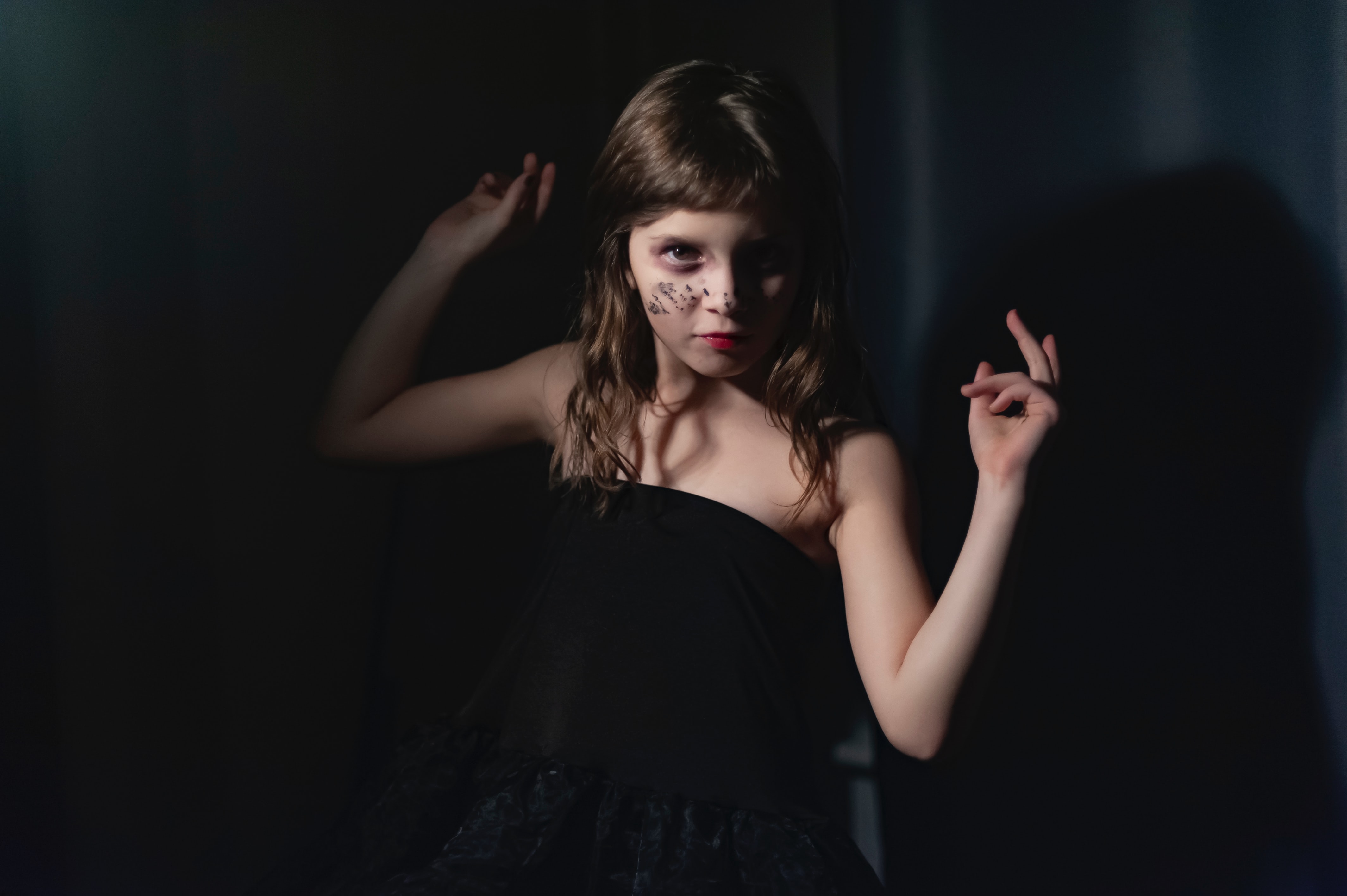
Photo: Dea Andreea/Unsplash.
When a child is in a play, she can see what it’s like to be someone else for a while.
You don’t really need a reason to justify doing theater with children. It is just so much fun. But if you need a reason, think about what theater-engendered empathy and active listening can do for kids throughout their lives.
Alexandra Moe writes at the Washington Post, “It’s after school, and the tweens are rowdy with angst. Then two of them, Charlotte Williams, 13, and Tally Vogel, 11, face each other. Williams raises an arm, and Vogel raises her arm to follow. They’re practicing ‘the mirror,’ an improv exercise in a theater classroom, and the room suddenly hushes. It’s indistinguishable which girl is leading, and which is following. When the exercise stops, and the teacher asks how they were able to sync up so completely without speaking, Vogel says, ‘I used my eyes.’
“In other words, she used ‘active listening,’ a type of verbal and nonverbal communication skill that promotes mutual understanding.
“Several studies show communication skills are the most essential skills for navigating American adult life. … These skills are often taught through Social Emotional Learning programs, offered in K-12 schools in 27 states. But they are also a by-product of theater class, according to a recent study from George Mason University and the Commonwealth Theatre Center. The study follows children aged 5 to 18 over six years — the longest look at theater’s impact in kids to date — and finds increases in communication skills across age, gender and race.
“ ‘The longer the kids spent in the theater classes, the more they gained in 21st century skills, like communication, creativity, imagination, problem solving, and collaboration,’ says Thalia Goldstein, the study’s co-author and an associate professor of applied developmental psychology at George Mason University. …
“Parents of young children are familiar with pretend play — the couch is suddenly a frog castle, the floor a lake, and unbeknown to you, sharks are circling your ankles. It may seem like pure fantasy, but in fact, pretend play is the foundation for developing empathy, Goldstein says. It helps young children build emotional understanding, regulation and executive function, the foundational skills that later predict empathy levels. Parents can help foster empathy in children by introducing fiction books throughout childhood, with varied characters, settings and authors, which correlates directly to empathy scores in adulthood. They can let them be the drivers of pretend play, authors of their own stories.
“And theater class is yet another way. It’s the social dynamic of theater, the give and take, the volley of listening and responding, that expands kids’ capacity to read cues, think quickly and creatively, work as an ensemble and see things from another perspective. Theater provides an awareness of space, pausing, waiting for somebody else to talk.
“For children with autism, improv techniques increase eye attention and reciprocity of conversation, says Lisa Sherman, co-founder of Act As If, a communications program that specializes in working with autistic youths. And this is where the arts level the playing field for children of different abilities; they can participate in meaningful ways where language is not a requisite skill.
“A study among K-2 children in San Diego showed that participating in activities in drama and creative movement significantly improved English-speaking skills among children from primarily Spanish-speaking homes. Children with the most limited English benefited the most, says the study’s co-author, Christa Greenfader, an assistant professor of child and adolescent studies at California State University at Fullerton. …
“Connecting is ultimately the goal of communication, and it is the reason the actor Alan Alda began using improv exercises with scientists. Scientists are trained to speak methodically, defend their arguments and use niche jargon, a communication style that doesn’t always land with a general audience, says Laura Lindenfeld, executive director of the Alda Center for Communicating Science. Through improv, they are taught to make mistakes and laugh about it, to ‘give ourselves permission to fail and move on.’
“ ‘When scientists come into a room, they’re like, “Oh man, you’re going to put me through improv?” ‘ she says. But after exercises like ‘the mirror,’ looking intently into other people’s eyes, they realize they can’t succeed unless they’re in touch with the other person. Speaking becomes about making a human connection rather than pushing information — and that’s the point. You may have the most wonderful scientific finding, but if no one understands it, what’s the use?
“Sara Williams, mother to Charlotte, cites theater as the foundation for her daughter’s self-awareness. Charlotte began drama classes at age 5. At 13, she is not afraid to speak publicly or join the student council; she listens and has confidence. ‘They go to these classes and come home feeling energized, like they accomplished something,’ Williams says. And not just the outgoing kids — for the shy, theater opens them up. For children with anxiety, like so many children coming out of the pandemic, ‘the least judgmental place you can be is in a theater class.’ You can keep your personality, and unlike in sports, you’re not competing with anyone.
“In the end, theater is about telling stories. It is one of the best ways to help young people get to know themselves, Dawson says. Stories help us make sense of the world and understand another’s experience.”
More at the Post, here.


 Suzanne's Mom's Blog