Feeds:
Posts
Comments

Posts Tagged ‘balance’

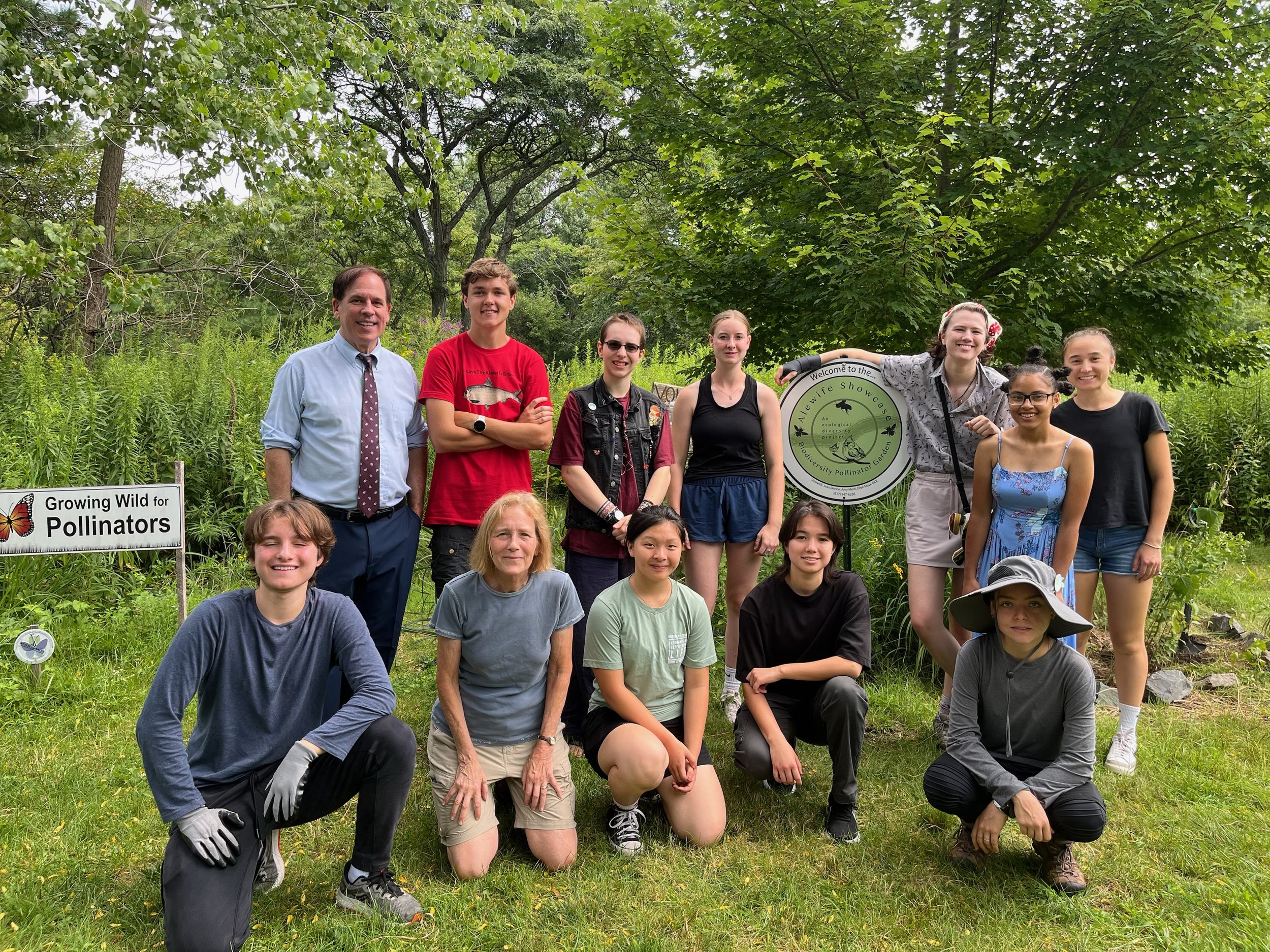
Photo: Devine Native Plantings.
Jean Devine, founder of Biodiversity Builders, is in the front row, second from left. She engages young people in the important work of improving the environment.

Recently, I blogged about my friend Jean Devine, founder of Biodiversity Builders, and described how she took me on a tour of local urban forests. (Click here.)

Now I find that Edible Boston has caught up with her and is highlighting the amazing environmental work Jean’s been doing with young people.

Nicole Estvanik Taylor writes, “Ask the average Gen Z-er to name their favorite native plant and you might expect a blank stare. But for alumni of the Biodiversity Builders program, the hard part is narrowing it down.

“Strawberries come to mind for Jasmine Rancourt, International School of Boston graduating senior — ‘or maybe butterfly weed, because it’s really pretty and vibrant … and it attracts butterflies, obviously.’

“Belmont High School’s Sophia Shaginian chose to plant bleeding heart in front of her house because it’s ‘absolutely gorgeous’ and ‘blooms all summer long.’

“Leia Ahmad-LeBlanc of Arlington Catholic High School gravitates to the striking red pods of wild sumac. ‘You can actually make lemonade out of it, and it’s a good source of food for animals.’

“And UMass Amherst student Kira O’Neill is partial to black birch trees: ‘They have such beautiful yellow leaves in the fall. And if you scratch a twig, it smells like root beer.’ 

“The students got to know these and many other plant species native to Massachusetts through a six-week paid summer internship created and run by Jean Devine, a Belmont-based environmental educator, native plant coach and specialty landscaper.

“Entering its fourth year, Biodiversity Builders has provided 55 high school students from Arlington, Belmont and Cambridge with hands-on experience designing and installing native plant gardens and removing invasive flora. The curriculum also covers entrepreneurial concepts like mission and marketing and culminates in a native plant sale run entirely by the students. …

“It’s only been a decade or so that Devine herself could tell you much about birch trees or bleeding hearts. …

“ ‘I was looking for opportunities to mentor youth and get them outdoors as an antidote to “nature-deficit disorder,” ‘ she says, referencing a term coined by journalist Richard Louv in his book Last Child in the Woods.

“A walk with a scientist opened Devine’s eyes to the ecological value of native plants, including as a source of food and shelter for pollinators and other wildlife, and the threat invasives pose to biodiversity. Teaching kids how to restore this balance struck her as ‘an ideal project with a purpose that helped the world and the youth at the same time.’ …

“After several years running nature programs for school kids in Cambridge and Brookline, she launched her own business, Devine Native Plantings, in 2021. Biodiversity Builders followed a year later, operating as a nonprofit under the fiscal sponsorship of the Vermont-based Tiny Seed Project. It partners with the Cambridge Mayor’s Summer Youth Employment Program to support the participation of students from that city and covers the rest of its budget through grants and crowdfunding. This July, it will recommence with a fresh batch of 14 high school students and a pair of college mentors, plus four young professionals interested in the Biodiversity Builders approach.

“ ‘Jean is so high energy and enthusiastic about the curriculum,’ says O’Neill, who did the program in 2022 and returned last summer as a mentor. ‘She very easily connects with the students … and she knows so many of the people in the area doing similar kinds of work.’

“Among her many affiliations, Devine is a co-founder of the Mystic Charles Pollinator Pathways Group, which maps local gardens that support declining populations of native bees, butterflies and birds. She guided Belmont High School’s Climate Action Club in creating a pollinator garden and is part of an intergenerational committee of Belmont residents organizing to plant a Miyawaki miniforest. As a member of the Native Plant Community Gardeners group in Cambridge, she’ll help install Danehy Park’s first pollinator garden this summer — with upkeep to come from the 2025 Biodiversity Builders crew. …

“For 2024 Biodiversity Builders participant Rancourt, who has artistic leanings, planning gardens that are aesthetically pleasing and ecologically useful was a highlight of the program.

“ ‘It turns out you have many colorful native plants that can be used,’ Rancourt reasons, ‘instead of those other plants that are colorful but look like plastic for pollinators.’ …

“Ahmad-LeBlanc, part of last summer’s cohort, says she applied to Biodiversity Builders after watching her sister go through the experience two years prior.

“ ‘She would always come home covered in dirt, she would have to wear super high socks because there were a lot of ticks, but she had a great time,’ she says. When it was her turn to get dirty, she understood why. ‘I think it was easier for us to process the information because it was all really hands-on … It’s a way that we’re not usually able to learn in school.’

“The Alewife reservation is Biodiversity Builders’ home base, but the students tend plots in other community spaces. … Last summer they removed invasives at Mass Audubon’s Habitat Education Center and Wildlife Sanctuary with the aid of its resident goats; toured Mount Auburn Cemetery with a herpetologist, a horticulturalist and an artist; and took the T to East Boston for birdwatching in Belle Isle Marsh. They also donned gloves and climbed into canoes with the Mystic River Watershed Association to remove thick, spiny mats of invasive water chestnuts from the Arlington Reservoir—filling 270 laundry baskets by day’s end.

“ ‘It was just amazing how we were all collaborating and working all together,’ says Shaginian, who shared a canoe with Devine. ‘I remember how big that pile was. It was huge.’

“Shaginian says pulls like that one, or the sweaty hours spent uprooting black swallow-wort along the edge of the Minuteman Bike Path, impressed upon her both the enormity of the problem and the importance of doing her part. …

“ ‘For me, the idea of getting paid to do gardening, which I did at my house for fun, was novel and exciting,’ says O’Neill, ‘and definitely cemented the idea that I wanted to study something related to working outside when I got to college.’ “

More at Edible Boston, here, and at this blog, here.

Read Full Post »

Photo: John and Suzanne’s Mom.
Beautiful clouds and farm. How much is enough?

Although there are people in every country who strive for balance in their lives — people who are happy with having just enough — in Sweden, it’s a way of being that has its own name.

Erika Page reports at the Christian Science Monitor about the Swedish concept of lagom.

“The ladder she’s standing on rattles in the wind, but Havana Dadian’s paintbrush is steady. With freezing fingers, she lays color inch by inch onto the whitewashed wall. The street below is empty, as residents shelter from an approaching storm. 

“The muralist was hired to spruce up the working-class neighborhood of Södra Sofielund in Malmö, just blocks from where she grew up.  More than that, Ms. Dadian is painting for the future of her country. 

“ ‘I wanted to shine light on the beautiful soul of Sweden,’ she says, gesturing to the sketch on her phone. She is painting a scene from the 1940s, back when this building was home to a neighborhood laundry house. It was a time of community, frugality, and hard work – which she sees as the foundation of Sweden’s egalitarian prosperity.

“ ‘Something has happened, and it’s not so certain anymore – the safety, feeling that you have everything you need,’ says Ms. Dadian. 

At stake is a uniquely Swedish philosophy: lagom. It’s a difficult-to-translate word meaning not too much, not too little, but about right.

“The lagom amount is just enough. The lagom solution is reasonable, appropriate, and moderate. … To be lagom is to respect the rules of the group. 

“ ‘Lagom is one for all and all for one,’ says Ms. Dadian. ‘It was a way for everyone to come together, for everyone to get their share.’

“Yet Sweden appears to be reaching a turning point. The threads of lagom seem to be fraying, as social services come under increasing stress and politics reach unprecedented levels of polarization. Public discourse, dominated by talk of rising rates of violent crime and gang activity, is bringing to light fears about the erosion of social trust. Some wonder whether the economic pie is still big enough to go around. Others question the very foundation of a growth-based economy, pushing instead for a return to ‘just enough.’ …

“The country was a poor, agrarian society of low taxes and limited government until the mid-19th century. Without a feudal system, farmers in decentralized villages worked primarily for themselves, laying the foundation for a society with a relatively flat hierarchy that rewarded hard work. These farmers were of minor importance to the government as individuals but powerful as a collective, making cooperation key. …

“While socialists in other parts of the world sought complete control over the means of production in the early 20th century, the socialists who gained traction in Sweden took a more lagom tack. They believed in harnessing the power of the market through taxation and redistribution to achieve social goals. By the 1960s, Sweden had one of the most robust social support systems in the world and one of the most egalitarian income distributions.  

“ ‘A lagom economy is a pragmatic economy,’ says [Andreas Bergh, an economist at Lund University, near Malmö]. ‘At its best, Sweden has combined the benefits of a capitalist, well-functioning market economy with a relatively generous social welfare state.’

“Salaries may be lower than those for comparable job titles in the United States or United Kingdom. But for many people, that difference is compensated by free education from preschool through university, universal health care, generous pension and unemployment systems, housing allowances, and other social safety measures. …

“Social trust – including faith that people are not taking advantage of the system – is a key ingredient in the lagom mentality, ‘where people share similar interests and work together for the benefit of the group,’ says Dr. Bergh. … Recently, however, a new narrative has taken hold among some, suggesting that perhaps Sweden was once the land of lagom – but no longer. 

“A financial crisis in the early 1990s led to near political consensus that the welfare state had become too hefty. Over the past three decades, the government has slashed taxes and public spending. Sectors from education to health care and elder care have increasingly been privatized. 

“To some, this privatization is lagom, allowing for a healthy balance between the public and private spheres. … Others take the privatization as a sign that Sweden is losing its lagom-ness. 

“Tax cuts mean there is less funding today for social services. Wait times for health  services have grown notoriously long; during the pandemic, the weaknesses in Sweden’s elder care system became impossible to ignore. And since the 1980s, income inequality has increased more than in any of the other 37 countries in the Organization for Economic Cooperation and Development, though still low by international standards.

“Sweden has a reputation of being one of the most welcoming countries in the world for migrants and refugees. [But recently] neighborhoods have become more segregated, with unemployment rates higher among immigrant communities. …

“ ‘My Swedish friends have an innate safety feeling,’ says Ms. Dadian, the muralist, whose mother is Swedish and father is from Lebanon. ‘[For] my friends with mixed backgrounds … it’s starting to feel more like a movie sometimes: drugs, guns, no trust, and much involvement with the police. It can be like different worlds.’ …

“Jon-Mikko Länta, one in a long line of Sámi reindeer herders, has struggled to find that [lagom] balance in his own life as the cost of living has risen. 

“ ‘I was working a lot, all the time, working, working, working. All the money went to buying new stuff, buying new stuff, replacing old stuff,’ he says. 

“But then he began to simplify. He stopped buying the latest tools and took new pleasure in repairing old things. He bought a piece of land outside the town, where he is building a campsite for visitors – and for his reindeer. He’ll be able to continue herding while supplementing his income and spending more time with his wife and three young children.

“It’s a different kind of satisfaction, says Mr. Länta during a lunch break in his kitchen. Dishes are stacked waiting to be washed; half a bottle of milk has been left behind by their 2-year-old. Mr. Länta’s work pants are patched with tape.

“For him, [a controversial local] mine would bring ‘catastrophic’ changes to Jokkmokk, eroding respect for reindeer herding and the natural world. ‘It pinpoints exactly what’s sick with the Western society. … [It’s] built upon growth, and as much growth as possible. And that’s completely unsustainable.’  

“He wishes debates about the mine would take lagom into account, he says, helping residents ‘feel the contentness of enough.’ ” 

More at the Monitor, here. No paywall. Subscriptions encouraged.

I liked the pictures that went with this article. They had a peaceful feeling.

Read Full Post »

In one of the Rhode Island English classes where I volunteer, there’s a former soccer pro. I do not know if he’s following this blog, but I would love to hear from any soccer player about the topic for today: ballet for sports agility and strength.

From an article by Toby Bryant in the Irish Times: “It’s November 29th, 2020, and Manchester United are 2-0 down at Southampton. Bruno Fernandes skews a shot goalward, it’s off target. Defeat seems inevitable.

“Out of nowhere, gliding across the box unnoticed with long black locks flowing, Edinson Cavani springs into the air and nods the misfired shot into the back of the net. With movement so stealthy and so swift, you’d easily mistake Cavani for a ballet dancer.

“As it happens, two months earlier the striker had swapped the football boots for the pointe shoes of ballet to train in his homeland of Uruguay at the Ballet Nacional de Sodre (BNS). … The images shared by the ballet company had soccer fans’ heads turning when they emerged. Such a sports star dabbling in ballet may have seemed unheard of, but it wasn’t a new trend.

“In 2017, over in the United States, St Paul Ballet and Element Gym’s boxers formed a partnership. The premise was simple: the ballet dancers box and the boxers dance ballet. Not simply as a social experiment but, for the boxers, to enhance footwork and balance. …

“American Footballer Eddie George spent hours forcing his 245lb body into demi-pliés and spins so it would become second nature on the field. England women’s rugby star Zoe Aldcroft spent her formative years balancing rugby with ballet and is now the Rugby Players’ Association England player of the year. … Former England rugby league international Darrell Goulding now coaches Wigan Warriors’ under-19 squad, another group who have dipped into ballet in the past.

“ ‘The season before we started we had quite a lot of ankle injuries and stability issues, so it was something we were keen to look at.’

Goulding tells the Irish Times, ‘Obviously our lads are not built for some of the ballet work, so a lot of the delicate stuff we didn’t progress to, but we used a lot of the simple drills to focus on that ankle area.’ …

” ‘Pound for pound, ballet dancers are the strongest athletes you will find,’ remarks ballet physiotherapist Luke Abnett, who believes the cross-sport benefits that ballet can offer are evident. ‘In ballet, there’s a need to not only have strength of movement but precision of movement. It’s a combination of the strong movement muscles with the fine-tuning stability muscles. …

“ ‘When you get to more advanced levels of ballet skills, you’re working on jumping, turning, pirouettes, control and rotation,’ Abnett says. ‘Landing in interesting positions and transferring your weight as you move into the next step – all of that would apply to situations like that.’

“Injury prevention is another benefit. While ballet can’t help stop the collisions that come with sports such as rugby and soccer, its muscle development can reduce the risk of any overuse injuries.

“One study compared basketballers, prone to ACL problems, and ballet dancers. Even though dancers would land at more difficult angles, their training meant they suffered far fewer ACL injuries. …

“ ‘Cavani’s movements have always been sharp but at his age and with the physical demands of the Premier League, it’s impressive,’ one fan tells the Irish Times. ‘Cavani’s spatial awareness and manoeuvrings are so incredible, it has me wishing he’d make ballet a thing in the United dressingroom too,’ another admits. …

“As well as the physical benefits, mainstream sports stars are entering the ballet studio to improve mentality and actively combat stereotypes.

“When speaking of his Wigan Warriors youth team, Goulding believes that ‘people only grow when they are outside of their comfort zone.

“ ‘As you can imagine, the idea of these physical rugby lads from tough working-class areas is a total contrast from ballet and how graceful it is. From the first session there was a lot of embarrassment – it wasn’t a comfortable situation for the lads. They grew a lot of respect, even from just trying the basics. They came back really sore and couldn’t believe some of the muscle they used.’ ”

More at the Irish Times, here.

Photo: ESPN.
Manchester United fans’ hopes of seeing … Edinson Cavani dancing through Premier League defenses may be helped by the striker’s passion for ballet,” says ESPN.

Read Full Post »

Photo: Jonathan Wiggs /Globe Staff
Lauren Mayhew was my Essentrics teacher for a year. Here she is leading a class at the Steinberg Wellness Center for Mind and Body. Despite the photo, Essentrics doesn’t have students hold positions.

I was never one for doing exercise for exercise’s sake, but a couple decades ago, my doctor friend Anna insisted I take up something. I’m so glad she did.

I knew that in order to do any exercise regularly, it would have to be something I really enjoyed, so I started walking every day. I don’t walk fast, but I keep the joints moving, and I learned that any sort of walking fulfills that Holy Grail called “weight-bearing activity.” I also love the time to think, and I like taking pictures on my walk.

In addition to walking, I take two exercise classes. I’ve been taking tai chi chuan at Zhen Ren Chuan for more than six years. I like taking tai chi chuan at a martial arts studio because the moves are more clear and understandable than at another place I tried. They are clear because the martial arts people like to tell you the self-defense origins of the moves.

Tai chi chuan is great for balance and moving your body in a seamless way so you don’t stress the joints as you might do when holding a yoga position.

Moving in a seamless way is also the goal of a class I’ve been taking for two years called Essentrics. Essentrics was developed by a former ballerina and aims to strengthen and stretch all the muscles in every session, with beneficial attention to often neglected hands and feet.

Although the tai chi class includes many young people who are also studying martial arts, my midday Essentrics class has mostly retired people, many of whom have had injuries of one kind or another.

What do you do for exercise? Do you take any classes? As a child I took a lot of ballet classes, and ever since then, I’ve had the idea that you make friends in classes. Do you find it works that way with grown-ups? Since starting exercise lessons again as an adult, I find that most grownups keep their heads down and avoid eye contact. I can’t figure out why that is.

Here’s a Boston Globe article that explains how Essentrics helps improve posture. Lauren Mayhew, one of my teachers, is featured in the story.

Photo: Zhen Ren Chuan
The Zhen Ren Chuan website highlights its community garden: “Our families learn horticulture as well as Martial Arts.” Students and teachers keep the school’s corner of the business district neat as a pin.

3-sm

Read Full Post »

As the lowest of the “higher belts,” I’m exhibit A demonstrating that anyone can learn tai chi chuan.

It was really hard getting started. I couldn’t relate the moves to anything I knew before: not ballet, modern dance, yoga, ballroom dancing, folk dance … .

Then I learned that this kind of movement relates to nature. We practice moves called White Crane Spreads Wings and Ocean Breathing. We breathe like a tortoise taking a dive, we float our arms like a butterfly, and from a crouch postion, we rise like a phoenix. Now I get it.

For someone who nearly every year discovers that the lower back or a knee or the neck is far enough gone to require physical therapy, tai chi chuan has been a big help. It’s also great for exercising all your muscles and for balance. It’s constantly flowing.

Longevity in the class pays. If you just stick with it, eventually you can do some of the routines moderately OK, and you get to be referred to as a “higher belt” in front of brand-new students. Which is nice, even though you know it won’t last.

Photo: Zhen Ren Chuan

Read Full Post »