Feeds:
Posts
Comments

Posts Tagged ‘strength’

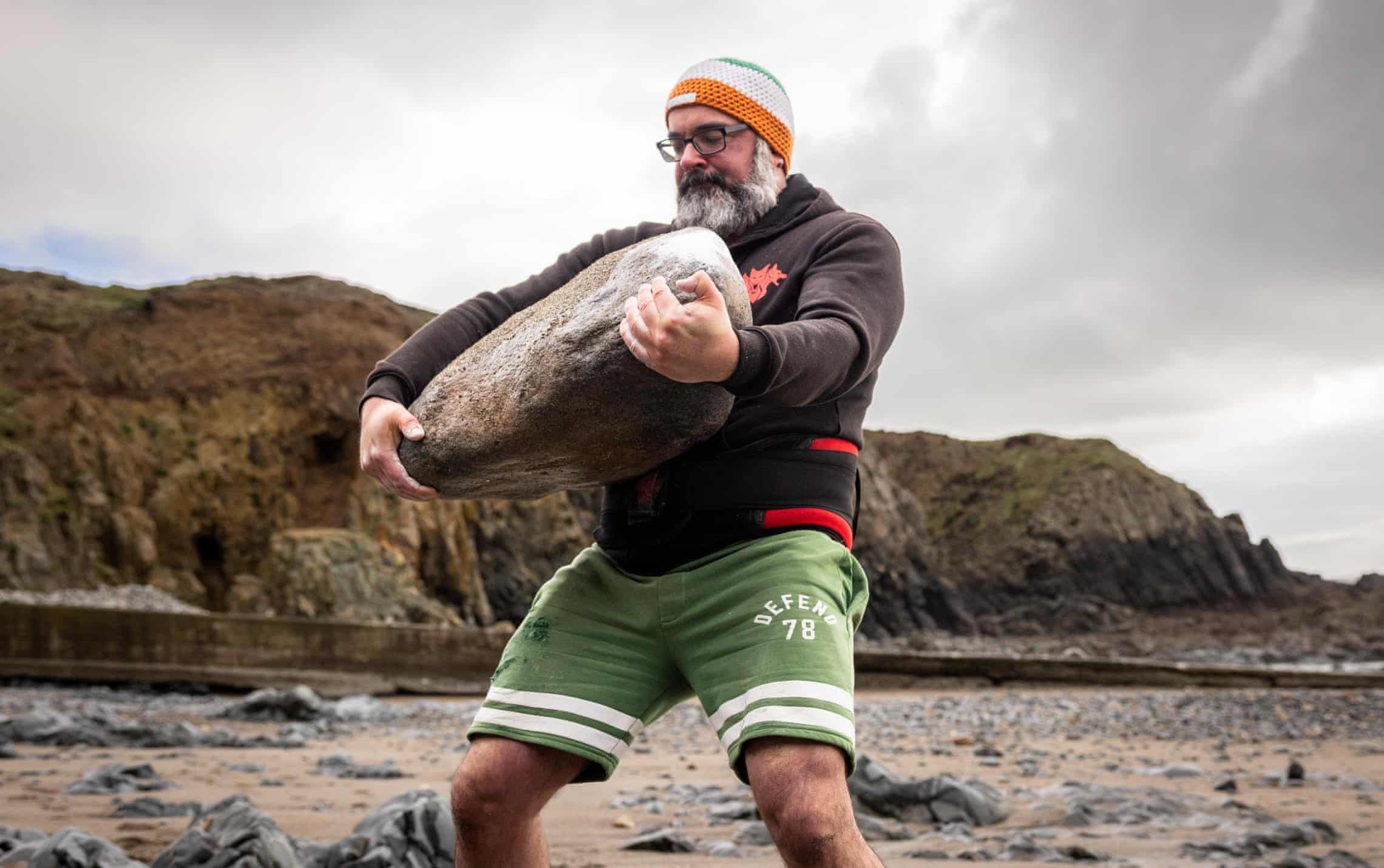
Photo: Johnny Savage/The Guardian.
David Keohan, aka Indiana Stones, lifting a stone on a beach in County Waterford. 

When the great James Hackett first visited his cousins in New Shoreham, Rhode Island, he commented on how much the island looked like his native Ireland. He wasn’t the first notice. It’s largely because of the ubiquitous stone walls.

Some of those walls have giant boulders placed strategically as a base. Today I’m learning that such boulders have a long history in Ireland, a history most contemporary Irish knew nothing about. Rory Carroll writes at the Guardian about the man who dug out the history.

“David Keohan surveyed the County Waterford beach and spotted a familiar mound half-buried in sand: an oval-shaped limestone boulder. It weighed about 115kg [~253 lb].

“He wedged it loose with a crowbar, wiped it dry with a cloth, dusted his hands with chalk and paused to gaze at the Irish Sea, as if summoning strength from the waves pounding ashore.

“He hunkered down, gripped the boulder and hoisted it to his lap. Legs trembling, Keohan straightened his knees and hoisted the weight up to his chest, close enough to kiss it. Two seconds later he lowered and dropped the boulder, which thudded back on to the sand.

“It was a demonstration of the ancient sport of stone lifting. Keohan has almost single-handedly revived the practice in Ireland and helped stir global interest.

“ ‘It’s not just about strength. Every single lifting stone has an amazing story attached to it,’ said Keohan, 47. …

“To his fanbase Keohan is better known by his Instagram handle Indiana Stones. On there, he is a scholarly Hercules who parses myth, folklore and literature to locate boulders around Ireland that for centuries were used to test strength and bond communities.

“Some were lifted at funeral games to honor the dead, some to celebrate harvest festivals and some to mark a chieftain’s ascension, said Keohan. ‘One stone was almost like a job interview to become a stonemason – you had to be strong enough to lift it.’

“To lift a designated stone … a few inches above the ground was known as ‘getting the wind under it,’ said Keohan. ‘That was a great day in a young man’s life. If you lift it to your knees, you’re a champion. Lift it up to your chest, you are a phenomenon of strength and spoken about for generations to come.’

“He has identified 53 lifting stones, spanning beaches, fields and graveyards, and hopes to locate dozens more. To lift such a stone today is to connect with all those who previously managed the feat, a continuum that in some cases stretches back millennia, said Keohan. …

“Few in Ireland had heard of the sport until Keohan stumbled into it.

“When Covid restrictions shut gyms in 2020, the former kettlebell lifting champion started using stones in his garden as weights. Galvanized by documentaries about stone lifting in Scotland, Iceland and the Basque region, he made a post-Covid ‘pilgrimage’ to the 127kg [280 lb] Fianna stone in Scotland. ‘It was strength, mythology, history. I fell in love with it.’

“After reading Liam O’Flaherty’s 1937 short story ‘The Stone,’ about an elderly man who tries to lift the ‘manhood stone’ of his youth, Keohan tracked down a pink-tinged granite lump that matched the story’s description on the Atlantic island of Inishmore, where O’Flaherty grew up.

“Now, a sport that was all but forgotten boasts a devoted following on Instagram and TikTok, and a competition organized by a group called Irish Stone Monsters. The ride-sharing company Lyft has sponsored a stone lifting studio at a Dublin gym.

“Enthusiasts trek to remote rural areas to try to lift designated stones. A stone in County Clare named after Mrs Kildea, a possibly apocryphal figure who reputedly lifted an enormous boulder, has inspired women to take part. Last year a boulder known as Cloch Bán, or White Stone, was shipped to enthusiasts in Boston.

“Stone lifting practices existed across Europe, Asia and Africa, said Conor Heffernan, a cultural historian at Ulster University. The legend of the warrior Finn McCool creating a path to Scotland by laying basalt columns in the sea – the Giant’s Causeway – illustrates Ireland’s connection to its rocky landscape, said Heffernan. …

“Keohan and Heffernan are seeking to get stone lifting included in Ireland’s inventory of intangible cultural heritage – a first step to Unesco recognition.

“Guided by local lore, the National Folklore Collection, and tips from Instagram followers, Keohan has found dozens more stones around Ireland. ‘This dam burst of information came out,’ he said. ‘It has given me purpose and a reattachment to what it means to be Irish.’ …

“The father of three, who works at a construction depot in Waterford, has tapped into a passion for Irish culture that has also boosted the Irish languageroad bowling and TikTok’s #GaelTok content. Keohan has written a forthcoming book, The Wind Beneath the Stone.”

More at the Guardian, here.

Read Full Post »

In one of the Rhode Island English classes where I volunteer, there’s a former soccer pro. I do not know if he’s following this blog, but I would love to hear from any soccer player about the topic for today: ballet for sports agility and strength.

From an article by Toby Bryant in the Irish Times: “It’s November 29th, 2020, and Manchester United are 2-0 down at Southampton. Bruno Fernandes skews a shot goalward, it’s off target. Defeat seems inevitable.

“Out of nowhere, gliding across the box unnoticed with long black locks flowing, Edinson Cavani springs into the air and nods the misfired shot into the back of the net. With movement so stealthy and so swift, you’d easily mistake Cavani for a ballet dancer.

“As it happens, two months earlier the striker had swapped the football boots for the pointe shoes of ballet to train in his homeland of Uruguay at the Ballet Nacional de Sodre (BNS). … The images shared by the ballet company had soccer fans’ heads turning when they emerged. Such a sports star dabbling in ballet may have seemed unheard of, but it wasn’t a new trend.

“In 2017, over in the United States, St Paul Ballet and Element Gym’s boxers formed a partnership. The premise was simple: the ballet dancers box and the boxers dance ballet. Not simply as a social experiment but, for the boxers, to enhance footwork and balance. …

“American Footballer Eddie George spent hours forcing his 245lb body into demi-pliés and spins so it would become second nature on the field. England women’s rugby star Zoe Aldcroft spent her formative years balancing rugby with ballet and is now the Rugby Players’ Association England player of the year. … Former England rugby league international Darrell Goulding now coaches Wigan Warriors’ under-19 squad, another group who have dipped into ballet in the past.

“ ‘The season before we started we had quite a lot of ankle injuries and stability issues, so it was something we were keen to look at.’

Goulding tells the Irish Times, ‘Obviously our lads are not built for some of the ballet work, so a lot of the delicate stuff we didn’t progress to, but we used a lot of the simple drills to focus on that ankle area.’ …

” ‘Pound for pound, ballet dancers are the strongest athletes you will find,’ remarks ballet physiotherapist Luke Abnett, who believes the cross-sport benefits that ballet can offer are evident. ‘In ballet, there’s a need to not only have strength of movement but precision of movement. It’s a combination of the strong movement muscles with the fine-tuning stability muscles. …

“ ‘When you get to more advanced levels of ballet skills, you’re working on jumping, turning, pirouettes, control and rotation,’ Abnett says. ‘Landing in interesting positions and transferring your weight as you move into the next step – all of that would apply to situations like that.’

“Injury prevention is another benefit. While ballet can’t help stop the collisions that come with sports such as rugby and soccer, its muscle development can reduce the risk of any overuse injuries.

“One study compared basketballers, prone to ACL problems, and ballet dancers. Even though dancers would land at more difficult angles, their training meant they suffered far fewer ACL injuries. …

“ ‘Cavani’s movements have always been sharp but at his age and with the physical demands of the Premier League, it’s impressive,’ one fan tells the Irish Times. ‘Cavani’s spatial awareness and manoeuvrings are so incredible, it has me wishing he’d make ballet a thing in the United dressingroom too,’ another admits. …

“As well as the physical benefits, mainstream sports stars are entering the ballet studio to improve mentality and actively combat stereotypes.

“When speaking of his Wigan Warriors youth team, Goulding believes that ‘people only grow when they are outside of their comfort zone.

“ ‘As you can imagine, the idea of these physical rugby lads from tough working-class areas is a total contrast from ballet and how graceful it is. From the first session there was a lot of embarrassment – it wasn’t a comfortable situation for the lads. They grew a lot of respect, even from just trying the basics. They came back really sore and couldn’t believe some of the muscle they used.’ ”

More at the Irish Times, here.

Photo: ESPN.
Manchester United fans’ hopes of seeing … Edinson Cavani dancing through Premier League defenses may be helped by the striker’s passion for ballet,” says ESPN.

Read Full Post »

After 46 years of marriage, I can say I have a husband who is the same guy he always was, just with more life experience. But among my small circle of friends, including my blog friends, many women are dealing with extraordinary changes.

It may be true that, overall, women are as likely to develop dementia as men (see study) and present their husbands with unexpected caregiving challenges, but so far those stories are not the ones I’m hearing.

A college friend married to a brilliant scientist who has known for some time he was developing Alzheimer’s recently told me, “I finally realized he is completely dependent on me.” She is biting the bullet, reaching out for more helpers and planning an altered future.

Another friend whose husband has dementia made the decision to leave behind all her East Coast activities and relocate to Minnesota, where there is a network of family members. She intends to keep her husband in their new home, which has become a safe place in his mind. When her husband no longer recognizes anyone at all, she says, she will get full-time care, move herself out, and come visit him.

I reconnected last month with a high school friend who suffered a bitter divorce decades ago. She told me her ex’s wealthy girlfriend has been able to provide high-quality care for him for the 15-plus years since he was diagnosed with dementia. Although the divorce is still raw enough that there are topics my friend can’t discuss with her children, she goes to the Alzheimer’s facility regularly to read to her ex. She wants to become a better person.

Dementia has not been the only challenge for women I know. In one case, after a relative discovered her husband’s multiyear dalliance with a blackmailing call girl (and he then suffered a physical and emotional collapse), the wife made heroic efforts to rebuild the shattered relationship. A year later, they are both enjoying life together a little more every day.

Then there is the friend whose husband’s rare disease progressed to the point that he can no longer be left alone. She has had friends come in for an hour or two so she can shop for groceries and walk the dog, but the cost of a few hours coverage from a trained home-health-care aide has to be parceled out frugally as this friend has lost one income, is trying to build a home-based career, and needs to pay for two children’s colleges.

I can’t say enough about how much I admire these women who are rising to meet unanticipated disruption despite their sorrow and fear.

Art: William Utermohlen
In 1995, U.K.-based artist William Utermohlen was diagnosed with Alzheimer’s disease. He created a series of self-portraits over five years, before his death in 2007. (Caution: This is the first in the series. The others may be painful.)

alzheimers-disease-self-portrait-paintings-william-utermohlen-1

Read Full Post »