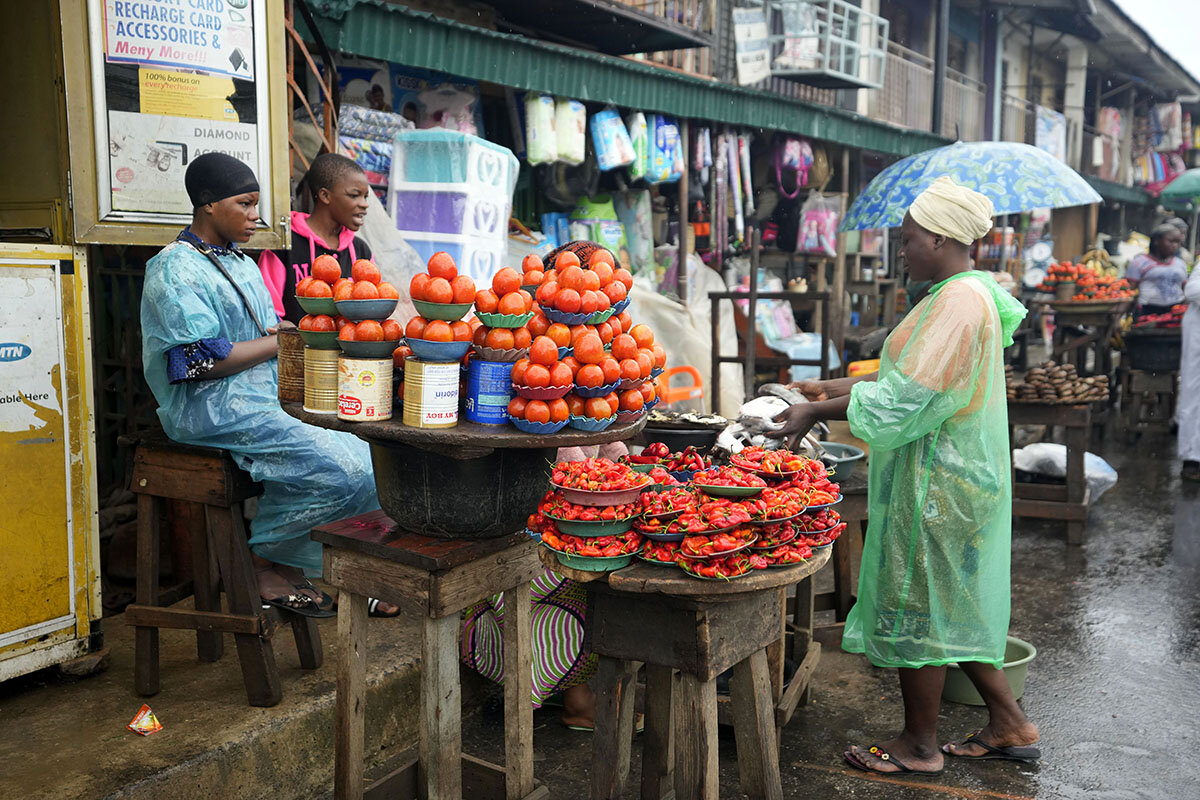
Photo: Sunday Alamba/AP.
Nigerian women find it hard to secure the bank loans needed to start a business, but social media platforms are providing alternative credit lines.
Do you know about lending circles? I learned about them when I worked at the Fed. Immigrants in the US sometimes use them to save money, waiting for their turn to get the whole pot. The circles can be risky, but they are needed.
Ogar Monday wrote for the Christian Science Monitor about a What’sApp lending circle in Africa.
“When Pricilla Yaor found a dream job that meant moving to the Nigerian capital, Abuja, there was just one hitch: There was no way she could afford rent in the country’s most expensive city. For the supermarket cashier, it was a struggle to raise the 300,000 naira ($390) she needed for a single-room flat on the outskirts of the city. Like most renters, she was expected to pay her entire annual rent in one lump sum – a typical practice among Nigerian landlords.
“Still, armed with a new job, Ms. Yaor thought she could get a loan from the bank. ‘I was given plenty of forms to fill, asked to bring two sureties, and I was asked if I had any property that I could use as collateral,’ she recalls.
“None of this was surprising. In Nigeria, 98% of women have no access to formal credit, limiting their ability to run businesses, pay for studies, or buy a home. Ms. Yaor never returned to the bank. Even if she had met its criteria, she could not afford the 18.75% interest on a bank loan, a typical charge.
“Instead, her saving grace – and a lifeline for a growing number of women in Africa’s most populous nation – came in the form of a women-only WhatsApp group that she was invited to by a cousin. Members of the group each pool in an equal sum every month and rotate who receives the payout. …
“There were no processing charges, and a trusted member of the group was appointed as an admin. A month after joining, Ms. Yaor received 400,000 naira ($506).Soon, she joined another group to raise funds for her younger brother’s school fees. The groups also helped her buy a fridge for her apartment and later a generator to keep the lights on during daily blackouts.
“Rotating saving programs, as they’re officially called, provide a safety net across much of Africa. … The use of these programs has skyrocketed in Nigeria recently – aided by technology such as WhatsApp and boosted by inflation that has soared to its highest level in two decades.
“In the past year, some 4 million Nigerians have been pushed into poverty by inflation that has caused eye-watering price rises for everything from food staples to transport. Women have borne the brunt of the country’s debt crisis. …
“Opportunities for women lag in many fields ranging from education to income; on average, their wages are 22% lower than those of men. Meanwhile, culture and tradition have subjected women to the role of caregiver at home, for which they are not paid. What’s more, women face historical biases embedded in the formal banking system, says Okpetoritse Akperi, a financial expert with a multinational company based in Nigeria.
“As in many other developing countries, Nigerian women struggle to get loans because “creditworthiness is typically judged by the ability to repay. … Even when banking services are available, they are not accessible to half of the women who run businesses, who have to rely on cash for all transactions.
“But that is slowly changing. Mobile credit companies such as Branch and FairMoney, boasting a combined 20 million downloads on the Google Play Store, are gaining popularity due to their lenient lending regulations.
“ ‘Technology now allows alternative credit assessments, helping women to access financial services without traditional barriers,’ says Iyonuluwa Pikuda, a financial analyst with Lagos-based Money Africa. Using WhatsApp lending groups, though, allows users to bypass any kind of formal structure altogether. …
“While the program has few overall downsides, the risks that do exist are not negligible. ‘We have had cause to report the admin of a group to the police because she refused to release the funds after everyone had sent in theirs,’ Ms. Yaor says of one such experience. But because everyone in the group is known to at least one other person, such matters are usually quickly resolved. … Members are united by their shared interest in helping each other raise funds, she points out. And the alternative is the banking sector’s bureaucracy and high interest rates.”
More at the Monitor, here.

 Suzanne's Mom's Blog