Feeds:
Posts
Comments

Posts Tagged ‘beekeeping’

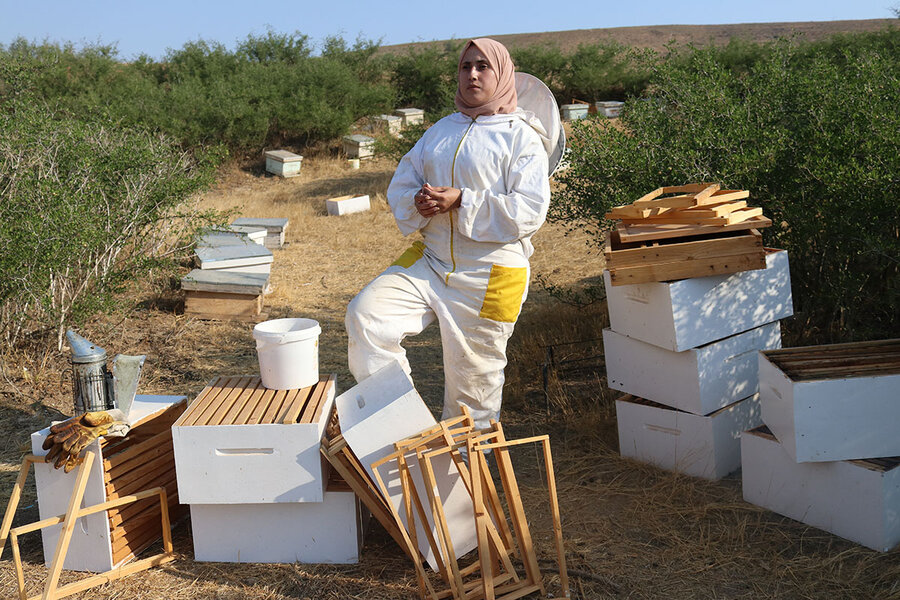
Photo: Taylor Luck.
Apiarist and entrepreneur Hela Boubaker stands next to one of her collections of beehives on a farm in Bizerte, Tunisia.

There are two news outlets I especially love for their focus on parts of the world most US media ignores until there’s a disaster. One is the weekday radio show The World. The other is the Christian Science Monitor. These organizations interview people on the ground in foreign countries, voices we seldom hear with perspectives we know nothing about.

In today’s example, Taylor Luck reports at the Monitor on what extreme heat is doing to beekeeping in Tunisia and how beekeepers are adapting to the warming trends that affect us all.

“Tunisian beekeeper Hela Boubaker keeps a firm smile as she inspects an empty hive box, the 20th hive she has lost due to heat or wildfires this year. Hives are carefully placed in the shade on this farm 40 miles north of the capital, Tunis. At 10 a.m. on a late-August Tuesday, it is already 95 degrees.

“Thirsty bees dive-bomb a bucket of water, drowning for a drink before she can place a sponge as a landing pad.

‘It’s not easy,’ she says as she slides an empty honeycomb frame back into its box, ‘but at the same time, we are not easy: We won’t give up.’

“In this North African country, where nearly 40% of citizens and entire communities rely on farming for their livelihoods, bees are a big business. And to protect their beehives against extreme weather, the nation’s apiarists are turning to innovative solutions. …

“Some 13,000 Tunisians work as full-time beekeepers, according to local farming unions, in addition to thousands more who rely on apiary work as another source of income, producing a combined 280,000 metric tons of honey per year. Yet for those new to beekeeping in Tunisia, the past two years have been no honeymoon.

“Tunisia has seen record-setting scorching temperatures, including dayslong 115-plus-degree heat waves and record 120-degree temperatures in its tree-lined temperate north – the nation’s beekeeping hub – that sparked devastating wildfires in 2022 and again this July. This year the country has also struggled with a record drought, leaving regions without water for weeks at a time.

“According to researchers and apiarists, the extreme weather has nearly halved honey production, from an average of 8 kilos (17 pounds) of honey per hive to 4 to 5 kilos per hive in 2023.

“Ms. Boubaker, an entrepreneur in her late 20s, is finding ways to keep her bees alive. She has developed a patented device and nonlethal method to extract bee venom from her honeybees, drawing exactly 0.01 grams of apitoxin per bee to be used in medical treatments and beauty products. …

“To adapt to a changing climate, Ms. Boubaker is working with other apiarists to better cultivate the rented or borrowed plots of farmers’ land where they place their hives. Increasingly, they rely on drought-resistant and hearty plants such as lemon trees, thyme, and marjoram to ensure year-round nectar and food sources for hives, as more delicate flowers and plants wilt in increasingly hot temperatures.

“Like many apiarists, she rotates her beehives through geographic locations with varying topographies – the mountainous pine-treed north, the more arid south, and the rich fertile farmland around Bizerte.

“Ms. Boubaker’s commute to check on her dispersed 82 colonies is a six-hour, 200-mile round trip that she takes every two days. Yet the geographic dispersal of apiarists’ beehives has led to another, emerging threat to Tunisia’s honey-makers: crime. Specifically, theft. …

“ ‘Only a beekeeper would have the knowledge and equipment to be able to pick up hives and transport them,’ says Ms. Boubaker, who rents fields in gated farms to minimize theft. ‘Unfortunately, people are desperate. When you lose the source of your livelihood, you are desperate to rebuild it. Some may be tempted to steal money. Others steal bees.’

“To help Tunisian beekeepers confront 21st-century challenges, innovators are putting constantly updated apiary data in an app. …

“Says Khaled Bouchoucha, a Tunisian engineer who has grappled with solving Tunisia’s plummeting bee numbers, ‘All the knowledge beekeepers have accumulated for decades and generations is no longer applicable’ in a rapidly changing climate.

“In 2021, Mr. Bouchoucha developed and launched SmartBee, a device and app that provides beekeepers with real-time data on hive temperature, humidity, weight, and mortality rates. …

“With the data, advance warnings, and advice sent to beekeepers’ phones, apiarists are informed when to move overheated hives to cooler areas and when isolated hives have become too cold, or they’re alerted to provide sugar solutions to boost weak bees – a critical service when hives are often dozens of miles away. SmartBee is also an anti-theft device.” 

More at the Monitor, here. No firewall. Subscription price is reasonable.

Read Full Post »

Whether we know it or not, we’re always passing down family customs, sayings, songs, crafts, and more to the next generation. Sometimes I’m a bit sad that I stopped singing songs in the car as an adult, because there are a ton of old nursery rhymes and folk songs from my childhood that my kids never learned. One time my youngest brother said to them, “Does your mother still sing in the car?” and they had no idea what he meant.

I’ve blogged before about efforts to preserve marginalized languages, and any similar initiative gets my attention. Consider this story on preserving artisan techniques in danger of dying out.

Gareth Harris writes at the Arts Newspaper, “Centuries-old practices and traditions across communities worldwide that might be lost forever — from beekeeping in Kenya to creating the Dalai Lama’s clothes — are being quietly supported and documented online through the British Museum’s Endangered Material Knowledge Programme (EMKP).

“The scheme, launched in 2018, has been boosted by an [$11.7 million] grant awarded by Arcadia, a charitable fund founded by the philanthropists Peter Baldwin and Lisbet Rausing; the cash injection means the project has been extended for seven years (2021-28). …

“ ‘Locally informed knowledge is in danger of being lost — knowledge that has helped communities thrive in unique environmental, social and cultural contexts,’ says a statement from the British Museum. …

” ‘We are offering communities the resources to record themselves; that is so powerful. It’s a form of auto ethnography as such,’ says Ceri Ashley, the head of EMKP.

“ ‘Once this material has been collated, it is uploaded onto an open access digital database hosted by the British Museum, and a digital copy is also shared with a partner in the country of work so that it remains close to the community whose cultural heritage it represents,’ say museum officials. …

“This year’s supported schemes include a survey of the skills of Venerable Phuntsok Tsering, the Dalai Lama’s personal tailor. ‘Since 1959, he has been responsible for (re)constructing the tailoring requirements of the Dalai Lama in exile. He rebuilt the ceremonial wardrobe left behind in Tibet and developed new garments for use in the unfamiliar environmental and cultural conditions of India. Despite this singularity his practice has never been documented,’ says an online statement.

“Ashley points out that the EMKP team, working primarily online, has worked throughout lockdown, collaborating with an international advisory panel to review and select the next round of grants. …

“Another 2020 project focuses on the manufacture of Ostrich eggshell beads among the El Molo Community in Kenya, capturing their making and use through audio files, video clips and field notes.

“Last year, the EMKP recorded the dwindling practice of beekeeping amongst the Sengwer communities living in the Embobut Forest in western Kenya. ‘Some projects celebrate the everyday, which is so important,’ says Ashley, referring to a 2019 analysis of the traditional natural broom and fibre rope crafts of the Urhobo people of Nigeria.

“Applications are now open for the 2021 round of funding (deadline for applications is 31 January 2021). Instructions online stress that prospective candidates should ‘consider the viability and ethics of conducting this work within the context of the Covid-19 pandemic.’ ” Read more at the Art Newspaper, here.

The Kenya beekeeping reference makes me think of a wonderful documentary, Honeyland, about an isolated beekeeper in rural Macedonia. Do watch it if you get a chance. I hope her techniques are being preserved, too.

Read Full Post »

Photo: Destiny Connect
More than 50% of the honey sold in South Africa is imported. Mokgadi Mabela, a beekeeper and founder of the Native Nosi, is striving to change the business landscape.

How doth the little busy bee
Improve each shining hour …”

Yesterday I paid a visit to friends who recently moved to Massachusetts from Minnesota. The wife is a textile and quilt artist. The husband is a woodworker and beekeeper. Before moving, he sold his 2,000 pounds of honey and all his beekeeping equipment. But the new home came with a beehive in the backyard, and he can’t resist setting up on a smaller scale.

I think these two, retired from careers that have nothing to do with bees or art, may be the most industrious people I have ever met.

Speaking of busy bees, I just happen to have a post today on beekeeping. Hope you like it. Nazley Omar wrote the story for Destiny Connect.

“More than 50% of the honey sold in South Africa is imported. Mokgadi Mabela, a beekeeper and founder of the Native Nosi, is striving to change the business landscape [and] keeping the legacy of beekeeping in her family alive.

“She is a third-generation beekeeper who specialises in organic honey production. Mabela launched the Native Nosi in 2015 with the aim of producing local, quality pure honey, alleviating poverty through job creation and providing rural beekeepers with access to urban markets.

“ ‘In South Africa, beekeeping was historically never part of the basic academic curricula in agriculture,’ she says. ‘Therefore, your average South African knows very little about bees and their role in the ecosystem value chain.’ …

“Several bee species across the globe are heading towards extinction, which would have a huge impact on agriculture and food production. Mabela says we need more beekeepers to help preserve bees and produce honey.

“ ‘Ordinary citizens who have no interest in beekeeping can help by planting more trees and plants that are bee-friendly, as habitat loss is one of the factors contributing to the global bee population decline.’ …

“It’s important for South Africans to consume honey, wax and by-products that are produced organically and locally. Imported honey products have to be irradiated in order to limit South Africans to the exposure of impurities and diseases.

“ ‘Although this process is done with good intent, it destroys all the nutrients and delicate properties for which honey is known. When you buy local, you consume natural, quality honey that has not been subjected to any processing,’ explains Mabela.

“When Mabela first launched her company, she encountered many challenges. The startup capital required to buy beehives and processing equipment was high. She tackled this by buying honey from her father and other beekeepers and selling it to raise enough money to buy beehives, increasing her production and securing her own supply.

“I also won [an award] through a pitch competition sponsored by SAB, Standard Bank and The Hook Up Dinner, which I used to buy the equipment. …

“ ‘We are here to change the game and smash stereotypes about young, black, females in business and agriculture. … Starting is often the most difficult step. Once you start, you are able to get a lot of the fear out the way and get on with the real business.’ ”

More at Destiny Connect, here.

Read Full Post »