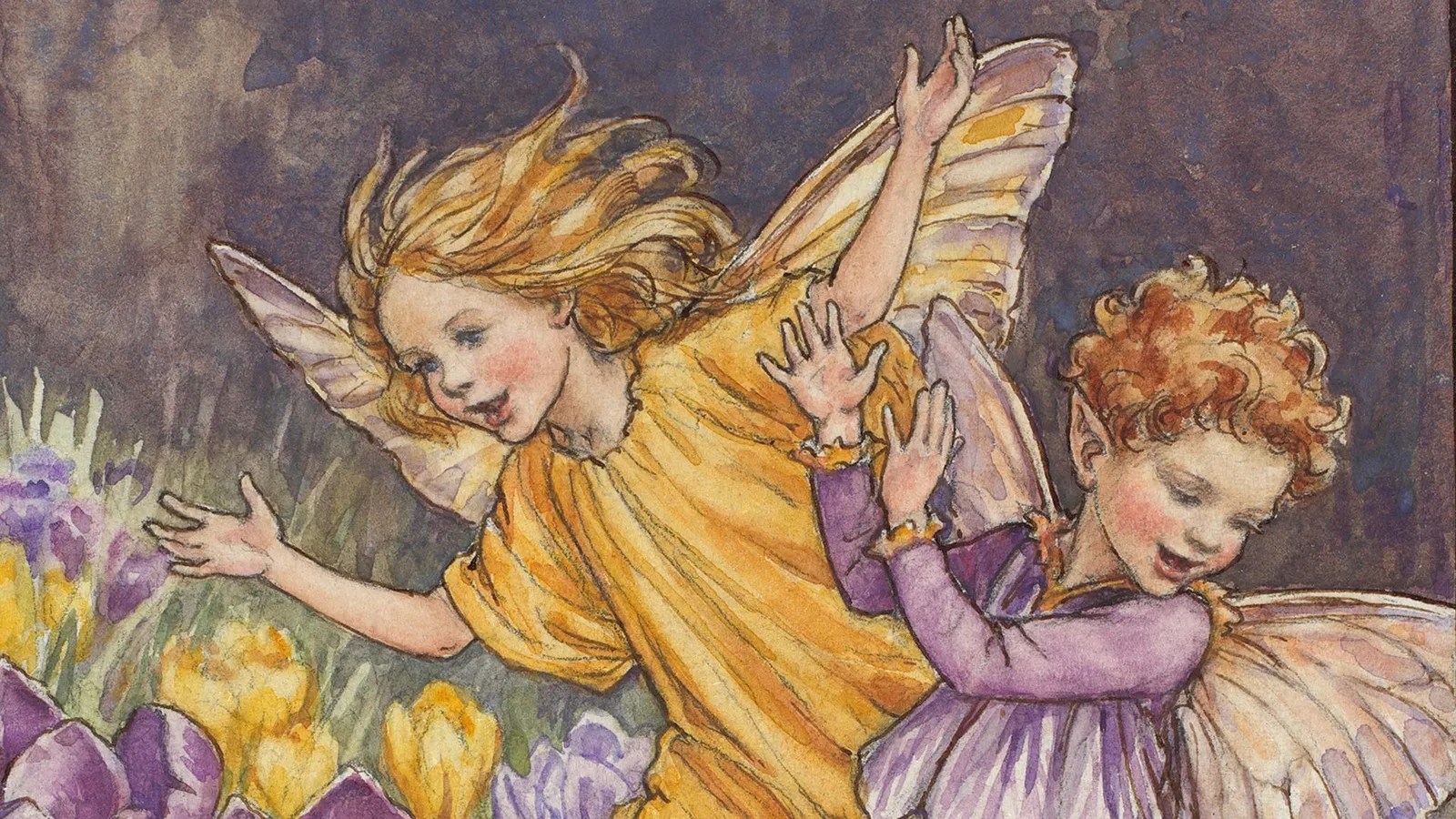
Photo: Estate of Cicely Mary Barker, 1934 Flower Fairies.
The Crocus Fairies from Flower Fairies of the Spring – the watercolors are still popular today with “fairycore” fans, the BBC opines.
Hannah will remember my devotion to the subject of today’s post. Fairies. I have always been into fairies, and long ago Hannah joined me in bringing them to life.
Meanwhile in the UK, the BBC’s Holly Williams writes this about them: “Imagine a fairy. Is the picture that appears in your mind’s eye a tiny, pretty, magical figure – a childish wisp with insect-like wings and a dress made of petals?
“If so, it’s likely you’ve been influenced by Cicely Mary Barker, the British illustrator who created the Flower Fairies. 2023 marks 100 years since the publication of her first book of poems and pictures, Flower Fairies of the Spring – an anniversary currently being celebrated in an exhibition at the Lady Lever Gallery in Merseyside, UK.
“The Flower Fairies’ influence has endured: they have never been out of print, and continue to be popular around the world. … Barker’s delicate watercolors certainly helped cement several tropes we now consider classic – almost essential, in fact – in the iconography of the fairy: they are miniature, sweet and youthful, they are intertwined with plants and the natural world, and they are distinctly twee.
“Yet her drawings were also ‘firmly footed in realism’ points out Fiona Slattery Clark, curator of the show. … Barker drew children from the nursery school her sister ran in their house in Croydon near London; each was assigned a flower or tree, and Barker’s detailed illustrations were botanically accurate – she would source samples from Kew Gardens, says Slattery Clark. Even the petal-like wings and fairy outfits were closely based on plants: an acorn cup becoming a jaunty cap, a harebell becoming a prettily scalloped skirt.
“The Flower Fairies were an immediate hit – but Barker was far from the only artist of her era to find success with fairies. In fact, fairy fever swelled within the United Kingdom for over half a century, reaching something of a peak around the time the Flower Fairies emerged in 1923. Over 350 fairy books were published in the UK between 1920 and 1925, including in Enid Blyton‘s first fairy foray, a collection of poems called Real Fairies in 1923. Fairy art even had the stamp of royal approval: Queen Mary was a fan of Ida Rentoul Outhwaite‘s ethereal drawings, and helped popularize them by sending them in postcard form. …
“But for many hundreds of years, they were not necessarily tiny and fey, but grotesque or fierce elemental forces, capable of great darkness. ‘In 1800, if you thought your child was a fairy it would have been like demonic possession – you would have put that child in the fire to drive out the fairy,’ points out Alice Sage, a curator and historian.
“Yet within 100 years, the whole conception of fairies completely changed. … Fairies became a fashionable subject for Victorian artists, often taking inspiration from Shakespeare’s A Midsummer Night’s Dream and The Tempest. John Anster Fitzgerald, Edwin Landseer, John Everett Millais, Joseph Noel Paton, Arthur Rackham and even JMW Turner – among many others – painted supernatural sprites from the 1840s onwards. But there was still a sense of otherworldly strangeness in many of their depictions – as seen in the work of Richard Dadd, who made his hyper-intricate fairy paintings while living in a Victorian asylum. …
“Barker never made any claims for fairies being real – ‘I have never seen a fairy,’ she wrote in a foreword to Flower Fairies of the Wayside. But it is worth noting that she first published the Flower Fairies at a moment when the desire to believe in magical beings was at a rare high. In 1920, Britain was gripped by the story of the Cottingley Fairies, after two girls claimed to have photographed fairies at the bottom of their garden in West Yorkshire – and were widely believed.
“Their beautiful photographs were created by paper cut-outs, floating on hat pins. Although many were skeptical, they nonetheless also fooled many of the great and the good – the photographs were brought to prominence by no less than Sir Arthur Conan Doyle, the author of Sherlock Holmes, who wrote a whole book about it, The Coming of the Fairies, in 1922.
“Cousins Elsie Wright and Frances Griffiths were aged 16 and nine when they took the first photos. Many years later, in the 1980s, they admitted it was a hoax, explaining that they kept up the pretense that the fairies were real a because they felt sorry for the middle-aged men, like Conan Doyle, that so wanted to believe. …
” ‘For Conan Doyle, it was all about a search for another realm of being that related to life after death, vibrations, telepathy, telekinesis – this fascinating world on the edge of the limits of human perception,’ says Sage. ‘And obviously that’s connected to the loss of his son in World War One.’ …
“Sage is pleased to see the Flower Fairies exhibited in a fine art context at the Lady Lever gallery. For a long time, men painting fairies has been considered art – but when women do it, it’s just silly flowery stuff for children. ‘This is fine art – it’s mass, popular fine art,’ insists Sage.”
More at the BBC, here. No paywall. If you live in the UK, you have until November 5 to see the fairy exhibit at the Lady Lever Art Gallery, Port Sunlight Village.

 Suzanne's Mom's Blog