Feeds:
Posts
Comments

Posts Tagged ‘Bethlehem’

Photo: Artsquest.
Sugar and garish food coloring go into making the perennial favorite
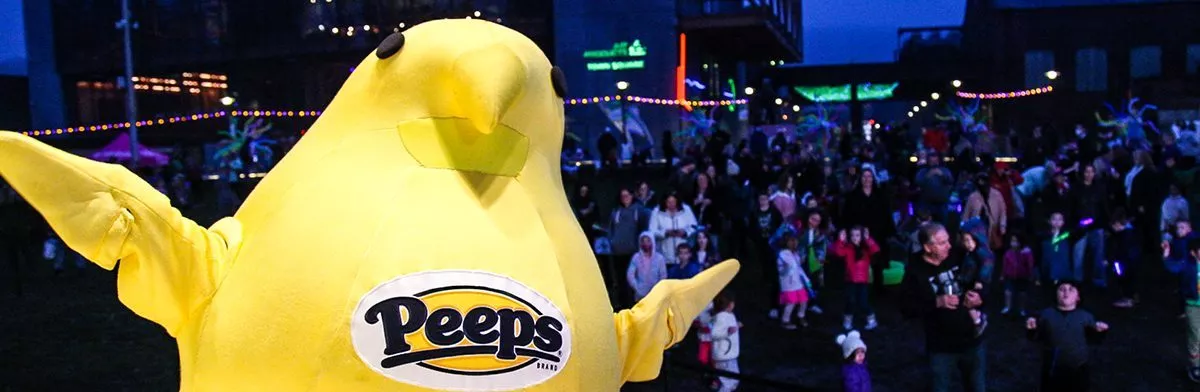
Easter Peeps at a multigenerational family company in Bethlehem, Pennsylvania. The city embraces the business year-round, including at Peepsfest, a New Year’s extravaganza, above.

Many of us follow traditions we remember from childhood, even if some of those traditions don’t jibe with our grownup views of things. Would you insist on eating loads of sugar mixed with scary food dyes if they didn’t evoke a feeling you used to get when discovering certain bright candies behind a bush in the yard or a vase in the living room? Everybody loves a hunt.

You’ve probably guessed I’m talking about Easter Peeps — yellow, pick, blue, or green chicks and rabbits in their own special weird shape.

Tassanee Vejpongsa and John Seewer wrote for the Associated Press that millions of Peeps “are made daily in Bethlehem, Pennsylvania. …

“Love them or hate them, those marshmallow Peeps that come in blindingly bright colors and an array of flavors are inescapable around the Easter holiday.

“Millions are made daily in Bethlehem, Pennsylvania, by Just Born Quality Confections, a family-owned candy manufacturer. …

“Peeps is Just Born’s most recognizable brand and one of a handful of candies that evoke strong reactions — good and bad. Some say an Easter basket isn’t complete without Peeps while others deride them as being indestructible. Some use them in recipes or even artwork.

“ ‘Even if you’re not usually one to gravitate to eating the Peeps, there’s always so many other fun ways to include them in your celebrations,’ said Caitlin Servian, brand manager for Peeps.

“On average, about 5.5 million are made each day. That adds up to 2 billion a year — or roughly 6 Peeps for every man, woman and child across the U.S.

“First hatched in yellow, the sugary chicks and bunnies come in nine colors … including pink, blue and lavender. And there are even more flavors — 14 for Easter — from cookies and cream, to fruit punch and sour watermelon. The varieties and colors vary throughout the year with different holiday seasons.

“Before the early 1950s, making the candies by hand took 27 hours.

“Bob Born, who became known as the ‘Father of Peeps,‘ came up with a way to speed up the process. He and a company engineer designed a machine to make them in less than six minutes. The same process is used today.

“The main ingredients — sugar, corn syrup and gelatin — are cooked and combined to create marshmallows, which are then shaped and sent through a ‘sugar shower.’

“A whopping 400 pounds (181 kilograms) of sugar is used per batch for Peeps’ colored sugars. Freshly made Peeps — each chick weighs one-third of an ounce — then move along a conveyor so that they can cool before being packaged.”

More at AP, here.

Check out Peepsfest, which happens December 31, here, and learn more about the Just Born company here.

Photo: Suzanne and John’s Mom.
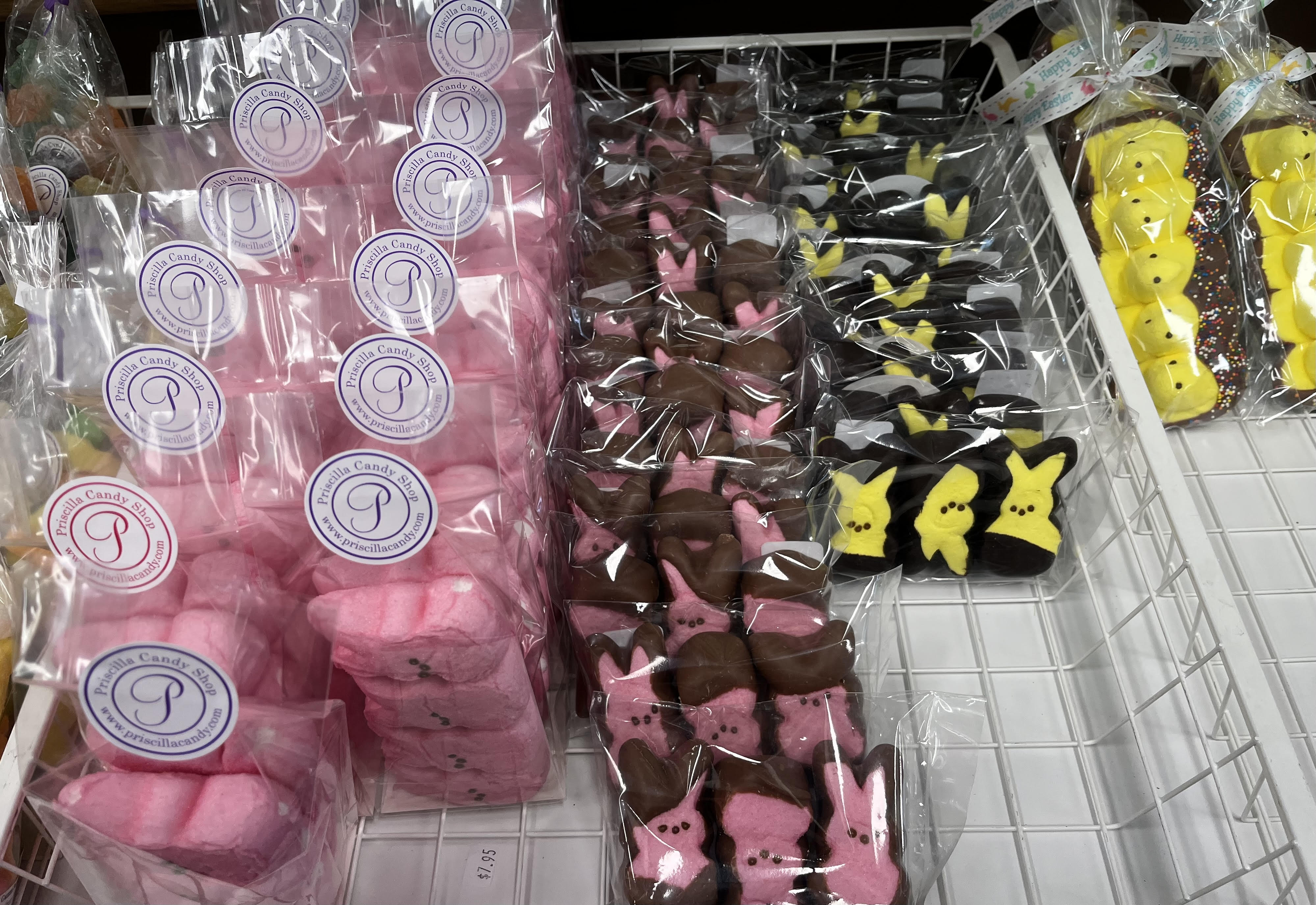
Priscilla’s candy shop goes an extra step, making their own special chocolates using Peeps.
Read Full Post »

Photo: Suzanne and John’s Mom.

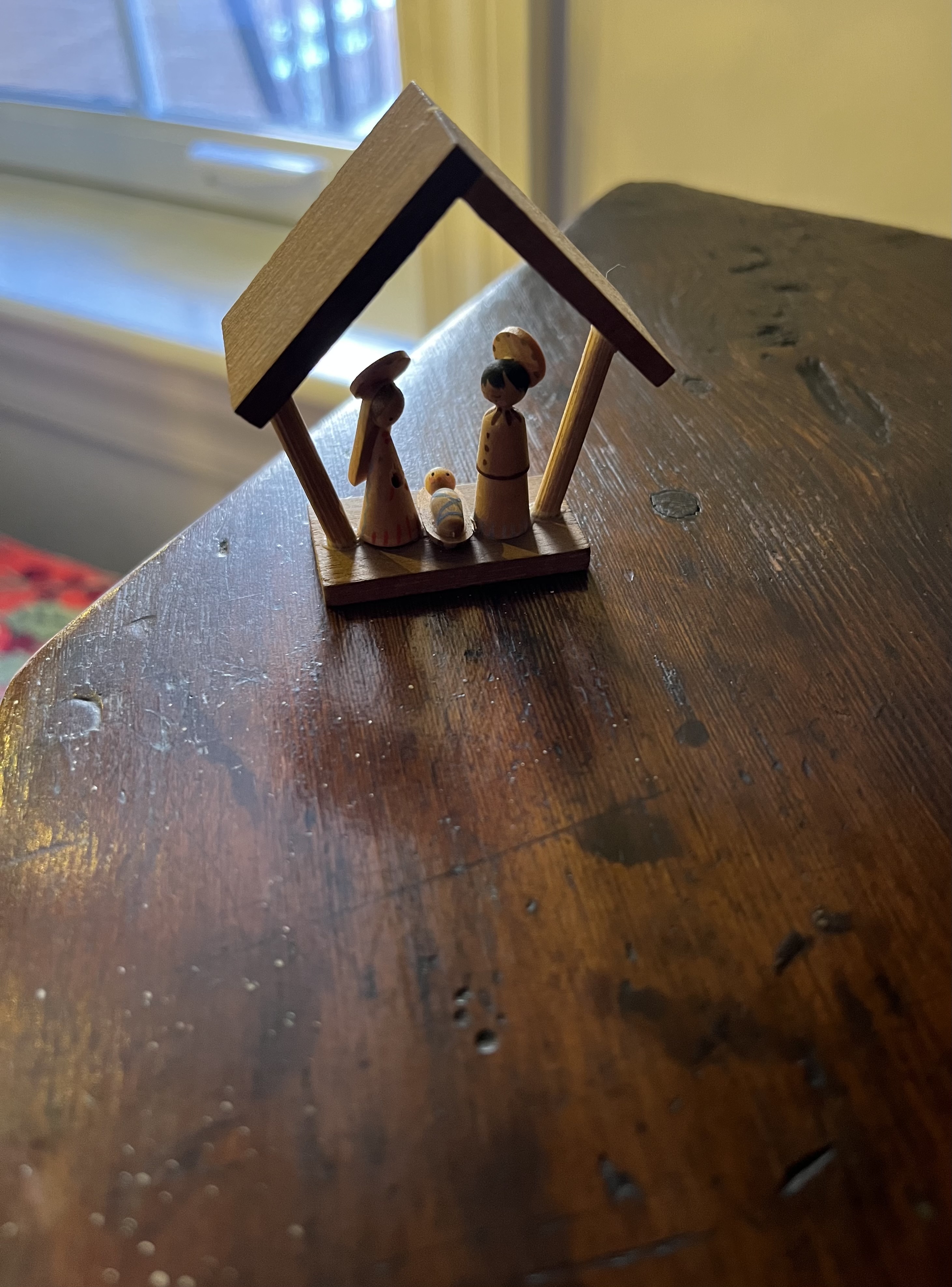
This is my favorite version of the Christmas story. There may be more-accurate translations of the original, but none that sounds as lovely to me or has as many associations with my younger years, when we memorized Bible verses in school.

“And it came to pass in those days, that there went out a decree from Caesar Augustus that all the world should be taxed.

“(And this taxing was first made when Cyrenius was governor of Syria.)

“And all went to be taxed, every one into his own city.

“And Joseph also went up from Galilee, out of the city of Nazareth, into Judaea, unto the city of David, which is called Bethlehem; (because he was of the house and lineage of David:)

“To be taxed with Mary his espoused wife, being great with child.

“And so it was, that, while they were there, the days were accomplished that she should be delivered.

“And she brought forth her firstborn son, and wrapped him in swaddling clothes, and laid him in a manger; because there was no room for them in the inn.”

Read Full Post »

Photos: AFP/THOMAS COEX
Renovated mosaics and columns inside the Church of the Nativity in the occupied West Bank biblical city of Bethlehem.

Do you like mosaics? I relate to arts such as mosaics or collage because I love putting pieces of things together to make something new. As quilters do. And editors. And activists who change the world one by one.

This is a story from Bethlehem, in the Palestinian Territories, where restoration work has tapped the artistry of workers who can envision how small pieces together make a whole.

Clothilde Mraffko writes at Yahoo News, “Masked for centuries by the soot of candles and lately by scaffolding, the mosaics of Bethlehem’s Church of the Nativity have been restored. …

“Over the past 15 months, experts have cleaned and repaired surviving fragments of the 12th century masterworks, preserving 1,345 square feet (125 square metres) of what was once 21,528 square feet (2,000 square metres) of glittering gold and glass. The rest has been eaten away by wear, humidity, wars and earthquakes.

“Now the restored remains shine against the white walls above the heads of visitors to the church in the Israeli-occupied West Bank city of Bethlehem that marks the traditional birthplace of Jesus.

“Overlooking the nave are seven angels framed in gold who appear to have landed on a carpet of vivid green grass. …

” ‘These mosaics are made of gold leaf placed between two glass plates,’ Marcello Piacenti, who supervises the work on behalf of his Italian family restoration firm Piacenti, told AFP [Agence France-Presse]. ‘Only faces and limbs are drawn with small pieces of stone.’

“One of the partially destroyed angel figures was restored using different materials to the original so as not to mislead future archaeologists. [!]

“Ibrahim Abed Rabbo, a Palestinian Authority (PA) engineer said the transformation caused by the restoration is striking. ‘When you entered the church before, you could not even make out that there were mosaics, it was so black,’ he said.

“In a rarity for the period, the works were signed by the craftsmen responsible, Abed Rabbo said. …

“Father Asbed Balian is the senior cleric of the Armenian church at the basilica, where property rights are shared with the Roman Catholic and Greek Orthodox faiths. After seeing the completed restoration, he said, he was ‘stunned. … Spiritually, we feel more exalted.’ …

“When the Palestinian Authority began renovations in 2013, ‘the basilica was in danger,’ PA restoration consultant Afif Tweme said. …

” ‘It’s very special, because of the location,’ said Piacenti. ‘Sometimes I have to force them (workers) to leave’ at the end of the day.” More here.

Read Full Post »