Feeds:
Posts
Comments

Posts Tagged ‘blight’

Photo: S.C. Mero.
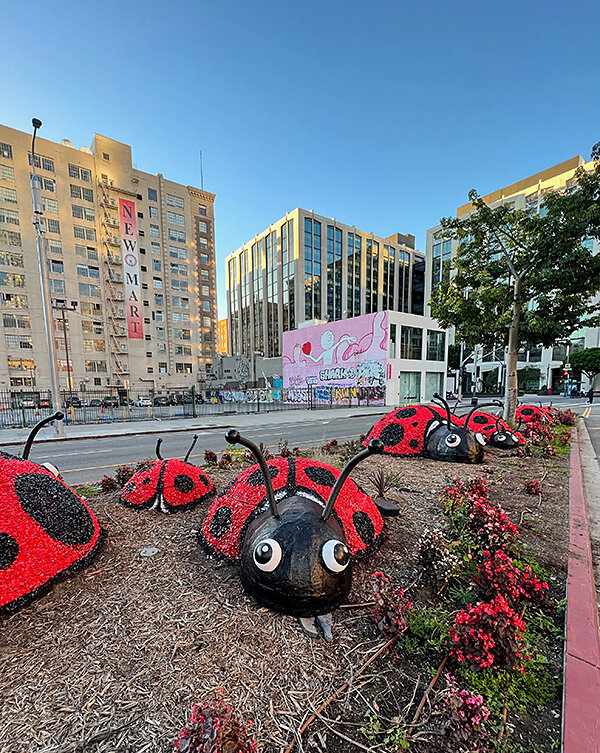
Ladybugs nestle into the intersection of 9th, Main, and Spring Streets in Los Angeles, spring 2023. LA’s Fashion District commissioned S.C. Mero to create a series of installations to decorate the median, which had fallen into disrepair.

Art can lift up a community. It can be an outlet for feelings of all kinds. Whether it’s the art of graffiti (see Manny’s documentary Stations of the Elevated), the art of whimsy, or any other kind.

In today’s post, Ali Martin interviews a whimsical street artist, S.C. Mero, for the MonitorDaily.

“In downtown Los Angeles, absurdity interrupts urban blight: A fire hydrant sprouts stockinged legs; a winged telephone leaps from a phone booth; a mailbox towers, inaccessible, over passersby. 

“The city’s historic business district and surrounding neighborhoods are the backdrop for contemporary street artist S.C. Mero, who sees opportunity in a landscape dogged by disappointment and deferred dreams.

“The Minnesota native embraced the area, known as DTLA, after graduating from the University of Southern California (USC) a decade ago. Today, her rogue installations are part of downtown’s creative fabric – and local authorities are in on it. She’s been honored by the city for her contributions to the Skid Row neighborhood and commissioned by the nearby Fashion District to decorate a median at an intersection.

“Transformation governs her art. Ms. Mero’s first pieces were mosaics made of pennies which she altered with heat, dye, and tools. Other projects reshape abandoned spaces into commentaries on politics and humanity. 

“Her work insists on hope, which she describes as rebellious. ‘To put something like cute little turtles on a median with downtown the way it is, it’s resisting something, right? It’s resisting the default, which is to be negative,’ says Ms. Mero.

“The Monitor spoke with Ms. Mero at Something Poetic, her venue for performance art. The space, offered to her during the pandemic by the Historic Core Business Improvement District, has become a hub for local artists. The conversation has been edited for clarity and length. 

Monitor: Why downtown? You joined an artist collective on Skid Row after graduating from USC. I’m guessing there were other options. 
“S.C. Mero: I think my mom asked me the same question all the time. I just feel like it’s a good fit for what I’m doing. It’s really a creative vortex. … You have the Arts District, the Flower District, the Fashion District, Little Tokyo, you have the Industrial District, the Financial District. And maybe that’s typical of most cities, but I feel like there’s a lot happening here and it’s good for cultivating ideas.  I’ve just felt like I want to see it through, too. Look at these [historic, vacant] buildings. I think this could come back to life and they’re not there yet. So I want to be part of that transition. …

You look at a pothole, you look at something breaking down around you, and you see whimsy and light. How does that happen? 
“Because nobody cares about it anymore. It’s free game, right? Nobody’s going to stop you from really, truly doing anything on a pay phone right now, or a newspaper stand, or – in certain areas – a pothole. … To do anything to it, people are like, ‘Oh, you know, it’s better than what was there.’ 

What do you want people to take away from your art? 
“I feel like wanting people to take away something is in a way thinking that I want something from them. … I’m thankful that they are even allowing me to do it. So the fact that their reaction is positive, I’m just even more grateful for that – it makes it a little easier to be able to keep doing it. So I don’t know if I want a certain reaction from people. I just hope that they can find something that they do that they love as much as what I’m doing. 

Is there a theme or an idea that pulses through your work?
“Yes. At first I didn’t really see it. … The age-old idea of spiritual growth and transformation. And I think that that’s evident in a lot of my work – the whole idea that something can lose its identity or lose its value, but then come back even stronger. 

“A lot of my work is critical of our government, but I still maintain hope that there is a better way. It speaks to the truth because it’s not really about a payphone or a penny. We’re no different than that, right? Something is that way, but it can be better. What does it take for that to happen? It takes a belief, for one. It’s not going to get better by not thinking or imagining or seeing it that way. 

What is the relationship between your work and the downtown community?
“They’re as much of a part of [the art] as I am. It’s that we’re-in-this-together kind of vibe. Whether they like the piece or not, they get it because they’ve seen that pothole. They’ve seen a payphone like that. … It has that sense of camaraderie, I think.”

More at the Monitor, here. Note the funny mailbox, among other things.

Read Full Post »

We all know that chestnut trees were wiped out by disease, right? Well, maybe not.

Susan Sharon at the Maine Public Broadcasting Network has a hopeful story.

“A century ago American chestnut trees dominated the eastern woodlands from Georgia to Maine. Growing straight and tall they were prized for timber. Wildlife depended on the nuts they provided every year.

“People ate the chestnuts, too, scooping them up by the sackful every Fall. Then came an exotic blight accidentally introduced from Asia and the species was virtually wiped out.

“That’s why scientists are excited by a recent find in western Maine, a record-breaking find that is raising their hopes for the future.

“The unusual discovery was made from the air. Dr. Brian Roth, a forest scientist with the University of Maine was surveying areas most likely to have habitat conditions favorable for chestnut trees and – voila! Flying over some woods in Lovell he saw a telltale sign.

” ‘In July, when nothing else is blooming, this tree will have a large amount of white flowers in its crown,’ says Roth. …

“This is not just any tree. This is an American chestnut tree worthy of the record books. …

“As girth goes, this chestnut tree is not so impressive. It’s on the skinny side. And most people wouldn’t pick it out as distinctive in a forest lineup. But when it comes to height, this American chestnut reigns supreme.

” ‘We think it’s around one hundred years old,’ says Roth. ‘It’s over 100 feet tall, which makes it the tallest [chestnut] that we know of in North America.’ …

” ‘We’re quite interested in these native trees, one for getting them into the population, our breeding program, as well as where do these trees grow?’ Roth says.

“The North Carolina-based American Chestnut Foundation is devoted to restoration of the American chestnut to its historic range. … Dr. Jared Westbrook is the American Chestnut Foundation’s geneticist. …

“He says more than 60,000 chestnut trees have been planted so far. To help them out, the group is using a virus that infects the chestnut fungus and makes it weaker. But Westbrook says only 500 trees, the toughest and the best of the bunch, will ultimately be selected for reintroduction to the wild.” Listen to the story here.

The poet Marianne Moore once wrote, “I rejoice that there are owls.” Today I rejoice that there are chestnut trees.

Photo: MPBN/Susan Sharon
Here’s the evidence. People are excited about finding a 100-year-old chestnut tree that survived blight in Maine. Other chestnuts are being nurtured in the South.

Read Full Post »

With a little creative thinking, a woman in Detroit was able to put a rundown house to good use, improve the neighborhood, promote her flower business, and help florists who focus on locally grown flowers.

Stacy Cowley writes at the NY Times, “Eleven months ago, a derelict house here that is now filled with 36,000 flowers contained far grimmer things. …

“Twelve thousand pounds of trash had to be hauled out before Lisa Waud, a florist who bought the duplex at auction for $250, could see what kind of canvas she had purchased.

“The house remains a structural wreck, but its atmosphere has been transformed. [In October] some 2,000 visitors [toured] Flower House, an art installation Ms. Waud and more than three dozen floral collaborators from around the country created on the site. Their goal is to cast a new light on the Detroit metropolitan area’s infamous blight, and on their own trade. …

“All of the plants and flowers filling [the rooms] are American-grown, a rarity in an industry that imports a majority of its wares from Colombia and elsewhere. …

“The inspiration for Flower House struck in 2012, when she saw images from that season’s Christian Dior couture show, held in a Parisian mansion filled with flowers in a rainbow of colors.

“ ‘It was stunning, and I knew immediately that I wanted to do that — but living in Detroit, I pictured it in an abandoned house,’ she said. ‘I’m trying to rebrand abandoned houses as a resource.’ …

“Ms. Waud estimated that she would need to raise $150,000 to cover the installation’s floral costs, but when she contacted her usual wholesalers, the California Cut Flower Commission, Mayesh and Nordlie, all three offered to donate their flowers.” Read about the inspiring results here.

Photo: Laura McDermott for The New York Times 
Lisa Waud, a Michigan florist, works on her room on the back side of the Flower House on the first day of the installation in Hamtramck. 

Read Full Post »

Even if, like me, you never got into the TV show “The Wire,” you may know that it was about a troubled section of Baltimore. You also may be interested in a new school there, intended to serve as a real community gathering place.

New York Times design critic Michael Kimmelman has the story.

“In many ways, public schools are gated communities, dead zones,” writes Kimmelman. “They’re shuttered after dark and during the summer, open to parents and students while in session but not to the larger community.

“A new public school in one of the poorest neighborhoods in East Baltimore wants to challenge the blueprint. Designed by Rob Rogers, of Rogers Partners in New York, Henderson-Hopkins, as it’s called, aspires to be a campus for the whole area — with a community center, library, auditorium and gym — as well as a hub for economic renewal.

“This is the neighborhood where parts of ‘The Wire’ were filmed. In 2000, when the city’s mayor convened local business leaders, the vacancy rate was 70 percent. Poverty was twice the city average. Crime, infant mortality and unemployment were all through the roof.

“The idea that emerged — of making the school the centerpiece of a major redevelopment project — is a grand urban experiment. Operated by Johns Hopkins University in collaboration with Morgan State University, the school, which opened in January, belongs to a $1.8 billion plan that also includes new science and technology buildings, a park, retail development and mixed-income housing. While gentrification might threaten to displace the poor, the school is to be the glue that helps bind the district together.” Read more here.

Photo: Matt Roth for The New York Times
Henderson-Hopkins, which shares its library, gym, auditorium, and other features with the surrounding area, is designed to catalyze change in a blighted section of Baltimore.
 

Read Full Post »