Feeds:
Posts
Comments

Posts Tagged ‘bog’

Photos: Avedis Hadjian.
Estonian canoe maker Mr. Ruukel works on his latest dugout canoe outside his barn in Tohera.

Today I want to share a lovely photo essay from the Christian Science Monitor about a canoe maker in Estonia. Be sure to click through and see all the pictures at the Monitor.

Avedis Hadjian writes, “Aivar Ruukel is one of the last five masters in Estonia who make the Baltic country’s traditional dugout canoe, known as a haabjas. Until the 1960s, it was the conventional means of transportation in the Soomaa, or ‘land of bogs,’ region during the spring floods, locally called the fifth season.

“Mr. Ruukel and Priit-Kalev Parts, another haabjas maker, are the most vocal advocates for preserving the tradition, which is threatened by the making of fiberglass or other modern – often motorized – boats.

“Both Mr. Ruukel and Mr. Parts learned their craft from older masters in the early 1990s, shortly after Estonia gained its independence from the Soviet Union, and are now trying to engage the new generation, training young apprentices in haabjas building. …

“On a gray morning, Aivar Ruukel is scouting for the ideal aspen in the Soomaa, a vast wilderness area in southwestern Estonia. The aspen is the preferred tree for making [the] traditional dugout canoe – an art that is now endangered.

“ ‘The ideal tree should have the shape of a pencil, but every tree is perfect in its own way,’ even if only a few can be used to build the boat, says Mr. Ruukel.

“Some of the trees are covered with black canker, a fungal infection. ‘You can’t make a haabjas out of them, but they are used by woodpeckers to make their nests, so they serve a higher purpose,’ he says.

“Mr. Ruukel is one of the last five masters in the Baltic country who make the canoes. Until the 1960s, it was the conventional means of transportation in the Soomaa [during] the spring floods. …

“Both Mr. Ruukel and Mr. Parts [train] apprentices in haabjas building. A skillful wielding of the axe to hollow out the tree is only part of the required expertise and techniques, which also involve expanding the trunk by filling it with water and then hanging it above a carefully controlled fire.

“What was a necessary means of transportation in the past has now become an Estonian identity marker. In 2021, haabjas building was inscribed on UNESCO’s List of Intangible Cultural Heritage in Need of Urgent Safeguarding.”

More at the Monitor, here.

In the “search” box at this blog, you can find several posts about Estonia, a country that’s interesting in more ways than one. (For example here, here, and here.)

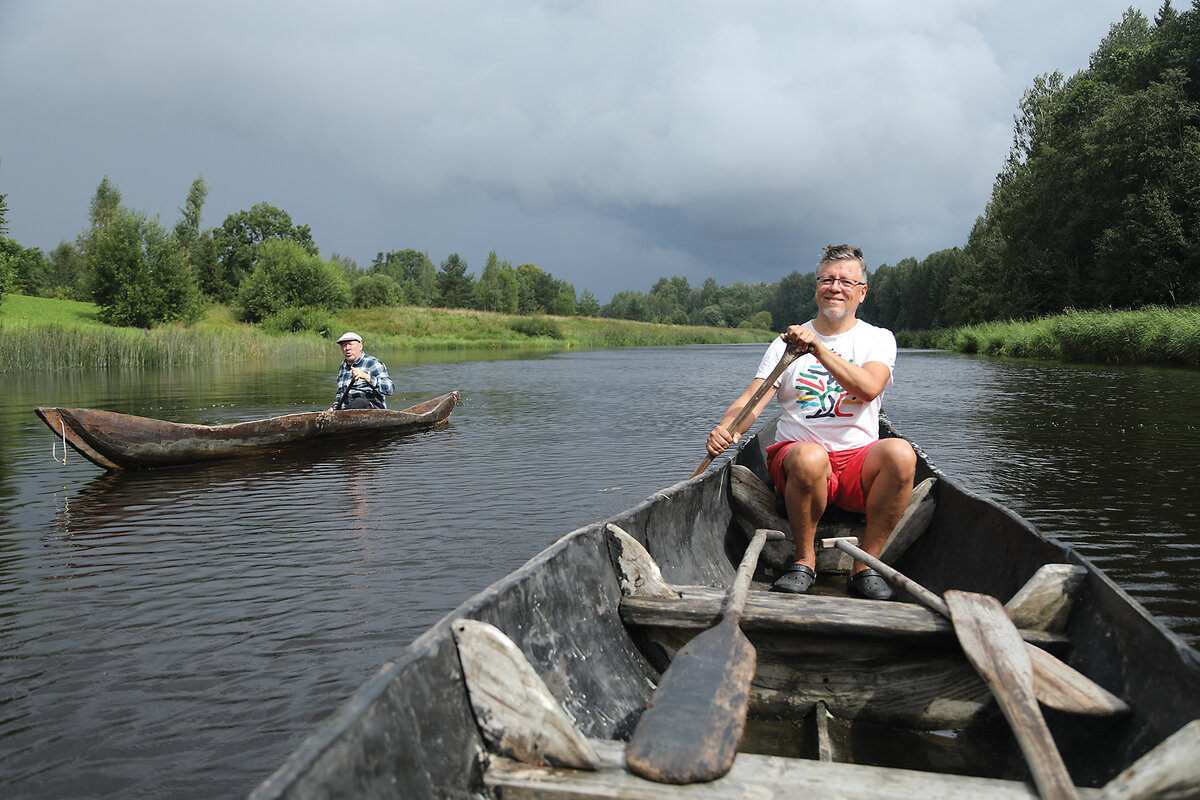
Mr. Ruukel (left) and Jari Hyvönen, his brother-in-law visiting from Finland, paddle in canoes on the Pärnu River.
Read Full Post »

Photo: Charles Krupa/AP.
Workers harvest cranberries at the Rocky Meadow bog in Middleborough, Massachusetts, ahead of Thanksgiving. 

Recently, I read about a federal program paying “farmers to convert the land of bogs that is not efficient for growing” into wetlands that can alleviate climate change consequences. Whether or not the federal program will continue, Massachusetts is on the case, helping its own farmers with restoration.

Gloria Oladipo wrote at the Guardian last November, “As millions of cranberries were being harvested for Thursday’s US Thanksgiving holiday, Massachusetts farmers were working to convert defunct cranberry bogs back to wild wetlands, amid climate crisis woes. Several restoration projects were awarded $6m in grants to carry out such initiatives, state officials announced this week.

“The grants, provided by the New England state’s department of fish and game division of ecological restoration (DER), will ‘increase resilience to climate change for people and nature, restore crucial wildlife habitat, and improve water quality’ in 12 communities, said the Massachusetts governor, Maura Healey, in a statement. …

“ ‘These initiatives will enhance our ability to store and sequester carbon with nature and help us meet our net zero goals,’ said Rebecca Tepper, secretary of the state’s office of energy and environmental affairs. …

“The grants are being awarded through two state programs: the DER’s wetland restoration program and the DER’s cranberry bog restoration program, which converts defunct cranberry bogs into wetlands and streams.

“To date, scientists and government officials have converted 400 acres of retired cranberry bogs into wetlands, the Washington Post reported. State officials have said they hope to restore an additional 1,000 acres of bogs within the next decade. …

“As sea levels rise in Massachusetts because of the climate crisis caused by humans burning fossil fuels, scientists are looking to develop bogs into wetlands to improve coastal resilience and slow down erosion.

“Wetlands can hold more water and filter out pollutants amid increased storms that bring potential flooding. They also have other environmental benefits, acting as wildlife habitats and storing carbon dioxide from the atmosphere in their soil.

“More farmers have been drawn to the prospect of transitioning their former cranberry bogs into wetlands. The climate crisis and economic factors, including the high cost of modernizing bogs, can make cranberry farming more difficult. …

“ ‘We are in an upward trend in terms of interest in retiring cranberry bogs,’ said Brian Wick, executive director of the Cape Cod Cranberry Growers Association, to the Post. … But getting land for restoration remains a competitive process, as other businesses – such as housing developers – vie for undeveloped coastal land.

“ ‘This opportunity won’t be here in 25 years,’ said Christopher Neill, a senior scientist at the Woodwell Climate Research Center and an expert in restored bogs, to the Post. ‘These growers are not going to hang on, they’re going to make decisions and the land won’t be available forever.’

“While conservation projects have steadily increased in southeastern Massachusetts, restoration initiatives are still relatively new. The majority of finished projects are only a few years old, with 14 restoration initiatives still being designed and implemented, the Post reported.”

In addition to benefits like carbon storage and habitat for wildlife, converted cranberry bogs can be lovely for walkers.

More at the Guardian, here. Nice photos. No firewall.

Read Full Post »

Photo: Dougie Barnett/NatureScot.
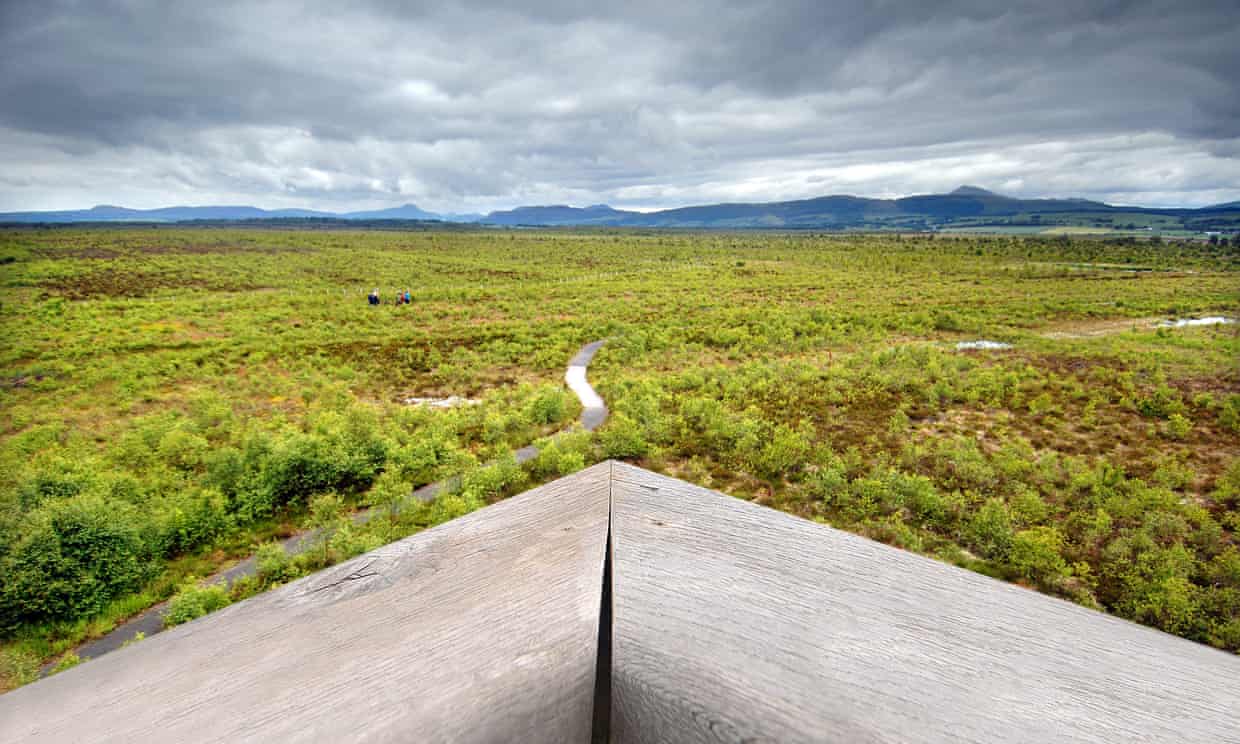
Flanders Moss in Scotland has seen the return of key bog plants such as sphagnum (peat moss) and cottongrass — so important now that we know bogs can store the carbon we don’t want in the atmosphere.

My father-in-law sold peat moss, among other agricultural products, for his entire career. He usually got the peat from Canada, although other people source it from places like Germany and Ireland. In Moat, Ireland, our friend James Hackett relied on peat for warming the house. (Burning it was not the best thing for his health.)

Today’s story is about Scotland’s heightened focus on protecting peat bogs so they can store carbon and fight global warming.

Phoebe Weston reports at the Guardian, “Flanders Moss bog is slumped on the flat, farmed landscape of the Carse of Stirling in Scotland like a jelly fungi. It wobbles when you walk on it, and a metal pole goes down eight metres before reaching hard ground. This lowland-raised bog is a dome of peat fed mainly by rainfall and it acts like a single organism – the whole thing has to be looked after for any part to be in really good shape. If it is drained in one area it will affect the water level across the entire bog.

“For much of human history peat bogs have been thought of as wastelands. This 860-hectare [~2,200 acres] site has been hacked away and drained since the early 1800s to make space for fertile farmland below. …

“It is now recognized that peat bogs are among the greatest stores of carbon and, after decades of restoration, the holes in the peat at Flanders Moss have been patched up. Areas that used to be purple with heather are turning green as key bog plants such as sphagnum (peat moss) and cottongrass come back. The bog rises out of the land like a sponge and ‘breathes’ as changes in the weather and water level cause it to swell and contract.

“Researchers in Scotland are tracking ‘bog breathing’ using the latest satellite technology that can detect just a few millimetres of change. … Thanks to the restoration work, the water table has risen [and] is now at the surface. As the bog draws in water from the surrounding land, it helps manage flood risk. Flanders Moss bog has removed [about 2,200 acres] from the Forth catchment, reducing flooding downstream. …

“The Scottish government-funded Peatland Action project, which started in 2012, is helping revive 25,000 hectares [~61,776 acres] of degraded peatland. In 2020, the Scottish government committed [about $300 million] over 10 years to bog restoration in a bid to lock carbon in the land. …

“It takes about a month to process the satellite data for a third of Scotland, which is available through the Copernicus Open Access Hub. The technology is still in development but is likely to be cheaper than ground-based mapping. …

“Despite these restoration efforts, Flanders Moss is still a net emitter of carbon. … Stopping these emissions and preventing further degradation are the primary objectives of the restoration project.

“Bogs work on a different timeframe than humans. They form slowly … taking up to 1,000 years to grow one metre. But [David Pickett, who manages the site with his National Nature Reserve] team has jump-started recovery. ‘We’ve done most of the big work here,’ he says. ‘Now, it’s a question of waiting. The process of fixing this site will last 100 years, and the benefits of work being done now will only be seen by the next generation.’

“It’s easy to see why bogs weren’t popular. They are stores of partly decayed organic matter, which are too acidic and devoid of nutrients to support healthy trees. But this bog is colorful and has a fresh, earthy smell. As well as being a fantastic store of carbon, this ancient, watery land – healthy peat is about 90% water – is also rich in wildlife, including rare lizards, dragonflies and even snakes.

“ ‘There isn’t headline sexy stuff like puffins and seals but you go around the boardwalk and it’s a fantastic place,’ says Pickett. ‘I always used to think bogs must have been named on a Friday after a really bad week. We’re trying to change the perception of bogs but it’s a hard sell.’ ”

More at the Guardian, here.

Read Full Post »

Photo: National Museum of Ireland.
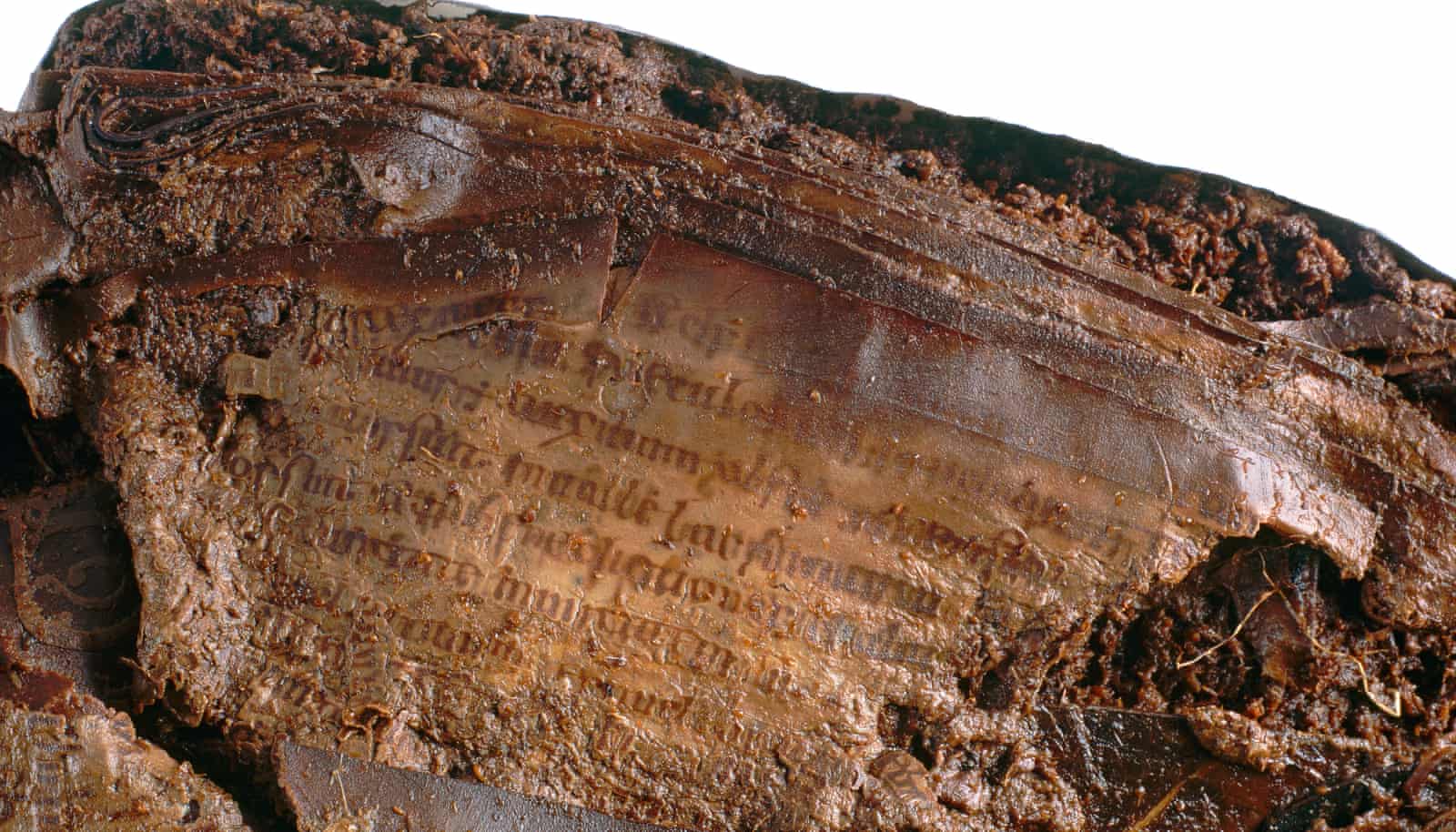
Found in an Irish bog. The psalter is shown here pre-conservation – lines of psalms clearly visible.

In the miracles-all-around-us department, imagine finding in a peat bog a medieval book of psalms that looked like the monastic compilers might have had links with Egypt! Lisa O’Carroll writes for the Guardian about a book on the psalter’s discovery and painstaking restoration.

“One summer’s day in Tipperary as peat was being dug from a bog, a button peered out from the freshly cut earth. The find set off a five-year journey of conservation to retrieve and preserve what lay beyond: a 1,200-year-old psalm book in its original cover.

“Bogs across Europe have thrown up all sorts of relics of the ancient past, from naturally preserved bodies to vessels containing butter more than a millennium old, but the 2006 discovery of an entire early medieval manuscript, entombed in a wet time capsule for so long, was unprecedented, said the National Museum of Ireland.

“The book fell open upon discovery to reveal the Latin words in ualle lacrimarum (in the valley of tears), which identified it as a book of psalms. One particularly unexpected feature was the vegetable-tanned leather cover with a papyrus reed lining, suggesting the monks could have had trade links with Egypt.

“ ‘It still blows me away,’ said John Gillis, the chief manuscript conservator at Trinity College Dublin, home of the Book of Kells, the Book of Armagh and 450 other medieval Latin manuscripts. ‘It was by far and away the most challenging, most interesting project I have ever undertaken – and to put that in context, I am surrounded by these iconic manuscripts.’

“Ten years after going on display at the National Museum in Dublin, the Faddan More Psalter is one of Ireland’s top 10 treasures and now the subject of a 340-page book from the institution documenting every stage of the ‘terrifying’ preservation process for future scholars. …

“The process of stabilising the book outside the bog, drying it and then unpicking and unfolding pages where possible was painstaking. Archaeologists placed the ‘conglomeration’ of squashed pages, leather and turf in a walk-in cold store in the museum at 4C. But there was no manual in the world to guide Gillis on how to go about the task. …

“Initial examination was limited in order to mitigate further trauma. CT scans and X-rays to find 3D structures were excluded owing to concerns that they could accelerate the degradation.

“After trying sophisticated versions of freeze-drying, vacuum-sealing, and drying with blotting paper, Gillis settled on a dewatering method using a vacuum chamber installed in the museum lab for four years to minimise shrinkage and decay.

“It would take two years before all the folio fragments were in a dry and stable state before the daunting task of dismantling could begin, a process chronicled in the book out later this month, The Faddan More Psalter, The Discovery and Conservation of a Medieval Treasure.

“ ‘It was absolutely terrifying,’ Gillis said of the responsibility he felt.

‘I heard from someone in the British Museum that there was a picture of the [book fragments] on the walls in a staff area there with the words “If you think you have a bad day ahead …”

” ‘You had this nerve-racking scenario of disturbing this material, which meant losing evidence, when the whole point was trying to gain as much information as possible.’

“Many of the spaces between the iron gall letters had dissolved into the bog, leaving an alphabet soup of several thousand standalone letters. It would take months after the drying process to piece them all together, in sequence on the right pages.

“ ‘The rewards when you slowly lifted up a fragment, and suddenly beneath this little bit of decoration would appear, particularly the yellow pigment they used. It would kind of shine back at you,’ Gillis said. ‘And you’d go: “Wow, I am the first person to see this in 1,200 years.” So that kind of privilege made all the sleepless nights and racking of the brain worthwhile.

“ ‘It was the purest conservation I’ve ever carried out. There is no repair, I’ve attached nothing new. All I’ve done is captured and stabilised.’ ”

More at the Guardian, here.

Read Full Post »

A friend is helping to build a playscape, a playground for all ages and abilities that takes advantage of the natural environment‘s restorative qualities.

My husband and I went to see where the playscape is emerging with a boost from the state’s Community Preservation Act. It is located over by Gowing’s Swamp, a lovely wooded area with native plants once cataloged by Thoreau. We walked on a hilly woodland path around the swamp and took note of Canada Mayflowers like tiny bottle brushes and a starlike white flower with six long, narrow leaves growing out from the stem at the same height. (If I’d had my camera, I’d have uploaded a picture at MisterSmartyPlants.com.)

The Sudbury Valley Trustees oversee Gowing’s Swamp, and have this to say about it:

“Gowing’s Swamp, named by Thoreau for its landowner in the mid-1850’s, is an 8.9 acre acidic wetland complex located in a protected, glaciated hollow on the eastern side of a glacial kame known as Revolutionary Ridge.  A kettlehole bog, at the southern end of the wetland, contains specialized plant communities that are locally rare in Southern New England.  The natural area provides habitat for a diverse range of wildlife.

” ‘Unlike any other bog in New England, Gowing’s Swamp found its way into American literature by virtue of significant passages in Thoreau’s Journal,’ says botanist Ray Angelo, and has been visited and studied regularly over the last 160 years by Concord naturalists, literary and historical scholars, and has been the subject of ongoing scientific studies.” More here.

Photograph of Gowing’s Swamp: Sudbury Valley Trustees

Read Full Post »