Photo: Chelsea Call
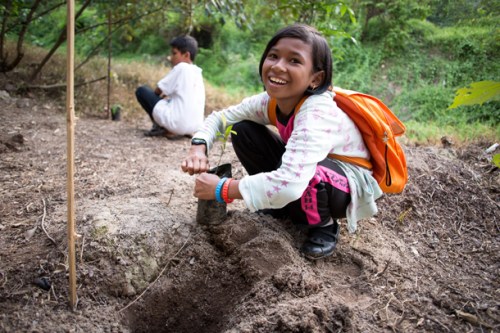
A young girl plants a seedling at the ASRI clinic in Gunung Palung National Park in Borneo, where a nonprofit enables patients to pay for medical care without resorting to illegal logging.
The radio show “Living on Earth,’ Public Radio International’s environmental news magazine, is a great source of stories about nature, climate change, and ecological initiatives worldwide. In this episode, we learn that medical costs in Borneo were the main reason that communities were illegally cutting down trees. And we see how one visionary addressed the danger to the rainforest by first asking the local community what needed to be done.
“Gunung Palung National Park on the island of Borneo is home to diverse species found nowhere else, and beloved by the people who live on the Indonesian island. But like many people who live near tropical forests, they have at times had to resort to illegal logging to pay for healthcare. Now the nonprofit Health in Harmony is providing healthcare that patients can pay for with a simple trade of labor, seedlings or manure, so that no one ever has to log to pay cash for essential health services. Founder Kinari Webb and Host Bobby Bascomb discuss the importance of listening to what forest communities say they need in order to stop logging.
“BASCOMB: The rainforests of Borneo are some of the oldest tropical forests in world, roughly 130,000 years old. And because they evolved on an isolated island the forests are teeming with endemic species found nowhere else on earth. From highly endangered orangutans, tigers, and rhinos to pygmy elephants just five feet tall.
“Borneo’s Gunung Palung National Park is a critical habitat for many of the island’s endangered species and a huge carbon sink – crucial in our fight against climate change. The rainforest was also being deforested at an alarming rate when Kinari Webb first visited in the early 90’s. Kinari was a student at the time, but she was so alarmed by the deforestation she saw that she went on to found the nonprofit Health in Harmony, which aims to keep the forest healthy by keeping people healthy. …
“WEBB: I first went to Borneo when I was an undergraduate. I took a year off and spent a year deep in the rainforest studying orangutans. And Gunung Palung National Park is considered the jewel in the crown of all the Indonesian national parks. … There’s a lot of people who live right around the park, about 60,000 people. They love the forest as well. …
“They want it to be there for future generations. But the logging was rampant, it was completely out of control. … I was just so angry at these people. But then I realized, and I talked to many of them, and what they told me was, you know, if my child is sick, or my family member is sick, I have no choice and it’s one of the only ways to get cash. … One medical emergency can cost an entire year’s income. …
“That just broke my heart. How can that be? And how can we be allowing that to be? So I ended up going to medical school and returning to Indonesia so that I could try to work on this intersection between human and environmental health.
“BASCOMB: You call it radical listening, the way that you discovered what these people need and how to help them. Can you tell me more? …
WEBB: We actually do what people say. And that is wildly unusual in the way that development is done and conservation is done. … We ask them, what would you all need as a thank you from the world community so that you could actually protect this precious forest that you all are guardians of?
“And it was amazing because every single community and everywhere we’ve been, it’s been the same, that every community will independently come to a solution that is the same in a given region. So around Gunung Palung, it was we need access to healthcare, and we need training and organic farming. And if we have those things, we can stop logging. Now, I just, in the beginning, I just trusted on faith that they truly knew what the solutions were.
“But 10 years later, we had incredible data that showed a 90% drop in logging households; a stabilization of the loss of primary forest, which had been shrinking like crazy. We had a re-growth, actually, of 52,000 acres of forest, and we had a 67% drop in infant mortality. …
“BASCOMB: A lot of NGOs [nongovernmental organizations] will go to a community and say, Oh, you need a school, or you need a road. But if you actually stop and ask people, they might say, we need water. We need sanitation. …
“WEBB: We ended up providing a kind of simultaneous to the government healthcare system, when the government was struggling to get a system that was quite functional. And since then [2007] they have done a much, much better job. And we coordinate with them all the time, and I think that together, we have really made a great difference in these communities. And one of the heads of the Department of Health at one point said to me, he said, ‘You know, I didn’t even know it was possible to provide high quality health care in a remote area. It wasn’t even trying until I saw your clinic.’ ”
More at the Living on Earth radio show, here.
Photo: Chelsea Call
An orangutan in Indonesian Borneo. “Kinari Webb was studying orangutans in Borneo in the early 1990s when she found out that much of the logging there was done so locals could cover healthcare costs,” says Living on Earth.


 Suzanne's Mom's Blog