Feeds:
Posts
Comments

Posts Tagged ‘breed’

Photo: Parks Australia via AP.
A road closed sign next to red crabs during their annual migration on Christmas Island, Australia, in October 2025.

I’m belatedly checking in on this year’s red crab migration. It happens annually on Australia’s Christmas Island, which, according to Wikipedia, “derives its name from its discovery on Christmas Day 1643 by Captain William Mynors.” I have reports from both Public Radio International’s The World and People magazine.

From AP’s Rod McGuirk via The World: “Tens of millions of red crabs are making their way to the ocean as part of their annual migration on Christmas Island, where a much smaller human population uses leaf blowers and garden rakes to help them on their way.

“Christmas Island National Park acting manager Alexia Jankowski [said] there were up to 200 million of the endemic crabs, also known as Gecarcoidea natalis, on the tiny Australian island territory in the Indian Ocean. Up to 100 million were expected to make their way from their forest burrows to the shoreline where they breed.

“The start of the Southern Hemisphere summer rains [triggered] the annual odyssey.

“The crabs seek shade in the middle of the day, Jankowski said, but early mornings and late afternoons bring about a vast, slow march that sees them move to the coast over roads and gardens. …

“ ‘Some people might think they’re a nuisance, but most of us think they’re a bit of a privilege to experience. They’re indiscriminate. So, whatever they need to get over to get to the shore they will go over it. So if you leave your front door open, you’re going to come home and have a whole bunch of red crabs in your living room. Some people if they need to drive their car out of the driveway in the morning, they’ve got to rake themselves out or they’re not going to be able to leave the house without injuring crabs,’ she added.

“On the shores, the male crabs excavate burrows where the females spend two weeks laying and incubating eggs. The females are all expected to release their spawn into the ocean at high tide. … The young spend a month riding the ocean currents as tiny larvae before returning to Christmas Island as small crabs.

“ ‘When they’re little babies only about half the size of your fingernail, we can’t rake them, because you’d crush them. So, instead, we use leaf blowers,’ Jankowski said.”

At People, Rachel Raposas adds, “The mass migration heavily impacts regular human activity across Christmas Island.

Footage captured by ABC shows a small road completely overrun by red crabs, slowly but surely all heading in the same direction towards the sea. During the migration, no space is off limits to the crabs, ABC reported, including busy streets and people’s homes. …

“Alexia Jankowski, Christmas Island National Park’s acting manager, told ABC [that] many residents try to avoid driving during the early morning and late afternoons to give the crabs ‘freedom’ during this important time.

“The migration is kicked off by the island’s first rainfall of the wet season, which is usually in October or November but can be as late as January, per the National Park’s site.

“The crabs’ migration is dictated by the moon and the tides, according to the park. The crabs consistently spawn eggs ‘before dawn on a receding high-tide during the last quarter of the moon,’ which the creatures somehow interpret each year.”

Isn’t amazing how critters know when and where to migrate or spawn? Read up on this at AP via The World, here, and at People, here. The pictures of crabs crawling over everything might creep out the uninitiated, but on Christmas Island, most folks love and protect their crustacean neighbors.
Read Full Post »

Photo: Pinterest.
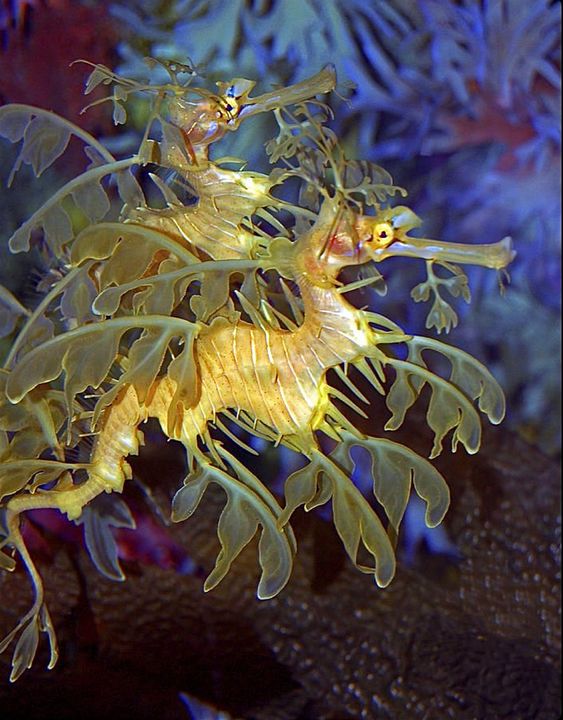
Seadragon, an elusive marine animal found in the waters around Australia.

Everyone in my family loves the ocean and the creatures that live in the ocean. Yesterday my oldest grandson was regaling me with stories of stripers swimming near where he surfs, crabs nibbling his toes, and a too-close-for-comfort encounter with a seal. His sister told me about last weekend’s visit to Mystic Aquarium in Connecticut and her subsequent internet research on sand sharks. She was relieved to learn that Rhode Island has very few shark attacks.

Australia seems to harbor some of the most exotic sea creatures, and today’s story is about another aquarium breeding one of them — the seadragon.

Remy Tumin reports at the New York Times, “For more than a decade, researchers at the New England Aquarium in Boston have been trying to breed some of the most elusive and enchanting fish under the sea. Lacy and delicate, sea dragons live only in the waters along Australia’s southern coast, and their small habitat and limited range make them an ideal candidate for in-captivity breeding.

“Since 2008, the aquarists have tried to replicate the sea dragons’ natural habitat. They have changed the temperature of the sea dragon tank to match the seasons of the southern hemisphere. They have adjusted the amount of light in the exhibit. They got a taller tank. None of it worked.

“ ‘I had kind of given up and thought it’s never going to happen,’ said Jeremy Brodt, an aquarist and galleries manager at the New England Aquarium. And then, ‘out of the blue,’ Mr. Brodt said, ‘it happened.’

“Last May, aquarium staff members discovered that a male weedy sea dragon was successfully carrying his mate’s eggs. … The eggs had hatched in mid-July, and [aquarists] have been raising 18 baby dragons since then. …

“Aquarists hope that breeding these fickle creatures in captivity will lead to fewer sea dragons being collected from their native sea grass habitat, which is under increasing stress from climate change and runoff from storms. Sea dragons, which are primarily of the leafy or weedy varieties, are not currently threatened, but the Australian government has strict regulations that allow only a limited number of them to be collected for public display in aquariums. Still, scientists are worried that the animals’ already limited habitat may be contracting.

“ ‘They’re a great, phenomenal animal, they get people’s attention,’ Mr. Brodt said. ‘It’s a way to get that message across and talk about these unique animals and the issues that they’re facing.’ …

“Like their sea horse cousins, male sea dragons are responsible for carrying the species’s eggs to term and can have more than 150 eggs attached to their tails. Their elaborate mating ritual involves male and female sea dragons mirroring each other, moving together as they spin upward through the water. During their dance, the female sea dragon transfers her eggs to a patch on the underside of her partner’s tail, where he fertilizes and carries them. If the transfer is interrupted somehow — by competing love interests, for example, or even clumsiness — the eggs may drop or end up unfertilized.

“No one has ever seen a leafy sea dragon mate in the wild, said Greg Rouse, a marine biologist at Scripps who was not involved in the New England Aquarium’s project. … To protect the male sea dragon from bumping the eggs off his tail, aquarists at the New England Aquarium moved him to his own smaller holding tank to be monitored. Once the eggs hatched, the team gently removed the baby sea dragons and placed them in a tank stocked with highly nutritious food. …

“ ‘They’re pretty impressive specimens when they’re adults,’ Mr. Brodt said. ‘That first year, it’s crazy. They’re about two centimeters when they hatch and look like floating grape stems. They grow about one centimeter a week for several months.’

“So what made this a successful pregnancy? The researchers were considering moving some of the adult sea dragons out of their display and into a larger tank to give them more space to float when they discovered the egg transfer had already occurred in the existing exhibit. Two developments may have helped the breeding effort, Mr. Brodt said: The aquarium had a surplus of live food to dole out (adult sea dragons are primarily fed frozen food with some live supplements), and because of natural population fluctuations, there were fewer sea dragons in the tank at the time. …

“Dr. Rouse, the Scripps marine biologist, said both food and space were likely factors in the success. Because sea dragons ‘bond up as pairs in the wild and they don’t hang around in big groups, maybe they get a little bit disturbed if there’s too many in a tank with them,’ Dr. Rouse said. … Even so, the hormonal ‘synchronization’ between a male and a female has to line up perfectly. Moon phase and water temperatures also probably play a role in their reproduction.”

More at the Times, here. Wouldn’t you love to be able to say to someone who asks you about your work, “Lately I’ve been raising ’18 baby dragons’ “?

Read Full Post »