Feeds:
Posts
Comments

Posts Tagged ‘building material’

Photo: EcoForge.
Startup EcoForge’s lead scientist, Jiale Han, working on making sustainable building products.

Sometimes the Boston Globe features interviews with founders of startup companies. This company is in Rhode Island, and it makes alternative building products for a greener future.

Alexa Gagosz has the story.

“Brown University graduates Rongyu Na and Myung Bender are the founders of EcoForge, a startup that is developing local and sustainable building materials from agricultural residues and plants.

Alexa Gagosz: How does EcoForge work?
“Rongyu Na: We start by providing our solutions, such as material binding agents and fire-resistant agents, to materials like hemp — a bio-based material that’s carbon-negative — to interested companies and manufacturers.

“Unlike traditional materials that harm both people and the planet, our materials significantly improve sustainability and ensure material health. EcoForge’s bio-based building products help construction projects secure permits, reduce carbon emissions by up to 40 percent, and save on future energy costs, estimated at more than 15 percent on heating and cooling.

“AG: How does EcoForge fit into both of your experiences?
“RN: With my extensive experience in industrial design at NASA and at Subaru, Nissan, and Amazon, I’ve worked on future clean mobility concepts and innovative products like the Kindle, and led global initiatives focused on sustainable materials. My passion for sustainability is complemented by a strong background in innovation and design excellence.

“My cofounder, Myung Bender, is a seasoned entrepreneur. Her startup was acquired by Apple, and as the former head of product at Bumble, she brings strong business acumen and operational expertise. We’ve both developed numerous products, and we are now focusing on products that significantly impact our health and the planet.

“AG: What kinds of ‘agricultural residues’ are you using? And what kinds of building materials can they be transformed into?
“RN: Our technology is highly compatible with various plants, allowing us to form building products by leveraging their natural material structures.

Agricultural residues like hemp/cannabis waste, sunflower husks, sugarcane waste, corncobs, and invasive plants like Arundo donax [giant reed] are of particular interest to us.

“We’re currently focusing on creating solutions such as zero-VOC [no volatile organic compounds], 95 percent bio-based binders, and highly compatible sustainable fire-resistant technology that work with hemp and cannabis waste. We’re looking to collaborate with interested companies and manufacturers to transform these faster-growing plants and agricultural residues into various building products.

“AG: Who are your customers?
“RN: Our primary customers are large manufacturers seeking innovation and reduced carbon footprints through selling or licensing our ecologically safe material solutions. Secondary customers include corporate owners and real estate firms who renovate frequently to meet ESG [Environmental, Social, and Governance] goals.

“AG: Who or what is your greatest competition? How do you plan on breaking into the market?
“RN: Our greatest competition comes from traditional material solution suppliers using petroleum-based materials that employ green-washing strategies and lack transparency. These companies are also energy-intensive and cause harm to both the planet and human health. They still have a strong influence in the market, with established market presence, customer bases, and industry equipment tuned for their specifications, making it challenging for new entrants.

“To break into the market, we plan to leverage our unique value propositions. … Our hemp recipes tackle cost, supply, fire safety, performance, recyclability, or degradability issues. Our adaptable products are compatible with existing manufacturing lines and can be used for various building products like ceiling tiles, drywall, insulation panels, and flooring. …

“AG: What challenges are you facing currently, and how do you plan to overcome them?
“RN: One of the biggest challenges has been overcoming the industry’s struggle with greenwashing and false claims. Many companies claim to be sustainable but fall short in practice. This makes it difficult for genuinely sustainable products to stand out and gain trust. … We’re committed to maintaining maximum transparency and conducting rigorous testing to ensure our materials are genuinely sustainable and healthy.”

Read about the cost of their products and their funding sources at the Globe, here.
Read Full Post »

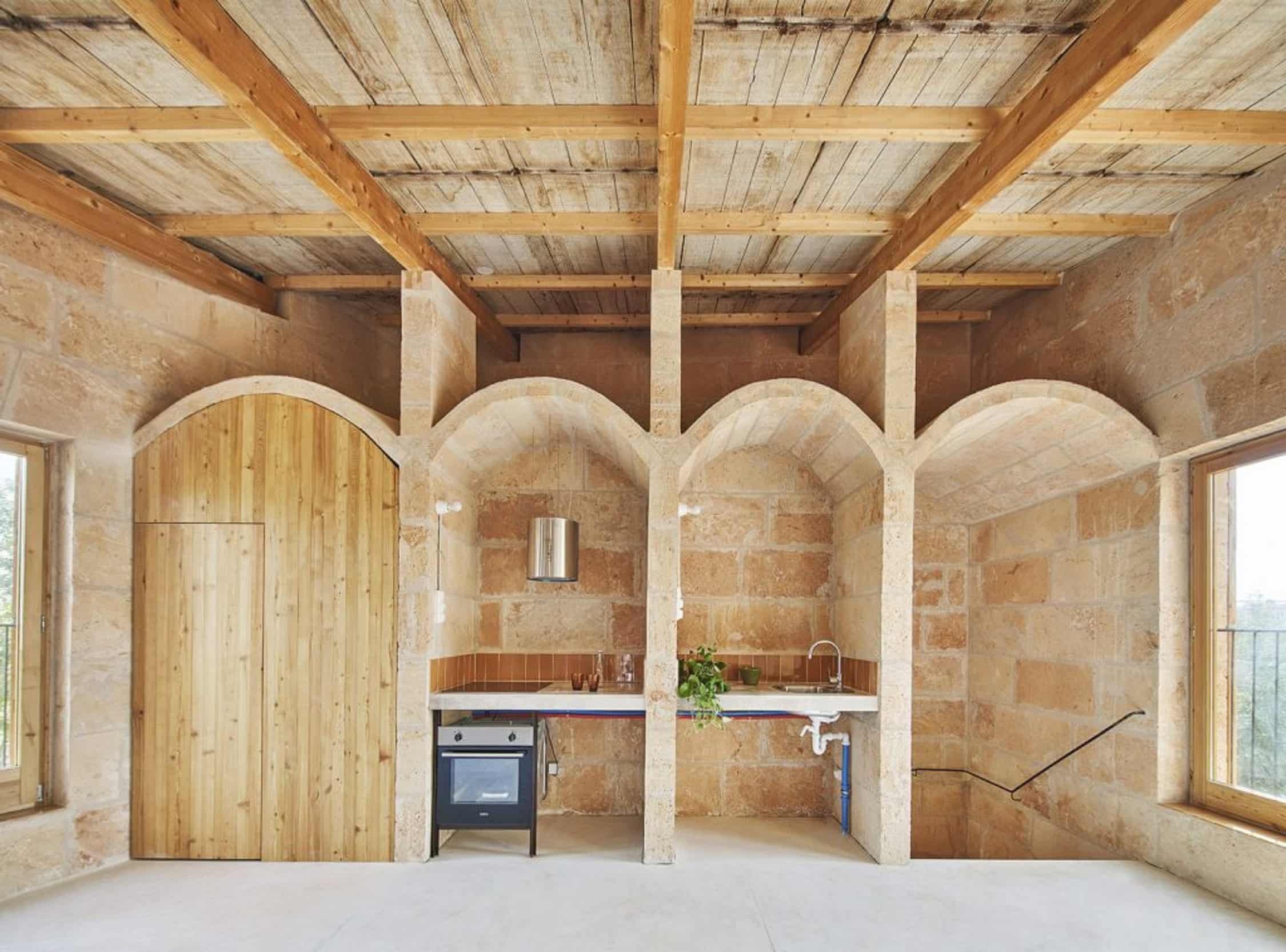
Photo: José Hevia.
The Guardian reports on “affordable housing near Palma, Mallorca, built by Balearic social housing institute Ibavi, constructed from load‑bearing stone quarried locally.” 

The materials we use these days for constructing new buildings are generally harmful to the environment, at least in their creation. Now some architects are advocating for the old ways, the more sustainable and beautiful old ways.

Rowan Moore writes at the the Guardian, “Imagine a building material that is beautiful, strong, plentiful, durable and fireproof, whose use requires low levels of energy and low emissions of greenhouse gases. It is one of the most ancient known to humanity, the stuff of dolmens and temples and cathedrals and Cotswolds cottages, but also one whose sustainability makes it well-suited to the future. Such a material, according to a growing body of opinion in the world of construction, is among us. It’s called stone.

“Last week I sat in the roof garden of a hefty pile of masonry in central London, talking to three advocates of this magnificent substance: engineer Steve Webb, Pierre Bidaud of the Rutland-based Stonemasonry Company and architect Amin Taha. … The building on top of which we met is their joint creation: the six-storey, five-year-old Clerkenwell block where Taha has his office and his home.

“Their point is that stone has been supplanted in the industrial era by steel, concrete and mass-produced bricks, and is used (if at all) mostly as a thin cosmetic facing, while the hard work of holding up a building is done by the upstart alternatives. They argue that solid stone can once again form the walls and structure of building, with benefits for the environment and for the beauty of architecture. Any form of the material – limestone, sandstone, basalt, granite – can, depending on its properties, be used.

“Webb explains how the strength of stone compares well with steel and concrete, yet its environmental impact is far lower. The latter require several different energy-consuming activities, including extraction, smelting, transport, processing and installation. Stone only needs to be cut out from a quarry, taken to a site and put in place. Where the many ingredients of steel and concrete require multiple holes to be dug in the ground, not to mention such things as blast furnaces and rolling mills, the stonework for a given project only needs one.

“The planet, as Taha points out, is made mostly of stone. … We are in no danger of running out. For the same reason, stone should almost always be locally available, which keeps the environmental costs of transport down. The material is long-lasting and recyclable. ‘Any stone building is a quarry,’ says Bidaud. ‘It can be dismantled.’

“At the same time, 21st-century engineering allows stone to be used more effectively than ever before. The material is naturally strong in compression – that is, when loads are pushed down on it – which means it is good for walls, columns and arches, but less so if it is stretched or bent, as in beams or floor slabs.

It is now possible to combine stone with a (sparing) use of steel such that it can perform like reinforced concrete. …

“Next year, a 10-storey residential tower is due for completion on Finchley Road in north London (by Taha’s practice Groupwork and Webb’s firm Webb Yates Engineers), whose load-bearing stone structure will make it one of the most remarkable buildings in modern Britain. The three are collaborating on a grand new private house whose masonry vaults look almost medieval in their craftsmanship.

“They also cite works by others, such as an eight-storey, all-stone social housing building in Geneva by local architects Atelier Archiplein, and the Salvador Espriu project on the edge of Palma, Mallorca, whose graceful stone ceilings belie the fact that these are affordable homes built by a government housing institute called Ibavi. …

“Webb, Bidaud and Taha argue that stone doesn’t have to be costly. Taha, for example, has demonstrated that you can cut stone into bricks at the same cost or cheaper than the more usual fired-clay kind, with less than one fortieth of the carbon emissions, which has led to 10 quarries offering them as a commercial product. The problem is rather ‘forces of habit in the building industry.’ …

“Meanwhile, [2 billion] bricks of the traditional, energy-hungry, carbon-intensive kind are bought in this country every year. Steel and concrete remain the standard options for a wide range of building tasks. Webb is scathing about professional inertia on the subject, about architects ‘who protest about climate emergency, cycle to work and eat locally grown tomatoes’ but don’t examine their own decisions about construction techniques.

“You can get a glimpse of the highly appealing alternatives in a display at the Design Museum in London, How to Build a Low-Carbon Home, where the work of Taha, Webb and Bidaud is on show (until March 2024) alongside structures in wood and straw. …

“Who could look at the solid stone structure of, for example, the Mallorcan social housing, where the forces of nature and the work of humans is evident in the fabric, and prefer the processed surfaces and plasticized finishes of their British equivalents? And the great thing about stone is that, having been used for millennia, it’s well tested.” More at the Guardian, here.

Construction in the UK is often shoddy. Consider the tragic Grenfell Tower fire, here, and the completely avoidable death toll. “The fire was started by an electrical fault in a refrigerator on the fourth floor. This spread rapidly up the building’s exterior, bringing flames and smoke to all residential floors, accelerated by dangerously combustible aluminum composite cladding and external insulation, with an air gap between them enabling the stack effect.”

My husband has been following that story and says more has been spent on lawyers than on fixing the materials in buildings or adding sprinklers.

Read Full Post »