Feeds:
Posts
Comments

Posts Tagged ‘Cajun’

Photo: Richard Ellis/Alamy.
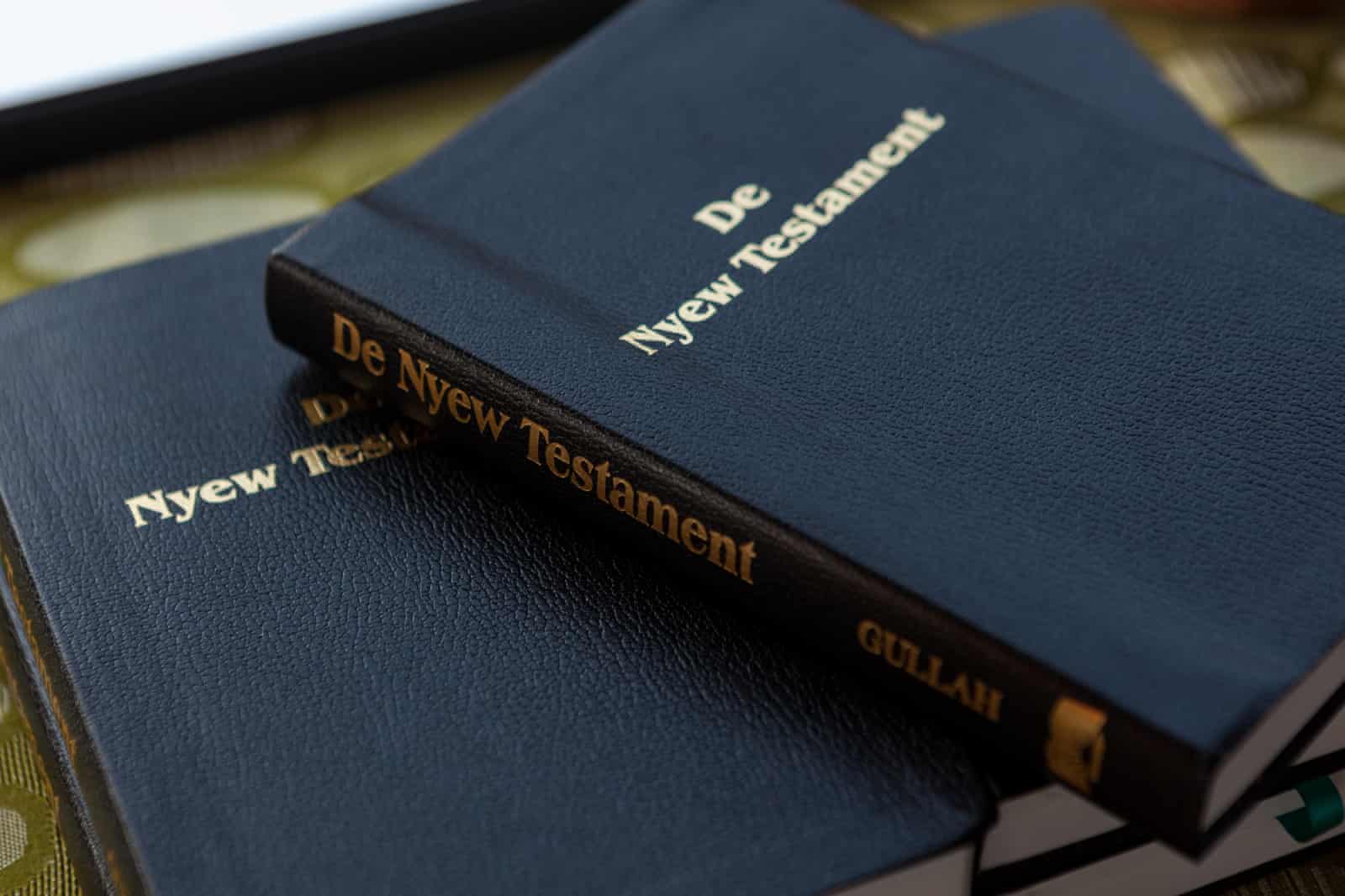
Copies of the Gullah-language Bible, De Nyew Testament. I once had a Bible collection that included this one. Some experts say artificial intelligence will help save endangered languages like Gullah Geechee.

For many reasons, including the fact that artificial intelligence “godfather” Geoffrey Hinton has said AI could wipe out humanity in three decades, I am not a fan. I know it can be helpful in medicine and other things I care about, but three decades is scary.

But what if AI saves dying languages?

Jonathan Abrams wrote recently at the New York Times about people using AI as a tool to do just that.

“While relaxing a couple of years ago, Prof. Joshua Caffery found himself in the mood to unwind with some old-time Cajun music. He asked Amazon’s Alexa to play selections from Dewey Balfa, a celebrated fiddler and singer credited with popularizing the genre.

“Instead, Alexa frustratingly steered him to the catalog of the modern pop artist, Dua Lipa, Caffery said.

“ ‘I love Dua Lipa,’ said Caffery, the director of the Center for Louisiana Studies at the University of Louisiana at Lafayette. ‘Don’t get me wrong. But it seems problematic if you’re interested in a different kind of culture and you want to surround yourself with the music of your region.’ …

“Louisiana French, the oral dialect of which Balfa was a cultural guardian, is part of the Bayou’s societal DNA, a link to its history, music and identity. Today, Caffery described the language as struggling and endangered. …

“In response, Caffery assembled a small team at the center to train its own language learning model in automatic speech recognition for Louisiana French, drawing from a trove of historical artifacts and interviews.

“Over the months, as the learning language model is trained on bits of the language — such as an old-age French nursery rhyme — it brings centuries-old dialect closer into the digital age.

“ ‘It’s scary how fast all this happened,’ Caffery said. ‘I don’t even think I knew a large-language model existed two years ago.’ …

“The efforts are part of inroads to preserve dialects at risk of being lost, and bridge a disconnect between large-language model machines, while maintaining a community’s ability to control and own its digital destiny.

“In the United States, questions exist over how to preserve languages like Louisiana French, the Gullah Geechee language (the English-based Creole language of some coastal regions in the Atlantic southeast) and Appalachian English in the modern, digital age.

“Globally, researchers at the University of Edinburgh are using artificial intelligence to strengthen and revive Scottish Gaelic and Manx. Google recently announced the availability of voice recordings of nearly 30 sub-Saharan African languages to help build tools like voice assistants and translation apps. …

“The importance of accurate speech recognition becomes greater as important tasks like job hiring and medical transcriptions become more automated and digitized, [Christine Mallinson, a professor of language, literacy, and culture at the University of Maryland, Baltimore County] said. …

” ‘There’s accents, patterns of grammar, word choice. Those differences are connected to our families, our neighborhoods, our age and gender and racial and ethnic and cultural backgrounds and where we grew up.’ …

“For centuries, Louisiana French was the predominant language spoken in South Louisiana. In 1921, a new state constitution declared English the primary language. Many parents stopped teaching their children the language out of fear of discrimination, as students who spoke Louisiana French in class were often punished with knuckle-rappings.

“A reversal came in 1968 when the Council for the Development of French in Louisiana was created to advance French, largely through education and community initiatives. In 2023, the Advocate of Baton Rouge estimated about 120,000 Louisianans still spoke French.

“Caffery grew up in Franklin, La., an antebellum town on Bayou Teche. As a child, he ate Cajun and Creole food. His grandparents sometimes sang Old French songs and passed along phrases in the language.

“ ‘Whether you spoke it or speak it, the language is floating in the air,’ he said. ‘There’s this feeling of there is this beautiful thing that we want to hang on to.’ …

“The Center of Louisiana Studies houses a vast trove of Cajun and Creole folklore recordings that include over 12,000 hours of oral histories, field recordings and music performances recorded on everything from wax cylinders to reel-to-reel tape. …

“The language is almost entirely preserved in vocal recordings. ‘A lot of it is sung in the language, and it’s something that’s vanishing,’ Caffery said. ‘Just in the same way you’d want food that’s local to your region, it’s important to have culture that is local to the region that makes you feel rooted and certain.’ ”

More at the Times, here,
Read Full Post »

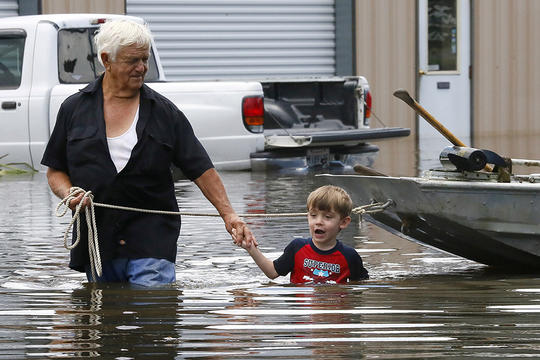
Photo: Jonathan Bachman/Reuters.
In Louisiana, climate change is erasing Isle de Jean Charles. French-speaking and indigenous residents are moving to higher ground, amid fears of losing their language and culture.

We all know someone who begins to rebuild right after a natural disaster like a wildfire or hurricane, and who are we to judge? But as extreme weather incidents become more common, some of those most affected are, with aching hearts, facing the necessity to be practical.

Patrick Cox reported at PRI’s the World, “Hurricane Ida killed dozens of Lousianans and displaced tens of thousands of others. Among the hardest hit were bilingual and French-speaking communities close to the Mississippi Delta. 

“Alces Adams lives halfway between New Orleans and the Gulf of Mexico in the small community of Cut Off in Lafourche Parish. Hurricane Ida destroyed his trailer.

“People in this part of Louisiana — bayou country — have long learned to live under adverse weather conditions. But things have gotten much worse in recent years. Rising sea levels, erosion and storm after storm have flooded entire communities. For some French speakers, Hurricane Ida was the last straw, and now many are moving away.

“A year after Ida, Adams’ trailer looks just as it did the day after the storm — twisted and torn apart with furniture spilling out, as if attacked by a pack of wild animals. Next to it is a new trailer, Adams’ temporary home provided by FEMA, the Federal Emergency Management Agency.

“Adams was born a block away in his grandparents’ house. His family’s older generation spoke only French. Adams said his grandmother learned English, but refused to speak it, except for one word: ‘Yeah.’ 

“ ‘English was forced on us about 100 years ago,’ Adams said. That’s when English was declared the only language of instruction in public schools. Adams recalled listening to his older relatives as they told him stories in French. Even then, he said, he considered the language beautiful. ‘I loved listening to that.’

“Adams’ grandmother and others told him stories of storms and floods they had survived. It helped prepare him — still a child — when Hurricane Betsy battered the region in 1965. …

“Adams doesn’t know what’s next for him. He comes from a long line of Cajuns who he said were compelled to move from one place to another, to escape poverty or discrimination, or hurricanes and flooding. 

“The French language has been a constant in all of this generational change. Adams knows that each time a French speaker moves away, it’s another micro-blow to the survival of French in southern Louisiana.

“Tulane University linguist Nathalie Dajko has been tracking the decline of French in Lafourche and neighboring Terrebonne Parishes for nearly 20 years. She was in graduate school at Tulane when Hurricane Katrina hit in 2005. It left hundreds of thousands of people homeless. Some even ended up in camps that were scattered across several southern states. Dajko visited a few of the camps as part of a gig she had with Save the Children, a nongovernmental organization.

“ ‘Every now and again, we’d come across these French speakers,’ Dajko said. ‘They would be so excited to meet somebody who spoke French, and they would talk about how they missed the French.’ …

“Louisiana French isn’t standard Parisian French. But French has had longstanding roots in the region after France claimed it in 1682. With the area drawing French speakers, the language gained a foothold. It even spread to local Indigenous tribes in the 1700s. They’d formed protective alliances with the colonial French against the British. Some of their descendants still speak French, especially those who live closer to the ocean — and the floods and storms.

“Across a causeway from one of the larger bayous in Terrebonne Parish is an island called Isle de Jean Charles. Abandoned dwellings are everywhere: collapsed walls, caved-in roofs, debris. A couple of the houses are being fixed up. But most aren’t.  Near the end of the road, a house with a sign outside says, ‘Isle de Jean Charles is not dead.’ … 

“Chris Brunet, who answered the door in a wheelchair, said he spoke French at home and English at school. Like Alces Adams, Brunet’s grandmother only spoke French; his parents were bilingual. Everyone living on the island was a member of the Biloxi-Chitimacha-Choctaw tribe. …

“ ‘Hurricane Ida is the first storm to damage the house,’ he said, pointing out his damaged roof. … Likely to be gone soon is this entire island. In the past 65 years, Isle de Jean Charles has shrunk from 22,000 acres to just 320. 

“It’s not just the storms. There are many reasons why the land is vanishing: rising sea levels, the rerouting of the Mississippi river — some of it natural, some engineered — canal construction, land erosion, some of that caused by oil and gas extraction. Then there’s the levee system, expanded after Hurricane Katrina: a life-saver for those living within it; potentially catastrophic if you’re on the outside of it.

“That’s why Brunet, and almost everyone else on the island, is leaving, with federal government assistance, to a city 35 miles inland where virtually no one speaks French.

“ ‘If I had to predict, I would suggest that people are not going to maintain French,’ linguist Nathalie Dajko said. … Still, Dajko has studied these French and bilingual communities for close to two decades, and said they’re full of surprises. 

“ ‘People have been predicting the death of Louisiana French for generations and it just won’t die,’ she said.”

More at the World, here. For a refresher on Longfellow’s fictional Evangeline, one of the French-speaking Acadians expelled from Canada to settle in Louisiana, click here.

Read Full Post »