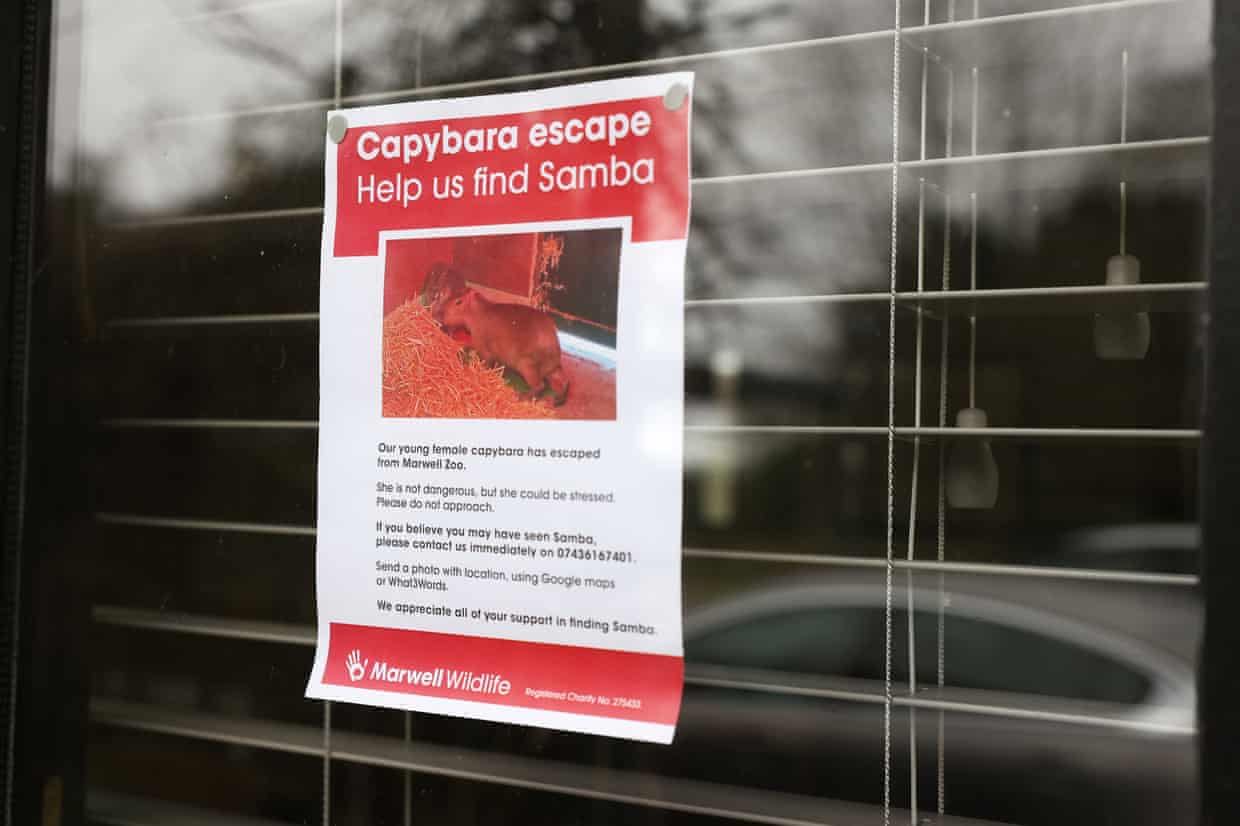
Photo: Martin Godwin/The Guardian.
Marwell Zoo is appealing for help from the public in the search for Samba the Capybara.
A fleet-of-foot zoo animal has played an April Fool’s joke on the community of Winchester, UK.
Isaaq Tomkins reports at the Guardian, “Barely 24 hours after nine-month-old capybaras Samba and Tango were brought to Marwell zoo near Winchester, they had made a break for it through a hole in their temporary enclosure. …
“Tango was quickly found, but her sister Samba remains at large, and the mission to find her has attracted national and international coverage. …
“ ‘We have deployed search teams including the use of specialist dog units used to track her scent, and thermal drones,’ said Laura Read, the chief executive of Marwell zoo. So far Samba has reportedly been sighted in a pub beer garden and basking on a riverbank.
“Capybaras are native to South America and are well adapted to evading capture. They are fast, with a top running speed of 22mph. They are also excellent swimmers, with webbed feet and the ability to hold their breath for up to five minutes.
“Capybaras are technically the world’s largest rodent species and at the upper end of the spectrum they can grow to 5ft long. … But Samba is just a pup, which makes her harder to spot.
“Dr Mark Pickering, a member of the University of Southampton’s engineering department who has been using thermal imaging drones in the search for Samba, has found the process challenging. … ‘This capybara is quite a small animal, in a large habitat,’ he said.
“With no natural predators in the UK, the urgency surrounding Samba’s escape is not because she is in a huge amount of danger, but the zoo is concerned about the separation of two sister pups. ‘Capybaras are social animals and our focus is on retrieving Samba safely and reuniting her with her sister Tango back at Marwell zoo,’ said Read.
“Claudie Paddick filmed Samba taking a dip in the River Itchen as she was walking her dogs Growler and Patsy near her house last Sunday. In the video, Samba is seen sunbathing on the riverbank in Twyford. Then Growler, a black labrador, barks in curiosity. Immediately the capybara dives into the water and does not resurface. …
“Said Paddick, a family lawyer, ‘I didn’t even know what a capybara was.’ She showed the video to her neighbors, Lindsay and Luke, who immediately recognized it as the zoo’s missing animal. …
“Soon volunteers had come out to help search the area, including Read, the zoo’s chief executive, who spotted Samba in the water. A zoo member borrowed Paddick’s paddleboard and used a net to try to flush the capybara out.
“Eliza Holland heard about Samba from relatives living nearby and came straight to Winchester on Friday, hoping to catch a glimpse of the animal and aid the search effort. … ‘There’s instantly a connection you make with people walking along the riverbank and you say, “Have you seen a capybara here?” …
“While the trail has gone cold for now, excitement is bubbling away online. AI-generated images have flooded local Facebook groups, featuring Samba in various local spots. Pictures of Samba at the hairdressers getting a trim, sipping a pint at the Cricketer’s Arms or delivering pizzas. …
“If you see Samba, please do not reveal her location immediately. Instead, contact the zoo on a dedicated 24-hour hotline at 07436 167401.“
More at the Guardian, here.

 Suzanne's Mom's Blog