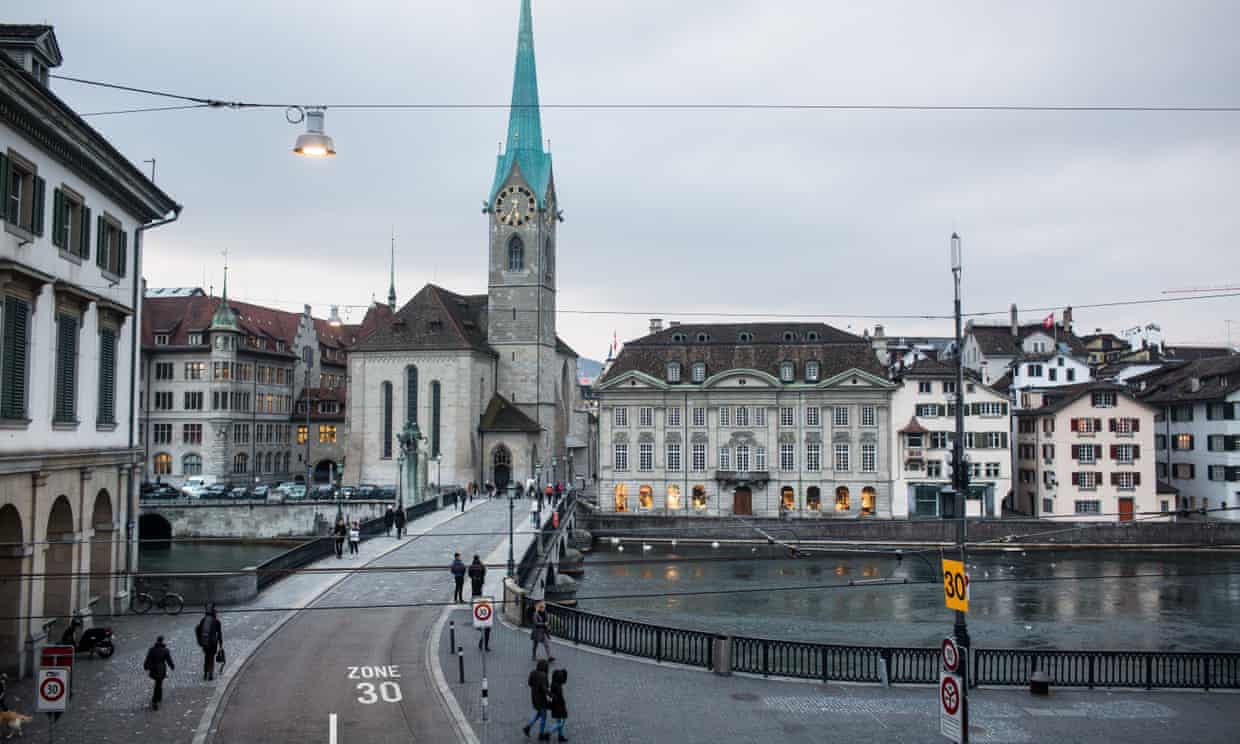
Photo: Robert Ormerod/The Observer.
Zurich city center, where 99.2% of residents live within a 15-minute walk of essential services such as health care and education.
My parents always preferred homes that were out in the countryside, and as much as I loved my walks in the woods as a child, I knew from car-free summers on Fire Island that being able to walk to everything was pretty great. After marriage, my husband and I always chose homes in walkable communities, whether we were in upstate New York or Massachusetts or Minnesota.
Ajit Niranjan writes at the Guardian on the topic of walkable communities.
“When Luke Harris takes his daughter to the doctor, he strolls down well-kept streets with ‘smooth sidewalks and [ramps] for strollers at every intersection.’ If the weather looks rough or he feels a little lazy, he hops on a tram for a couple of stops.
“Harris’s trips to the pediatrician are pretty unremarkable for fellow residents of Zurich, Switzerland; most Europeans are used to being able to walk from one place to another in their cities. But it will probably sound like fantasy to those living in San Antonio, Texas. That’s because, according to new research, 99.2% of Zurich residents live within a 15-minute walk of essential services such as health care and education, while just 2.5% of San Antonio residents do.
“ ‘Zurich feels extraordinarily walkable to me, coming from the US,’ said Harris, a landscape architect from Portland, Oregon. ‘Most of the things you need are within walking distance – and if they’re not, it’s easy to take public transport.’
“Just a tiny fraction of 10,000 cities around the world can be considered ’15-minute cities,’ according to a study published in the journal Nature Cities [in September]. The researchers used open data to work out the average distance people must walk or bike to reach essential services – such as supermarkets, schools, hospitals and parks – and calculated the proportion of residents who have the necessities at their fingertips.
“ ‘When we looked at the results, we were amazed by how unequal they are,’ said Matteo Bruno, a physicist at Sony Computer Science Laboratories in Rome and lead author of the study.
“The researchers selected 54 cities to explore in detail and found that the most accessible cities were midsize European ones such as Zurich, Milan, Copenhagen and Dublin – all of which had essential services that could be accessed within 15 minutes by more than 95% of residents. At the bottom of the rankings were sprawling North American cities with a high dependency on cars, such as San Antonio, Dallas, Atlanta and Detroit.
“Small cities tended to score better but the researchers found that in some big metropolises, such as Berlin and Paris, more than 90% of residents live within a 15-minute walk of essential services.
“The authors developed an algorithm to explore how much these cities would have to change to become more accessible. They found Atlanta would have to relocate 80% of its amenities to achieve an equal distribution per resident, while Paris would need to relocate just 10%.
“Hygor Piaget, a co-author of the study who grew up in São Paulo, where 32% of people live within a 15-minute walk of essential services, said the study was not a proposal to destroy cities and reallocate their services but a mathematical exercise to get people thinking. ‘We’re searching for ways to make the lives of most people better,’ he said.
“The concept of a 15-minute city has been attacked in recent years by conspiracy theorists who see it as a government plot to control movement and restrict freedom. The vitriol has frustrated scientists, urban planners and doctors. …
“The authors say the study is limited by the quality of the open data, which is patchier in cities outside of Europe and North America, and how practical it is to walk in some cities. Heavy traffic, high crime, bad weather and steep hills may discourage people from walking even geographically short distances. …
“Researchers caution that making a city more accessible is not enough in itself to wean residents away from private cars. The Netherlands boasts some of the best bicycle infrastructure in Europe but has more cars per person than rural countries such as Ireland and Hungary.”
More at the Guardian, here. No firewall, but please donate occasionally. Not owned by US oligarchs!


 Suzanne's Mom's Blog