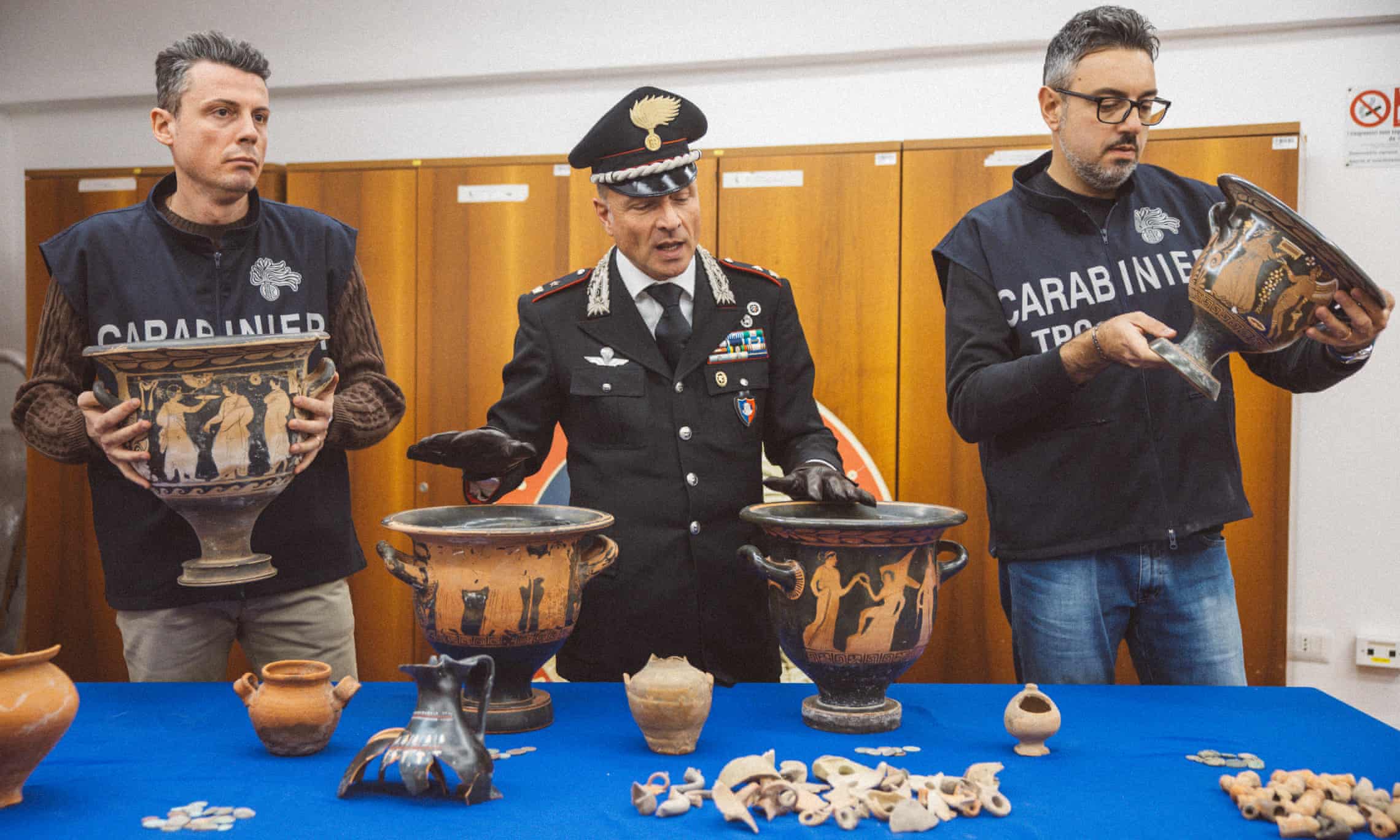
Photo: Roberto Salomone/The Guardian.
Italy’s Carabinieri cultural heritage protection squad at work. The force recently uncovered a clandestine dig in the middle of Naples.
Every morning on the social network Mastodon, German archaeologist Nina Willburger (@ninawillburger) posts a beautiful, or at least curious, artifact from a dig. The history of archaeology suggests that not all of them were unearthed in legal ways, but they are in museums.
Nowadays there are strict laws around digging. Which is why Italy needs its cultural heritage protection squad.
At the Guardian, Angela Giuffrida wrote about the team’s latest success.
“Looking towards the semicircular apse with a frescoed image of a partially identifiable Christ on a throne staring back at them, the archaeologists crouching in the small space deep beneath a residential building in Naples were left speechless. They were amid the remains of an 11th-century church.
“The archaeologists, however, could not take the credit: the historic jewel, which had just been seized by police, was dug up by tombaroli, or tomb-raiders, illicit gangs who for decades have been plundering Italian cultural sites, in turn fueling the global market for stolen art and antiquities.
“Investigators believe the group’s leader was a local entrepreneur, currently under investigation, who owns two apartments in the building above. His cellar was turned into a well-organized excavation site, from where the tomb-raiders dug a warren of tunnels leading them about 8 metres [~26 feet] down into ancient Naples, where they unearthed medieval art. …
“But impressive though their workmanship was – they even installed concrete pillars to prevent the structure from collapsing – officers from the Naples unit of Italy’s Carabinieri cultural heritage protection squad unmasked the gang and confiscated the church after a covert investigation.
“The force also recovered 10,000 fragments of Roman and medieval pottery from the alleged gangmasters’ homes and 453 intact artifacts, including vases, terracotta lamps and coins. …
“The gangs commonly work by marking out clandestine excavation spots close to known archaeological sites, which in the Campania region surrounding Naples can include Pompeii, Herculaneum, Paestum or areas where there were Roman settlements. So uncovering a clandestine dig in the middle of the city took the specialist squad by surprise.
“ ‘When you think of Pompeii, for example, you know a dig can lead to a wealthy domus where prestigious objects can be found,’ says Massimo Esposito, the chief of the squad’s unit in Naples. ‘But it’s rare to find one in the heart of Naples.’
“The group’s alleged leader is believed to have had an inkling that there might be something beneath his home when construction works nearby on the city’s metro were interrupted and the site cordoned off after a small part of the remains of another, albeit less historically interesting, church emerged.
“The group worked for several months, carrying out their noisiest activity during the day, but not loud enough to attract complaints from the building’s residents. Little did the gang know that their comings and goings were being observed by Esposito’s team, with the squad staking out the building and wiretapping its alleged leader’s phone. Suspicions were especially aroused after seeing him carrying boxes filled with materials. …
“The Carabinieri’s cultural heritage protection squad was established in 1969 with the task of protecting Italy’s priceless cultural assets. Since then, more than 3m stolen artworks and relics have been retrieved, including those that ended up on display in some of the world’s biggest museums, such as the Getty in Los Angeles.
“Art and relics thieves in Campania especially thrived in the 1980s, taking advantage of a devastating earthquake at the beginning of that decade to ransack churches of paintings. The long-lost La Desposizione, a 2-metre high masterpiece painted by Angelo Solimena in 1664 depicting the crucifixion, was recently returned to Campania only after it was spotted on display in a museum in the Marche region. …
“Esposito met the Guardian in his unit’s office located in Castel Sant’Elmo, a medieval fortress overlooking Naples. He was surrounded by relics … including a wine amphora and a house-shaped sarcophagus believed to have contained the remains of a child, and various other funerary objects dating back to the fourth century AD. The artifacts are usually kept there pending the conclusion of judicial cases, before being either returned to their origin or entrusted to museums. …
“Data in recent years indicates a gradual decrease in crimes against cultural heritage. Laws for crimes against cultural heritage have been tightened, and work intensified to return stolen assets from abroad. … Use of social media, especially over the past decade, has also made it easier for the squad to identify thieves. A trove of funerary treasures, believed to have belonged to Etruscan princesses and illegally excavated from an underground tomb in Umbria, was retrieved in November after police came across a photo of the bungling thieves posing on Facebook as they attempted to sell it online.
“ ‘Despite the risk, there is sometimes this egotistical element: they want to boast about the beautiful items they’ve found,’ says Esposito.”
Check out the treasures at the Guardian, here. No paywall. Donations are important to the Guardian‘s journalism.

 Suzanne's Mom's Blog