Feeds:
Posts
Comments

Posts Tagged ‘cattle’

Photo: Melanie Stetson Freeman/CSM.
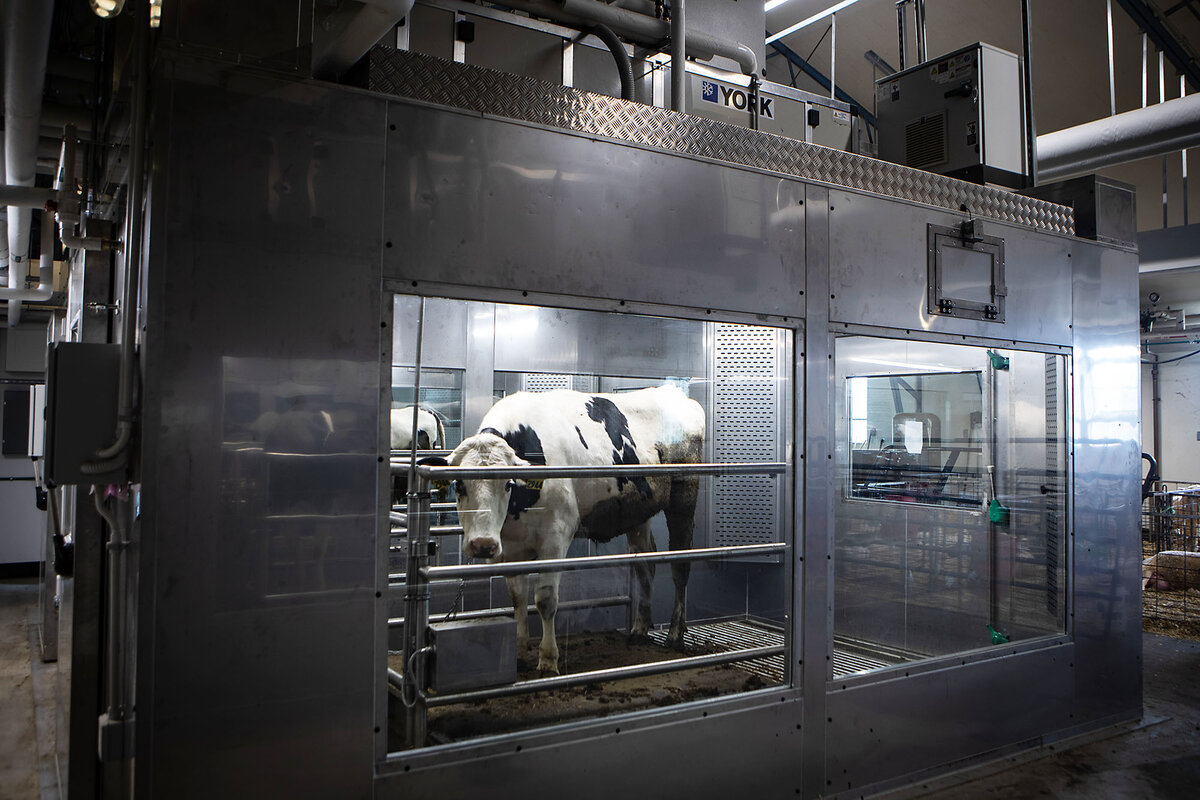
A heifer stands inside a methane chamber at Cornell University, June 7, 2024, in Ithaca, New York. Researchers are studying how to reduce methane emissions from dairy cows.

When he was only 11, one of my grandsons gave up eating beef after learning in school about the effects of cows’ methane emissions on global warming.

I guess it’s fortunate that there are people researching ways to make cows “less gassy.” But some of the research sounds like it’s not much fun for the cow.

Stephanie Hanes of the Christian Science Monitor reported recently on work at Cornell.

“On the campus of Cornell University, within an intricately monitored and carefully sealed chamber, there is a cow. Scientists carefully record what this cow eats and what she drinks. They open the chamber only once a day, so as to limit disturbances to her environment. Every breath she takes – or more crucially, exhales – is also measured to its molecular level. There is hydrogen. There is carbon, recorded down to its isotopic composition. There is oxygen. And, most important to this state-of-the-art study, there is methane.

“Methane is a naturally occurring gas that comes from a variety of biological and industrial sources, from oil- and gas-well leaks to decomposing garbage to, well, cow burps. It is also one of the world’s most potent greenhouse gases – far more heat-trapping than carbon dioxide. …

“ ‘There is growing awareness amongst environmental advocates, policymakers, that reducing methane emissions is the fastest way to reduce warming,’ says Dan Blaustein-Rejto, director of food and agriculture at the nonprofit Breakthrough Institute. …

“Although exact percentages are difficult to determine, researchers estimate that cows are responsible for around 30% of U.S. methane emissions. This is largely because cattle, like goats or sheep, are ruminants: animals with four-chambered stomachs that ferment grass and other vegetation into consumable food. And a natural by-product of rumination is methane. …

“According to the U.S. Department of Agriculture, there are 28.2 million beef cattle in the U.S., along with 9.36 million dairy cows and 33.6 million calves. And those numbers pale in comparison to countries such as India, which has an estimated 61 million milk cows, or Brazil, with around 234 million beef cattle. 

“With growing pressures from policymakers and climate advocates, then, agribusiness and scientists are trying to figure out how to make individual dairy cows more productive, which could lead to smaller herds, while at the same time trying to find ways to make cow burps — the body function that produces the most methane — less gassy.

“The first step to doing that, says Cornell associate professor Joseph McFadden, is to get good measurements of bovine methane in the first place. …

“ ‘The challenge comes in capturing the methane,’ says Joe Rudek, lead senior scientist at the Environmental Defense Fund. ‘Cows are breathing out this methane. You’ve got them walking around in a pasture, how do you capture that methane that’s coming out of the cows’ mouth and nostrils?’

“So instead of individually measuring each cow, scientists are trying to build up a robust sample size of measurements that would let them statistically predict methane emissions, both broadly and specifically. One contraption they use now is called the GreenFeed – basically a high-tech box with cow treats. When the cow puts her head into it to eat, the box measures methane and other gases. These instruments are portable, so theoretically farmers can use them in different locations.

“But, Dr. McFadden says, those measurements are not always exact. That’s why his respiration chambers are important. Because the pods are highly accurate, closed systems, they can calibrate other machines. … The chambers can help him monitor other inputs and outputs that can give clues about animal health and well-being, and about how the animal uses energy – as well as about other greenhouse gases, such as nitrous oxide. …

“Across the country, at the University of California, Davis, professor Ermias Kebreab is also working with dairy cows, and has his eye on some solutions. In addition to feed additives, he is measuring what happens when cows eat local agricultural by-products, such as the grape residue from winemaking. GreenFeed measurements are finding some promising initial results, he says.   

“ ‘We found a 10% to 12% reduction in emissions,’ he says. ‘Animals were happy to eat it … and it avoids the emissions from putting it into a landfill.’ Not only that, he says, but grape pomace — the fruit’s leftover skin, seeds, or stems — seems to improve milk quality. 

“ ‘It’s a win-win kind of situation,’ he says.”

More at the Monitor, here.

Read Full Post »

Not everyone can be an inventor, but inventors can be found everywhere.

“Richard Turere, 13, doesn’t like lions. In fact, he hates them. Yet this bright Maasai boy has devised an innovative solution that’s helping the survival of these magnificent beasts — by keeping them away from humans.

“Living on the edge of Nairobi National Park, in Kenya, Turere first became responsible for herding and safeguarding his family’s cattle when he was just nine. But often, his valuable livestock would be raided by the lions roaming the park’s sweet savannah grasses, leaving him to count the losses. …

“So, at the age of 11, Turere decided it was time to find a way of protecting his family’s cows, goats and sheep from falling prey to hungry lions …

” ‘One day, when I was walking around,’ he says, ‘I discovered that the lions were scared of the moving light.’

“Turere realized that lions were afraid of venturing near the farm’s stockade when someone was walking around with a flashlight. He put his young mind to work and a few weeks later he’d come up with an innovative, simple and low-cost system to scare the predators away.

“He fitted a series of flashing LED bulbs onto poles around the livestock enclosure, facing outward. The lights were wired to a box with switches and to an old car battery powered by a solar panel.

“They were designed to flicker on and off intermittently, thus tricking the lions into believing that someone was moving around carrying a flashlight.

“And it worked. Since Turere rigged up his ‘Lion Lights,’ his family has not lost any livestock to the wild beasts, to the great delight of his father and astonishment of his neighbors.

“What’s even more impressive is that Turere devised and installed the whole system by himself, without ever receiving any training in electronics or engineering. …

Paula Kahumbu, executive director of the Kenya Land Conservation Trust …  helped him get a scholarship at Brookhouse International School, one of Kenya’s top educational institutions, where he started last April. …

” ‘One thing that’s unique about Richard is that if you give him a problem, he’ll keep working at it until he can fix it. [He] doesn’t give up; he doesn’t find things too difficult; he’s not afraid of being unable to do something and I think this is why he is such a good innovator — because he’s not worried that it might not work, he’s going to try and do it anyway.’ ”

More here. And you can catch Richard’s TED Talk here. (Yes, he got on TED Talk!)

Photo: CNN

Read Full Post »

In February, Treehugger posted an article on sustainable husbandry in Africa by Charlotte Kaiser, of the Nature Conservancy’s NatureVest arm.

“For thousands of years,” she writes, “the pastoralist communities of northern Kenya have herded their cattle alongside elephants and zebras, the grass of the rangelands shared between livestock and wildlife in relative balance. In recent decades, climate change, habitat loss, and human population growth have combined to erode that balance, leading to overgrazing and the degradation of the grasslands that both humans and wildlife need to survive.

“For over a decade, the Northern Rangelands Trust (NRT) has worked with the communities of Northern Kenya to develop community conservancies that support better management of cattle and grass. …

“A key tool in driving the better management of the rangelands is access to markets. … In 2008, NRT created the Livestock to Markets program (LTM), which brought the market to the Conservancies. In exchange for conservancies achieving specific targets in conservation, LTM buys cattle directly from the conservancies, purchasing several hundred head at a time from dozens of households. Providing access to markets allows pastoralists to better manage their herd sizes, since they know they can sell animals when they need to at a fair price. And LTM also encourages the herders to bank their cash, bringing mobile banking representatives to market days so herders can open bank accounts with the proceeds from the sale.

“Once the cattle are purchased, NRT treks the animals to Lewa Conservancy, a partner NGO. After six weeks of quarantine, the animals move to Ol Pejeta Conservancy, another partner, where they are fattened on grass for 15 months, improving the size and quality of the animals. Finally, the animals are [sold] into the Nairobi meat market. By capturing much of the full value of the supply chain, NRT can pay a levy on every animal they buy to the conservancies themselves. This levy funds conservancy investments in wildlife guards, ecotourism lodges, and community facilities like clinics and schools.” Check out the full article here, and the lovely pictures.

Photo: Ron Geatz
Livestock is the primary measure of wealth among herding communities of northern Kenya.

Read Full Post »

John’s web surfing has been turning up topics he knows I’d like, too, and he takes the time to send a link. An article he sent from Modern Farmer describes why scientists are studying cows’ hairstyles.

Anne O’Brien writes, “While a bovine couldn’t care less about a hair whorl gone awry, it may be prudent for the farmer to take note. Turns out there is some serious science behind hair whorl behavior and brain development.”

Hair whorls on cows’ foreheads, O’Brien reports, “may be more than an aesthetic quirk. About two decades ago, animal behaviorists began to notice a connection between crazy hair whorls and crazy animals.

“Dr. Temple Grandin, professor of animal science at Colorado State University and author of the best-selling book Animals in Translation, first noticed a connection between the location of a bull’s hair whorl and whether the animal was excitable when handled by humans. Studies showed that location — meaning above, between, or below the eyes — as well as shape of the whorl could be, to some extent, a predictor of excitable behavior in cattle. …

“How, then, are hair growth patterns and temperament related? It all has to do with brain development, says Dr. Amar Klar, head of the Developmental Genetics Section within the National Cancer Institute in Frederick, Maryland.

“ ‘Our skin and the nervous system come from the same layer of cells in embryonic development, the ectoderm,’ Klar says.

“As embryonic cells migrate to form a developing fetus, skin and brain cells are closely intertwined, particularly at the scalp. …

” ‘When we were looking at brain laterality and the location of internal organs, hair whorls also came up,’ Klar says. His research has shown that within the human population, the majority is right-handed and demonstrates a clockwise hair whorl.

“Livestock seem to mimic this handedness. A study from the University of Limerick in Ireland in 2008 demonstrated that horses with clockwise hair whorls were significantly more likely to move toward the right, or begin a gait with the right-sided hooves — in essence, these horses were right-handed.” More here.

Photo: Temple Grandin
Scientists have been exploring the connection between the cow’s hair whorl and its behavior.

Read Full Post »