Feeds:
Posts
Comments

Posts Tagged ‘chess’

Photo: John and Suzanne’s Mom.
The Simpsons play chess, too.

One of my grandsons lives and breathes chess. He will represent his state and age group in a national competition in Grand Rapids this July. I told him his idea of beach reading is Ten Thousand Tried and True Pawn Structures to Terrify Your Opponent, and he couldn’t disagree.

Turns out, he is not alone.

Hannah Natanson writes at the Washington Post, “Jeffrey Otterby, a middle school teacher in Illinois, is facing an epidemic of student distraction. When his seventh-graders are supposed to be learning social studies, they are glued to their school-issued Chromebooks. He has taken to standing in the back of the room to monitor their screens, where he can see the online game they’re all playing:

“Chess.

“ ‘I guess I’m happier they are playing chess rather than some shoot-’em-up game. Actually, I love it,’ said Otterby, a chess enthusiast. ‘I just need them to do it at a better time.’ …

“Across the country, students from second grade to senior year have stumbled across a new obsession, which is, in fact, a centuries-old game. Interviews with teachers and students in eight states paint a picture of captivated students squeezing games in wherever and whenever they can: at lunch, at recess and illicitly during lessons, a phenomenon that is at once bemusing, frustrating and delighting teachers.

“Data from Chess.com, whose usership is the highest it’s ever been, and anecdotal evidence nationwide suggest a fervid, growing base of young users. This month’s U.S. Chess Federation National High School Championships in D.C. had to add overflow rooms to accommodate a record 1,750 attendees — spurring fears of a shortage of participation medals.

“A California school librarian this year set aside a portion of her library for chess-playing students to indulge their habit during lunchtime. An Illinois teacher bought 24 chess sets to meet surging student demand. And in Hawaii, passion for chess is messing up the morning routine. …

“It’s unclear what is driving the sudden adoration of chess among tweens and teens. Students and chess spectators point to the influence of chess stars and social media personalities such as Levy Rozman, whose YouTube channel GothamChess has more than 3.5 million subscribers; Hikaru Nakamura, an American grandmaster with 1.9 million YouTube subscribers; and the Botez sisters, elite American Canadian players who boast a combined following of close to 2 million on YouTube and Twitch.

“Max Magidin, a 15-year-old attending California’s Burlingame High School, said chess content began showing up on his and his friends’ TikTok feeds early this year. Almost immediately, it seemed everyone in the Bay Area’s San Mateo Union High School District was playing the game — including Magidin, who nowadays fits in between two and four hours of chess daily. …

“Chess has always been something of a faddish sport, said David Mehler, president of the U.S. Chess Center. He recalled a big jump in interest in the early 1990s after the release of the movie Searching for Bobby Fischer, which tells the story of a 7-year-old chess prodigy and is based on the life of Joshua Waitzkin.

“More recently, chess experienced a spike in popularity among adults at the start of the coronavirus pandemic, and again when many people confined to their homes streamed The Queen’s Gambit, a Netflix series, said Erik Allebest, the chief executive and a founder of Chess.com. After the virus arrived, Chess.com’s average daily user count of 1.5 million rose to between 5 million and 7 million, he said. …

“As of April, Chess.com is averaging 12 million users a day, Allebest said. Chess.com does not track users’ ages, Allebest said, but as best he and Chess.com staffers can tell, the latest wave of fandom is dominated by middle and high school students. …

“He sent links to viral Reddit posts in which K-12 teachers lament an outbreak of chess enthusiasm and grade school students share tales of administrative crackdowns limiting access to Chess.com. (The Washington Post found no examples of the latter.) Allebest also noted that his own son, 15, has become a chess convert — not because of his father’s job but through watching GothamChess on YouTube.

“Some teachers have mixed feelings about the clandestine playing of chess in their classes.

“Justine Wewers, a high school geography teacher in Minnesota’s Anoka-Hennepin district, said she has seen a wearying number of student infatuations over the years, including video games, ‘Uno’ and fidget spinners. By comparison, the chess craze strikes her as a healthy activity for young minds. …

“James Brown, a teacher in New York’s South Colonie Central School District, sees nothing but positives. Brown, who teaches computer science and programming at Sand Creek Middle School, has long set Fridays aside as a free period for children to pursue activities of their choice. Since January, many students have chosen chess, leading Brown to buy three more chess sets to augment the 10 he already owned. …

” ‘It’s all things we want to instill in the student,’ Brown said. ‘If they’re doing that on their own, in a format that is fun for them, it ties right into what I’m trying to do. I don’t see it as a distraction; I see it as a benefit.’

“Another benefit of playing chess is its transcendence of social groups, said Maurine Seto, a librarian at California’s Burlingame High School. In early 2023, she said, students started stampeding into her library before school, during lunch and in snatches between classes to play chess at a handful of tables.

“ ‘It pairs different sets of kids together that you don’t normally see,’ Seto said. ‘They come up and say, “Hey, do you wanna play chess?” and I normally would never see those two kids interact.’ ”

More at the Post, here.

Read Full Post »

Photo: Oluwatoyin Adewumi/BBC
Tanitoluwa Adewumi playing chess.

That today’s media has a downside needs no elaboration, but think about the good that sharing stories can do! In this case, a young asylum-seeker in a New York City shelter gained attention for chess playing and, when the word got out, ended up with a home for his family.

Here’s what I first learned from the BBC. “Tanitoluwa Adewumi left his home in northern Nigeria with his family in 2017 because of the ongoing attacks by the Islamist militant group Boko Haram. He moved with his family to the United States, but is currently living in a homeless shelter with his mother Oluwatoyin, father Kayode and older brother.

“Despite the challenges, when Tanitoluwa showed an interest in playing chess, his mother made sure that he could attend the local club. He has been playing for just over a year, but hours of practice and hard work have paid off – he has just won top prize in his age category at the New York State Chess Championship.” More at the BBC.

And here’s what happened after New York Times columnist Nicholas Kristof spread the word. This piece was published March 23. “Tanitoluwa Adewumi, age 8, skidded around the empty apartment, laughing excitedly, then leapt onto his dad’s back. ‘I have a home!’ he said in wonderment. ‘I have a home!’

“A week ago, the boy was homeless, studying chess moves while lying on the floor of a shelter in Manhattan. Now Tani, as he is known, has a home, a six-figure bank account, scholarship offers from three elite private schools and [more]. …

“I wrote in my column last weekend about Tani as a reminder of the principle that talent is universal, even if opportunity is not. A Nigerian refugee who had learned chess only a bit more than a year earlier, he had just defeated kids from elite private schools to win the New York state chess championship for his age group. …

“A GoFundMe drive raised more than $200,000 for Tani, his parents and his brother. A half-dozen readers offered housing — in a couple of cases, palatial quarters. Immigration lawyers offered pro bono assistance to the Adewumis, who are in the country legally and seeking asylum. …

“The family settled on one of the more modest and practical housing offers: An anonymous donor paid a year’s rent on a two-bedroom apartment near Tani’s current school. The apartment is clean, comfortable and freshly painted, without being luxurious, and the Adewumis gaze adoringly at their new kitchen.

“ ‘I want my mom’s cooking again!’ Tani mused as he explored the apartment. It was bare, but another donor had offered furniture, sheets and towels. Someone else was sending 100 chess books. …

“The Adewumis have decided that they will not spend a cent of the $200,000 GoFundMe money on themselves. They will take out a 10 percent tithe and donate it to their church, which helped them while they were homeless, and the rest will be channeled through a new Tanitoluwa Adewumi Foundation to help African immigrants who are struggling in the United States the way they were a week ago. …

“ ‘I’m a hardworking guy,’ Mr. Adewumi explained. He has two jobs: He drives for Uber with a rented car and sells real estate through Brick & Mortar. Someone has now offered him a free car so that he can keep more of the money he makes driving, and Tani’s mom was just offered a job as a health care aide at a hospital. …

“The family was tempted by the offers of full scholarships at top private schools. But Tani and his parents decided that while he might accept such a scholarship for middle school, he would be loyal and stick with the public elementary school, P.S. 116, that taught him chess and waived his fees for the chess club. …

“ ‘God has already blessed me,’ Mr. Adewumi told me. ‘I want to release my blessing to others.’ ”

More  at the Times.

Read Full Post »

bn-vu227_nyches_m_20171025125530Photo: Bess Adler for The Wall Street Journal
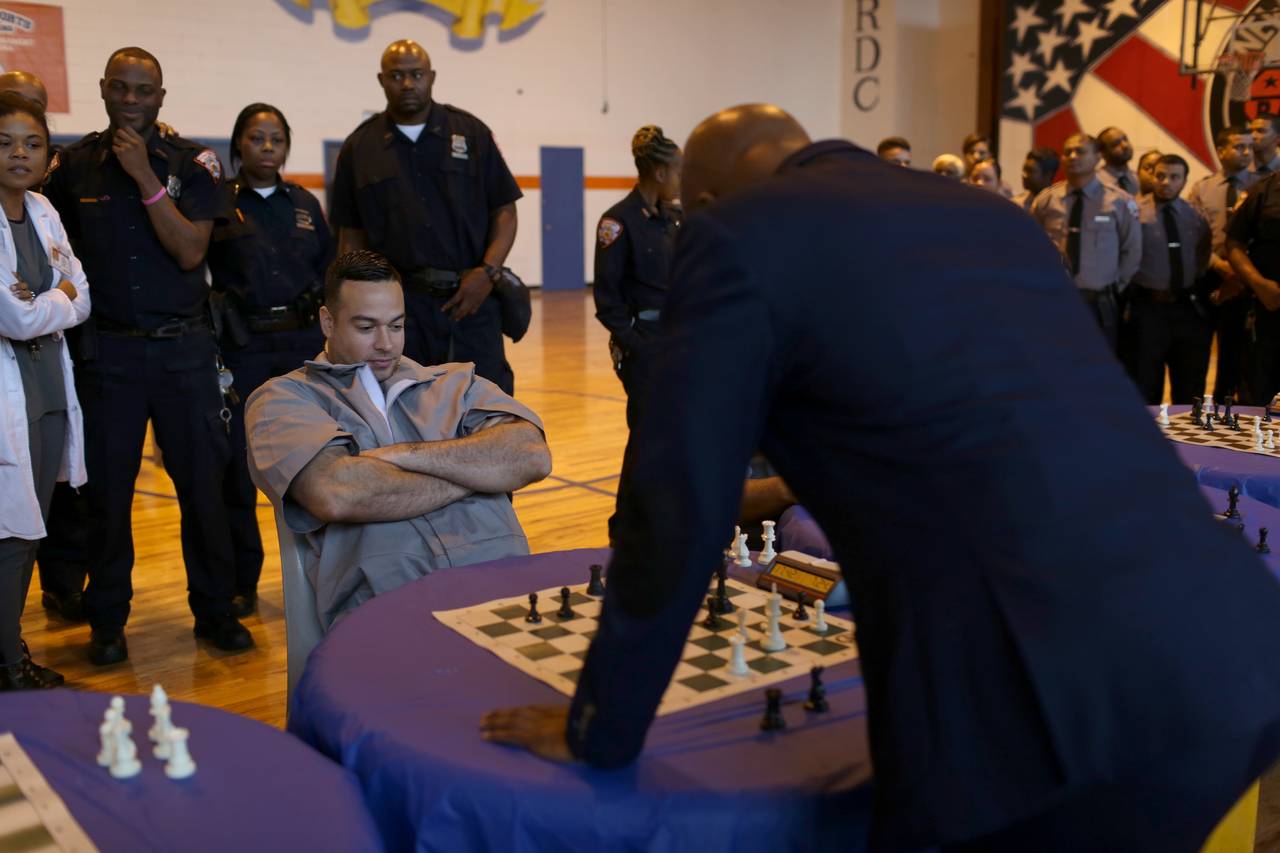
Rikers Island inmate Camilo Arcelay faced off against chess grandmaster Maurice Ashley at the Rikers Island jail complex.

I like articles about better ways to prepare prison inmates for a return to society. In this 2015 post, for example, I wrote about a jailhouse debate club that beat Harvard, raising the spirits and aspirations of prisoners at the Eastern New York Correctional Facility.

Today’s story concerns a serious chess competition in a notorious New York City prison.

Zolan Kanno-Youngs at the Wall Street Journal writes, “On a rainy afternoon at the Rikers Island Jail Complex [in October] five men and one woman wearing tan uniforms sat in front of chess boards surrounded by an audience of correction officers and fellow inmates.

“Maurice Ashley, a 2003 U.S. Chess Federation grandmaster of the year walked from one board to the next, simultaneously playing six games. One by one, he eliminated the inmates — except for Camilo Arcelay, 37 years old, who used his king to take Mr. Ashley’s last pawn. That left Mr. Arcelay and Mr. Ashley with a king as their last piece.

“The result was a draw — enough for Mr. Ashley, who also judged the event, to name Mr. Arcelay the winner of the first chess tournament, which is slated to become an annual event at Rikers Island.

“ ‘To be in a situation that I’m in right now in jail, it leaves me speechless,’ Mr. Arcelay said, referring to his chess victory. ‘Because I’ve made so many bad decisions to be here.’

“The final round of the 2-month tournament is part of a series of programming designed to educate and reduce idleness funded by a $38.9 million New York City initiative.

” ‘It teaches them how to think, how to strategize, in an environment that is conducive to those things,’ said James Walsh, department of corrections deputy commissioner of adult programming & community partnerships.

“While this was the first official tournament at Rikers, chess has long been popular behind bars. Carl Portman, 53, the author of Chess Behind Bars, and the manager of prisons chess for the English Chess Federation, said the game’s history in prisons dates to World War II, when inmates would create chess pieces from scrap materials, and differentiate the two sides by using coffee powder to dye some pieces. …

“At Rikers, the seed for the tournament was planted two years ago when corrections officer Gregory Lamb bought a chess set so he could play with 16- and 17-year-old inmates. Prison officials soon asked him to organize sessions with adult inmates twice a week. That evolved into the tournament organized by the corrections’ Adult Programs Unit that began two months ago with 800 inmates participating.

“ ‘Inmates are probably the best chess players because they play all day,’ Mr. Lamb noted. …

“During the games, inmates stood on bleachers cheering, critiquing and moving their arms on imaginary boards as if they, too, were participating.

“ ‘Society wastes so much when we don’t channel the energy and capabilities of those who have been incarcerated,’ Mr. Ashley said.”

More at the WSJ, here.

Read Full Post »


Photo: David Llada
Dorsa Derakhshani could read before the age of 2 and grew up to be a chess champion. She was banned from Iran’s chess association for not wearing a headscarf.

After you read this article on an Iranian chess prodigy, you are sure to be surprised by her current career goal. Not that there’s anything wrong with it; it’s just surprising.

Mika Klein interviewed Dorsa Derakhshani at WBUR radio’s Only a Game, first watching an old video of Dorsa to get some background.

“The year was 2000. Dorsa was 2, and appearing on a children’s television show. Dorsa wears a red velvet dress with puffy sleeves and dark tights. She’s tightly clutching a stuffed puppy, so the interviewer holds the microphone for her. Dorsa breaks into song, with the poise of seasoned performer, and the studio audience applauds.

“The camera cuts to the audience. Most of the girls are sitting in the back, many are wearing headscarves. Dorsa’s head is uncovered.

“Dorsa was born in Tehran in 1998. And this is just one of many times she appeared on Iranian TV. This time, she reads a story from a children’s book. …

” ‘Are you saying you could read at the age of 2?’

“ ‘No,’ Dorsa says. ‘I could read when I was 1 1/2. But I finished first grade when I was 2.’

“Dorsa’s television career as a child prodigy was never going to last forever, but it ended abruptly when she was 6.

“ ‘They made me wear a scarf against my will,’ says Dorsa … ‘I never went back for the TV.

“ ‘I finished fourth grade when I was 4 1/2. Math, science, everything. … My parents tried to fill my time with other things like music, swimming, ballet, gymnastics, painting.”

“Right next door to her painting class was a chess class. Dorsa decided to join. …

” ‘Chess was really different, because you are actually playing with a live human being,” Dorsa says. … ‘You can’t be 100 percent ready and sure that you play good when you go to a tournament.’

“Dorsa’s first big success came in the Iranian national youth under-8 tournament.

“ ‘It was a big surprise for everyone, because there were players who already had private coaches and they came to win,’ Dorsa says. ‘I came out of nowhere, and I won the tournament. I remember that everybody else was wearing a scarf, even under 8. But I wore a princess dress and a tiara. And it was really cute. …

“Dorsa went on to win three straight gold medals at the 2012, 2013 and 2014 Asian Junior Championships. In the numerical chess ratings lists, Dorsa was at the top for all girls in Asia. …

“I first met Dorsa at the Chess Olympiad in September 2016. She was attending as a journalist, not a player. The tournament was in Baku, the capital of Azerbaijan, a country that is 98 percent Muslim. She did not wear a headscarf at the tournament or on the street. I’ve never seen her wear one.”

Klein continues with a story of the time when Dorsa was traveling and saw that her Instagram account was going crazy. She went to bed and forgot about it. In the morning friends explained that ” ‘they saw on newspaper that my federation banned me — my brother and I, actually, both of us. It was just very out of the blue.’ ”

Dorsa’s brother, Borna, was banned for competing against someone from Israel, Dorsa for not wearing a headscarf.

“She believes the action against her and her brother was a tactic to divert from other news. The announcement came in the middle of the Women’s World Chess Championship, which was being held in Tehran. Several notable players, including the reigning U.S. women’s champion, boycotted the event because players were required to wear a headscarf. All three Iranian women competing had just been eliminated in the opening round. …

“This July, she moved to the U.S. after being accepted to the chess team at St. Louis University. She said there were no problems when she landed in New York and cleared immigration.

” ‘I’m hoping to become a dentist,’ Dorsa says. ‘I’m looking forward to finally having a stable trainer and a team, and I really wish to become grandmaster.’ ”

More at WBUR, here.

Read Full Post »