Feeds:
Posts
Comments

Posts Tagged ‘china’

Photo: Edward Burtynsky.
“Manufacturing #17, Deda Chicken Processing Plant, Dehui City, Jilin Province” (2005) is one of Burtynsky‘s best-known large-scale photos of China’s industrialization of just about everything.

The International Center of Photography in New York City recently hung an exhibit of Edward Burtynsky, a photographer I’ve admired since I first encountered his massive works in the early 2000s.

Louis Bury at Hyperallergic calls the show “A God’s-Eye-View of Earth’s Destruction.,” which doesn’t sound like fun but is sure to be interesting.

Edward Burtynsky: The Great Acceleration,” writes Bury, “at the International Center of Photography contains the artist’s largest ever print, which is saying something. Across a celebrated 40-plus-year career, Burtynsky has been renowned for his work’s ambition and scalar play. His fantastic images, often taken from aerial vantages, depict landscapes modified by human industry, from a stepped mine resembling an amphitheater … to a salt pan whose multicolored pond rows evoke a painter’s palette. …

“The large formats and supra-human perspectives render the Earth alien, potentially confronting the viewer not only with our species’ collateral ecological harms but also our estrangement from them. 

“Even by that standard, the exhibition’s 28-by-28-foot mural Pivot Irrigation #8, High Plains, Texas Panhandle, USA (2012) stands out. The distant overhead view and subdued color palette transform farmland into an almost abstract composition, in which the pictorial space is divided into textured, geometric browns on one side and alternating vertical stripes of washed out blues and grays on the other. A teensy farmstead occupies the bottom left corner and the roads running parallel to the edges of the picture plane serve as a clever framing device.

“But the two-story-tall print’s physical size produces its most dramatic effects. It dominates the central gallery, dwarfing visitors in a manner akin to the quarry cliffs that sometimes loom over the ant-like human figures in Burtynsky’s other landscapes, such as the miners digging for cobalt, for a couple dollars a day, in ‘Dry Tailings #1, Kolwezi, Democratic Republic of Congo’ (2024).

“Curator David Campany’s approach encapsulates the ‘bigger is better’ ethos. … The scope of the artist’s environmentalist muckraking matches the scope of the iniquities it portrays; for decades, Burtynsky has pursued research leads around the globe to capture yet more examples of civilization’s terraforming. Early in his career, before the term ‘Anthropocene’ became common in academic and artistic circles, such images offered a prescient vision of large-scale anthropogenic changes that were typically out of sight and out of mind.

“But as others have caught up to and even surpassed that vision … its style has remained mostly the same, god’s-eye-view consciousness raising feels more and more like a pretext for aesthetic dazzle.

“Burtynsky’s dazzle serves a psychological rather than a moral function. It can provoke in viewers the uncomfortable recognition that harmful ecological realities nonetheless appear beguiling. But it can also occlude the human-scaled implications of those realities. On the central gallery’s terrace level, Campany has helpfully included examples of Burtynsky’s lesser known work: early 1980s portraits of food plant laborers; studies of marshlands taken during the COVID-19 lockdown. While these series lack the wow factor of the artist’s panoramic work, they evidence his eye for formal patterns and keen details. …

“[The show] continues at the International Center of Photography (84 Ludlow Street, Lower East Side, Manhattan) through September 28.”

Fantastic photos at Hyperallergic, here. No firewall. See also Photographic Journal, here, and the artist’s site, here.

Read Full Post »

Photo: Panoramic Studio/Landprocess.
Thammasat University’s rooftop farm features cascades of rice paddy-style terraces used to grow organic crops.

Here in the US, we are all preoccupied with floods because we’re in the midst of an extreme hurricane season. So it seems strange to think of places where a certain amount of flooding is desired — rice paddies.

Xiaoying You at the BBC writes about what can be learned from ancient techniques for controlling rice-paddy flooding.

“One of Kotchakorn Voraakhom’s most memorable moments growing up in Bangkok in the 1980s was playing in floodwaters in a small boat built by her father in front of her home.

” ‘I was so happy that I didn’t need to go to school because we didn’t know how to get to it,’ recalls Voraakhom, a landscape architect based in the Thai capital.

“But nearly 30 years later, flooding turned from a fun childhood recollection to a devastating experience. In 2011, Voraakhom and her family – along with millions of others in Bangkok – found themselves ‘displaced and homeless‘ when floods plowed through swathes of Thailand and poured into the metropolis. …

“The disaster deeply shook Voraakhom, who believed it was time to use her expertise to do something for her hometown. She founded her own landscape architecture firm, Landprocess, which over the past decade has designed parks, rooftop gardens and public spaces in and around the low-lying city to help its people increase their resilience to flooding.

“Perhaps her most intriguing design so far has been an enormous nature-laden university roof inspired by rice terraces, a traditional form of agriculture that has been practiced in Asia for some 5,000 years. …

“The university roof designed by Voraakhom is part of a wider trend in Asia that is seeing architects seek inspiration from the region’s rice terraces and other agricultural heritages to help urban communities reduce waterlogging and flooding. …

‘The answers to the future of climate change, many of them are actually in the past,’ says Voraakhom.

“At Thammasat University, north of Bangkok, tiers of small paddy fields cascade down from the top of the building along Voraakhom’s green roof, allowing the campus to collect rainwater and grow food.

“There are four ponds around the building to catch and hold the water flowing down. On dry days, this water is pumped back up using the clean energy generated by the solar panels on the roof and used to irrigate the rooftop paddy fields. …

“Compared to a design made of concrete, the green roof can slow down runoff – excess rainwater that flows to the ground, a big problem for Bangkok – by about 20 times, according to estimates from Voraakhom. It can also lower the temperature inside the building by 2-4C (3.6-5.4F) during Bangkok’s notoriously hot summer, she says.

“Rice terraces are layer upon layer of paddy fields usually created by smallholder farmers along the sides of hills and mountains to maximize the use of land. They can be found in many Asian countries. …

“While their shapes and sizes may vary, all rice terraces are built to follow natural contor lines, which means each layer has equal elevation above sea level. This feat enables them to collect and hold rain and use it to nurture the soil and crops. Some rice terraces, such as those of the Hani people in southern China, overlook rivers, allowing the tiered soil to reduce, decelerate and purify excess rainwater washing down from the top of the mountain before it flows into the valley.

“Such indigenous know-how, passed down by generations of small-scale farmers, can hugely benefit Asian cities when it comes to handling rainstorms, according to Yu Kongjian, a professor of landscape architecture at Peking University in Beijing and the brains behind China’s ‘sponge city’ concept

“Chinese cities – as well as many others in Asia – have a monsoon climate, which is characterized by rainy summers and drier winters. … Huge downpours mean their flood-control measures need to be based on localized ways of adaptation tested and proven over thousands of years, he argues.

“Rice terraces are one of the pillars of Yu’s spongy city theory, which urges cities to turn to soil and greenery – not steel or cement – to solve flooding and excess rainfall problems. According to him, rainwater should be absorbed and retained at the source, slowed down in its flow and then adapted to where it ends up. Rice terraces deal with mitigating floods at the source, Yu says. …

“The Yanweizhou park, for example, completed in 2014 in Jinhua, Yu’s hometown, has a rice-terrace-like bank planted with grasses that can adapt to an underwater environment. The spongy feature is capable of reducing the park’s yearly maximum flood level by up to 63%, compared with a concrete one, a 2019 paper found.

“Such designs can also filter floodwater, which is often contaminated by sewage, chemicals and other pollutants. Another of Yu’s projects, Shanghai Houtan Park, is situated on a piece of once highly polluted land that used to house a landfill site for industrial waste. Since its establishment in 2009, each hectare of the park, which also features Yu’s terracing element, is capable of purifying 800 tons of heavily polluted water per day.”

Read about related flooding projects at the BBC, here. Fascinating photos.

Read Full Post »

Photo: Ng Han Guan/AP.
A worker arranges books in a Chengdu, China, bookstore that specializes in nüshu, a centuries-old secret script.  

As a kid I always liked the idea of communicating in mysterious ways. For a long time, my friends and I used what was called Goose Latin, which was based on English but with syllables repeated using an “f” in front. Did you ever hear of it? Something like Pig Latin.

I liked the idea of leaving messages in strange places and talking through a tin can on a string and making up a code known to maybe one other person.

So I was intrigued to read today’s report on a secret style of writing that women in China once used.

Huizhong Wu writes at the Associated Press (AP), “Chen Yulu never thought her home province of Hunan had any culture that she would be proud of, much less become an ambassador of. But these days, the 23-year-old is a self-proclaimed ambassador of nüshu, a script once known only to a small number of women in the south China.

“It started as a writing practiced in secrecy by women who were barred from formal education in Chinese. Now, young people like Chen are spreading nüshu beyond the women’s quarters of houses in Hunan’s rural Jiangyong, the county whose distinct dialect serves as the script’s verbal component.

“Today, nüshu can be found in independent bookstores across the country, subway ads, craft fair booths, tattoos, art and even everyday items like hair clips.

“Nüshu was created by women from a small village in Jiangyong, in the southern province where Mao Zedong was born, but there’s little consensus on when it originated. Scholars estimate the script is at least several centuries old, from when reading and writing were deemed male-only activities. So the women developed their own script to communicate with each other.

“The script is slight with gently curving characters, written with a diagonal slant that takes up much less space than boxy modern Chinese with its harsh angles. …

“Women lived under the control of either their parents or their husband, using nüshu, sometimes called ‘script of tears,’ in secret to record their sorrows: unhappy marriages, family conflicts, and longing for sisters and daughters who married and could not return in the restrictive society.

“[Xu Yan, 55, the author of a textbook on nüshu] is also the founder of Third Day Letter, a nüshu studio in Beijing named after a centuries-old practice by the script’s practitioners. The third-day letter is a hand-sewn book presented in farewell to a woman in Jiangyong on the third day after her marriage, when she’s allowed to visit the childhood home she left.

“The script became a unique vehicle for composing stories about women’s lives, typically in the form of seven-character line poems that are sung. A secret world sprung from the script that gave Jiangyong women a voice through which they found friends and solace. …

“Chen, who studied photography at an art school in Shanghai, said her male professors often doubted that she could keep up with the male photographers because of her slight physique. That attitude, she said, is ‘in every aspect of life, there’s nowhere it doesn’t touch.’

“She was frustrated but didn’t see much room to push back — until she learned about nüshu. ‘I felt that I had received a very strong power, and I think a lot of women need this power,’ she said.

“Chen wanted to make a documentary about feminism and came across nüshu in her online search. When she realized the script originated from Jiangyong, just a few hours from her hometown, she immediately knew that she had found her graduation project’s topic.

“The more she learned about this script, the more she learned about its duality: that it was as much a painful thing as it was a source of strength.

“In her documentary, she follows He Yanxin, a formally designated inheritor for nüshu who is now in her 80s. … He comes from Jiangyong and says she was forced to marry a man she didn’t want to be with, who physically abused her and tore up photos from nüshu meetups and workshops she attended. She did not feel that the script had made her life materially better, according to Chen’s first-person account, published on social media. Yet, He is the one who urged her to learn the script.

“Formal inheritors of the script have to be from Jiangyong, Chen said, and have to master the nüshu, but there was nothing stopping her from sharing her love of the script with others. …

“Lu Sirui, a 24-year-old working as a marketer, learned about nüshu from online feminist groups and joined Chen’s nüshu-focused WeChat group.

“ ‘At first I just knew that it was a women’s inheritance, belonged only among women,’ Lu said. ‘Then, as I got to know it better, I realized that it was a kind of resistance to traditional patriarchal power.’ “

More at AP, here.

Read Full Post »

Photo: South China Morning Post composite/Zhihu.
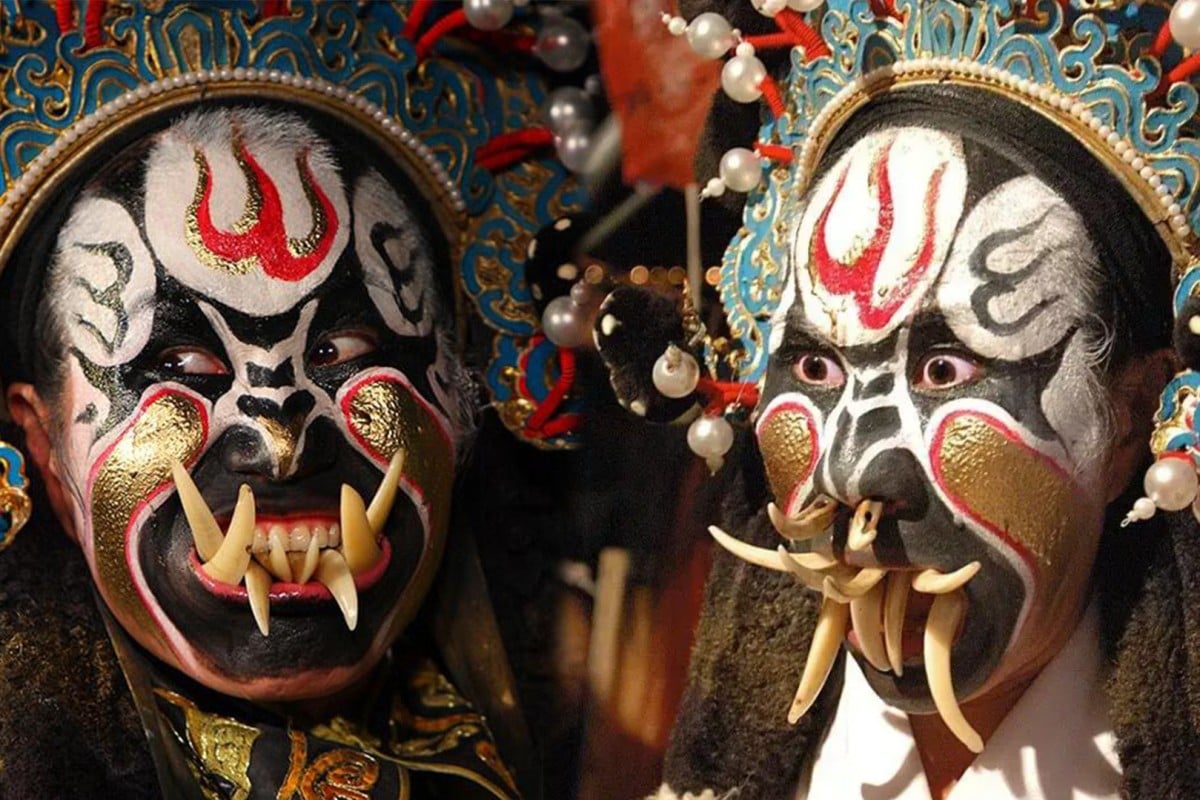
“Teeth Playing” is one of China’s most terrifying, and difficult, forms of folk art. Performers manipulate up to 10 wild boar tusks at a time with their mouths. 

At Halloween in the US, children often think it’s fun to be vampires and go trick-or-treating with scary wax fangs in their mouths. But the fake dentures soon come out and go in a pocket because they are so uncomfortable.

In China, there’s a performance art that involves singing with actual boar tusks in the performer’s mouth. Talk about uncomfortable! At the South China Morning Post, you can see a photo of the damage that tusks are causing a young performer.

Zoey Zhang reports on the strange art of “teeth playing.”

“A performer with a fierce makeup conceals the tusks of several wild boars in their mouth, flipping them up and down with their tongue and teeth. Throughout this process, they need to sing, read and dance.

“It could well be the most terrifying, and most difficult, folk art in China. It is called shua ya, which literally means ‘teeth playing.’

“Shua ya is a stunt used in traditional Chinese opera designed to portray the dark, dangerous and complex psychology of villainous characters.

“The tusks of male wild boars that it uses are polished and disinfected and usually reach the length of an adult index finger.

Performers need to manipulate four to 10 tusks in their mouths, using their lips, teeth, and breath to make them move, conveying the emotions of characters.

“Lowering the tusks indicates relaxation and satisfaction, while shaking them vigorously indicates anger. …

“Shua ya has a history spanning over 400 years and is a distinctive feature of opera performances in Ninghai, a county located in Zhejiang province in eastern China.

“The most classic shua ya performance is Jinlian Slays Jiaolong. Jiaolong, or the Chinese water dragon, diverges from the auspicious portrayal of Chinese dragons, causing chaos and bringing misfortune to people. Artists portraying Jiaolong need to master shua ya to perform the part of a villain.

“The stunt is recognized by the government as an intangible piece of cultural heritage. Due to the arduous training process, the art form is on the brink of extinction. Its exponents must keep sharp tusks in their mouths at all times, except when eating or sleeping, until they can speak clearly. It typically takes over a decade of practice to fully master.

“Xue Qiaoping, 41, from Zhejiang province, is a sixth-generation inheritor of China’s shua ya art and one of its few female performers.

“She told China Central Television: ‘When training with eight tusks in my mouth because they are very hard, my entire gums were worn out. I couldn’t eat or drink for a week, only relying on intravenous drips for nutrition.’

“When she reached 10 tusks, Xue needed to use both hands to open her mouth wide enough to fit in all the teeth. Her mouth cracks after each performance.

“Meanwhile, Li Yi, 19, from Henan province in central China, is a shua ya artist with 1.4 million followers on Douyin. He has been practicing this stunt for eight years.

“ ‘My mouth has torn and ulcerated more than 70 times, my jaw muscles enlarged, my teeth were ground down and my appearance changed dramatically,’ Li said. ‘But I am willing to devote my youth entirely to traditional culture.’ “

More at South China Morning Post, here. No paywall.

Read Full Post »

China/Taiwan Comedy Act

Photo: An Rong Xu for NPR.
Vickie Wang (left) is from Taipei, Taiwan, and Jamie Wang is from Shanghai, China. Together they make a funny team.

Recently a resident in my retirement community was telling a dinner table of avid listeners about his (non-Chinese) grandson who speaks perfect Mandarin and has a comedy act that’s a hit both in Taiwan and on the US West Coast. I thought, it can’t be easy for a Caucasian to make comedy about China, especially if he ever hopes to go there.

I thought of this young man when I read Ailsa Chang‘s interview with two Chinese comedians at National Public Radio.

“Vickie Wang calls Jamie Wang her ‘mirror sister.’ No, they are not related, but they share an inverse history. Vickie, who’s originally from Taipei, Taiwan, spent about a decade living in Shanghai, where she began her stand-up comedy career, notably under Chinese censorship. Jamie, who’s from Shanghai, came across the Taiwan Strait and fell into a stand-up career in Taiwan.

“They both met at the bar in a bilingual comedy club, tucked inside Taipei’s red-light district and began performing together. Their recent show, A Night of Cross-Strait Comedy, was so well-received that their friends suggested they start touring together.

“Vickie jokes that if they were to tour together it would feel like something of a ‘peace and reconciliation tour.’ … They spoke to All Things Considered host Ailsa Chang at the very bar where they first met.”

Here are some excerpts from the conversation.

Vickie Wang [of Taiwan]: I grew up thinking that people in mainland China are not to be trusted, that they spit, and that they’re really aggressive and they’re not, like, polite and civilized like Taiwanese people. And it took years in Shanghai to consciously undo that kind of stereotype and prejudice. …

Jamie Wang [of Mainland China]: I think people kind of have this stereotype about Taiwanese where they’re, like, villagers because they live on a small island and they haven’t seen much of the world. They’re very backwards.

“Because I’m a Chinese student here, there’s a lot of unfair regulation towards us. Like, Chinese students are the only international students who cannot work here. Luckily, this February, Chinese people can have health insurance in Taiwan now. But for the past seven years, I couldn’t. [Most] Chinese people are also not allowed to work here, so there’s no way for Chinese people to stay and live and work in Taiwan unless, like, you get married to a Taiwanese citizen.

Vickie: When I first started doing stand-up in China, I was immediately briefed on the three Ts: Tibet, Tiananmen Square and Taiwan. These are hard red lines that we’re not supposed to talk about. It’s interesting. It means that I can’t talk about politics. I can’t really talk about LGBTQ issues. …

Now that I’m not living in China anymore, right now, I’m also revenge bingeing on democracy and freedom of speech. I’m really enjoying being able to say whatever I want.

“Jamie: I posted two jokes, and they were all viral, obviously because I’m very funny. But one of the jokes touched the fine line. And I thought it was OK, but a lot of Chinese people were trolling me on the internet. I also received death threats. Trolls DMd me, they were like, ‘I’m going to kill you.’ And I’m like, ‘You can’t. Because you can’t get a visa here.’ I don’t think you can ever be free as long as you are Chinese.

Vickie: There are a lot of things that I can say that Jamie can’t say. And I don’t want to speak over my Chinese friends, but I’m also very aware that, like, there’s things that I have to amplify for them. And in the meantime, I can also call out my own people. Ever since COVID started, I had Taiwanese friends on my Facebook feed who were saying things like, ‘Oh, yeah, they deserve it. These commies, they deserve a plague on their house.’ And I was so, so devastated to feel, like, oh my God, my people, who I’d like to think are generally decent, kind people, have so dehumanized this other population that they’ve never actually encountered. And, you know, I feel like having both of us on stage performing together, I hope that somehow bridges the gap.

“Jamie: I think comedy is a very powerful thing ’cause it’s not, like, a debate. Comedy is like, ‘I make you like me. I make you feel weird together. And then let me tell you what I have to say.’ I think it’s a very non-hostile, very friendly way to make people listen to you.

“Vickie: When someone laughs with you, it’s the closest thing you get to changing someone’s mind. When you’re laughing with someone, it means you — in that moment — you get their perspective. To a degree, you agree with them. It’s a very proactive kind of empathy. And it’s a very joyful kind of empathy. … I think that’s the best thing we can do, is to make jokes about it. I just still struggle to make everything funny. I’ll get there. I’ll figure it out, or Jamie will first.”

More at NPR, here.

Read Full Post »

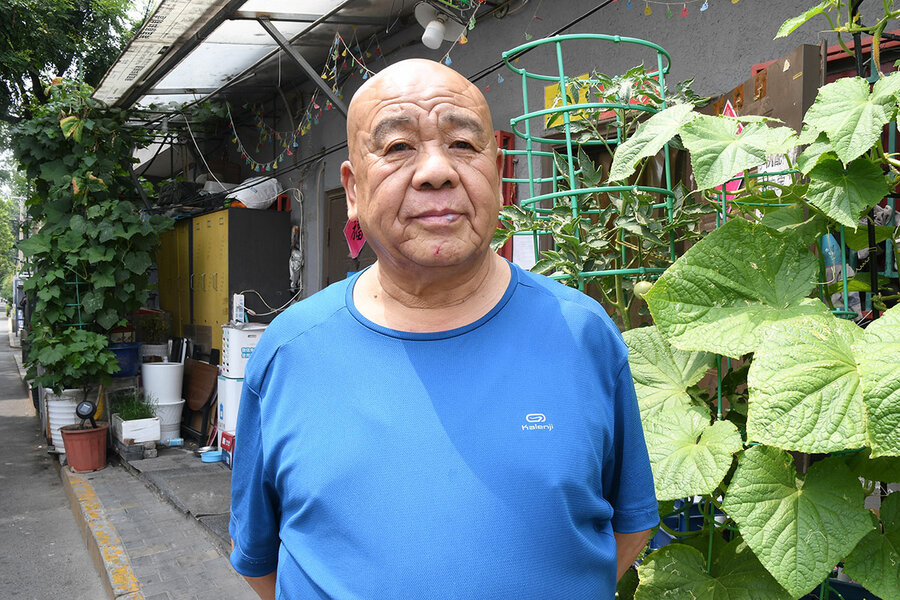
Photo: Ann Scott Tyson/Christian Science Monitor.
In China’s hutongs, people travel more slowly, affording them time to enjoy the lush bounty of small gardens.

I do like stories about the joy and innocence of growing things. Check out today’s feature from the Christian Science Monitor, an outlet that reliably covers more positive news than the blaring headlines we are used to.

Ann Scott Tyson writes, “On his morning rounds after a summer rainstorm breaks Beijing’s heat, Zhao Shisheng inspects his favorite vine of gourds. 

“From a small pot of dirt set against the wall of his back alley home, the vine climbs a bamboo pole, rising past mops hung out to dry. From there, it scales window ledges, pipes, and electricity wires, soaring toward a makeshift trellis Mr. Zhao built on his rooftop.

“In fact, Mr. Zhao’s prolific, potted garden – bursting with vines of melon, grapes, tomatoes, cucumbers, mint, and beans – is rapidly enveloping his modest, one-story house, where he lives with three generations of his family and a pet parrot.

“Mr. Zhao counts himself among the ranks of Beijing’s hutong gardeners – the avid, green-thumbed residents who work wonders in the city’s maze-like ancient neighborhoods, tucked behind skyscrapers and traffic-clogged avenues. In hutongs, as the narrow alleys are called in Chinese, people travel more slowly – often by bicycle or by foot – affording them time to enjoy the lush bounty, and admire the gardeners’ horticultural feats. 

“ ‘We eat some and I share the rest with neighbors. I don’t need to sell what I grow. I already have a way to make a living,’ Mr. Zhao says, pointing to a tiny convenience shop in the front room of his house.

“These gardens are largely vertical, rising like Jack’s beanstalk out of humble clay pots or small planters. Vibrant vines and curly tendrils cling to the old stone and rounded tiles of the traditional courtyard homes. Their rustling leaves create a soothing sound and welcome shade as they arc over alleys and courtyards on trellises. …

“Around the corner next to another hutong garden, a plein-air painter has set up an easel and canvas to capture the scene. ‘This plant is a loofah gourd,’ says Liu Changli, dabbing leaves on his watercolor tableau. ‘People in Beijing like to grow it because you can eat it, or simply enjoy looking at it.’ …

“The grower of the loofah gourds, Zhao Guangliang, steps out his door carrying a potted tomato that needs a sunnier exposure. Space is precious in the hutongs, where people live in crowded conditions and share public toilets. So gardeners must be creative. Assisted with strategically placed bamboo, they use every nook and cranny for plants. One of Mr. Zhao’s neighbors arrays plants on the roof of an unused van. Mr. Zhao opts, for now, to seat his tomato on a small chair. …

“Visit with them for a time, and the gardeners enjoy sharing not only growing tips, but also how to use different plants in cooking and other practical ways. ‘This is a Sichuan pepper bush I’ve been growing for more than a decade,’ boasts Mr. Wang, who withheld his first name for privacy. ‘You dry out the pepper in the yard, then you can use it to make mapo tofu or meat stew.’ …

“ ‘This is mint. Do you have some in your house? Smell this kind – see how strong it smells? If you get bitten by a mosquito you can crush some and rub it on your skin. … It’s good for people to chat like this,’ he reflects. ‘It gets rid of your worries.’ “

I wanted to grow loofah gourds here, but I knew I shouldn’t introduce a species to my region. Loofahs make those wonderful “sponges” I used to think came from the sea.

More at the Monitor, here. No paywall. Subscriptions encouraged.

Read Full Post »

Photo: Hannah Wright via Unsplash.
The Mekong River, where it passes through Cambodia.

You would think that because I was around in the 1960s, mention of the Mekong River would bring to mind only Vietnam War scenes from television. I do think of those but also of Colin Cotterrill’s Dr. Siri Paiboun mystery series, where the river is a character all its own, and where Laotian characters may cross secretly to Cambodia, Thailand, or Vietnam.

So naturally, research on the river’s improving quality caught my eye.

Stefan Lovgren has a report at YaleEnvironment360. “Among the many ailments plaguing Southeast Asia’s Mekong River, ‘hungry water’ stands out with particular clarity. In recent dry seasons, the Mekong has in places turned a pristine blue as upstream dams rob it of the nutritious particles that normally color the river a healthy mud brown. It’s a phenomenon that can be highly destructive, with the sediment-starved water eating away at unbuffered river banks — hence the ‘hungry’ epithet — and causing harmful erosion.

“It also encapsulates the troubled state of the Mekong, a river that may look healthy on the surface but has grown increasingly sick from a wide range of problems, including dam building, overfishing, deforestation, plastic pollution, and the insidious impacts of a changing climate. During El Niño-induced droughts in recent years, things got so bad that some people suggested the Mekong River was approaching an ecological tipping point beyond which it could not recover.

But events in the past year suggest such doomsday predictions may be premature, especially in Cambodia, which sits at the heart of the Mekong basin.

“Thanks to the last monsoon season, which delivered above-average rainfall to the region, and authorities cracking down on illegal fishing, fish stocks have increased. Fishers along the Mekong have discovered giant fish thought to have disappeared, and the Cambodian government, which has a mixed environmental record, has stepped up conservation efforts.

“Among them is a new government-backed proposal that seeks to turn a particularly bio-rich stretch of the river in northern Cambodia into a UNESCO World Heritage Site. Such a designation, reserved for sites of great scientific or cultural significance, means this part of the river should, at least on paper, enjoy protection from various forms of development, including dam building. …

“ ‘The Mekong is not dead,’ says Sudeep Chandra, director of the Global Water Center at the University of Nevada, Reno, who leads the USAID-funded Wonders of the Mekong research project. ‘We’ve seen huge environmental pressures causing the Mekong to dry up and fisheries to almost collapse. And yet we also see the incredible resilience of this river in the face of those threats.’

“Originating in the Tibetan highlands and winding its way through six countries before disgorging into the South China Sea, the 2,700-mile-long Mekong River is home to the world’s largest inland fishery, with about 1,000 species of fish. Many of the 70 million people living in the basin rely on the river for their livelihoods, whether that is farming, fishing, or other occupations.

” ‘A case could be made that the Mekong is the world’s most important river,’ says Chandra.

“The river’s extraordinary productivity is linked to a giant flood pulse that, in the wet season, can raise water levels 40 feet. With the increase comes sediment that’s essential to agriculture as well as vast numbers of young fish, which are swept into Cambodia’s vital Tonle Sap Lake and other floodplains where they feed and grow.

“But the river’s natural flow regime has been increasingly disrupted by dams, especially those that China began building in the early 1990s in the Upper Mekong and which the country has operated with little regard for downstream impacts. 

“A subsequent frenzy of dam building in Laos and elsewhere, mostly on tributaries to the Mekong, has greatly exacerbated the problem, with dams blocking fish from completing their natural migrations. Already under extreme pressure from overfishing, some fish populations have plummeted, especially large species like the critically endangered Mekong giant catfish, which can grow to 10 feet in length and more than 600 pounds, but is now on the brink of extinction.

“With climate change intensifying, monsoon rains have become more unpredictable. During droughts in 2019 and 2020, the flow of water from the Mekong into Tonle Sap, the largest lake in Southeast Asia, dried up. …

“Mass deaths of fish due to shallow and oxygen-poor water were reported in the lake, and many of the hundreds of thousands of fishers operating on the lake were forced to abandon their work. On the Tonle Sap River, which connects the Mekong and the lake, two thirds of the 60-something commercial ‘dai’ operators working stationary nets, which in years past could each catch several tons of fish in just an hour, had to shut down. …

“However, the river system caught a break with the most recent monsoon season, which runs roughly from June to November, delivering greater than average rainfall to the lower basin and the Tonle Sap Lake region. Although China continued to hold back water to counter its persisting drought, water levels in Tonle Sap rose more than one meter above recent-year averages. With the lake expanding into seasonally flooded forests, which provide excellent feeding grounds for fish, fish populations appear to have been boosted. …

“On a recent visit to the lake, Ngor noticed an increase in medium- and large-size carps, including Jullien’s golden carp, also known as the isok barb, a critically endangered species. There were spottings of other rare fish too, like the Laotian shad and clown featherback, along with increases of more common fish, like the climbing perch and snakehead. Several wallagos, a catfish that can grow up to 8 feet long, could be seen jumping from the open water.

More at YaleEnvironment360, here. No firewall.

Read Full Post »

Photo: Tadek Kurpaski.
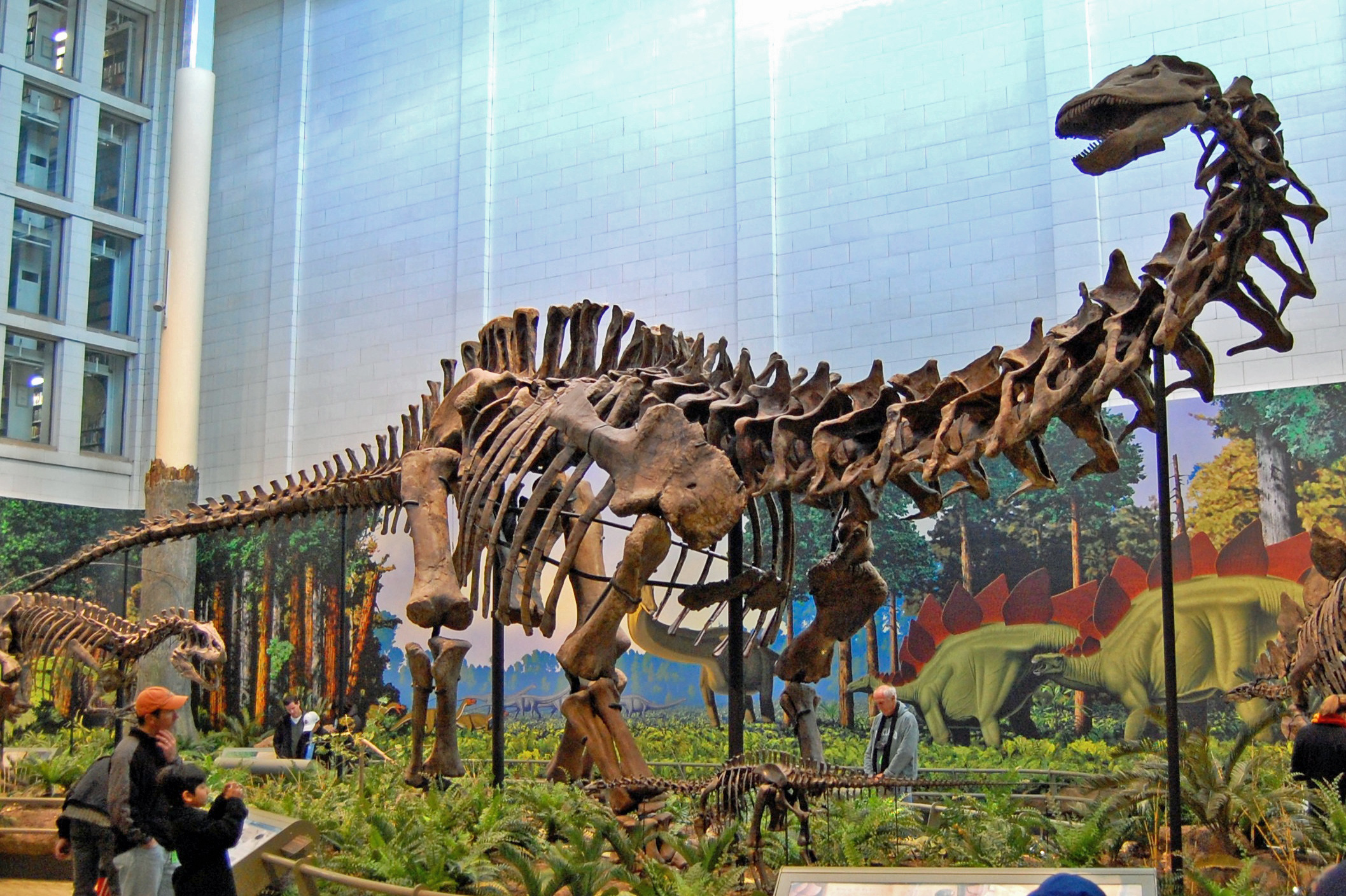
A sauropod at the Carnegie Museum in Pittsburgh, Pennsylvania.

Who doesn’t love a dinosaur — at least, now that dinosaurs are extinct? Wouldn’t it be fun to discover evidence of one like the people in today’s story? At the Washington Post, Dave Kindy reports that In recent years, a number of major dinosaur finds have occurred by happenstance.

“A diner sitting in the outdoor courtyard of a small restaurant in China’s Sichuan province happened to look down at the ground and spot something unusual. It appeared to be a dinosaur footprint.

“[In July], Chinese paleontologists confirmed that the diner was right. The depressions had in fact been left by two dinosaurs. …

“Using a 3D scanner, scientists determined that the tracks were made by sauropods — large herbivorous dinosaurs with long necks and four legs. According to Lida Xing, a paleontologist at China University of Geosciences who led the team investigating the site, these footprints were probably made by the species Titanosauriformes. The footprints are about 22 inches long on average, and the dinosaurs probably measured about 26 feet long and weighed more than 2,000 pounds, Xing told the Washington Post.

“While not an everyday occurrence, the discovery of dinosaur footprints happens on occasion in China — just not in urban environments.

“ ‘Sauropod tracks are not rare in Sichuan Basin … but they are very [rarely] found in restaurants in downtown,’ Xing said in an email. …

“But this wasn’t the first accidental discovery of dinosaur remnants in recent years. Take, for example, the case of Mark McMenamin, who was walking across the campus of the University of Massachusetts at Amherst last year. He and his wife collected stones at a construction site, then later noticed one of them appeared to be a fossil. It was, in fact, the elbow bone of a 30-foot-long predatory dinosaur known as a neotheropod. …

“Then there was the discovery of a well-preserved dinosaur ‘corpse,’ unearthed by miners in Canada. While excavating at the Suncor Millennium Mine in Alberta in 2011, they stumbled upon the fossilized remains of a Nodosaurus, a heavily armored creature. … Displayed for the first time in 2017, it is considered one of the best-preserved dinosaur fossils ever found.

So complete are the remains that scientists at the Royal Tyrrell Museum in Alberta were able to examine the contents of its stomach, including twigs, leaves, mosses, pollen and spores.

“Last year, archaeologist Marie Woods was looking for clams on the beach in Yorkshire, England, when she spotted something unusual: the [footprint] of a species of theropod. A dinosaur similar to a Tyrannosaurus rex, this ancient reptile also stood on two legs and was carnivorous. It was the largest footprint of its kind ever found in that part of England, reported the Good News Network. …

“In 2011, paleontologists in China encountered a big rock with a fish fossil on the surface. They hauled it back to the lab, where it sat for about a year, according to New Scientist. Then the researchers decided to crack it open.

“To their amazement, they discovered inside the remains of a mother ichthyosaur [giving] birth to three babies. One was already out of the womb, another was halfway out, and the third was waiting for its chance.

“This fossil find altered the view of when dinosaurs began having live births. … Ichthyosaurs, which evolved from land-based creatures, proved that dinosaurs had moved on from egg-laying much earlier than previously believed.

“ ‘This land-style of giving birth is only possible if they inherited it from their land ancestors,’ one of the researchers told Live Science. ‘They wouldn’t do it if live birth evolved in water.’

“Back at the restaurant in Sichuan province, [the] owner was anxious that news of the primordial find would impact her business serving homestyle meals based on local cuisine. However, she has since embraced the media hype.

“ ‘She was initially concerned that she would attract a lot of curious people and affect the restaurant’s traditional customers,’ Xing wrote. ‘But now she understands the change and is ready to roll out some dinosaur track-themed treats.’ ”

I love the names of dinosaurs and how children can recite many of them at a very young age — their first introduction to ancient Greek. When John was five, he would chant dinosaur names to baby Suzanne to make her laugh. She thought they sounded funny.

More at the Post, here.

Read Full Post »

Photo: via Wikimedia Commons and Hyperallergic.
Unknown artist, “Mummy portrait of a young woman named Eirene from Egypt” (c. 1st century BCE), encaustic on wood panel.

Isabella Segalovich at Hyperallergic recently had a lot of fun surveying women’s eyebrows in art.

“Being a public persona on the internet means that my face is looked at almost constantly by strangers,” she writes, “leading to uninvited comments about one feature in particular: my eyebrows. On TikTok, the more viral my video, the more ‘feedback’ my bushier-than-average, Ashkenazic brows receive. Reactions range from applause to truly unhinged amounts of anger and disgust. 

“I started wondering: Have people always been this weird about eyebrows? … Let’s take a quick tour of how [eyebrow] ideals have shown up in art across civilizations throughout history: from bushy, to bold, to completely bare. 

“Ancient Egypt: No matter the gender, many people in Ancient Egypt took special care to bolden their eyebrows with kohl or mesdemet. Like other Northern African and Asian cultures, the face was understood to be sacred, and thus, it required protection: kohl and mesdemet both served to guard against infections around the eyes. Kohl is used by many to this day around the eyes, both for adornment and for spiritual protection or devotion. This preference for strong eyebrows combined with traditions of carved reliefs resulted in highly defined, expressive arches in many Ancient Egyptian portraits. [Check Hyperallergic to see that the] wooden Inner Coffin of the Singer for Amun-Re is a beautiful expression of this high-contrast aesthetic. …

“Nigeria: From 1500 BCE to about 500 CE, a culture in Nok, Nigeria left behind now-famous terracotta sculptures with particularly detailed faces. Researchers Peter Breunig and James Ameje observed Nigerian craftsman Audu Washi, who showed them how to make these terracotta features using traditional methods.

A sharpened, sanded-down piece of wood is gently pushed into the clay to create fine details including the very distinct, graphic [Nok] eyebrows.

“The arched outlines of the eyebrows in these sculptures are similar across the portraits, but subtle tweaks in their shape and the space between them conjure vastly different personalities.

“Ancient Greece and Rome: While it’s hard to imagine with today’s inaccurate images of pristine white sculptures, many women in Ancient Greece and Rome were also unibrow fans! In some settings, a hairy unibrow was not just considered beautiful, but viewed as a sign of wisdom. Victoria Sherrow’s Encyclopedia of Hair recounts how Ancient Greek women used powdered antimony (also known as kohl) or even patches made of goat hair glued onto the forehead to achieve this look. A fresco of Terentius Neo and his (unfortunately anonymous) wife was a unique find in Pompeii because they are displayed as having equal status. Many may have been envious of her pair of prominent eyebrows — or really, just the one. …

“China: Women of the Tang Dynasty in China (618–907 CE) painted their eyebrows in dozens of different fashions, long, short, thick, thin, and wavy, depending on what was in style that year. Well-off women would use qingdai, a blue-ish pigment made from indigo. The woman in the portrait [here] has her face painted with additional decoration on her forehead — huadianor plum makeup. In 5000 Years of Chinese Costume, Xun Zhou writes that women would even decorate between their brows with luminous materials like ‘specks of gold, silver, and emerald feather.’ 

“Europe: Women in late medieval art display a very distinct hairstyle; that is, no hair at all! John Block Friedman writes that ‘misogynistic scientific writing had made female body hair a psychic and physical danger to men.’ So when it came to eyebrows, some women would pluck them until they were almost nonexistent. This plucking extended to thinning out hairlines to reveal large, bald foreheads. Petrus Christus’s 1449 painting ‘A Goldsmith in His Shop’ shows a wealthy woman bedecked in sumptuous fabric. She may have even used harsh chemicals to help rid herself of unsightly hairs. …

“Japan: Eyebrow fashion had an especially unique moment in the Heian period of Japan (794–1185 CE) where, in a manner similar to Chinese trends, both men and women would pluck out their eyebrow hairs completely, drawing new ones an inch above the natural browline. One of these styles was known as hikimayu (引眉) in which both thumbs were dipped in black makeup pigment and then used to create mirroring prints far up on the forehead. This print actually comes from many centuries later in 1876, and is a part of Toyohara Kunichika’s dazzling print series titled Thirty-six Good and Evil Beauties, which are portraits of ‘good and evil’ women throughout Japanese history. …

“Iran: At the beginning of the Qajar dynasty in Persia (1785–1925), male and female ideals of beauty grew closer and closer together, and so did the eyebrows! [Scholar] Afsaneh Najmabadi has shown that women would darken their eyebrows and even decorate their upper lips with mascara to show a faint mustache. Men often took on stereotypically feminine features, sometimes appearing beardless with slim waists in paintings.”

For fabulous pictures from those locales/eras and others, click at Hyperallergic, here. There is even a lovely eyebrow photo of a robot called Kismet. No firewall at Hyperallergic; donations encouraged. PS. Check out the author’s eyebrows here.

Read Full Post »

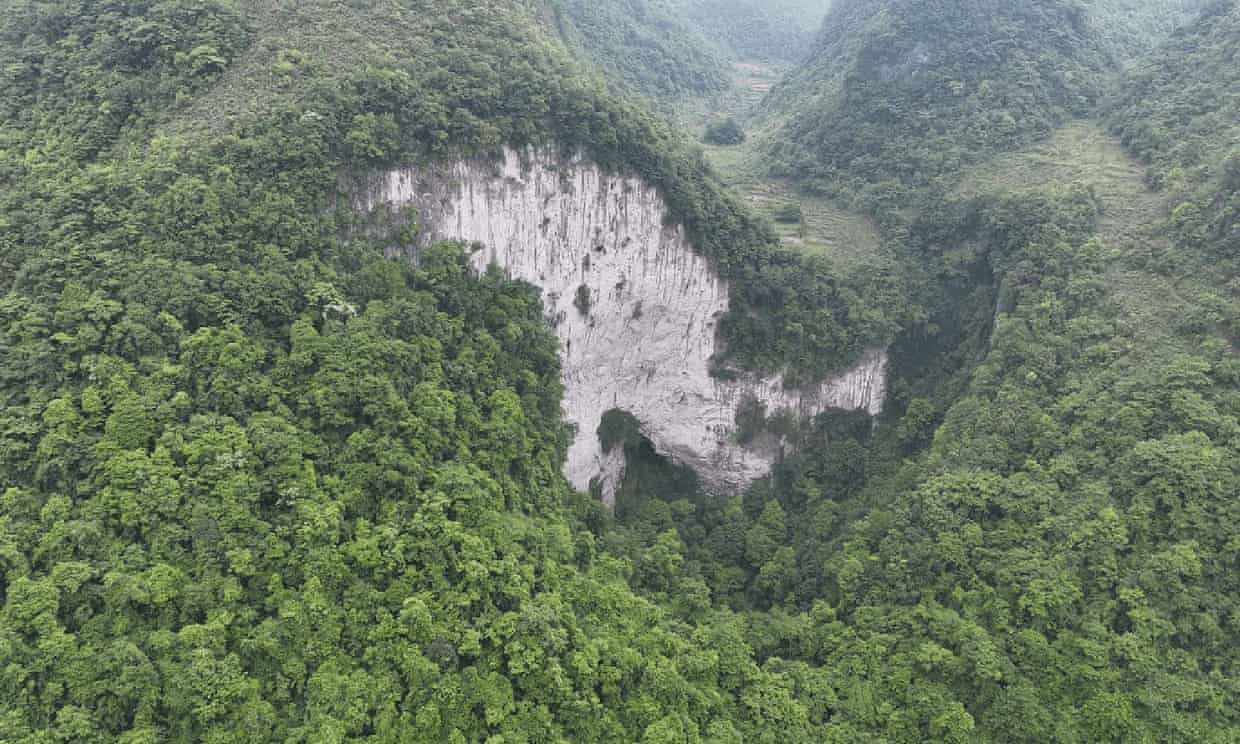
Photo: Guangxi speleology research team 702 via the Guardian.
Cave explorers have come across a sinkhole, or karst, in a semi-autonomous region of southern China. Previously known only to locals, it is 306 metres (335 yards) in length, 150 metres (164 yards) wide and 192 metres (210 yards) deep. It has a forest at the bottom.

When I was a kid spending summers on Fire Island, we all thought the Sunken Forest the most magical place ever. But just imagine if a forest were so removed from the world that it harbored previously unknown species! Scientists in China are beginning to study a forest of tantalizing possibilities at the bottom of a huge sinkhole.

Stephanie Pappas reports at Live Science, “A team of Chinese scientists has discovered a giant new sinkhole with a forest at its bottom. 

“The sinkhole is 630 feet (192 meters) deep, according to the Xinhua news agency, deep enough to just swallow St. Louis’ Gateway Arch. A team of speleologists and spelunkers rappelled into the sinkhole on Friday (May 6), discovering that there are three cave entrances in the chasm, as well as ancient trees 131 feet (40 m) tall, stretching their branches toward the sunlight that filters through the sinkhole entrance. 

” ‘This is cool news,’ said George Veni, the executive director of the National Cave and Karst Research Institute (NCKRI) in the U.S., and an international expert on caves. Veni was not involved in the exploration of the cave, but the organization that was, the Institute of Karst Geology of the China Geological Survey, is NCKRI’s sister institute. …

“Veni told Live Science, [that] southern China is home to karst topography, a landscape prone to dramatic sinkholes and otherworldly caves. Karst landscapes are formed primarily by the dissolution of bedrock, Veni said. Rainwater, which is slightly acidic, picks up carbon dioxide as it runs through the soil, becoming more acidic. It then trickles, rushes and flows through cracks in the bedrock, slowly widening them into tunnels and voids. Over time, if a cave chamber gets large enough, the ceiling can gradually collapse, opening up huge sinkholes. 

” ‘Because of local differences in geology, climate and other factors, the way karst appears at the surface can be dramatically different,’ he said. ‘So in China you have this incredibly visually spectacular karst with enormous sinkholes and giant cave entrances and so forth. In other parts of the world you walk out on the karst and you really don’t notice anything. Sinkholes might be quite subdued. … Cave entrances might be very small, so you have to squeeze your way into them.’ 

“In fact, 25% of the United States is karst or pseudokarst, which features caves carved by factors other than dissolution, such as volcanics or wind, Veni said. About 20% of the world’s landmass is made of one of these two cave-rich landscapes. 

“The new discovery took place in the Guangxi Zhuang Autonomous Region, near Ping’e village in the county of Leye, according to Xinhua. Guangxi is known for its fabulous karst formations, which range from sinkholes to rock pillars to natural bridges and have earned the region UNESCO world heritage site designation.

“The sinkhole’s interior is 1,004 feet (306 m) long and 492 feet (150 m) wide, Zhang Yuanhai, a senior engineer with the Institute of Karst Geology, told Xinhua. … Chen Lixin, who led the cave expedition team, told Xinhua that the dense undergrowth on the sinkhole floor was as high as a person’s shoulders. Karst caves and sinkholes can provide an oasis for life, Veni said.

‘I wouldn’t be surprised to know that there are species found in these caves that have never been reported or described by science until now,’ [team leader] Lixin said.

“In one West Texas cave, Veni said, tropical ferns grow abundantly; the spores of the ferns were apparently carried to the sheltered spot by bats that migrate to South and Central America.

“Not only do sinkholes and caves offer refuge for life, they are also a conduit to aquifers, or deep stores of underground water. Karst aquifers provide the sole or primary water source for 700 million people worldwide, Veni said. But they’re easily accessed and drained — or polluted.” More at Live Science, here. No firewall.

The Washington Post offers more on the forest. Reporter Marisa Iati writes, “Large sinkholes are known in Chinese as ‘tiankeng,’ or ‘heavenly pits.’

“The sinkhole near Ping’e village is known to local residents as Shenying Tiankeng, or ‘the bottomless pit.’ From a distance, the cliff looks like a pair of soaring wings, the Guangxi Daily newspaper reported.

“The researchers arrived at the sinkhole May 6 and saw dense trees blocking the bottom of the pit, the newspaper reported. They used drones to explore the area and then rappelled and hiked to the bottom for several hours, passing dense thorns and fig plants. They found three caves in the wall that may have formed early in the sinkhole’s evolution, Zhang Yuanhai, senior engineer at the Institute of Karst Geology of China Geological Survey, told Chinese state-run news agency Xinhua.

“While trees exist in other sinkholes, Veni said they can only grow if the hole is shallow enough and has a big enough opening to let in sunlight. The newly explored sinkhole is almost definitely home to small animals, such as insects, that are currently unknown to scientists, he said.”

More at the Post, here.

Read Full Post »

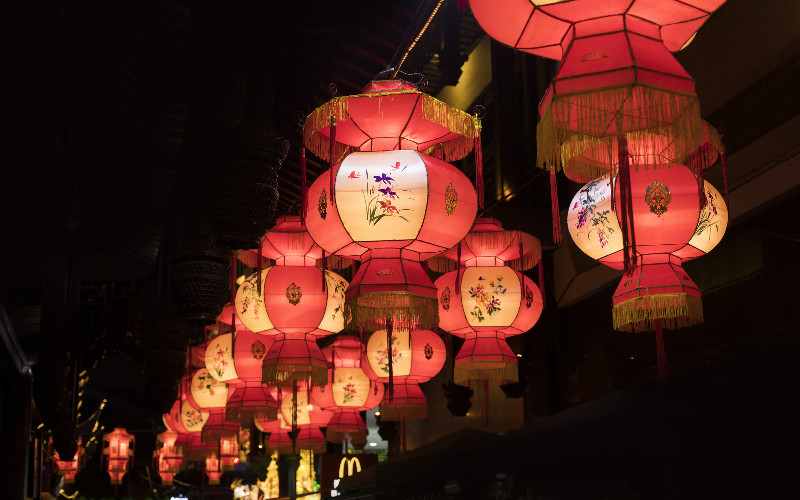
Photo: China Highlights.
“In ancient China, lanterns were used to provide light and as aspects of worship. Today, they are used only for decoration,” says China Highlights.

There is something about candles and lanterns that seem to take one back in time. If I light candles in a hurricane when the electricity goes out, I don’t think of lighting candles last week for a dinner or a birthday party, I think of being a little girl in a long ago hurricane. Lanterns also take me back in time — to my college’s traditions and our night-time processions with the lanterns of our particular year and the songs we’d learned to sing in ancient Greek.

Rebecca Kathor at Public Radio International’s The World reports on how China passes the ancient tradition of lantern making to new generations.

“Sixty-five-year-old Li Jianguo grew up in Shanghai during the Cultural Revolution,” she writes. “He remembers not always having enough to eat when he was young and having to drop out of school. Yet, his happiest memories as a child were during the Lunar New Year.

“ ‘That was when we had new clothes to wear and good food to eat,’ he said. ‘After dinner, [we] kids would run outside and play with our lanterns in the alleyways.’

“In China, the tradition of children playing with handmade paper lanterns during the Lunar New Year has been passed down for generations. During Lantern Festival, the last day of Lunar New Year celebrations, families gather for a meal of dumplings and light lanterns together. …

“Today, most lanterns are manufactured, but when Li was a boy, everyone had simple bamboo and paper ones. His was made by his father who learned from his own father. It was lit by a candle and had four wooden wheels and a string to pull it along.

“ ‘At the time, the streets in Shanghai weren’t well-paved and our rabbit lanterns would bump along behind us as we ran,’ he said. ‘If the rabbit fell over, the candle inside would burn up the lantern. The other kids would laugh at you, but it was also considered good luck — like you burned up all your bad luck and could start fresh in the new year.’

“These days, Li doesn’t play with lanterns anymore. He makes them. Li is one of the last remaining lantern craftspeople in Shanghai. His cramped apartment is covered floor to ceiling with paper lanterns shaped like rabbits, dragons and lotus flowers. He and his wife spend the entire year making 600 lanterns to sell during the 15 days of the Lunar New Year. Sometimes, he’s so busy, he said, that he doesn’t have time to sit down for a meal.

“ ‘This isn’t the busiest time of the year for me. Every day, I’m busy,’ Li said. ‘If I don’t keep up the pace during the year, when it comes time to sell my lanterns, people will be disappointed if I run out too fast.’ …

“Li demonstrated how to make a rabbit lantern. It takes 60 intricate steps to build the bamboo frame and decorate each one — a nearly six-hour process that he learned from watching his father. Each sells for $15. …

“Craftspeople like Li are disappearing, though, in a rapidly modernizing Shanghai.

“Zhou Qi is the author of a book featuring 60 of Shanghai’s remaining craftspeople. Over the course of eight years, she searched out artisans who make everything from handspun cloth to woven bamboo shopping baskets to hand-stitched cotton shoes.

“ ‘They all make everyday things I used as a child growing up here in the ’80s,’ she said. ‘But they are more than just things we use, they are also a part of our culture.’

“Many of the craftspeople in her book are elderly. And they haven’t passed down their skills because there are few people who want to learn these crafts. Zhou said that she found only four lantern makers in Shanghai. …

“The craftsmen are tough to find — most of them don’t have a storefront and aren’t on social media.

“One place you can find lanterns is at Yu Gardens, in Shanghai’s Old City. Every year at this time, crowds flock here to take photos of the massive lantern displays near the City God Temple.

“Rabbit lantern maker Li is here too, but … many people are buying their children cheaper, mass-produced plastic and paper versions instead. And these days, they are lit up by battery-powered light bulbs.

“Li said that he doesn’t make lanterns for the money. He and his wife live off their retirement pension.

“ ‘I want my children and grandchildren to have a memory of playing with rabbit lanterns just like I did,’ he said.”

More at the World, here. No firewall.

Read Full Post »

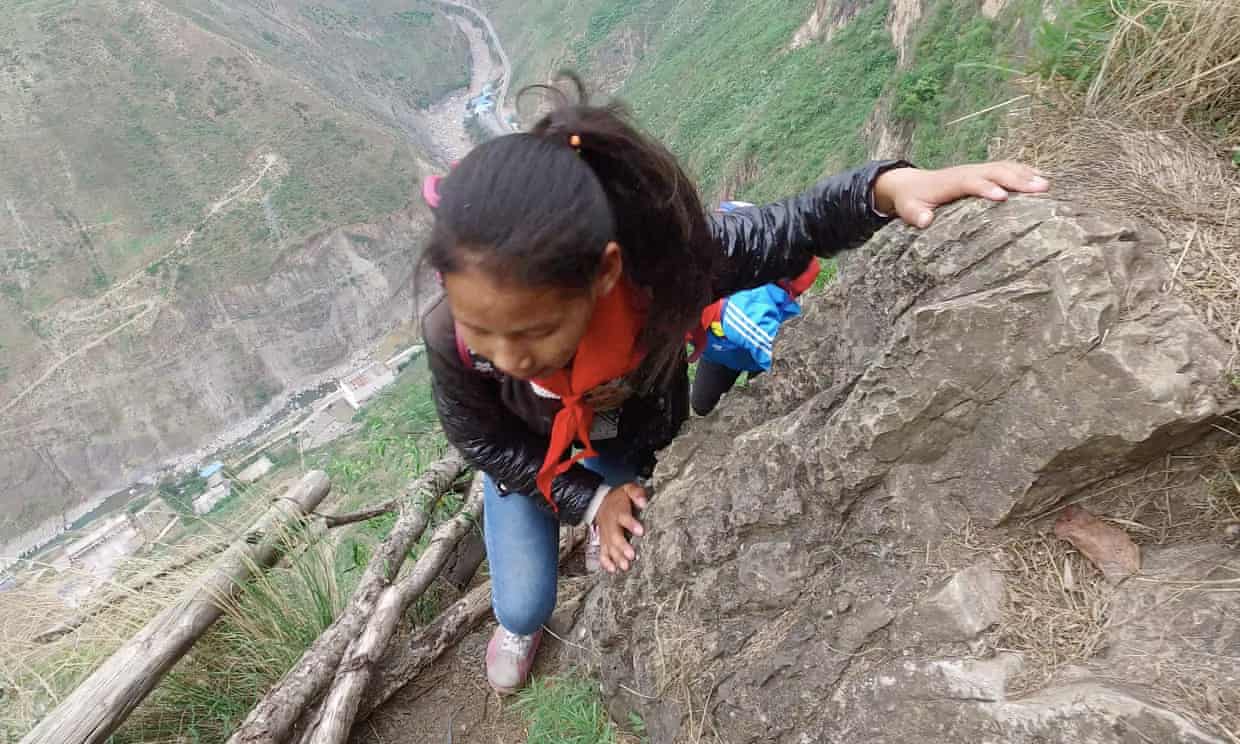
Photo: Feature China/Barcroft Images.
“There are 17 vine ladders on the 800-metre-high way home, but the most dangerous part is a path on the cliff without a vine ladder.In 2016, the Guardian reported this story on children as young as six going to school from Atuler village in Sichuan.

In one of the online English classes where I volunteer, the teacher likes to provide unusual news stories for our adult students to practice their reading on. Recently she gave the class an article from 2016 that astounded us all. After class, I searched online for a follow-up.

In 2016, Tom Phillips wrote at the Guardian, “To attend class, backpack-carrying pupils from Atuler village in Sichuan province must take on an 800-metre rock face, scrambling down rickety ladders and clawing their way over bare rocks as they go.

“Images of their terrifying and potentially deadly 90-minute descent went viral on the Chinese internet [after] they were published in a Beijing newspaper. The photographs were taken by Chen Jie, an award-winning Beijing News photographer. …

“Chen used his WeChat account to describe the moment he first witnessed the village’s 15 school children, aged between six and 15, scaling the cliff. ‘There is no doubt I was shocked.’ … Chen, who spent three days visiting the impoverished community, said the perilous trek, which he undertook three times, was not for the faint of heart.

‘It is very dangerous. You have to be 100% careful,’ he told the Guardian. ‘If you have any kind of accident, you will fall straight into the abyss.’

“So steep was the climb that Zhang Li, a reporter from China’s state broadcaster CCTV who was also dispatched to the mountain, burst into tears as she attempted to reach Atuler village. ‘Do we have to go this way?’ the journalist said as her team edged its way up the cliff face. ‘I don’t want to go.’

“Api Jiti, the head of the 72-family farming community which produces peppers and walnuts, told Beijing News there had been insufficient room to build a school for local children on the mountaintop.

“But the perils were evident. The villager chief told the Beijing News that ‘seven or eight’ villagers had [died] after losing their grip during the climb while many more had been injured. He had once nearly fallen from the mountain himself.

“The trek to school is now considered so grueling that the children have been forced to board, only returning to their mountaintop homes to see their families twice a month.

“Villager Chen Jigu told reporters the wooden ladders used to move up and down the mountain were, like the village, hundreds of years old. ‘We replace a ladder with a new one when we find one of them is rotten,’ he said.”

In the Insider follow-up story, we learn that the government came to the rescue, although not everyone agreed to move. Michelle Mark wrote, “The Chinese government has resettled 84 households who once lived in a remote village at the top of a 2,624-foot cliff.

“The village made international headlines in 2016, after harrowing photos showed young children climbing down the cliff to go to school, descending rickety ladders made of vines and scaling narrow paths without any guardrails or safety devices.

“The villagers have since been moved into apartment buildings near the town center of Zhaojue County in the province of Sichuan, according to the state-run broadcaster CGTN.

“The broadcaster quoted one villager who said Atule’er residents drew lots for their new homes — [the villager] said he was allowed a 1,076-square-foot dwelling because there are five people in his family, and that he was looking forward to accessing services in the new area that were previously unavailable to him. …

“The resettlement of the Atule’er villagers is reportedly part of a broader campaign to house impoverished families in remote villages. The Zhaojue County site is expected to soon house more than 18,000 residents from 4,057 households, according to CGTN.

“Despite the efforts, not all Atule’er villagers were willing to leave their homes. CNN reported that 30 households intended to stay in their clifftop homes, partly due to a newfound tourist economy. Roughly 100,000 people visited Atule’er in 2019, creating some $140,000 in revenue for the village”!

More at the Guardian, here, and at Insider, here.

Read Full Post »

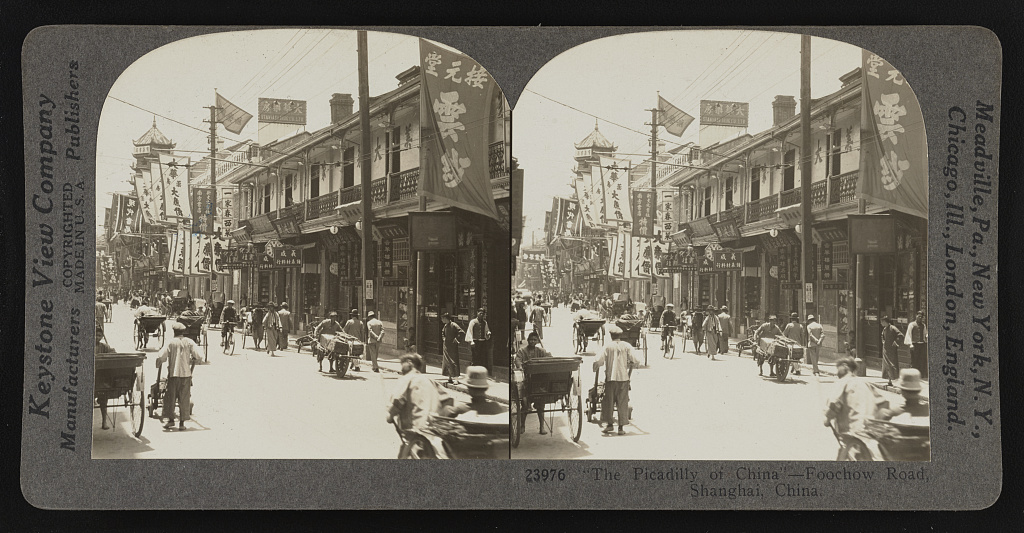
Photo: Library of Congress.
Shanghai in the 1930s.

Something worth remembering as the need for asylum in our world grows every year, is that Shanghai accepted many Jewish refugees in the 1930s, where they joined an already thriving community of Jewish immigrants from Baghdad.

And as most immigrants do, these transplants made valuable contributions to their new country. Today’s story is about one such contribution in Shanghai: an unusual ballet.

Susan Blumberg-Kason writes at the Los Angeles Review of Books, “Jews in Shanghai have been the subject of many memoirs and novels. … Kirsty Manning’s The Song of Jade Lily (2018) and Rachel DeWoskin’s Someday We Will Fly (2019) are two recent novels that tell stories of Jewish refugees who fled to the Chinese city, one of the only places in the world that didn’t require papers back then.

“Other books have told of a Jewish community in Shanghai before the refugees arrived. Taras Grescoe’s Shanghai Grand (2016) and Jonathan Kaufman’s The Last Kings of Shanghai (2020) center around Baghdadi Jewish families like the Sassoons and Kadoories, families that arrived in Shanghai a century before the onset of World War II. …

“Judaism is not a monolithic culture, as the different communities in Shanghai before and during the war show. Besides the refugees and the Baghdadi businesspeople, Shanghai was also home to Jews in the performing arts. Very little has been written about their contributions to Shanghai before the Japanese took over most of the city in 1937.

“These contributions centered around two people: Russian Jewish composer Aaron Avshalomov and American Jewish theater producer Bernardine Szold Fritz. …

“Avshalomov left Russia to study medicine in Zürich before the Bolshevik Revolution. … But by the end of the 1910s, he had decided to leave medicine and the US, and pursue a career in music. He moved to Shanghai.

“At the time, customs in this port city were not administered by Chinese officials, nor was it managed by French, British, or American authorities, all of which held local concessions. Because of these loose arrangements, Shanghai became a refuge for anyone seeking a new home. It attracted Russians fleeing the Bolshevik Revolution and Jews escaping pogroms. In Shanghai, Avshalomov worked with other Jewish musicians.

“Bernardine Szold Fritz was a Jewish actress-turned-journalist who fled three husbands before the age of 30, arriving in Shanghai in 1929 to marry her fourth husband, an American silver broker. Born in Peoria, Illinois, she had acted at Chicago’s Little Theatre before moving to New York and then Paris. …

“In Shanghai, Bernardine started a salon, bringing together Chinese and foreign writers, artists, musicians, and actors. In early 1933, she invited Avshalomov and learned that he had written a ballet, The Soul of the Ch’in, while living in Peking in 1925–’26. The ballet had been performed in Portland, Oregon, in the late ’20s, but had yet to be produced in China.

“Suddenly Bernardine envisioned a new project that inspired her to think beyond her living room. She convinced Avshalomov that the two of them together could produce his ballet right there in Shanghai. Not unfamiliar with the dance world, she was friendly with Ruth Page, the American ballerina, and her partner, Harald Kreutzberg, a German pioneer in modern dance.

“Avshalomov’s experience in China — he had already lived there for almost 15 years — and Bernardine’s theatrical background allowed the duo to bring a ballet to Shanghai that would appeal to all arts enthusiasts, both Chinese and expat. Bernardine also tapped into her connections in Shanghai’s financial, political, and artistic communities. She and Avshalomov knew members of the influential Soong family, including Madame Chiang Kai-shek (or Soong Mei-ling) and Madame Sun Yat-sen (or Soong Ching-ling), both avid patrons of the arts. The performance ran on May 21, 1933, at 9:15 p.m. at the new Grand Theatre. …

The Soul of the Ch’in was possibly the first Chinese ballet performed on a grand scale in China. … The event was even more remarkable because the cast of dancers was all Chinese, as were the set designers, dramaturge, and stage manager. In fact, the only foreigners on the crew were the costume designer and the person managing the lights.”

More at the Los Angeles Review of Books, here. There’s a full description of the ballet’s rather wild plot.

Read Full Post »

Photo: The Home Depot.
Easy-care succulent plants are media stars in China.

A new craze in China shows a revealing side of the natural character, including the determination to find online fun that no government could possibly object to. In fact, I can’t imagine anyone objecting — unless the fad were to lead to depletion of the planet’s succulent plants.

Rebecca Tan writes at the Washington Post, “There’s a group of burgeoning new stars on China’s live-streaming scene. They’re painfully photogenic, diverse in age and origin, and offer up vividly different performances as the seasons change.

“Succulents.

“The thick, fleshy plants have been growing in popularity in China for nearly a decade, but only recently collided with live-streaming in e-commerce, a $60 billion industry that got a massive boost during the pandemic. Hundreds of thousands of people are logging on daily to admire these vegetating celebrities, oohing as chattering hosts turn and twirl them around, showing off blushes of new color, entire centimeters of growth, or — what a treat! — some velvety new leaves.

“ ‘For me, it’s a must-watch every day. I can’t not watch it, I’ll feel like I’m missing something,’ said Yang Weichun, 39, of Zhejiang province. Before live-streaming drew her into a passion for succulents, or ‘duorou’ in Chinese, her phone used to be filled with pictures of her two sons, 13 and 16. Now, her phone has space only for pictures and videos of her several hundred plants, which she scrolls through daily to feel at peace. Unlike teenage boys, she noted, succulents never throw tantrums.

“ ‘My sons say, “mom is silly to buy so many succulents, what is it for?” But when I look at my succulents, these useless things, I feel really happy,’ said Yang, a business executive with 14-hour work days. ‘It’s like unconditional love.’

“Yang is a top client at Gumupai Succulents — one of the many succulent nurseries in the mountainous region of southwest China run by 30-somethings fleeing their former lives in cramped cities. Equipped with selfie sticks and ring lights, these online-only merchants are part of what Chinese media calls ‘new farmers.’

“A former fruit-peddler who auctions off fruit online as ‘Brother Pomegranate‘ garnered 7 million fans. A once-struggling beekeeper found riches through Douyin, the Chinese version of TikTok.

“Succulent sellers have found their success through live-streaming, described by Forbes as ‘the Home Shopping Network, but with charismatic, trendy anchors.’ On platforms like Taobao Live, sellers host videos that last 16 hours a day or more, blurring the lines between commerce, entertainment, and social media.

“Jialu Shan, an economist who studies China’s digital market at the International Institute for Management Development, said live-streaming caught on because it cut out the middleman between buyer and seller, offering more transparency and intimacy in a country often short of both. Instead of relying on Photoshopped or filtered images, buyers can examine products in real time, pose questions to sellers and swap notes with other users. …

“In China, home to nearly 1 billion Internet users, there are some unique outgrowths to traditional plant-rearing.

“Demand is on the rise for ‘succulent fostering,’ merchants say. A growing number of (wealthy) clients want to own succulents but aren’t in a rush to get them right away — or ever, actually. They prefer to outsource the parenting part of plant parenthood, content with watching their wards grow through pictures, videos or maybe the occasional visit.

“According to state-run broadcaster CCTV, more than 80 percent of succulent sellers now provide fostering. One seller told local media that when he started fostering mid-pandemic, he only wanted to take care of a few succulents on behalf of friends in hotter places. Now, he has 5 acres of land and 270,000 foster plants. A 37-year-old seller from Yunnan, who asked to be identified by her live-streaming name Queen of the Strange Flower, said she has 600 clients who have left plants under her care — some for as long as four years. …

“Yang is Gumupai’s biggest foster client, with hundreds of succulents under their care. She wants eventually to retrieve all her dourou — she recently bought a house with a large garden expressly for this purpose, she said — but she’s in no rush. She’s working toward retiring at age 50, at which point, her succulent-rearing skills will be more up-to-mark, she said. And in the meantime, she can see her plants whenever she wants, a collection of pin-sharp pixels on her phone screen.

“ ‘In the past, I wanted to travel and see all of China’s grand rivers and mountains. Now, I don’t have any of that desire at all,’ Yang said. ‘I just want to be in my garden, raising my succulents — just that simple.’ “

More at the Post, here.

Read Full Post »

Yu Hua in Jia Zhangke’s Swimming Out Till the Sea Turns Blue. The film documents life in rural Chinese villages over the past seven decades.

There’s a new documentary covering 70 years of life in China. In an interview at Hyperallergic, Jia Zhangke, director of Swimming Out Till the Sea Turns Blue, tells Jorden Cronk about some of the challenges of extracting personal memories from elderly people raised with a group mindset.

“Moving fluidly between fiction and documentary, the work of Chinese director Jia Zhangke assumes many forms, often within the same film. His latest, Swimming Out Till the Sea Turns Blue, is a documentary portrait of rural China, told through the lives and words of four authors — Ma Feng, Jia Pingwa, Yu Hua, and Liang Hong — whose work collectively spans from the 1949 communist revolution to the present day. Combining reflections on each era’s politics with memories of the authors’ rural upbringings, Jia charts the cultural evolution of China in intimate strokes. … Jia and I connected on Zoom to discuss hidden histories and the generation gap separating today’s Chinese youth from their rural roots.

Hyperallergic: I’ve heard you refer to the new film as the third in your ‘Artists Trilogy.’ At what point did you begin to conceive of the film as such?

Jia Zhangke: I shot the first two films in the trilogy back-to-back. In 2006 I made Dong, about the painter Liu Xiaodong, and in 2007 I made Useless, about the fashion designer Ma Ke. Immediately after I thought I would make the third part, about artists who are either architects or city planners. … I had found quite a few architects and city planners that would be perfect for the project, but they didn’t seem to want to share on camera the things I wanted to capture, so we postponed the project.

“It wasn’t until recently that I started to think again about the third installment. For the past few years, I’ve been going back and forth between Beijing and Jia Family Village [Note: no relation to the director], and while I was there, I noticed that they are facing many issues — and not uniquely Chinese issues, but global issues in terms of the younger generations leaving rural areas for urban settings. Nowadays in these rural areas, you tend to see mostly older people; younger people don’t stay in these areas for long. So now when these younger generations have children, they will have no connection or memories or understanding of their rural or agricultural roots. …

They’re very old. … We had to spend a lot of time during post-production finding a coherent logic and structure in what they were saying, to properly distill their memories.

H: How did you come to the four main subjects of the film? Do they have certain characteristics or writing styles that you felt were particularly suitable to the story you were trying to tell?

JZ: As I was thinking about who I could call on to tell these rural histories, one particular element in Jia Family Village stood out: a literary tradition with very strong connections with the first writer depicted in the film, Ma Feng. He was born and raised in Jia Family Village, and he often wrote about the region. I thought I could use writers born in similar areas who have been writing about these regions as a way to make this documentary come alive. …

“Ma Feng, he was born in the ’20s and most prolific in the ’50s and ’60s, while Jia Pingwa mostly wrote in the ’70s and ’80s, Yu Hua about the ’80s and ’90s, and Liang Hong about anything from the ’90s until now. So it made sense for me to put these authors together as a kind of relay to talk about their formative years, and even though they have some overlap, the most important eras for each of them represent specific moments in time. …

“But more interesting for me was that I could capture each author’s unique way of storytelling and their worldview through the way they talk through their memories, lives, and history, as well as how they depict their characters. … In addition to learning about the last 70 years of rural history, you’re witnessing the evolution of Chinese literature.

H: Ma Feng is the only writer who’s no longer alive. How did you decide to have his daughter speak for him?

JZ: For me, to put together a comprehensive understanding of these rural areas during Ma Feng’s time, it wasn’t sufficient to rely only on his daughter, because I really needed that firsthand account. That’s the reason why, in addition to the daughter, I included two village elders, both in their 90s. These elders had direct experiences and interactions with Ma Feng that I relied on to offer eyewitness testimony to what happened during this period. All three of them talk about the collectivization of society that occurred during Ma Feng’s time. When we look back and rethink the ideas from that era, we might now have different assessments, viewpoints, or understandings of these concepts, but what I want to articulate with the film is that we have to admit that this happened, no matter how we interpret what happened. Through these three people, I wanted to capture the social and historical contexts for these things.

“However, this also posed a couple of problems with regards to interviewing them. They’re very old, of course, but they also come from a society that focused on collectivism rather than individualism, which means that it is very difficult for them to talk from a first-person, or ‘I,’ perspective. It was a challenge to interview them in such a way that they would open up in front of the camera and share their private and subjective memories. And since they are old, they tend to not talk in chronological order, and instead jump around, skip ahead, and flash back in a way that isn’t always coherent. We had to spend a lot of time during post-production finding a coherent logic and structure in what they were saying, to properly distill their memories.

H: Is this hesitancy to talk from a first-person perspective one reason you chose to shoot the interviews from multiple angles and from what seems like a quite a distance?

JZ: For me, the compositions evolve in a natural way within the film’s structure. For the first interviews, I wanted to things to be impressionistic, so we started with images of old people eating, and through that group concept slowly but surely segue into individual memories. In other words, I wanted to locate a visual concept that would take us from the collectivist to individualist way of viewing memories.

H: Much of the film is about the official record of Chinese history and the personal experiences of each author, and how those are quite different. In general, what is the public’s understanding of these events?

JZ: In terms of the grand narrative, the ‘official’ version of history is pretty much the same for everyone, at least in terms of how people understand the big historical junctures. However … everything is stated in such an abstract or statistical way. That’s why I think films like this are very much needed. You can’t feel abstract or statistical histories. There’s no impact — it’s meaningless. What’s missing are visceral connections with history. Of course, there are many ways you can hide certain parts of history. But what’s more important to realize is that what’s often hidden is not necessarily what happened, but how things happened.”

More at Hyperallergic.

Read Full Post »

Older Posts »