Feeds:
Posts
Comments

Posts Tagged ‘china’

2014-DeCordova-in-winter

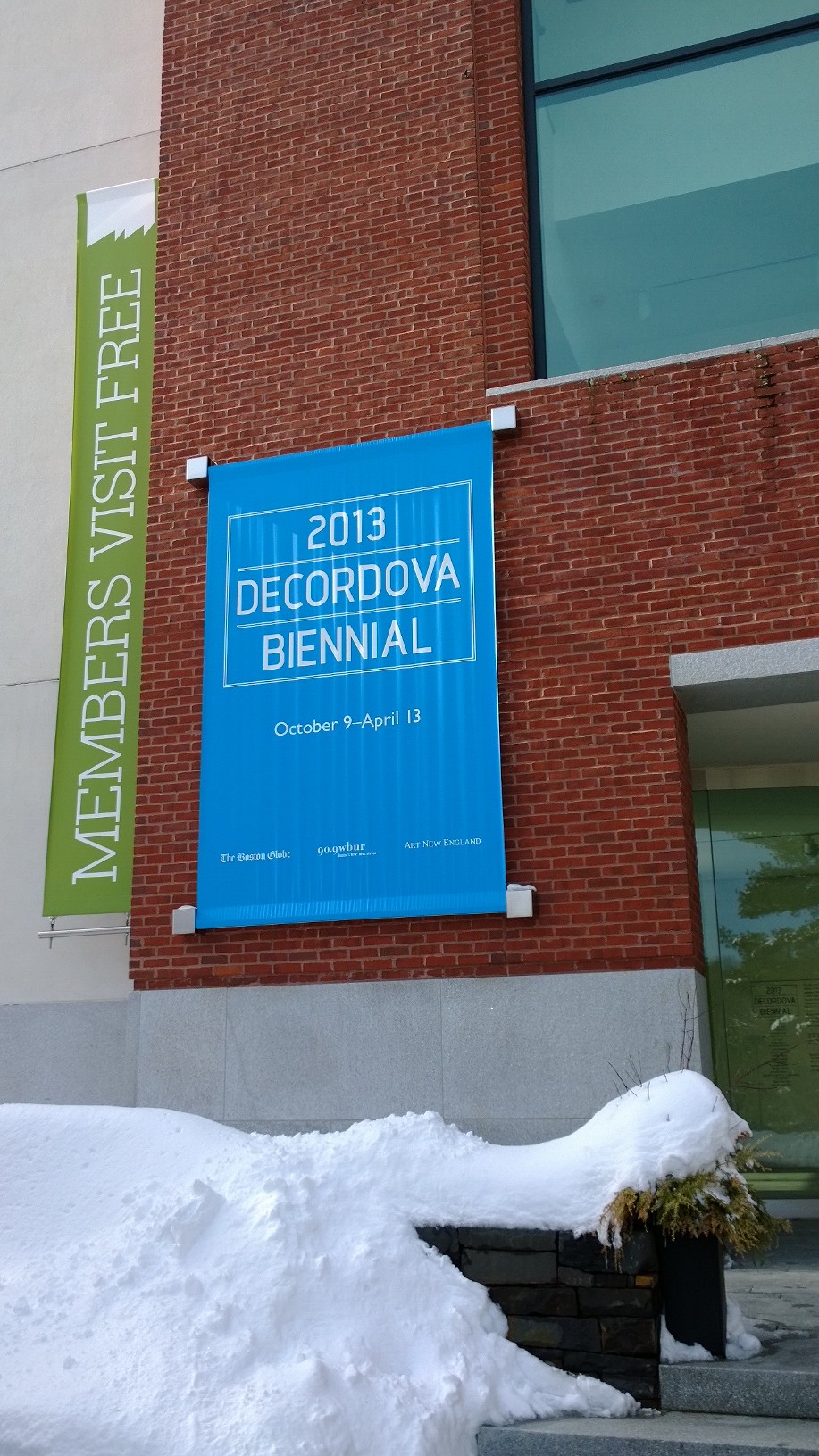
On Sunday, my husband and I decided to see what’s new at the DeCordova Museum in Lincoln.

A favorite in the biennial show of New England artists was Laura Braciale of Manchester, NH. It took me a minute, but when I realized she had displayed everyday objects along with what they looked like once she had turned them into art, I thought, Yes, art really is in everything if you look.

The blurb about her says, “close observation reveals subtle differences between the three-dimensional structures and their two-dimensional renderings. …  Her works engage a question concerning representation—which image is more ‘real’? As both her items and her illustrations occupy the same physical reality, however, Braciale’s work suggests that neither is more real than the other.” (Sigh. I’m not really fond of the way museums write.)

In a different DeCordova exhibit we saw three tintype photo portraits by the late David Prifti, Suzanne’s high school photography teacher. (A solo show in Winchester, Mass., goes through March 2, here.)

The biggest surprise was a documentary about Laos, a country we are interested in largely because of the the mystery books of Colin Cotterill. (Read one of my posts about him, here.)

The film, Route 3, shows a small mountain town that, having been leased to China for 75 years, was utterly destroyed to make way for casinos, hotels, entertainments, and jobs for Chinese people alone. Hard to imagine selling a part of your country like that, but Laos is desperately poor.

The documentary was by Patty Chang and David Kelley, who live and work in Boston and Brooklyn.

The DeCordova says on its website, “Blending the genres of documentary and road trip films with surrealist cinematic passages, Patty Chang and David Kelley present a compelling trip through the physical and psychological landscape of a community in transition. … Enlisting the help of tour guides and local entrepreneurs in this tightly controlled area, the artists immersed themselves in this community to create a unique portrait of a changing society.” More information on the artists here and here.

Read Full Post »

Someone tweeted this today, and I thought you would like it.

Chinese artist Ai Weiwei has created a nighttime art installation made of bicycles all lit up.

On October 5, says Alice at the website My Modern Met, “Chinese artist and activist Ai Weiwei presented a new version of his incredible Forever Bicycles installation. As the centerpiece of this year’s Scotiabank Nuit Blanche, the all-night contemporary art event that takes over city streets, 3,144 bicycles, the most Weiwei has used of this work to date, were stacked 100 feet in length and 30 feet in height and depth in Toronto’s Nathan Phillips Square. This was the first time the installation has been displayed in an open air, public space. Since this was a night-time festival, it was spectacularly lit up with pink and blue lights.”

Check My Modern Met for a stunning array of photos, here.

Photo: http://www.mymodernmet.com

Read Full Post »

I went to school with the daughter of the consul general from Taiwan. One time she told me that the people of mainland China looked physically different because of communism.

I thought I already knew a bit about China. After all, my mother had traveled there in the 1930s as an assistant to Owen Lattimore (cowering later under the dark cloud manufactured by Joe McCarthy and his ilk, who saw Reds under every teacup). She was always talking about China. so although I realized my high school friend probably knew more about China than I did, I had doubts about her statement. How could living under communism make a Chinese person look different from family members on Taiwan?

Nowadays, a rapprochement between the two Chinas is in the air. At first I was surprised that so many people living in Taiwan — and accustomed to views like my friend’s — seemed to have no trouble talking about reunification with the mainland. But family does reach out to family.

Now I see that two sections of an ancient scroll are also being reunited. An article in the NY Times last week describes a new Taipei exhibit and the reunification of “Dwelling in the Fuchun Mountains.” Writes the Times:

“Wu Hongyu, a wealthy Ming Dynasty art collector, was evidently not fond of sharing, given his deathbed command to burn his most beloved painting, ‘Dwelling in the Fuchun Mountains.’ Fortunately, a nephew snatched the scroll from the funeral pyre that day in 1650, but not before flames split the work in two.

“During the three and a half centuries since then, the two sections were kept apart by greed, civil war and the vicissitudes of geopolitical gamesmanship. The smaller piece, just 20 inches across, found its way to a provincial museum in Communist-ruled China. The more imposing 21-foot-long section ended up on Taiwan, the island where the retreating Chinese Nationalists — and boatloads of treasures from Beijing’s imperial palace — ended up after they lost the civil war in 1949.

“If the story of ‘Fuchun Mountains’ is richly symbolic of China’s tumultuous history and its six-decade estrangement from Taiwan, then the painting’s reunification last month at the National Palace Museum here in the Taiwanese capital is a made-to-order metaphor for the reconciliation that Communist Party leaders have long imagined for what they deem a breakaway province.”

Who would have thought?

Read Full Post »

In China, the artist responsible for some of the Beijing Olympics’ most amazing effects, Ai Weiwei, has been released on bail, at least for now. The authorities say they still are investigating him for tax evasion, but it is tempting to think it is really for being a free spirit. Here’s the NY Times article: “Chinese legal authorities released the dissident artist Ai Weiwei on Wednesday after a three-month detention, apparently ending a prosecution that had become a focal point of criticism of China’s eroding human rights record.”

Meanwhile in California, where a young Whitey Bulger once did a stint in Alcatraz, the missing Boston gangster has been found after 16 years on the lam.  Within a couple days of the FBI focusing on his girlfriend, he was identified.

Suzanne’s dad can now stop pretending to be Whitey’s double. Here’s the Whitey doppleganger with Pat.

I don’t think the Boston Globe, which claims all matters Whitey as its own, realizes to what extent the hunt was slowed down by look-alikes. The Globe reports here.


Read Full Post »

Chinglish

I first read about Oliver Radtke and his website dedicated to preserving Chinglish in around 2006. Radtke was alarmed that some of the more charming English translations of signs were disappearing in China prior to the Beijing Olympics. He elicited the help of international visitors to China, requesting them to e-mail their pictures to him for posting. As I went to Shanghai in early 2007, I was able to join the fun. Radtke used a photograph I took of an escalator sign in his first Chinglish book.

My sign said “Keep your legs.” Other samples included signs in parks, like “Show mercy to the slender grass.” Menus, of course, were great hunting grounds, and Radtke posted numerous examples, including “man and wife lung slice” and “advantageous noodle.”

Radtke doesn’t have a corner on the market,, though. Many people have been having fun with Chinglish over the years. Read more at Wikipedia.

Of course, I would sound much more ridiculous trying to speak or write Chinese — or any other language, for that matter. I admire anyone who launches into such foreign terrain. But I do think there is something fascinating and instructive about how speakers of other native tongues use one’s language. I always appreciate the more awkward translations for how they show a different culture’s thinking.

Read Full Post »

« Newer Posts