Feeds:
Posts
Comments

Posts Tagged ‘chorus’

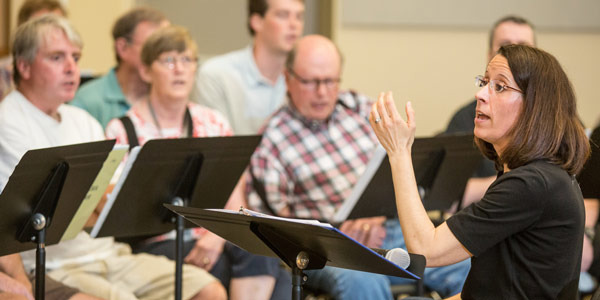
Photo: The Aphasia Choir of Vermont.
Aphasia Choir of Vermont founder and director Karen McFeeters Leary leading the group in a concert. Aphasia is caused by damage to the parts of the brain that control language.

We all know, or knew, someone who lost the ability to speak well because of a stroke or other brain injury. The condition is called aphasia. We also have heard that music can do miracles for people with disabilities — dementia for example. (Click here.)

Now read about the Aphasia Choir of Vermont and how it produces miracles for people with aphasia — and their families.

From the website: “The Aphasia Choir of Vermont was founded in 2014 by singer/songwriter and former speech-language pathologist Karen McFeeters Leary.

“The choir is composed of stroke and traumatic brain injury survivors who have expressive aphasia (difficulty talking or using language) as well as spouses, family members, University of Vermont (UVM) students studying speech-language pathology, and rehabilitation professionals from the UVM Medical Center who provide assistance.

“Because music is largely mediated by the undamaged hemispheres of the brains of people with aphasia, they can sing and are often fluent while singing even if they have severe difficulty speaking or are nonverbal. Bringing these individuals together in song enables them to experience freedom of expression in a context that fosters social connections and a sense of belonging.

“In honor of National Aphasia Awareness Month, the Aphasia Choir of Vermont performs a free public concert each spring, wherein educational information is provided in order to raise aphasia awareness in our communities. Concert audiences have grown since the choir’s inception, and attendees have used words and phrases such as ‘amazing’ and ‘awe-inspiring’ to describe what they’ve witnessed. In 2020, the American Stroke Association chose the Aphasia Choir of Vermont as the winner of their Stroke Hero Award for Outstanding Group. …

“If you or someone you know has aphasia and is interested in joining next year’s choir program, please contact Karen McFeeters Leary at kmcfeeters@aol.com or (802) 288-9777 for more information.”

But if you don’t live in Vermont, you should know there are aphasia choirs around the world. Click here.

It was my daughter-in-law who first heard about this music program in Vermont and knew it would be great for the blog. More here.

Read Full Post »

Photo: Katherine Taylor for the Boston Globe
Eureka Ensemble, whose mission is to nurture social change, launched a Women’s Chorus that welcomes women experiencing severe poverty and homelessness.

How does one write a headline for a story like this? It’s not exactly about music giving homeless people hope. It’s more that focusing on music — music performed for you and music you make — activates a positive side of who you are. It’s that positive things can lead to other positive things.

During the 2018 Christmas season, there was quite a bit of comfort and joy being spread by music in the Greater Boston homeless community. Zoë Madonna wrote about it at the Boston Globe.

“The CASPAR homeless shelter, a low-slung brick building, crouches on Albany Street in Cambridge. When percussionist Jennie Dorris wheels her marimba through the front door, half of a large central room has been cleared, and a line of grizzled men sits at a long row of tables, watching. An enthusiastic older man in a Boston Strong T-shirt marches up, introducing himself as Danny. ‘Finally, the marimba’s here!’ he exclaims, grinning. ‘I wait all year for this.’…

” ‘What compels me is to take music where it’s needed and treat everyone with respect,’ says founder Julie Leven, a violinist. This year, its eighth, Shelter Music Boston has mounted scores of concerts in shelters throughout the Greater Boston area, including a full schedule in the days leading up to Christmas.

“It’s not the only music group focusing on the homeless around Boston. Eureka Ensemble, whose mission is to nurture social change, launched a Women’s Chorus that welcomes women experiencing severe poverty and homelessness. …

“Eureka’s most ambitious project, according to cofounder and conductor Kristo Kondakci, was a commissioned composition, Stephanie Ann Boyd’s ‘Sheltering Voices.’ Auditions for choral fellowships for women were held at Pine Street Inn and Women’s Lunch Place, says Kondakci, a recent graduate of New England Conservatory who has worked with the homeless since his student days at Boston College High School. Around 15 took part.

“Carrie Jaynes and Rottisha Mewborn are friends who met at Pine Street Inn. When they saw the audition sign-up sheet, they were initially skeptical, they say — they’re used to well-meaning outsiders putting in a few hours and then disappearing. But they went to the audition in March, in a room where the heater was going haywire. To cool it down, Kondakci threw open the door of a nearby freezer.

“And that, Mewborn says, put them at ease. … As Eureka Fellows, Jaynes and Mewborn rehearsed weekly with Kondakci, learning ‘Sheltering Voices.’ They were never treated as anything less than important and independent, they say.

“ ‘We became so desensitized at Pine Street that we forgot how we can be treated like a normal person,’ says Jaynes. At the rehearsals, she says, ‘we knew that we were in this together. We knew that we were all right . . . we could be human again. We could show emotion and not be judged if we cried, or laughed, or showed a softer side of us.’ …

“Shelter staff say that after Shelter Music Boston concerts, the atmosphere is more peaceful, and nights are more restful, notes Leven, who also plays with Handel and Haydn Society and the Boston Pops Esplanade Orchestra. …

“As for the Eureka fellowships, Jaynes and Mewborn say their experiences were powerful. ‘Having Kristo say “We’ll get you there no matter what” built up our trust and our safety,’ Mewborn says. Because Pine Street Inn has a daily lottery, she explains, she never knows if she’ll have a bed to sleep in each night. There’s little in her life she can truly count on. ‘So just having this little safety — even if things are going crazy out here, we can get there — it’s amazing.’ ”

More here.

Read Full Post »

Maria Popova at Brainpickings tweeted recently about artist Marina Abramović’s new production, “The Cleaner,” noting that it incorporated 40 Swedish choral groups. I couldn’t confirm that the choirs were 40 in number, but it looks like they were diverse.

At Deutsche Welle, Julia Hitz reports on her March 2017 visit to “The Cleaner.”

“Visitors had to leave all their personal belongings at the entrance and were allowed to stay as long as they wanted, becoming part of the performance. In fact, they were the actual performance. …

“Choirs and soloists are part of the performance. A group of professional singers connects the different choirs performing one after the other, resulting in a continuous, eight-hour-long musical performance.

” ‘They’re really a reflection of Sweden, like a small Stockholm: There are choirs of immigrants, such as the Iraqi Women’s Choir or the Bulgarian Choir, as well as traditional Swedish men choirs and church choirs, singing classical songs. Some solo musicians are also part of the performance,’ explains Catrin Lundqvist from Moderna Museet, who picked the choirs with Abramović and choreographer Lynsey Peisinger in a months-long process [that also involved] finding the 29 performers who are accompanying and guiding spectators through …

” ‘The Cleaner’ [was] performed daily at the Eric Ericson Hall in Stockholm through March 5, 2017. [Re-performances] of Abramović’s works are held through May 21, 2017. The retrospective will travel to Denmark and then to the Bundeskunsthalle Bonn in Germany next year, from April 20 – August 12, 2018.”

Some critics have called Marina Abramović too egocentric — for example, in the recent MoMA performance that had museum goers lining up for hours to sit and gaze into her eyes. But Maria Popova read her autobiography and feels sympathy for the traumatic childhood that shaped the artist. Popova posts this quote from the book:

‘When one of my baby teeth fell out and the bleeding wouldn’t stop, everyone thought I might have hemophilia so I was put in the hospital for a year. That was the happiest, most wonderful time of my life. Everybody was taking care of me and nobody was punishing me. I never felt at home in my own home and I never feel at home anywhere.’

Read about the Swedish performance of “The Cleaners” here and about Maria Popova’s take on the artist here.

Photo: Moderna Museet/Åsa Lundén
Marina Abramović’s “The Cleaner” performed in Stockholm.

Read Full Post »

Photo: Big Belly
Foot-pedal version of Big Belly for those who are squeamish about handles. (That would be me.)

Those Swedes! What will they think of next?

Are you familiar with the Big Belly solar-powered trash compactors sprouting up in public places? Well, in Uppsala, Sweden, the trash compactors have been taught to sing.

From a company post on Youtube: “Bigbelly International Partner, EWF, introduced an innovative and inspiring campaign to raise awareness of the Bigbelly Smart Waste & Recycling system in the metropolitan city of Uppsala, Sweden – home to one of the largest deployments in the world.

“The Uppsala ‘Waste Choir’ had their first performance during the Valborg celebrations on April 30th. Valborg is an annual holiday to welcome spring in Sweden. …

“The beautifully wrapped Bigbellys – each as a unique character and voice in the choir – stood together in front of 60,000+ visitors to the city and sang traditional Swedish songs in celebration of spring! …

“As noted in a press release regarding the campaign: ‘Citizens and visitors could for the first time listen to a garbage choir during the famous celebration of Walpurgis in the University City of Uppsala. The choir consists of 20 so called smart dust bins run by solar energy. Uppsala and Sweden are known for their many choirs.

“Maria Gardfjell (MP), chairman of the responsible municipal board had the honor of introducing the choir and informing the audience about other commitments to diminish littering.

“Fundamentally, it is an issue of changing attitudes and to encourage all of us to put our litter where it belongs, in a dust bin. … Since Uppsala introduced smart dust bins in 2013, the visible litter in the City Park and other main parks has decreased by 20 percent. The work environment for the sanitary workers has improved and the usage of plastic bags has decreased by 80 percent.”

Read the press release in full, here. And listen to the singing trash cans here:

Read Full Post »