Feeds:
Posts
Comments

Posts Tagged ‘churches’

Photo: Melanie Stetson Freeman/CSM.
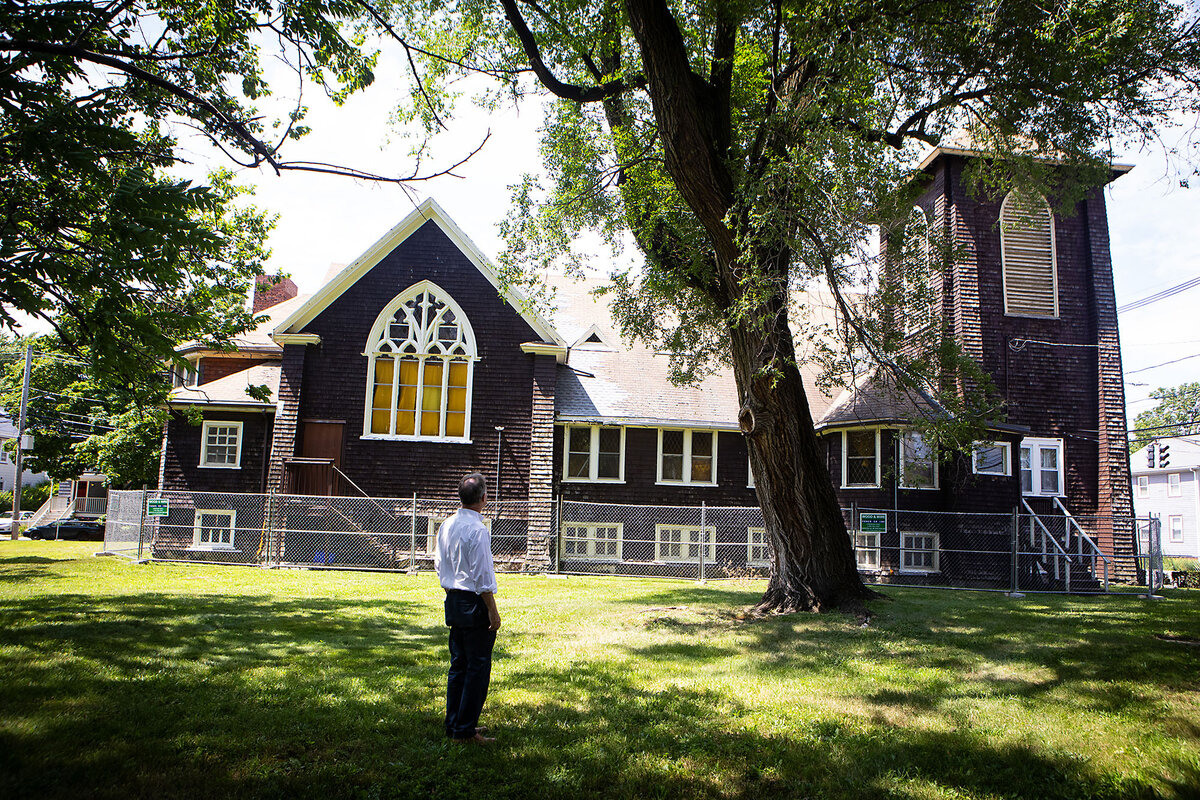
John Woods, director of Allston Brighton Community Development Corp. in Massachusetts, stands in front of Hill Memorial Baptist Church in July. The church and grounds are being turned into a housing complex for older adults.

My 9-year-old granddaughter assures me that the best place to stay overnight in Nova Scotia is a converted church. The light from the stained glass was beautiful, she says, and so was the rest of the building.

Her family’s rental was privately owned, but in today’s story we learn about a Boston-area initiative to turn other unused churches into subsidized housing. And Boston is not alone.

Troy Aidan Sambajon reports for the Monitor, “With its 58-foot bell tower standing sentinel, Hill Memorial Baptist Church has witnessed Allston-Brighton’s dramatic transformation. Upscale apartments and condos now stand on the site of once-bustling stockyards. Gourmet food shops have replaced affordable grocery stores. Now, the 120-year-old church is set for its own transformation. … The church is finding a new role in the community: much-needed affordable housing for older people.

“Churches and faith communities across the United States are increasingly closing their doors. Five years ago, The American Baptist Churches of Massachusetts, noting a dwindling congregation in Allston-Brighton, considered downsizing or repurposing the land. The choice was ultimately left to Hill Memorial’s congregation.

“In a final act of generosity, members chose to sell the land to fulfill the church’s ‘mission of giving back to the Allston community in the form of senior housing,’ says the Rev. Catherine Miller, former pastor, over email. With the blessing of its former congregation, the site will become 50 apartments for older adults on a fixed income. Today, the average price to rent a one-bedroom apartment in Allston is $2,786 per month, according to Apartments.com. The average wait time for senior housing in Boston currently stretches more than five years.

“ ‘Something good needed to happen here,’ says John Woods, executive director of Allston Brighton Community Development Corp., a housing developer. …

“Across the country, more faith communities are opening their doors to creative affordable housing solutions: Some are building homes on underutilized land or converting unused residences.

“In California, the grassroots ‘Yes in God’s Backyard’ movement led to the Affordable Housing on Faith Lands Act. This makes it legal for faith-based institutions to build affordable, multifamily homes on lands they own by streamlining the permitting process and overriding local zoning restrictions.

A federal version, the Yes in God’s Backyard Act, was introduced this spring by Ohio Sen. Sherrod Brown. …

” ‘It’s sad when a church closes,’ says Donna Brown, executive director of the South Boston Neighborhood Development Corp., which is leading the conversion of a former convent. ‘When they sit empty, it leaves a real void in the neighborhood. But when a building can be converted to housing so that people can stay in that community – it can be a wonderful thing to knit a community back together.’

“The U.S. is not building housing fast enough to support America’s aging population, according to Housing America’s Older Adults 2023 report, recently released by Harvard University’s Joint Center for Housing Studies. … By 2030, Americans age 65 and older will make up more than 20% of the population, according to Census Bureau projections. The need for affordable housing for this demographic will only grow. Meanwhile, homelessness is rising among older adults. …

“Sometimes, those being priced out of a neighborhood have lived there for decades. Moving means leaving not only friends but also support structures. Take Allston-Brighton, which was once a very affordable neighborhood, says Karen Smith, president of Brighton Allston Elderly Homes Inc. With rising rent costs and the cost of care, it’s tough for older adults on a fixed income to stretch their budgets thousands of dollars more a year. …

“In densely populated cities, the space to build affordable housing is often far from where it is needed most, says the Rev. Patrick Reidy, associate professor of law at the University of Notre Dame. However, faith communities and former churches are typically located in high-density areas that are accessible to the most people.

“ ‘These kinds of adaptive reuse projects for affordable housing are a win-win-win,’ says Professor Reidy. ‘The local governments that are desperately in need of land for affordable housing are given access by faith communities seeking to live out their religious mission, and those who need affordable housing don’t always have to uproot their lives from their neighborhood.’

“Boston is a prime example of this trend. The transformation of former churches … illustrates how adaptive reuse can unite communities in finding solutions to the housing crisis. The locations of older church properties in New England are unique for other reasons. Many are quite literally older than zoning laws, which were first passed around the 1920s.

“Blessed Sacrament Church sits at the heart of the historic Latin Quarter. It is set to become a sanctuary of affordable living, with 55 income-restricted units, along with a performance and community space.

“The building sat empty for years. High restoration costs prompted its owners to contemplate selling it to developers on the open market to become high-end apartments. Former parishioners and residents opposed the sale and advocated for community input. In the end, after meetings attended by hundreds in the area, the selected proposal from developer Pennrose aimed to preserve the historic exterior of the church while renovating the interior to create affordable housing.”

More at the Monitor, here. No firewall. Subscriptions are reasonable. For more on repurposing old church buildings, see the other part of the Monitor series, here.
Read Full Post »

Photo: Harout Bastajian.
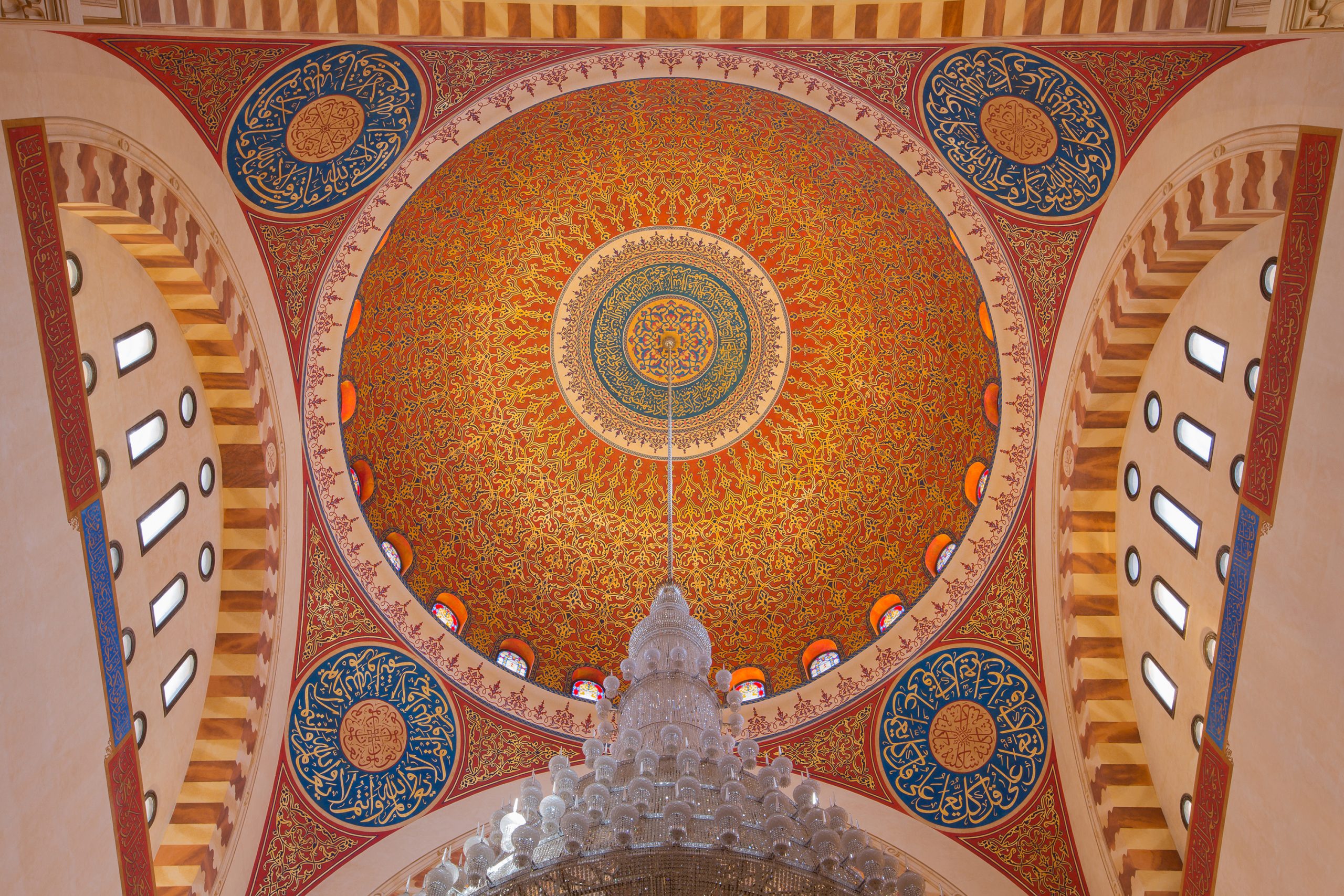
The Mohammad al-Amin Mosque, also referred to as the Blue Mosque, in downtown Beirut, Lebanon.

Some years ago, I read Jason Elliot’s fascinating book about his travels in Iran, Mirrors of the Unseen. One thing that stuck with me was his theory about caves and how they might have influenced Islamic art and the dome shape of mosques. I wrote about it before.

Today I chose an article on a man who is often called in to paint or repaint domes, both Islamic and Christian. His own theories are about which types of imagery are best for which sects.

Hrag Vartanian reports at Hyperallergic, “At the center of downtown Beirut is the prominent Mohammadal-Aminmosque, the largest mosque in Lebanon. …

“Inside is a stunning painted dome. It is the work of an artist who has gained a reputation as a leading painter of decorative ornament, particularly in mosques. What may surprise many people unaware of the rich cosmopolitan tradition of Islamic religious art is that the artist, Harout Bastajian, is not Muslim himself. When people ask him how a Christian is creating the decorative program of a mosque, he likes to answer, ‘God works in mysterious ways, brings us all together to decorate his house of worship.’

“He embarked on this artistic path back in 2004, when he was asked by the Hariris, a prominent business and political family in Lebanon, to decorate the newly inaugurated Hariri mosque in Sidon, Lebanon. …

“The journey into painting in sacred spaces has been inspiring for the artist. Not only has he painted the interiors of mosques but he’s also been involved in the restoration of Roman Catholic and Armenian Catholic buildings in Lebanon. He remembers his first mosque commission in Sidon well. ‘When I went in and saw the huge dome, which is like 900 square meters [roughly 9,687 square feet], I couldn’t sleep that night.

‘I was thinking, “How am I supposed to do this?” And then I was playing basketball in my backyard. I saw the basketball, the shape, how it’s divided. So I started thinking, how can I divide the dome and try to manage it?

” ‘And it was easy. Within two months I was able to finish the project with my team,’ he explains. … ‘I go through history, through different schools, and I try to come up with something somehow contemporary and work on it. And I will always use the golden ratio as a fundamental for my work. Regarding the colors, I don’t see one color. I always work with layers of colors.’ …

“He currently has a team of six or seven colleagues who work with him full time, and a graphic designer who helps organize the project plan since Bastajian doesn’t like to work with digital tools. …

“In the last 18 years, Bastajian says, he has painted 37 full and half domes, which translates into over a dozen mosques and many secular projects as far afield as Nigeria, the United Arab Emirates, Saudi Arabia, Kuwait, and Switzerland.

“ ‘[When] I did my first few mosques, I had to travel a lot and check other mosques in order to understand it all better. Then I took some courses in Islamic design and Islamic art [and] after a while it became part of me. I can see the end result only by doing the sketches and preparing the designs.’ …

“He conceives each project from the ground level, where visitors will experience the work, incorporating a mixture of geometric designs, along with vegetal and floral motifs, to create a rich web of patterns. ‘The shape of the dome itself, it has something divine in it because it’s circular. It doesn’t have a start or an end,’ Bastajian explains. ‘And the light that comes in from the windows, they call it the light of God. The dome itself, you feel that it’s flying, it’s something divine.’

“[The artist] is sometimes inspired by other works, such as the designs from the Topkapi Palace in Istanbul, which influenced his work for the al-Aminmosque in Beirut. He adjusts the designs according to the sect: Ottoman designs tend to work better for Sunni spaces, while Shia holy spaces tend to take their aesthetic cues from Persian-influenced styles and geometry.”

More at Hyperallergic, here. No firewall.

Read Full Post »

This is such a great idea. It shouldn’t be necessary in a country rich enough for CEOs to earn billions of dollars, but that’s where we are. Today’s story is about churches that have taken it on themselves to relieve struggling patients of intolerable burdens by buying up medical debt for pennies on the dollar.

In an opinion piece in the New York Times, Elizabeth Bruenig writes, “Vanessa Matos couldn’t believe what she was reading. ‘I was like, OK, this is a scam,’ she recalled of the letter she received in February. …

“Ms. Matos’s medical debt — more than $900 owed because of complications from surgery at the Massachusetts hospital where she had worked as a nurse — had been forgiven by strangers at a church she had never been to.

“Adam Mabry, the lead pastor of that congregation, Aletheia Church, a multiethnic, 1,400-member Boston-area Christian community, doesn’t know Ms. Matos, and she doesn’t know him; the two have never spoken. …

“Aletheia worked through RIP Medical Debt, a charitable organization founded in 2014 by two former debt collection executives, Craig Antico and Jerry Ashton. It uses donations to buy portfolios of medical debt at a fraction of their value — and then forgives it.

“Debt is a particularly destructive consequence of an American health care system that treats medical care as a consumer good. A Kaiser Family Foundation survey in 2018 found that 67 percent of Americans worry about paying for unexpected medical bills. …

“In just societies, these debts do not exist. But in our society, charity must stand in for justice so long as the latter is in short supply.

“Partners of RIP Medical Debt need not raise the actual amount of money they intend to relieve in debt, because the price of debt reflects what collectors could recover — far less than is owed. That means a buyer can eliminate the debt for much less money than the debtor could.

RIP Medical Debt estimates that just one dollar can purchase, and relieve, $100 in medical debt.

“So with a series of relatively moderate fund-raising efforts and donations from corporations, nonprofit and religious groups, and individuals, RIP Medical Debt said, it has been able to eliminate almost $2.7 billion in medical debt.

“Some religious congregations … grasp what our legislators can’t: The cost of survival in this country is unconscionable, and we all share a moral obligation to do something about it. …

“Forgiving medical debt has managed to ally very different Christians behind the same cause.

“Mr. Mabry, for example, cheekily described his theological stance as ‘historically boring and orthodox,’ even evangelical. Most people ‘would associate social concern with progressivism and maybe theological liberalism,’ he said, but ‘the great majority of actual social programs are funded and executed by really frustratingly conservative, boring, historic, orthodox people.’

“The Rev. Traci Blackmon is associate general minister of justice and local church ministries for the United Church of Christ, a fairly liberal denomination. ‘The U.C.C. has no rigid formulation of doctrine or attachment to creeds or structures,’ the church’s website says. ‘Its overarching creed is love.’

“A recent campaign led by the church abolished more than $26 million in medical debt throughout New England, and the church plans to expand efforts to include the entire country. …

“ ‘We’re buying somewhere close to $100 worth of debt for a dollar,’ she told me, ‘and when you think about how many people’s credit is being ruined, how much access is being denied people because they can’t pay that bill, and I can come and pay your $5,000 bill with $12 — that’s not just.’ …

“The trouble with medical debt is that it is a consequence of the way our health care system is structured, with individuals owing, even in the best case, some out-of-pocket costs for their care. Debt may be eliminated today, but more will begin accumulating tomorrow unless drastic changes are made. …

“There is an apocryphal statement often attributed to Saint Augustine, who helped lay the foundations of modern Christian theology: ‘Charity is no substitute for justice withheld.’ “

More at the New York Times, here.

Read Full Post »