Feeds:
Posts
Comments

Posts Tagged ‘citizen scientist’

Photo: Valkyrie Pierce/Unsplash.
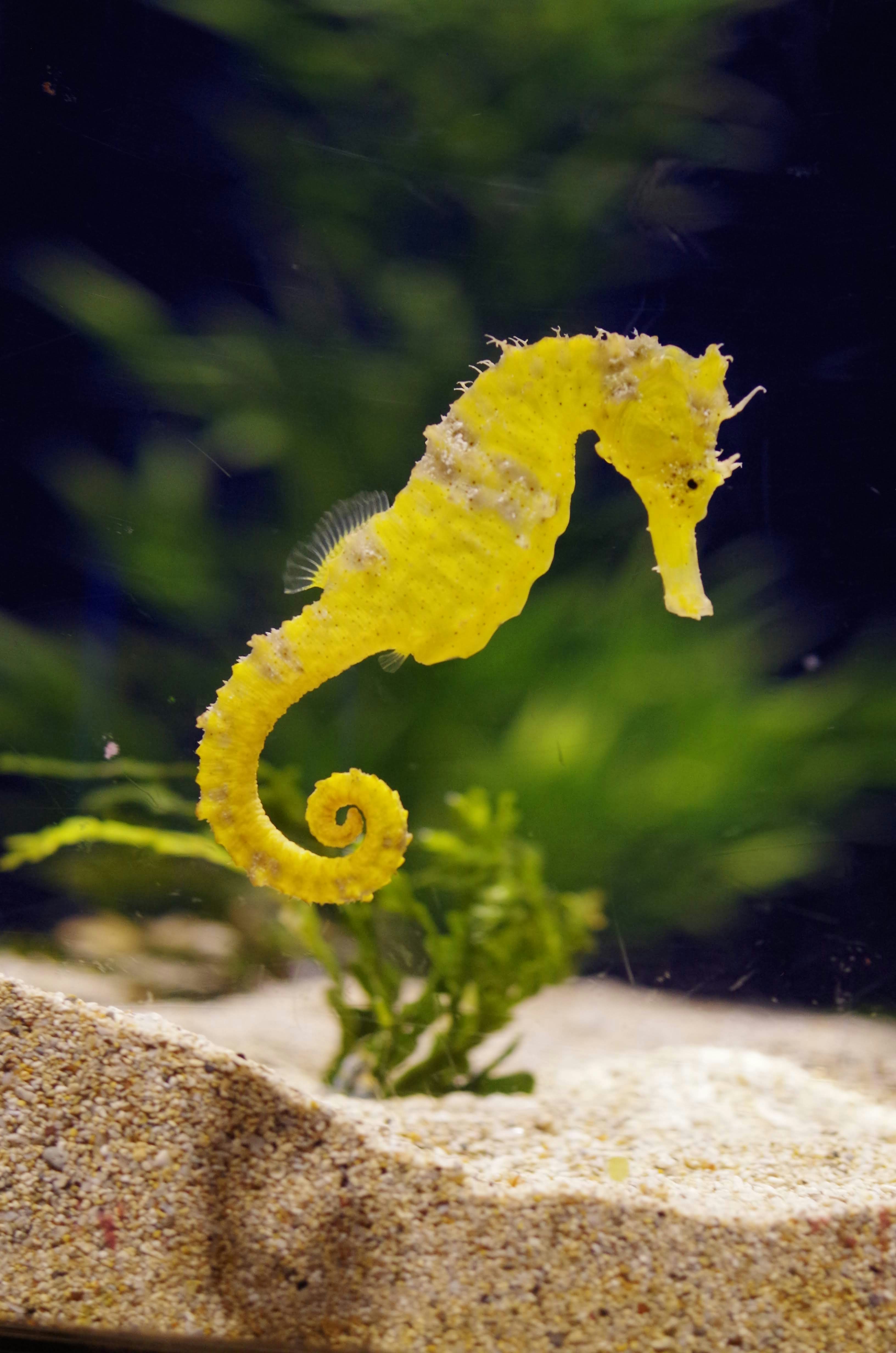
Citizen scientists are helping us learn more about seahorses.

For all its shortcomings, social media has enabled us to work together on meaningful projects if we so choose. Consider the citizen scientists who are expanding our knowledge of the natural world.

Erin Blakemore has a story at the Washington Post about the latest research on seahorses — and how you can help study them.

“Members of the public are helping to advance research on sea horses, the tiny fish that can be found in coral reefs, shallow waters and estuaries around the world, according to a study.

“When researchers looked at the results of public contributions to the iSeahorse science project between 2013 and 2022, they found the community effort enabled scientific advances in the field.

“Citizen contributions provided new information on 10 of 17 sea horse species with data once considered deficient and helped update knowledge about the geographic distribution of nine species, researchers wrote in the Journal of Fish Biology. Some of the observations even helped scientists better understand when and how sea horses breed. … According to the project website, iSeahorse has amassed about 11,000 observations from more than 1,900 contributors to date.

“Overall, the researchers were able to validate 7,794 of the observations from 96 countries and 35 sea horse species. The volunteer observers even noted rare species that traditional monitoring probably would not detect, they write.

“ ‘Seahorses are very much the sort of fascinating species that benefit from community science, as they are cryptic enough to make even formal research challenging,’ Heather Koldewey, the project’s co-founder and the lead on the Bertarelli Foundation’s marine science program, said in a news release. …

“Want to get involved? Visit https://projectseahorse.org/iseahorse/ to learn more. More at the Post, here.

And check out this page from the Journal of Ethnobiology and Ethnomedicine, here. It reads, in part, “Seahorses are endangered teleost fishes under increasing human pressures worldwide. In Brazil, marine conservationists and policy-makers are thus often skeptical about the viability of sustainable human-seahorse interactions.

“This study focuses on local ecological knowledge on seahorses and the implications of their non-lethal touristic use by a coastal community in northeastern Brazil. Community-based seahorse-watching activities have been carried out in Maracaípe village since 1999, but remained uninvestigated until the present study. …

“We interviewed 32 informants through semi-structured questionnaires to assess their socioeconomic profile, their knowledge on seahorse natural history traits, human uses, threats and abundance trends.

“Seahorse-watching has high socioeconomic relevance, being the primary income source for all respondents. Interviewees elicited a body of knowledge on seahorse biology largely consistent with up-to-date research literature. Most informants (65.5 %) perceived no change in seahorse abundance. Their empirical knowledge often surpassed scientific reports, i.e. through remarks on trophic ecology; reproductive aspects, such as, behavior and breeding season; spatial and temporal distribution, suggesting seahorse migration related to environmental parameters.

“Seahorse-watching operators were aware of seahorse biological and ecological aspects. Despite the gaps remaining on biological data about certain seahorse traits, the respondents provided reliable information on all questions, adding ethnoecological remarks not yet assessed by conventional scientific surveys. We provide novel ethnobiological insight on non-extractive modes of human-seahorse interaction, eliciting environmental policies to integrate seahorse conservation with local ecological knowledge and innovative ideas for seahorse sustainable use. Our study resonates with calls for more active engagement with communities and their local ecologies if marine conservation and development are to be reconciled.”
Read Full Post »

Photos: Libby Keatley.
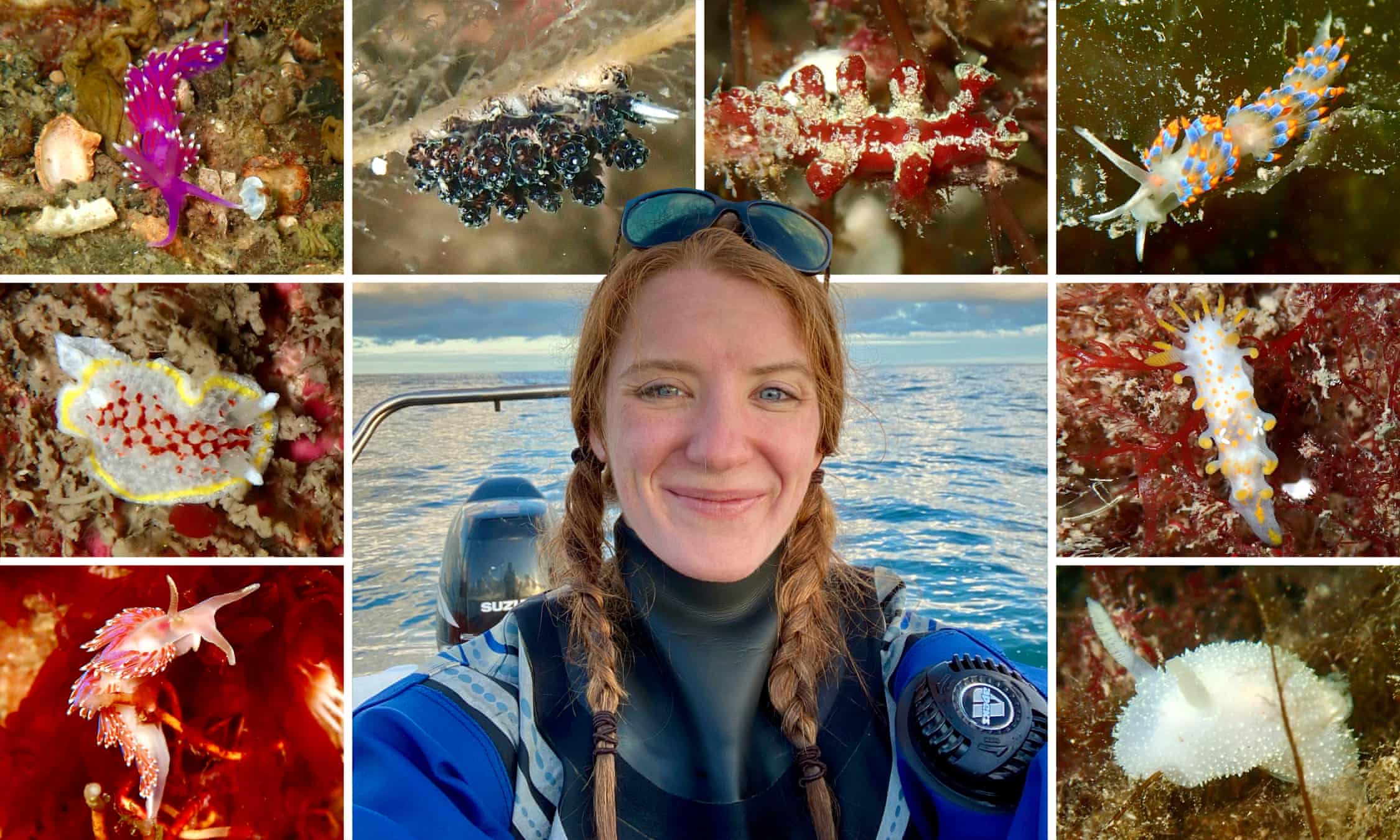
Libby Keatley and some of the “inherently charismaticsea slugs she has encountered. 

After blogging singer Will McMillan told us more than we ever imagined about sea snails once used for a royal purple dye, I remembered that the Guardian had an equally fascinating story on sea slugs. It turns out some young people are huge fans of the critters and are helping scientists keep track of them.

Helen Scales writes, “Two years ago, Libby Keatley was diving off the coast of County Antrim in Northern Ireland when she spotted something unusual. It was a sea slug – or nudibranch – whose transparent body had orange lines running through it and twiggy projections arranged along its back. ‘It was quite distinctive and not like anything I’d seen before,’ she says.

“Keatley called over her diving buddy, Bernard Picton, a local marine biologist and pioneer in UK sea slug studies. He scooped it up in a plastic bag and, back at his lab, confirmed it was a newly discovered species. He named it in Keatley’s honour: Dendronotus keatleyae.

“ ‘Three years ago, I didn’t really know what a nudibranch was or I thought they only lived in tropical countries,’ says Keatley.

‘It just shows you can learn – you don’t have to be somebody who’s been in a lab for 20 years to know that something looks a bit funny or different.’

“For a niche but growing group of amateur naturalists, sea slugs have become an ideal subject: as stunning as butterflies but with the good grace to sit still while you peer in close and take a photograph. Distant relatives of the slimy, drab land-dwellers that live in gardens, sea slugs are an altogether more endearing bunch. Many are daubed in jewel-like colors that warn off predators. Others take on hues to blend in with their surroundings, often gaudy seaweeds and sponges. There are also plenty of sea slugs to discover in UK waters, with about 150 known species across the north Atlantic. …

“To show me why the hobby has attracted a worldwide community of scuba divers and amateur photographers – and how it makes important contributions to scientists’ understanding of how our oceans are changing – Keatley takes me diving in Strangford Lough. An hour’s drive south of Belfast, it is one of Europe’s largest sea inlets and a renowned wildlife spot, home to seabirds, seals and recently a pair of bottlenose dolphins.

“There’s even more going on beneath the waterline. At high tide, the Irish Sea brings in a soup of particles and nutrients which feeds a rich mix of underwater species – and a host of other creatures that feed on them. …

“We are joined on the dive by Keatley’s partner and fellow enthusiast, Phil Wilkinson, and Picton, who recently updated a guidebook to sea slugs of the north Atlantic with Christine Morrow. …

“We find more sea slugs than I’ve ever seen, even in tropical seas: neon pink ones and transparent ones covered with finger-like projections with shiny turquoise tips; another is white with yellow specks and a pair of bunny ears that are for smelling not hearing. We encounter a gathering of sea slugs that look like miniature fried eggs splashed in chili sauce, and Keatley points out a peach-colored specimen hitching a ride on a hermit crab. It feeds on minute hydroids – stinging relatives of jellyfish – that grow on the crab’s shell.

“For Keatley, sea slug spotting was part of an unexpected reawakening of a childhood interest in nature. In January 2019, she learned to scuba dive and was an instant convert to the underwater world. ‘I couldn’t get enough,’ she says. ‘The more I saw, the more I wanted to learn, and then the more I was seeing. So it just snowballed a wee bit.’ ”

Don’t you love the variety of things that people get interested in? At the Guardian, here, you can read about the importance of citizen scientists in the slug world. No firewall. Donations encouraged.

Read Full Post »

Well, I had a treat last week! I went to watch horseshoe crabs being tagged for research — kind of like birdbanding, but for crabs. The woman with the funny expression above was actually enjoying the whole thing and helping to take notes for the scientist, Kim Gaffett.

Kim, who may be best known to New Shoreham visitors for birdbanding, has been working for some years with Connecticut’s Sacred Heart University on an initiative called the Limulus Project. The idea is to learn more about the amazing horseshoe crab, a species that, depending on whom you ask, has managed to survive between two and five mass extinctions on Planet Earth, including the one that wiped out the dinosaurs.

In spite of their amazing record of survival, the crabs are considered threatened today, so it’s important to study them and try to find out what’s going on. As I wrote a few years ago, their blood has the ability to clot in the presence of bacteria, so it has become invaluable to pharmaceutical companies. Researchers are supposed to draw the blood as one would for a human and then have the fishermen return the crabs to the ocean, but that may not be happening consistently.

I asked Kim how she knew she would find any crabs that particular morning, and she told me that when there is a high tide and a full moon in June (flood tide), the horseshoe crabs come up to the shore to mate. The male has one claw like a boxing glove, with which he attaches to the female’s shell in order to be available when she drops her eggs. The eggs are fertilized outside the body. Sometimes other males are hanging around, and it’s possible for one batch of eggs to get fertilized by more than one male.

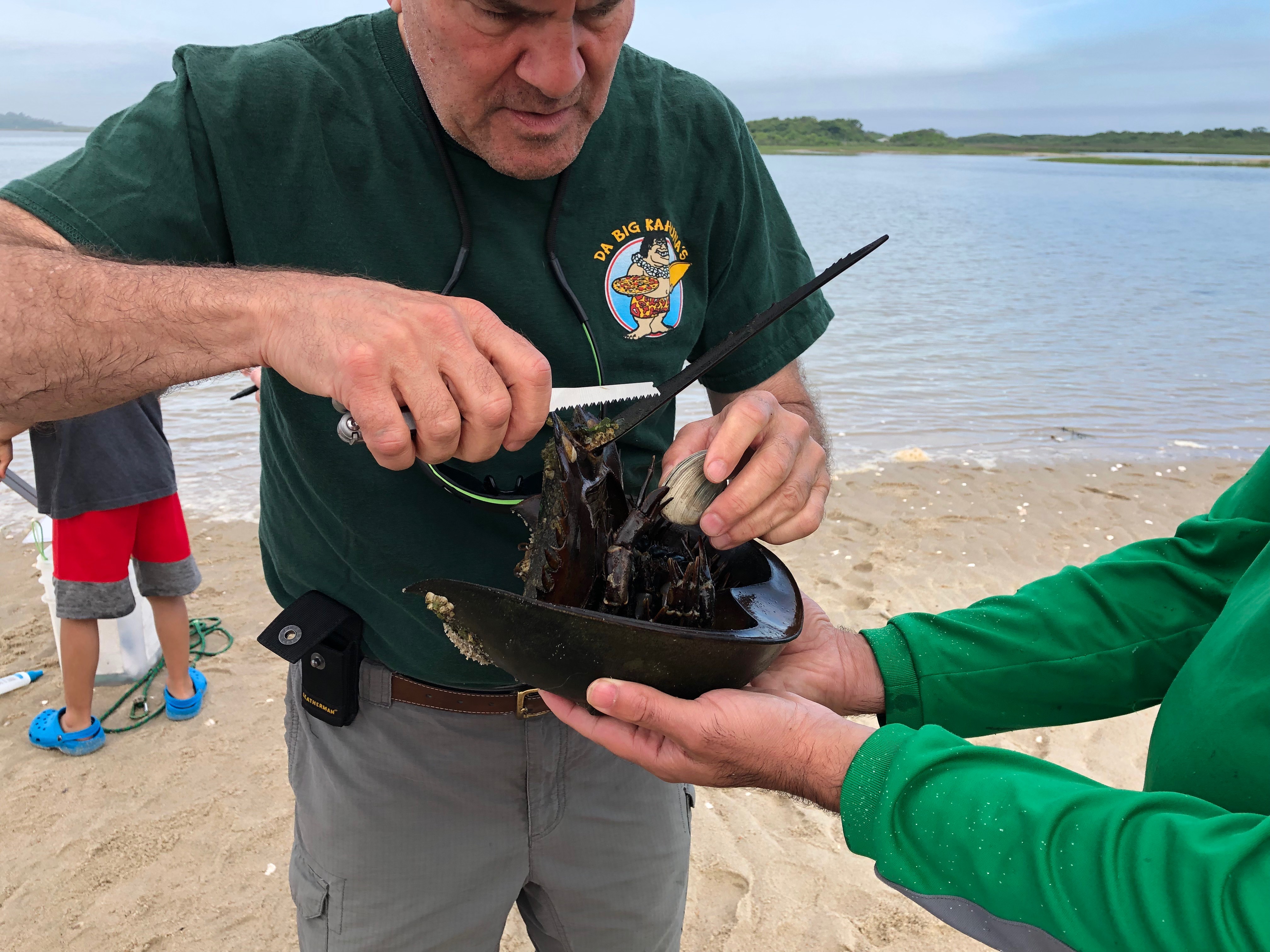
All sorts of marine life forms attach themselves to horseshoe crabs — seaweed, barnacles, slipper shells. Kim calls the crabs “their own ecosystem.” The crabs’ fellow travelers don’t usually cause any trouble, but as you can see below, a quahog had snapped onto a claw of one crab. A citizen scientist is shown detaching it.

From Phys.org, I read this about horseshoe crabs’ survival: “They have a special kind of blood, which … coagulates when it encounters bacteria. They can ‘wall up’ any wounds they receive.

“Another key to their survival seems to be their tolerance of habitats that fluctuate in salinity (levels of salt). When environmental changes happen, they can move to safety.

“An ability to live with low levels of oxygen is also important. [Natural History Museum expert Richard Fortey] adds, ‘The horseshoe crab was able to cope with periods of oceanic deoxygenation that were fatal to many marine organisms.’ ”

I was also interested in what Quartz had to say: “These amazing crab species are among the handful of species referred to as ‘living fossils’ because their current form resembles those found in the fossil record. Externally at least, the crab hasn’t changed much in nearly 450 million years. In that time, it has survived all five of Earth’s great mass extinctions, the worst of which killed off an estimated 95% of all marine species, and the most recent of which did away with the dinosaurs. …

“The crab’s blue blood contains a chemical called limulus amebocyte lysate (LAL), which thickens when it comes in contact with toxins produced by bacteria that can cause life-threatening conditions in humans. Labs use LAL to test equipment, implants, and other devices for these toxins.”

Kim says she hopes labs will start using the synthetic version of LAL more and give the horseshoe crab a break.

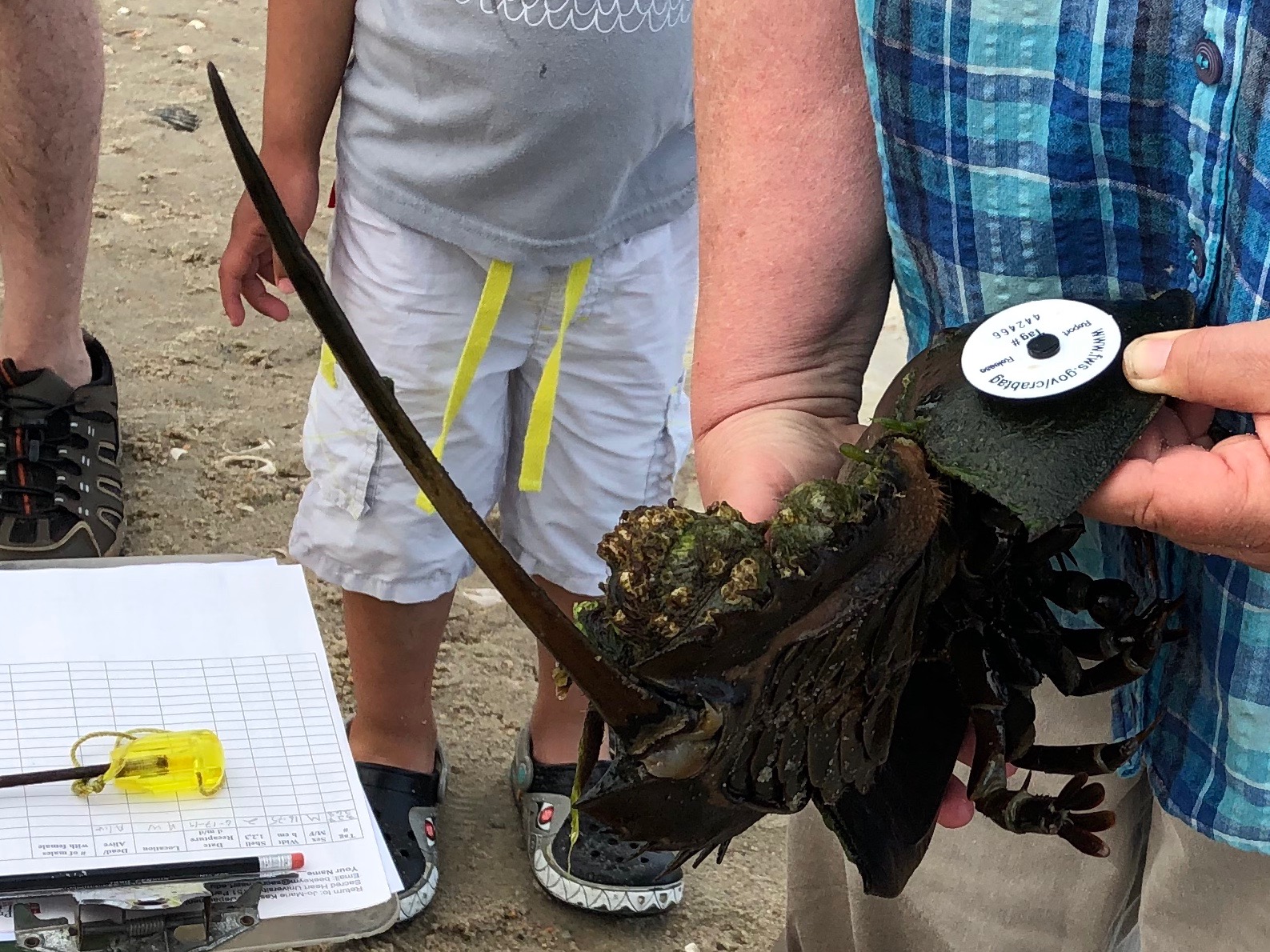
Note the tag below. Kim found one crab with a tag from a previous year, and she attached another tag to a newer find.

061719-removing-clam-from-horseshoe-crab

061719-.horsehoe-crab-tagging

Read Full Post »

Photo: Australia Nuclear Science and Technology Organisation
Australian wetlands researchers behind the Feather Map invite citizen scientists to send feathers and include an explanation of where the feathers were found.

I recently saw a great quote on twitter from a Rhode Islander about what he learned years ago when he visited post-apartheid South Africa: “I learned that the power that you have to change big things is entirely about how strong of a community you can form.”

That quote came to mind as I was reading about how researchers in Australia are enlisting the enthusiasm of citizen scientists to address the challenges of wetlands protection. That may not sound as important as ending apartheid, but wetlands are expected to play a big role in the fight against global warming.

Livia Albeck-Ripka had a report at the New York Times.

“One day in April 2016, Kate Brandis opened a weathered envelope, mailed to her from suburban Sydney. Instead of a letter inside, she found the feathers of an Australian white ibis. A day or so later, another envelope arrived, stuffed with more feathers. In the days following, more began to come.

“Soon, Dr. Brandis, who is a research fellow at the University of New South Wales’s Center for Ecosystem Science, was receiving three to four envelopes a day containing the feathers of birds from across Australia, including those of pelicans, wood ducks, cormorants, herons and spoonbills. …

“Two years before, she had put out a call to the public to send her fallen feathers of wetland birds so she could analyze where they came from, in an effort to map how the birds are moving between the country’s disappearing wetlands. …

“Wetlands — which include swamps, marshes, lakes, mud flats and bogs — are biodiverse ecosystems that can improve the quality of water and mitigate damage from flooding and pollution. But since the beginning of the 20th century, some estimates say, more than half the world’s wetlands have been lost, largely because of human activities. …

“Now, the impacts of climate change — which can include less rainfall in some areas, changing river flows and flood patterns, and potential saltwater intrusion into inland bodies of water — are further threatening some of Australia’s wetlands, and the birds that rely on them for breeding. …

“ ‘When our floodplains flood, which is only every couple of years, these birds come together in the hundreds of thousands to breed,’ Dr. Brandis said. But when the water recedes, the birds disband. …

“Where do the birds come from, and where do they go afterward? ‘Because we don’t track our birds, we have no idea,’ she said.

“Traditional tracking methods, like banding birds, have not fared well in Australia. … Many birds, like the ibis, have a high mortality rate. Another factor is simply Australia’s size: Inland birds often go to places where people do not.

“For that reason, Corrie Kemp, a 73-year-old retiree from Queanbeyan, New South Wales, made a special effort to collect feathers for Dr. Brandis’s project from among the most remote corners of Australia, in western Queensland. ‘We made a point of going places where no other people where going,’ Mrs. Kemp said, adding that she and her husband, Peter, had devoted an entire three-month trip to collecting feathers, during which she kept a diary of her discoveries and often corresponded with Dr. Brandis. …

“Bird feathers, like human hair and nails, are made of a protein called keratin. As the feathers grow, the keratin keeps a record of the bird’s diet, much like the rings of a tree. By analyzing a section of a feather, Dr. Brandis and her team can get a snapshot of the bird’s diet while the feather was developing.

“Feathers from chicks — which have spent their entire lives at one wetland — are particularly useful to researchers, providing what Dr. Brandis and her team call a ‘fingerprint’ of each place. By comparing the diet record of adult feathers against this information, researchers hope to map which wetlands the birds have been using, and how healthy those wetlands are. …

“Dr. Brandis said the possibilities were endless when studying animals’ tissue for clues about their environments, their habits and their origins. ‘It’s like the tip of the iceberg.’ ”

Read more about the Feather Map of Australia here and here.

Read Full Post »