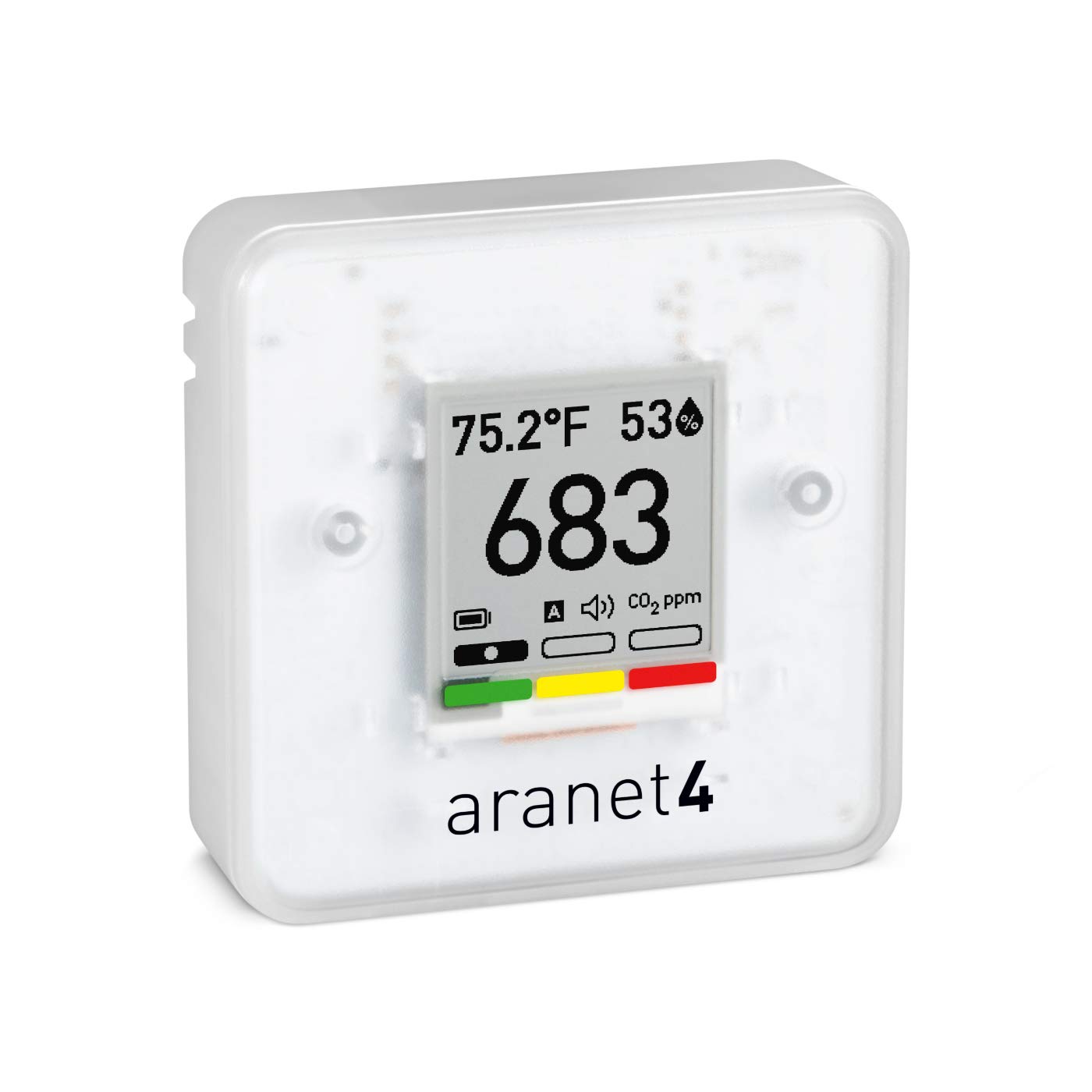
Trust anxious parents to come up with an extra level of protection for their school-age children! Something different is going in lunch boxes now.
Emily Anthes reports at the New York Times, “When Lizzie Rothwell, an architect in Philadelphia, sent her son to third grade this fall, she stocked his blue L.L. Bean backpack with pencils, wide-ruled paper — and a portable carbon dioxide monitor.
“The device gave her a quick way to assess how much fresh air was flowing through the school. Low levels of CO2 would indicate that it was well-ventilated, reducing her son’s odds of catching the coronavirus.
“But she quickly discovered that during lunch, CO2 levels in the cafeteria rose to nearly double those recommended by Centers for Disease Control and Prevention. She shared what she’d learned with the principal and asked if students could eat outside instead.
“ ‘He expressed surprise that I had any data at all,’ she said.
“Ms. Rothwell is one of a growing number of parents who are sneaking CO2 monitors into schools in a clandestine effort to make sure their children’s classrooms are safe. Aranet, which makes a monitor popular with parents, says orders have doubled since the new school year began.
“Some school systems have made the monitors part of their official pandemic precautions. New York City has distributed the devices to every public school, and the British government has announced plans to do likewise.
“But elsewhere, parents are taking matters into their own hands, sneaking in the monitors — which can cost a hundred dollars or more — in their children’s backpacks or pants pockets.
“Although the devices, which can be set to take readings every few minutes, work best when exposed to the open air, they can generate informative data as long as they are not completely sealed away, said Dr. Alex Huffman, an aerosol scientist [who] has sent the monitors to school with his children. …
“Some school officials have frowned upon these guerrilla air-monitoring efforts, but parents say the devices have armed them with data to advocate for their children. …
“The coronavirus spreads through tiny, airborne droplets known as aerosols. Improving indoor ventilation reduces the concentration of these aerosols and the risk of infection in an indoor space, but there is no easy way for members of the public to measure the ventilation rate — let alone the accumulation of viral aerosols — in shared spaces.
“ ‘Ideally there’d be some machine that cost $100 and it starts beeping if the virus is in the air,’ said Jose-Luis Jimenez, an aerosol scientist at the University of Colorado Boulder, who is sending a carbon dioxide monitor to school with his son. But in the absence of such a device, he said, ‘CO2 is something that provides an affordable and very meaningful shortcut.’
Every time we exhale, we expel not just aerosols but also carbon dioxide; the worse the ventilation, the more carbon dioxide builds up in an occupied room. …
“Jeanne Norris, who lives in the St. Louis area, said that she bought her monitor after losing confidence in officials in her son’s school district.
“ ‘They just hadn’t been very transparent about their ventilation,’ she said. ‘They say that it’s fine and that they did their own testing but then they wouldn’t share that data with me.’
“Ms. Norris and her husband are both science teachers, and so far their data suggest that the ventilation is excellent in both of their classrooms. But CO2 levels in her son’s classroom sometimes surpass 1300 parts per million. The C.D.C. recommends that indoor carbon dioxide levels remain below 800 p.p.m. After she collects more data, she plans to take her findings to school officials and ask them to improve the ventilation. …
“Some parents have gotten results. When Jeremy Chrysler, of Conway, Ark., sent a monitor in with his 13-year-old daughter, this fall, the CO2 readings were a sky-high 4,000 p.p.m.
“He brought his findings to district officials, who discovered that two components of the school’s HVAC system were not working properly. After the units were fixed, CO2 levels plummeted.
“ ‘What my measurements showed was, hey, measuring CO2 can identify problems and sometimes those problems are easy to fix,’ he said.”
More at the Times, here.
Wish I had one of these monitors the other day when I was worried enough about air quality to risk asking someone if she was vaccinated!


 Suzanne's Mom's Blog