Feeds:
Posts
Comments

Posts Tagged ‘clean water’

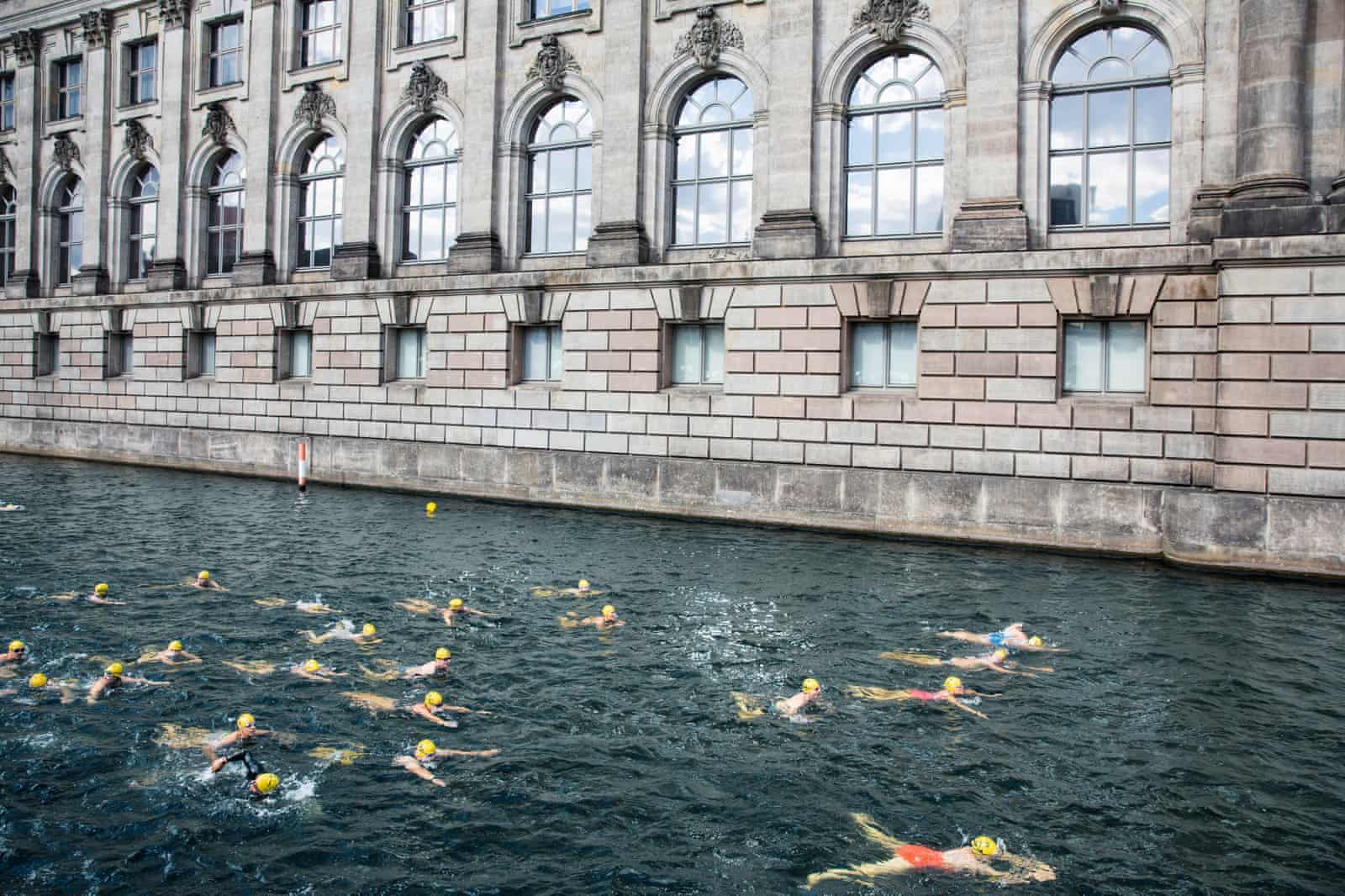
Photo: Axel Schmidt.
The Fluss Bad swim in the Spree canal, Berlin, is part of a campaign to change bylaws against swimming. 

How many lovely, tinkling waterways have we forced through metal pipes and covered over with roads and buildings?

For some years now, cities have started daylighting them. And in the countryside, dams have been removed to bring back fish, often in collaboration with the tribes that always knew better. (See the Penobscot report.)

Last summer, it was touch ‘n go about what days the Seine would be clean enough for Olympic meets, bringing renewed attention to the issue.

At the Guardian, Oliver Wainright writes. “After a century of ignoring the very arteries that allowed them to grow in the first place, cities are learning to love their rivers again. Around the world, as global heating causes summer temperatures to soar, people are flocking to urban waterways and reclaiming these once polluted, poisoned gutters as indispensable places to cool off and unwind.

“[In the summer] the urban swimming movement made its biggest splash yet, when 110 athletes dived into the River Seine for the Olympic triathlon. The televised spectacle of swimmers front-crawling their way through Paris, flanked by beaux-arts bridges, offered a glimpse of what all our urban waterways could look like. Might these dangerous arteries of cargo and sewage be reborn as the great free public spaces that they could be? …

“ ‘What’s happening in Paris represents a generational baton change,’ says Matt Sykes, an Australian landscape architect and the convener of the Swimmable Cities Alliance, a global network of urban swimming campaigners pushing to make the scenes in the Seine an everyday reality for us all. …

“To coincide with this summer’s Olympics, the alliance published a charter, signed by a host of municipalities, government agencies, community groups and cultural institutions from 31 cities around the world, in a bid to create safe, healthy and swimmable waterways, accessible to all. The hope is to have 300 new cities starting their journey towards ‘swimmability’ by 2030.

“The alliance is already making headway. In the Dutch city of Rotterdam, a masterplan for the Rijnhaven dock includes a new permanent beach and a tidal park. In Sydney, the Urban Plunge program has plans that include floating pools, and riverside ladders and lockers. By next summer, if all goes according to plan, New Yorkers will be swimming beneath skyscrapers in the safe surrounds of a floating, filtered pool in the East River.

“ ‘This is going to be the cleanest water anyone ever swims in,’ says Kara Meyer, the managing director of Plus Pool, a project which began in 2010 as a Kickstarter campaign by four young designers. Fourteen years on, New York State and New York City have announced changes to regulations that finally make the project possible, and committed [$16m] to see a prototype pool realized by 2025.

“ ‘The original idea was: “What if you just dropped a big strainer in the river?” ‘ says Meyer. ‘Now, we’re essentially building a floating wastewater treatment facility.’ Engineered by Arup, the pool will pass the river water through a series of filtration membranes and blast it with UV disinfectant, in order to meet stringent water quality standards. …

“The Clean Water Act, passed in 1972 with the ambitious goal of making all US rivers and lakes swimmable by 1983, set the wheels in motion, but that target is still a way off.

“ ‘The pandemic was a real catalyst,’ says Meyer. ‘There’s been a realization that we need far more public space, and much better access to our natural environment.’ She says a recent rise in drowning deaths, after decades of decline, underlines the importance of access to water and basic swimming skills – a need exacerbated by a shortage of lifeguards, after decades of pool closures. …

“Along with Switzerland – where Rheinschwimmen has been a tradition since the 1980s, after wastewater treatment reforms – Denmark is leading the way. Thirty years ago, Copenhagen’s harbor was a polluted mess of sewage and industrial waste. Now Danes are spoilt for choice of architect-designed bathing structures, and water quality is constantly monitored on a dedicated app. …

“Elsewhere in Europe, the Fluss Bad campaign in Berlin organizes an annual swim in the Spree canal, seeing swimmers splashing past the cultural palaces of museum island. The group is pushing for local bylaws to be changed to permit swimming, and has launched a water quality monitoring website to show the canal is clean enough to swim in 90% of the time. In Brussels, a city without a single outdoor swimming pool, the Pool Is Cool campaign operates a temporary pool each summer, as a prelude to future plans for swimming in the canal. In the bathing capital of Budapest, the Valyo group wants to see the city’s history of floating wooden pools return to the Danube. Swim fever is rampaging across the continent.”

More at the Guardian, here. No firewall.
Read Full Post »

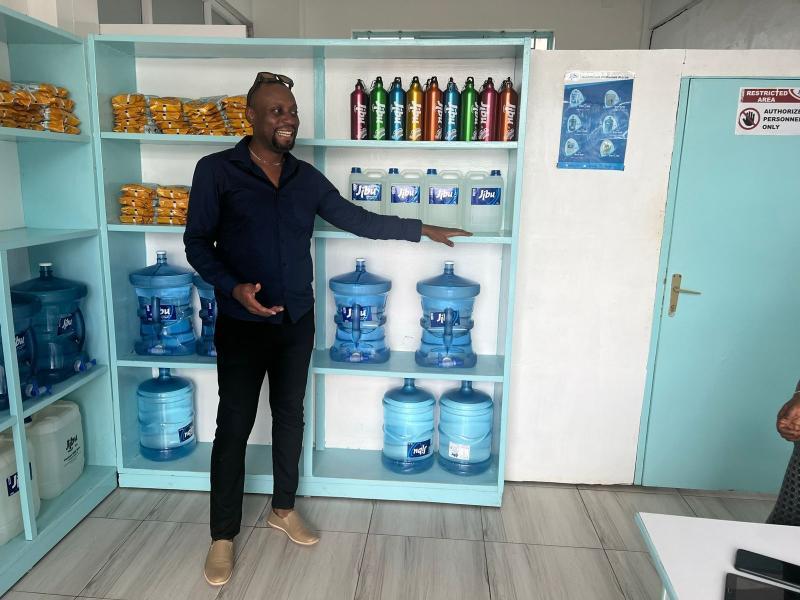
Photo: Kiva.org.
Ivan provides safe, affordable drinking water to people in Uganda, a country where, according to my grandson, 38 million people are without safe water. Ivan has applied for a loan from Kiva.org.

I was visiting Suzanne’s family yesterday and heard from my grandson about a worthy cause he’s donating some savings to. Actually, not donating. He is lending what he can to an entrepreneur called Ivan to help people in a country he has studied get access to safe drinking water.

How did this interest come about?

My grandson’s sixth-grade class’s research on the UN Global Goal of Eradicating Extreme Poverty involved choosing someone from a poor country who had applied to the lending nonprofit Kiva — and making a loan. After studying the poverty issue, screening a living-on-$1.98-cents-a-day experiment, and researching some of the Kiva offerings, the class voted.

My grandson was disappointed when the majority chose to support a grandmother in Thailand who was selling hammocks to help her care for a sick grandchild. He says that Uganda is a poorer country than Thailand — and he maintains that hammock accidents kill people. (He Googled it.) He also says that the annual income in Thailand is 8 times higher than in Uganda.

I asked him what the class majority’s reasoning was. He said (a) there was no way his favorite would get the extra $10,000 he still needed in the 8 days left in his application and (b) the grandmother still had 30 days left and was doing this for family. (He talks that way — “a and b.”)

He is not taking his defeat lying down, lending some of his own savings to Ivan’s cause, posting the link about Ivan in all the many chat rooms of his chess groups, sending Suzanne to twitter to promote Ivan’s application, and talking to me about a blog post.

Now here’s what Kiva says about Ivan: “Ivan is an experienced and seasoned entrepreneur in the safe water production and distribution sector. He has owned and run a Jibu water franchise for over five years and still counting. With the opportunity to open up a water production in the Munyonyo neighborhood, Ivan is excited at the opportunity to take safe and affordable drinking water to the residents of Munyonyo and also subsequently provide jobs for the youth who will be involved in the production and distribution value chain.

“Ivan is seeking a Kiva loan to open the Munyonyo operations. The loan will facilitate the launch of a water production and storefront facility, ensuring that every corner of Munyonyo has access to clean and affordable water. Please support Ivan so he can provide safe and affordable drinking water closer to the Munyonyo neighborhood.”

Interested? Please go to https://www.kiva.org/lend/2688341. Click on “technology.” Then click on the photo of Ivan and his water bottles. If you like the concept, maybe you or someone you know on social media will be up for helping. The Kiva rule is that Ivan has to get the total amount he applied for within the time allotted.

My grandson admits that this kind of lending is not a money-making proposition. He will get paid back in 39 months — in other words, when he is nearly 15 — without interest. (And I guess Kiva will reach him through Erik’s email, as Papa used a charge card when my grandson handed him the cash.)

But look, my grandson says, water is important — every 10 seconds someone in the world dies of water-borne disease, and 38 million Ugandans are without safe water.

Not a guy to argue with.

For more background on the nonprofit (“100% of every dollar you lend on Kiva goes to funding loans”) click here. It has a very good rating from Charity Navigator.

Read Full Post »

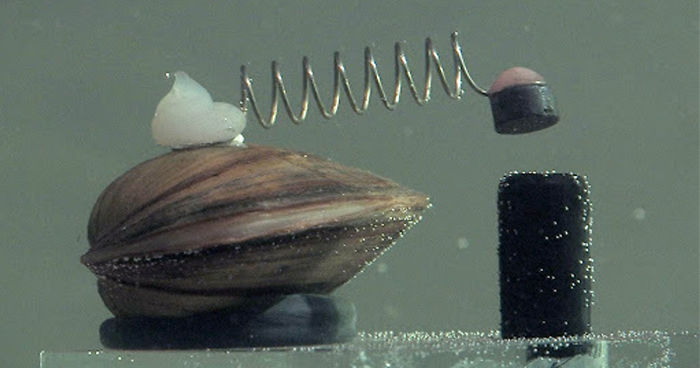
Photo: The documentary Fat Kathy.
In Warsaw, clams are used to test for toxicity in the water supply.

I have blogged before about the role of oysters and oyster shells in cleaning up polluted water (for example, here and here), but today’s story suggests other mollusks are equally hard at work.

Judita K writes at Bored Panda, “Some manmade things are better left to nature. [That’s why parts of] the world have decided to trust clams and mussels to monitor the cleanness of their water. Despite most of us being used to seeing clams on a fancy dinner plate, some of them get a more important mission — monitoring the purity of drinking water. …

“The water quality in Warsaw, the capital city of Poland, is monitored by … well, yes, clams. A Polish Tumblr user who goes by nickname Ftgurdy explained that the city of Warsaw gets its water from a river and ‘the main water pump has 8 clams that have triggers attached to their shells. If the water gets too toxic, they close, and the triggers shut off the city’s water supply automatically.’

“There’s a whole documentary on that, called Fat Kathy, and you can check out its trailer here. It follows how the main scientist-malacologist watches over the system’s operation. …

“Municipal Water and Sewage Enterprise in the Capital City of Warsaw confirms the use of fish and mussels for biomonitoring. They explain that they use biomonitoring at Warsaw Waterworks to increase the safety of the water treatment process. …

“The mollusks first undergo an acclimatization process after being caught and brought to the laboratory. It takes about two weeks. During that time, scientists also determine the natural opening of their shell — clams leave a slight opening and feed by filtrating water. Within one hour, one clam can filter and thus analyze the quality of 1.5 liters of water.

They live only in completely clean waters and shut their shells immediately if they sense any impurity.

“After completing their acclimatization process, clams are placed in a specially designed flow tank. They are connected to the system controller that sends data to a computer which records the degree that the clams’ shells are open all the time. If the water quality deteriorates, the clams close their shells to isolate themselves from the contaminated environment. That automatically triggers an alarm and shuts down water supply while scientists perform laboratory tests.

“In order for the clams not to get used to the water that’s being tested, they only serve for three months. After their service is done, they are transported back to the same water they were taken from and are marked by the scientists so they don’t pick up the same clams again.

“This Polish Waterworks company claims that this biomonitoring method is one of the most effective proven technologies for water quality testing. According to them, mussels monitor water quality for over 8 million people in Poland. Turns out, Minneapolis is using this method as well. Minneapolis Water Treatment and Distribution Services credit 12 mussels for keeping the water clean and safe.

“ ‘They are filter feeders, so they are feeding off of the water that’s in there, pulling the nutrients down,’ said George Kraynick of Minneapolis Water Works. ‘They live for up to 50 years, they are there 24/7 and they are happy in the tank, just feeding. [After they’ve served their time] most likely, we will just set them free in the river. … Minneapolis is currently the only city in the US that uses clams for biomonitoring.”

The writer also includes great comments on this technology from Twitter and elsewhere on the internet.

More at Bored Panda, here. No firewall. If you prefer your sources to be less like Tumblr and more like the Economist, click here.

Hat tip: John.

PS. You might also like to read how Dr. Thabile Ndlovu in Eswatini (formerly Swaziland) is building a national bank of water data to ensure the water is safe to drink: here. She and her team are particularly focused on the danger of heavy metals.

Read Full Post »